Maxim set his fork down on the edge of his plate.
“The perks are over,” he said, not looking at Vera. “Starting Monday, we’re separating our finances.”
Vera stood by the stove with a ladle in her hand, finishing the borscht.
“What do you mean?”
“My salary is my money. Your pension is your responsibility. Groceries, clothes, bills—you pay for yourself. I’ve spent twenty-five years building a career while you’ve been sitting at home. From now on, it’s every person for themselves.”
He said it like he was dismissing an employee.
But twenty-five years earlier, Vera had sold the two-room apartment she’d owned before marriage in the city center—back then, the proceeds could have bought them a bigger place. Maxim didn’t want an apartment. He wanted a house. The land was already there: an old family plot, inherited by Vera from her grandfather. Vera agreed.
They built a house.
Or rather, he built it—while she sold her apartment and handed over every last ruble.
For twenty-five years she got up at six every morning. Ironed his shirts. Every Saturday his parents came over. Vera cooked, set the table, cleaned. His mother always found fault—wrong tablecloth, soup too salty.
Three years ago her mother-in-law suffered an attack and was bedridden. Vera went every day—fed her, washed her, changed the sheets. Maxim came once a week, stood in the doorway for ten minutes, then left. After six months the older woman began to recover, and soon she was fully back on her feet.
“Alright,” Vera said. “I agree.”
Maxim blinked. He’d expected tears.
But Vera simply dried her hands and walked out.
On Monday she bought pink sticky notes.
She brought home groceries—two bags. One went into the refrigerator. The other she left on the table. Every item had a label: “Vera’s property.”
That evening Maxim opened the fridge.
Empty.
On the shelf lay a note: “Yours is on the table.”
His cheek twitched, but he said nothing.
Tuesday. Vera took out a notebook and started writing: “Laundry—4 shirts, 3 pairs of socks, 2 towels. Time—2 hours including ironing. Electricity, water, detergent.” She photographed the basket of his clothes and left it exactly as it was.
In the morning Maxim opened the closet. No clean shirts.
“Where are my clothes?”
“In the basket. I wash only mine. Separate budget, remember?”
“Are you serious?”
“Completely.”
He pulled out a wrinkled shirt, put it on anyway, and slammed the door as he left.
Wednesday. Vera didn’t clean the boiler. She didn’t water the garden Maxim loved showing off to guests—“my wife grows everything.” That evening, she didn’t cook dinner.
Maxim came home. The stove was cold.
“Are you going to feed me?”
“There’s bread and butter on the table. Everything else costs money.”
He ordered delivery and ate without looking up.
On Friday night Vera opened the notebook again and wrote: “Sunday. Hosting guests—table setting, cooking, cleaning.”
Every Sunday Maxim’s parents visited. His mother, Zinaida Vasilyevna, always sat at the head of the table, criticized the food, and bragged about other daughters-in-law—“real homemakers, unlike some people.”
Sunday morning, Vera didn’t even turn on the stove.
At eleven-thirty Maxim walked into the kitchen. The table was bare.
“My parents will be here in thirty minutes!”
“I know.”
“Why isn’t anything ready?!”
“Because cooking is a service. A paid one. You said it yourself—everyone for themselves.”
Maxim’s face reddened with outrage.
“Are you kidding me? My parents are about to arrive!”
“Your parents are your responsibility. Take them to a restaurant.”
He snatched up his phone. Delivery time: three hours minimum.
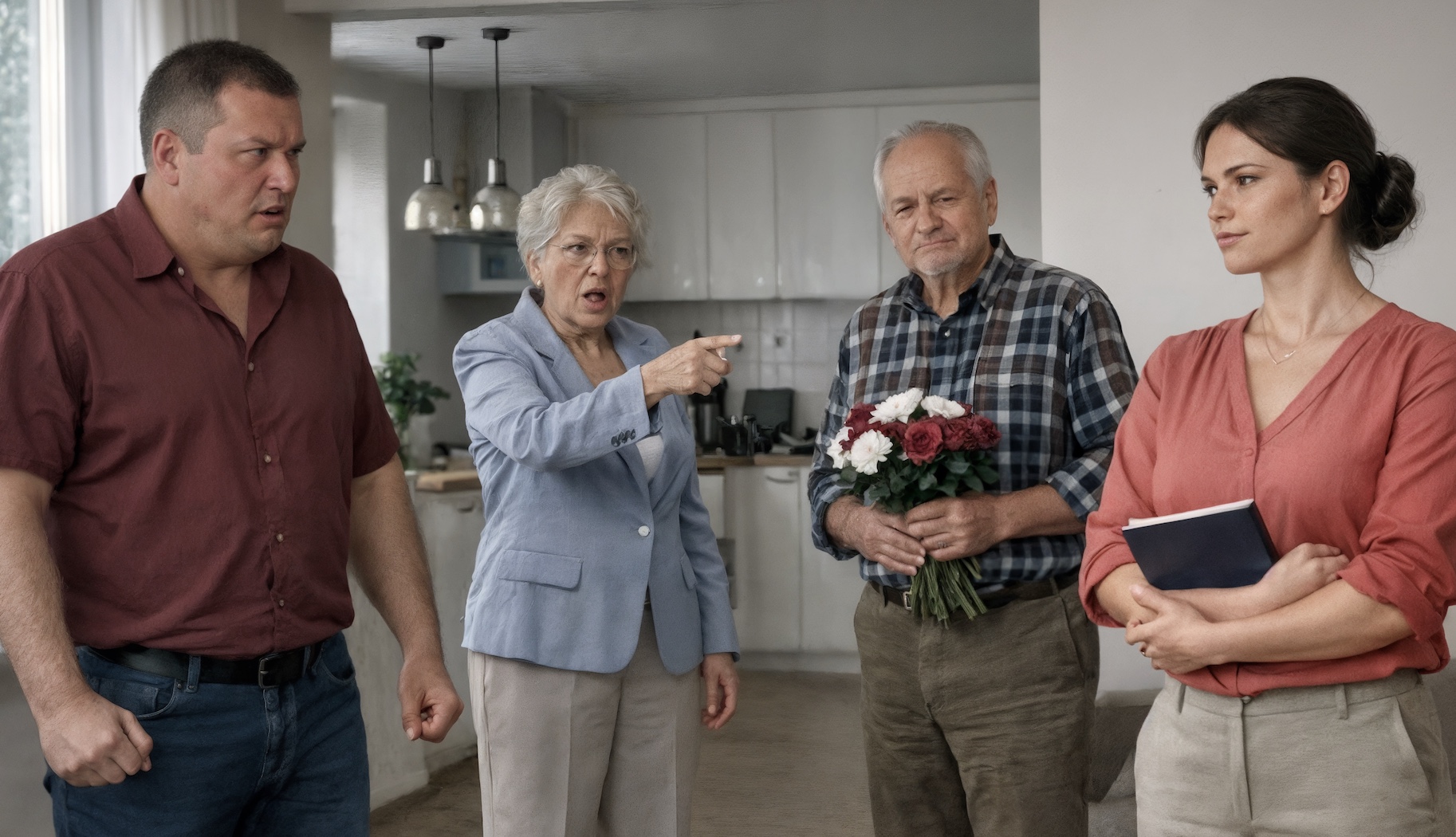
At exactly noon a car pulled up outside. Zinaida Vasilyevna stepped out first, in a light-colored suit, her face already sour. Her husband, Boris Stepanovich, followed with a bouquet of chrysanthemums.
They walked in—and stopped.
The table was empty. The stove was empty too. No smell of baking, no plates, nothing.
“Where’s lunch?” Zinaida Vasilyevna asked, taking off her gloves.
Vera came out of the room holding her notebook.
“There won’t be lunch.”
“What do you mean, there won’t be?! This is outrageous!”
“Your son announced separate finances last week. He said I ‘just sit at home.’ He said he doesn’t have to support me. I agreed. So now everything is done his way.”
Zinaida Vasilyevna turned to Maxim.
“What have you done?”
“Mom, it’s none of your business…”
“None of my business?” Her voice sharpened. “For twenty-five years she’s served you! Every Sunday she hosts us, cooks for us! When I was recovering after my stroke, she came to me every single day! You showed up once a week for ten minutes—and she was there every day!”
Maxim clenched his jaw.
“Mom, don’t get involved…”
“Oh, I will.” Zinaida Vasilyevna’s tone turned cutting. “This house stands on her land. Or did you forget that her grandfather left that plot to her?”
“What does that have to do with—”
“Everything!” She faced Vera. “Did you sell your apartment when you were building this house?”
“I did,” Vera said calmly. “A two-room place downtown. Every cent went into the build.”
“Did you hear that?!” Zinaida Vasilyevna jabbed a finger at her son. “She sold her apartment—hers, from before marriage—and you’re lecturing her about separate finances?”
Boris Stepanovich, usually silent, set the flowers on the empty table.
“Maxim,” he said quietly, “did you use your head at all?”
“Dad, don’t start…”
“I’ll finish. For twenty-five years this woman has run your home. The house is on her land. Built with money from her apartment. She nursed my wife for years while you vanished into work. She irons your shirts so you don’t embarrass yourself in front of your boss. She waters the garden you brag about. And you’re talking about a budget?”
“Dad, this is between me and my wife…”
“Wife?” Vera opened the notebook. “A wife is a partner. Who was I to you—free help? Someone you generously allowed to live in a house built with my money?”
“It’s my house! I built it!”
“On my land. With money from my apartment. Or did you forget how ‘we decided together’ what to do with my place? I wanted to buy a bigger apartment. You said, ‘Let’s build a house, a family nest.’ Turns out the nest was only yours.”
Maxim fell silent.
Zinaida Vasilyevna picked up her handbag.
“Let’s go, Boris. I’m ashamed to be here.”
She turned back to Vera.
“Forgive him if you can. But if I were you, I wouldn’t. He’s a fool. I told him his whole life—protect your wife. He didn’t.”
They left. Maxim stood in the middle of the living room.
Vera closed the notebook.
“Tomorrow I’m seeing a lawyer,” she said. “I’m filing for division.”
“You wouldn’t dare.”
“We’ll see.”
The lawyer explained it in ten minutes. The land had been gifted to Vera by her grandfather and registered to her before the marriage. The house was built on her plot with money from the sale of her premarital apartment. Maxim had a claim to jointly acquired assets—furniture, appliances—but the house was not his.
Maxim hired an attorney and tried to contest it. He argued he’d invested in construction. But the receipts, invoices, bank statements—everything contradicted him. Vera sold her apartment, the money hit her account, and she transferred it to pay for materials. Legally clean.
Two months later the court ruled: the house went to Vera. Maxim received compensation for his share of furniture and equipment.
He rented a tiny one-bedroom on the outskirts. An old building, third floor, no elevator. He did his own laundry—shirts shrank, collars creased badly. At work his boss called him in, looked at the rumpled suit and said, “Maxim, what happened to you? You look… not right.”
He was moved to a lower position. Less pay. Now his “separate budget” didn’t even cover decent rent.
He visited his parents, ate in silence, eyes down. Zinaida Vasilyevna didn’t say a word—she just placed a plate in front of him and turned away.
Vera sold the house quickly. A family with kids bought it—no haggling, cash-ready. She purchased a bright two-room apartment downtown, windows facing a park.
She enrolled in courses. Three months later she earned a lash technician certificate. She started a social media page. Her first client came within a week. Then another. Soon she was booked a month in advance.
She worked from home in a separate room. Set up a lamp, turned on soft music, applied lashes—fine, precise, careful. Girls left happy, came back, brought friends.
The money went to her card. No one asked where it went.
She no longer ironed someone else’s shirts. She no longer listened to Zinaida Vasilyevna’s lectures about “real wives.” She no longer spent Sundays serving someone else’s family.
Four months later the doorbell rang. Vera looked through the peephole.
Maxim. No suit jacket, an old coat, thinner now, dark circles under his eyes.
She opened the door with the chain still on.
“What do you want?”
“Vera… can we talk?”
“Talk.”
“Let me in. Please.”
She said nothing.
“I realized I was wrong,” his voice shook. “Completely wrong. Forgive me. Let’s start over. I’m miserable without you. I can’t manage. Problems at work, chaos at home, I—”
“Maxim,” Vera interrupted calmly. “No.”
“But I’m apologizing! I understand now! I’ve changed!”
“You haven’t changed. You’re just uncomfortable now. For twenty-five years it was comfortable for you—clean shirts, hot dinners, a tidy house, your parents hosted every Sunday. Then it became convenient to declare a separate budget, because you decided I ‘just sat at home.’ Now it’s uncomfortable again, so you came back. But I’m done living according to what’s comfortable for you.”
“Vera… I love you.”
“No. You loved convenience. Clean shirts, a warm meal, a spotless house.
That wasn’t me. That was a service—and it’s closed.”
“But we were together for twenty-five years…”
“I was with you for twenty-five years,” Vera said. “You were with the amenities.”
She closed the door. The lock clicked.
Maxim stood outside. She could hear him breathing. Then footsteps. He left.
Vera removed the chain and hung it on its hook. She walked to the kitchen, poured herself water, and drank slowly.
A planner lay on the table. Four appointments tomorrow. Five the day after. A week out, the schedule was full until evening.
Her money. Her time. Her apartment.
She opened the window. From the street came voices, laughter, the sound of a passing car. An ordinary evening—except for the first time in twenty-five years, it was her evening.
The perks really were over.
And that was exactly right.
Six months later Vera was walking home from the store when she saw Maxim at a bus stop. He stood with a bag from a cheap supermarket, in the same wrinkled coat.
Their eyes met.
He looked like he wanted to speak.
Vera walked past. She didn’t speed up or slow down. She just kept going—
as if he were a stranger.
Because that’s what he had become.