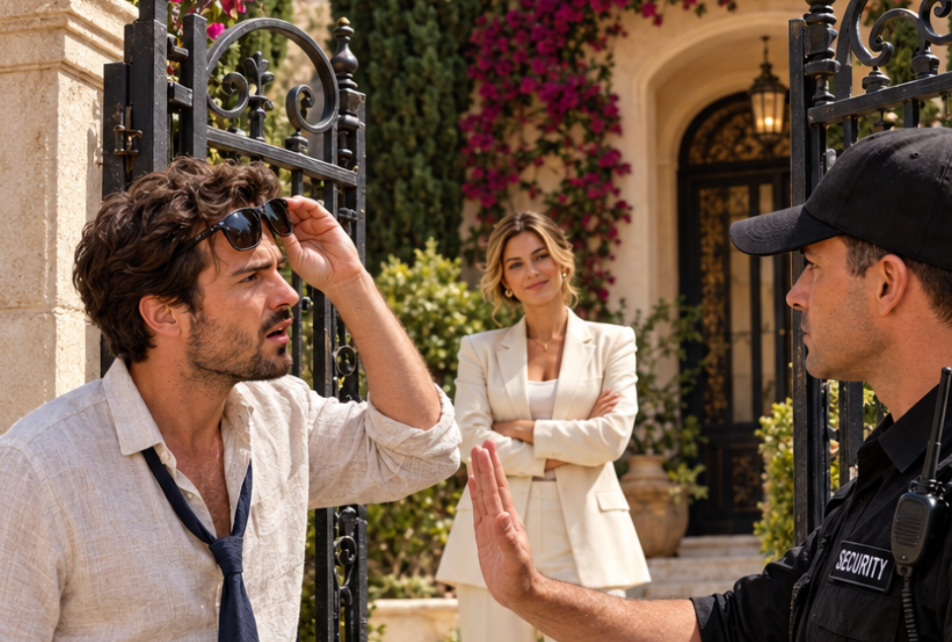
My husband took off on another trip without me for the fourth time. When he returned, he heard at the gates: “The villa has been sold; your access card is disabled.”
“Put her bag back,” Konstantin told the driver when he lifted my suitcase toward the van. “Larisa isn’t coming with us.”
I stood at the gate with my passport and a printout of the booking. The day before, my husband himself had sent it to me and told me to be ready by half past five. He’d even helped me pick out a new suitcase—a burgundy one, so it wouldn’t get mixed up with his black one. But now, he held the bus door with his shoulder, talking as if we were deciding who feeds the cat.
“The booking is in my name,” I reminded him, handing over the paper. “You said yesterday it was all sorted.”
“It is. Circumstances changed. Mom can’t be alone, Semyon’s with his fiancée, Inna has to come. You wouldn’t last two days away from your workshop anyway.”
Inna was by the window, in my favorite spot, next to Konstantin’s travel pillow. A blonde in a straw hat looked up at me, turned away quickly, and fixed her seatbelt. Konstantin’s mom, Raisa Arkadyevna, handed her son a thermos.
“Larisa, don’t embarrass us in front of the driver. Grown-ups have things to do. No one can leave the pool unattended, someone has to stay behind.”
This was the fourth family trip in our eight-year marriage. The first three times, I stayed home. But this time, I’d postponed orders, told my seamstresses, bought sandals. Just a day before, Konstantin swore there was a spot for me.
“How is Inna related to you?” I asked.
“She’s helping Semyon with apartment paperwork. Enough with the questioning. We’re running late.”
He set my suitcase by the gate. The bus rolled away, and through the rear window I saw my mother-in-law’s hand waving, like someone telling a woman to watch over someone else’s house. I stood there, passport open to my photo page for a few more minutes. Then I picked up my suitcase and opened the gate.
Ever since security was installed in our community, my husband called our place a “villa.” The two-story house with a pool near Kaluga was built by my dad, Mikhail Nikolaevich. For 20 years he ran a carpentry shop. A crew did the masonry and roof, but Dad made the banisters himself. One still had a slight mark from when he’d slipped with the plane.
Dad gifted me the house two years before the wedding. Back then, I was making curtains and throws, working in a rented room above a shop. He’d say, “When things get tough, at least you have a roof.” Mom planted four peony bushes by the walkway; one never bloomed, and every spring she threatened to move it.
For the first years, Konstantin praised every detail. I remembered how he once spent a night helping me sort through flawed fabric for a big order and brought groceries for my mother when she was ill. It was for that caring man I kept holding on through our quarrels. But over time he started showing guests around, saying “I designed everything here.”
Last year, without asking, he gave Semyon a key to the gate. His brother came over with friends to grill by the pool, and I’d end up cleaning wet towels and glasses from the terrace.
Once, I asked my husband to let me know about guests beforehand. He put his phone down and said:
“You want my brother to have to call his own house like a stranger?”
“It’s my house, Kostya.”
He barely spoke to me for two days. On the third, he brought pastries, called me stubborn, and said to forget the fight. I agreed: I wanted peace more than to be right. That’s how Semyon kept his key, and Konstantin kept making decisions for me.
After they left, I went up to his office to look for the pool filter’s warranty card. On his desk was a list of errands. The final line was underlined: “Semyon will pick up the paperwork for the house. Don’t delay; it’s urgent.”
I called my husband. No answer. Half an hour later, a text: “Don’t start again about yours and mine. It’s for the family.” I reread it, then put my phone down next to the banister my dad had made, and for the first time in years, dialed Nina—a friend from college I hadn’t talked to in a while.
“I need a lawyer,” I told her, “and a good one, I think.”
Nina met me the next day after work. She didn’t do family law, but knew who to talk to, and never accepted my excuses for Konstantin. We sat in her kitchen; laid out in front of us were the deed of gift, a prenuptial agreement, and proof of ownership.
“The house is yours, the land is yours,” Nina said. “But I’d find out immediately why your husband needs those papers.”
Konstantin proposed the prenup before the wedding. He had a trading company, I had a small workshop. He was afraid I’d get a share of his business if we split and insisted on separate ownership of assets and income. I was hurt but signed: I wanted to show I married him, not a warehouse of tiles and paint. Later, it was my own accounts that paid for heating, security, and repairs, while he claimed his money had to keep working.
Nina flipped to the last page.
“And how was it, living by those rules?”
I pulled from my bag a receipt for the pool service and was about to joke, but then an unknown number called. A woman introduced herself as a bank loan officer, asking me to confirm I agreed to use the house as collateral for Konstantin’s loan.
“What loan?” I asked.
“For eight million four hundred thousand rubles. The paperwork shows you as the owner and consenting. We need your personal confirmation.”
My palm started sweating. Nina silently pushed a piece of paper so I could write down the bank employee’s name and application number. I said I hadn’t given consent and asked to halt the process pending a document check.
The next day we went to the bank. After checking my passport, they showed me a copy of a document with my details and signature. The signature looked very much like mine, except that Konstantin had made a long loop for the “L” that I never did. The bank explained that one page wasn’t enough for the collateral; they’d need my personal appearance and legit documents. But someone had already tried to start the process in my name.
I filed a written objection, with receipt. On the lawyer’s advice, I requested that no transactions could be registered without my presence, and separately reported an alleged forgery. No guarantees of a quick investigation—but at least the bank confirmed they couldn’t use the house without me.
In the car, Nina was silent for a long time. All morning, I used my hands to sew a heavy curtain; now they shook at the thought that my house could have been used to secure someone else’s debt.
“Will you tell him?” Nina asked.
“Not yet. First I’ll find out who needed the money.”
On Saturday, Semyon showed up at lunchtime in a new car. Through the gate, I saw him pull a fancy box of chocolates from the trunk. Usually, he came empty-handed; this time, the conversation promised to be serious.
“Sister-in-law, got those papers ready? Kostya said you’d help.”
I opened the gate but didn’t invite him in. Semyon peered past me at the terrace, as if checking I hadn’t hidden a folder.
“Explain why you need my house.”
“It’s only for six months, max. I need to buy out an apartment—got a good deal before the price climbs. My brother gets the loan, I’ll pay it back. The house is just for the bank to see—makes it look good.”
“Collateral isn’t just for show. If you don’t pay, you lose property.”
Semyon smirked, as he always did when a woman started ‘overthinking.’
“Kostya said you’re not that good with paperwork. Don’t worry, we’ve worked it all out.”
He reached for the keys to the office; I didn’t budge. He dropped his hand and spoke, annoyed:
“You’ve got a whole yard empty here, while Alla and I are bouncing from rental to rental. Can’t you help your family out just once?”
“You’ve been vacationing here for free eight years now. Is that not me helping?”
He turned red, shoved the chocolates back in the trunk, and left. An hour later, my mother-in-law called. She spoke from a noisy restaurant, but I caught every word.
“Konstantin trusted you with the family, and you refused Semyon’s request. That’s how marriages fall apart, Larisa. A man needs to know his wife is on his side.”
I stared at the tire tracks by the gate. Not long ago, I would have started explaining, promising to think it over. Instead, I asked:
“Would you put your own apartment up as collateral for Semyon?”
She fell silent. Then said I was comparing the incomparable, and hung up.
The next evening, Konstantin finally called on video. Water splashed in the background, music played, and he was on the balcony using someone else’s phone.
“What did you tell Semyon? He’s fighting with Alla now. I just asked for a small favor.”
“You applied for a loan under my house as collateral. And forged my signature.”
He looked toward the room’s door, then softly closed it so no one could hear.
“Nobody forged anything. The manager asked for a sample signature, I scribbled it down to speed things up. You still would’ve had to come to the bank and sign.”
“So, you planned to spring it on me at the last minute.”
“I thought you wouldn’t embarrass my brother by refusing. Actually, Lar, after what you pulled, we need to have a serious talk about trust.”
I might have laughed if I didn’t remember my suitcase left at the gate. At that moment, a woman’s voice sounded from his end: “Kostya, you promised we’d make it to the boat.” Inna, wearing his white shirt tied at the waist, flashed in the doorway. Konstantin quickly turned the camera to the wall.
“Who’s that?” I asked.
“You saw her before the trip. Semyon’s friend. She’s getting everyone together for the tour.”
“In your shirt?”
He hung up. Ten minutes later, a message arrived: I was ruining his trip and owed him an apology.
It all became clear in the morning. Alla, Semyon’s fiancée, called me herself. She spoke quickly and nervously: Semyon promised her a down payment on an apartment, counting on his brother’s help; now the deal had fallen through. Then, hesitantly, she added:
“Larisa, I didn’t know they were taking Inna instead of you. She’s been seeing Kostya since winter. Semyon told me you two barely speak anymore and are planning to divorce.”
I sat on the edge of the bed. On my nightstand lay my passport, unused. I removed it from its cover and put it away. Then I opened the family chat. In the group photo, Inna sat beside Konstantin, while my mother-in-law held her hand. The caption read: “Our favorites.”
That day, for the first time, I didn’t call my husband for an explanation. I called my dad and asked him to visit.
Dad traced his finger over the old plane mark on the banister. He didn’t ask why I was crying, even though my eyes were red. First, he walked the yard, checked the gate, and fixed the cabinet door Semyon had left crooked since spring… Continued just below in the first comment
“Put the bag back,” Konstantin told the driver as he lifted my suitcase toward the minibus’s trunk. “Larisa isn’t coming with us.”
I stood by the gate holding my passport and a printed reservation. My husband had sent it to me himself just the day before and told me to be ready by half past five. He even helped pick out a new travel suitcase—a burgundy one so we wouldn’t confuse it with his black one. But now he was propping the bus door open with his shoulder, talking as casually as if we were just discussing who would feed the cat.
“The reservation is under my name,” I reminded him, handing over the paper. “You said yesterday that everything was settled.”
“It is settled. Just the circumstances changed. Mom can’t manage alone, Semyon is bringing his fiancée, and we needed to invite Inna. You can’t go two days without your workshop anyway.”
Inna was sitting at the window in my favorite seat, next to Konstantin’s travel pillow. The fair-haired girl in the straw hat glanced up quickly, looked away, and adjusted her seatbelt. Raisa Arkadyevna, my mother-in-law, handed her son a thermos.
“Larochka, don’t embarrass us in front of the driver. Adults sometimes have things to do—no hard feelings. You can’t leave the pool unattended at the property, someone needs to watch over it.”
This was the fourth family vacation in the eight years of our marriage. The first three times, I stayed home. But for this one, I put my orders on hold, let my tailors know, and bought myself sandals. The day before, Konstantin assured me they’d found a spot for me.
“How is Inna related to you?” I asked.
“She’s helping Semyon with the flat paperwork. Enough with the interrogation. We’re running late.”
He set my suitcase down by the gate. The bus pulled onto the street, and through the back window, I saw my mother-in-law’s hand waving at me the way you wave to someone left to look after someone else’s house. I stood for several more minutes with my passport open to the photo page. Then I picked up my suitcase and opened the gate.
My husband called our place a villa ever since they put up security in the neighborhood. My father, Mikhail Nikolaevich, built the two-story house with a pool near Kaluga. He ran a carpentry workshop for twenty years. A crew laid the brick and did the roof, but my father handmade the staircase rails himself. One of them still has a shallow dent from his plane.
He gave me the house two years before my wedding. Back then, I was sewing curtains and soft covers, working in a rented room above a shop. My father would say, “If things ever get tough, you at least have a roof over your head.” My mother planted four peony bushes along the walkway; one never bloomed, and every spring she threatened to replant it.
In the early years, Konstantin praised every little detail. I remembered how he once spent the whole night with me sorting through faulty fabric right before a big order, and how he brought my mother groceries while she was sick. It was for that caring man I held on to during our fights. But over time, he started showing guests around and saying, “I designed everything here myself.”
This past year, without asking, he gave Semyon a key to the gate. My brother-in-law would come over with friends to grill by the pool, and afterward, I’d be the one cleaning up wet towels and glasses left on the terrace.
One day, I asked my husband to let me know if guests were coming. He put down his phone and said:
“You want my brother to call before coming to his own house, like he’s a stranger?”
“It’s my house, Kostya.”
After that, he barely spoke to me for two days. On the third day, he brought pastries, called me stubborn, and suggested we forget the argument. I agreed—it mattered more to me to have peace than to be right. So Semyon kept his copy of the key, and Konstantin kept his habit of deciding for me.
After he left, I went up to his office to look for the warranty card for the pool filter. On the desk was a sheet with some tasks. The last line was underlined: “Semyon will pick up the papers for the house. Don’t delay—it’s urgent.”
I called my husband, but he didn’t answer. Half an hour later, I got a message: “Don’t start again about what’s yours and what’s mine. This is for the family.” I read it over, set my phone down next to my father’s old banister, and for the first time in years, dialed Nina—a friend from college that I hadn’t spoken to much lately.
“I need a lawyer,” I said. “And I think a good one.”
Nina met me the day after work. She wasn’t a divorce lawyer, but she knew who to call, and she never accepted my excuses for Konstantin. We sat in her kitchen; in front of us were the deed of gift, the marriage contract, and the property statement.
“The house is yours, the land is yours,” Nina said. “But I’d immediately find out why your husband needs those papers.”
Konstantin had suggested a prenuptial agreement before the wedding. He had a trading company, I had a small workshop. He worried that if we divorced, I might get a share of his business, so he insisted on separate ownership of assets and income. I was hurt, but I signed—I wanted to prove I married him, not his warehouse full of tile and paint. Afterwards, I paid for the heating, security, and repairs from my own accounts while he insisted his money should be put to work.
Nina flipped to the last page of the contract.
“And how was it, living by these rules?”
I pulled a receipt for pool maintenance from my purse and was about to make a joke when a strange number called. A woman introduced herself as a bank loan officer and asked if I agreed to pledge my house and land as collateral for Konstantin’s application.
“What application?” I asked.
“For eight million four hundred thousand rubles. The papers state you’re the owner and agree to the arrangement. We need your personal confirmation.”
My palm started sweating. Nina silently pushed a piece of paper toward me so I could write down the employee’s name and the application number. I told the woman I hadn’t given consent and asked her to halt the process until the documents could be checked.
A day later, we went to the bank. After checking my passport, they showed me a copy of a document with my information and signature. The signature was very similar, but in the letter “L,” Konstantin had made a long loop that I never use. The bank explained that one document wouldn’t be enough to arrange collateral anyway—they’d need my actual presence and the proper documents. But someone had already tried to start the process in my name.
I wrote a formal objection and got confirmation it was received. Then, following my lawyer’s advice, I filed a request to block the registration of any transactions without my personal presence, and separately reported a suspected forged signature. No one promised a speedy investigation. But at least the bank confirmed: my house can’t be mortgaged without me.
Nina was silent for a long time in the car. I stared at my hands—just this morning I’d used them to straighten the heavy curtain seam, and now they were trembling at the thought that my home had almost become collateral for someone else’s debt.
“Are you going to tell him?” Nina asked.
“Not yet. First, I need to find out who needed that money.”
On Saturday, Semyon showed up for lunch in a new car. Through the gate, I saw him pull an expensive box of chocolates from the trunk. He usually came empty-handed, so I knew: this visit meant a serious conversation was ahead.
“So, daughter-in-law, did you get the documents ready? Kostya said you’d help out.”
I opened the gate but didn’t invite him into the yard. Semyon looked past me at the terrace, as if checking whether I was hiding the folder he needed back there.
“First, explain why you need my house.”
“It’s just for six months, no more. I need to buy out an apartment. It’s a really good deal, and the price might go up soon. My brother will take the loan, I’ll make the payments. We just have to show the bank the house to make things look good.”
“Collateral isn’t for show. If you don’t pay, the property is at risk.”
Semyon smirked, just like he always did when he thought a woman was overthinking things.
“Kostya said you’re not really into paperwork. Don’t worry, we’ve got it all figured out.”
He reached for the keys to the study. I didn’t move. Semyon dropped his hand, looking irritated, and said,
“You have an entire yard just sitting there empty, while Alla and I keep bouncing from one rental apartment to another. Can’t you help your own family out just this once?”
“You’ve been vacationing on my property for free for eight years now. Isn’t that helping you enough?”
He turned red, shoved the chocolates back in his car, and drove off. An hour later, my mother-in-law called. She was speaking from a noisy restaurant, but I heard every word loud and clear.
“Konstantin trusted you with his family, and you refused to help Semyon. That’s how marriages fall apart, Larisa. A man needs to know his wife is on his side.”
I stared at the wet tire tracks by the gate. Not so long ago, I might have tried to explain, to plead, to promise I’d think it over. Instead, I asked,
“Would you put your own apartment up as collateral for Semyon?”
My mother-in-law fell silent. Then she said I was comparing things that can’t be compared and hung up.
The next evening, Konstantin finally called me on video chat. Water was splashing and music was playing in the background, while he sat on the balcony holding someone else’s phone.
“What did you say to Semyon? Now he and Alla are fighting. All I asked for was a small favor.”
“You applied for a loan using my house as collateral. And you forged my signature.”
He glanced toward the hotel room door, then quietly closed it so no one could hear.
“Nobody forged anything. The manager wanted a sample signature, so I scribbled something to speed things up. You’d have to come to the bank and sign it yourself, anyway.”
— So, you were just going to spring this on me without warning.
— I was hoping you wouldn’t embarrass my brother by refusing. Really, Lara, after what you pulled, we need to have a serious talk about trust.
I might have laughed if I hadn’t remembered my suitcase sitting by the gate. Just then, a woman’s voice came from his side: “Kostya, you promised we wouldn’t miss the boat.” Inna appeared in the doorway, wearing his white shirt tied at the waist. Konstantin quickly turned his camera away towards the wall.
— Who’s that? I asked.
— You saw her before you left. Semyon’s friend. She’s gathering everyone for the excursion.
— In your shirt?
He ended the call. About ten minutes later, he texted saying I made a scene during his vacation and I owe him an apology.
Everything became clear the next morning. Alla, Semyon’s fiancée, called me herself. She spoke quickly and nervously: Semyon had promised her a down payment for an apartment, counting on his brother’s money; now the deal was falling through. Then, as if hesitant, she added:
— Larisa, I didn’t know they’d take Inna instead of you. She’s been seeing Kostya since winter. Semyon told me you and he live separate lives and are planning to divorce.
I sat down on the edge of the bed. My passport, which never got used, was lying on the nightstand. I removed it from its cover and put it in a drawer. Then I opened the family chat. In the group photo, Inna was sitting next to Konstantin, and my mother-in-law was holding her hand. Under the picture, it read: “Our beloved ones.”
That day, for the first time, I didn’t call my husband for an explanation. Instead, I called my father and asked him to come over.
My father walked over to the railing and traced an old mark left by a planer. He didn’t ask why I was crying, even though my eyes were red. He made a round of the property, checked the gate, and closed the crooked cabinet door Semyon had left ajar since spring.
— Dad, I want to sell the house.
My father paused. He was already retired, but his hands were still broad and stained with sawdust ingrained deep into the skin, no matter how much he washed.
— That’s your decision to make. Just don’t do it out of spite for him. You’ll regret it later.
— Every week I pay for maintenance, electricity, and for other people’s gatherings here. I can’t afford the workshop, but the pool is always spotless. I’m afraid to leave even for two days—someone from his family might show up with their own key.
My father sat down on the terrace step, took off his cap, and slowly turned it in his hands.
— I built this house so you’d always have somewhere to come back to. If this place feels too small for you now, it’s time to find somewhere else. Just don’t rush with the buyer.
A few months ago, our neighbor in the community, Tatyana Sergeyevna, had asked if we might be thinking of selling. Her daughter’s family was looking for a place nearby so they could visit more often. Back then I said no. Now, I called her myself and asked if we could discuss their offer again.
They didn’t come just for a quick viewing. First, Tatyana Sergeevna and her daughter walked around the house, then they brought in a specialist to inspect the roof, heating system, and the property itself. The buyers knew I was married and asked to see not just the property statement but also our marriage contract. I didn’t hide the fact that my husband had lived here and might not be happy about the sale. They consulted with their lawyer and came back with an offer: twenty-four million six hundred eighty thousand rubles, payment through the bank after the registration process.
It wasn’t the amount that made me feel uneasy. I pictured the empty staircase without my father’s railings and my mom by the peonies. I called Tatyana Sergeevna and asked for one day to think it over. She didn’t haggle or try to persuade me. She simply said:
“We want to buy the house, not your troubles. Take your time and decide calmly.”
That night, I walked from room to room. In the guest bedroom stood the bed my mother-in-law once firmly claimed as “hers.” On the office door hung a sign that read “Do Not Enter,” bought by Konstantin. In my sewing room, meanwhile, bolts of fabric sat on the windowsill because I could never find them a place. By morning, I agreed to the sale and arranged with the buyers to sign the documents.
The paperwork took longer than I’d hoped. The buyers were thorough in checking the house and land documents. For several days, everything stalled: their lawyer insisted on separate proof that the house had been gifted before marriage and wasn’t renovated with my husband’s money. I tracked down old contracts with workers and receipts from repairs, and my father brought photos of the house from before our wedding. Tatyana Sergeevna only called on Friday evening: the documents satisfied her, and they weren’t backing out of the deal.
We agreed on the contract, the payment process, and the date for handing over the keys. At the registration office, I was there in person to submit the application. The money would only be transferred after the ownership was officially registered. Their lawyer explained that I shouldn’t rush to pack my bags before then.
I rented a small apartment not far from my workshop in Kaluga. There was no swimming pool, but it took only ten minutes to walk to my employees, and in the evenings I could drop by the store. I spent two weeks packing. Seven boxes were filled with fabrics, four with books and dishes. I packed Konstantin’s tools, clothes, and things from his office separately, made an inventory with photos, and arranged for storage until he could collect them. I wasn’t about to keep or throw away his personal belongings.
A few days before the move, I received an ownership statement with the new owners’ names. The buyers came to inspect the house, checked the meters, received the keys, and signed the handover act. Only then did the property manager, on the new owners’ request, update the entry list. I gave them information about my husband and the possibility of his claims; I couldn’t promise he would never try to dispute anything.
There was only one thing left—to pick up the old red tool bag from the closet. My father had left it to me along with the house. Inside I found a tape measure, and on its back, years ago, he’d scribbled in pencil: “For Lara. So everything adds up.” I took the bag with me, and later put the tape measure on the cutting table in my workshop. Then I closed the closet for the last time.
Got a message from Konstantin: “We’ll be home by tomorrow evening. Buy something for dinner. Mom is tired of eating in other people’s kitchens.”
I read the message while standing with a customer. Tatyana Sergeyevna looked up from the acceptance document.
“Did you tell your husband about the sale?”
“I’ll tell him today. He’ll get the documents from my lawyer. And tomorrow I’ll come by to return my last access pass.”
I didn’t want the new owner to be caught off guard by someone used to running someone else’s house. We agreed that her family would be home, and if needed, my lawyer would meet him at the gate. That evening, Konstantin got a message notifying him of the sale and Nina’s contact info. His reply was immediate: “Don’t make me laugh. We’ll sort this out tomorrow.”
The next evening, I was at the security booth with my last plastic pass. Chief of staff Andrey Petrovich checked the number and put the card into the box for deactivated passes. A few minutes later, the familiar minivan pulled up at the barrier. Konstantin stepped out in a light shirt, tapped his key fob to the reader, and a short denial beep sounded.
“Andrey, is your system acting up again?” he shouted. “Open up, I just got off the road.”
The guard stepped out of his booth and replied calmly:
“Konstantin Sergeyevich, your passes have been disabled at the request of the new owners. The villa’s been sold!”
My husband turned to me so fast his bag slipped off his shoulder onto the pavement. My mother-in-law peeked out from the bus, and Semyon, without waiting for the driver, threw open the trunk.
“Larisa, what kind of spectacle is this?” Konstantin came right up to me. “Do you realize what you’ve done?”
I showed him the title transfer statement. My hands were full of documents, and I couldn’t hide their trembling. He scanned the buyer’s name, the date, and then looked back at me.
“That house was ours! I lived there for eight years!”
“You lived there. But you couldn’t make decisions about it without my consent. You’re the one who insisted on the prenup.”
Inna stepped out of the van holding my old travel blanket—the one Konstantin took with him. She saw the papers and almost whispered:
“Kostya, you told me the villa was yours. You invited me here to live.”
He didn’t answer. Semyon tried to jump in, saying the loan was for everyone, and that his brother planned to pay it back soon. Raisa Arkadyevna demanded they at least let her son pick up his things. I explained that his belongings were safe and would be handed over with an inventory. Andrey Petrovich asked everyone not to block access for other cars.
Beyond the gate, the new owner appeared with her daughter. The little girl carried a watering can over to the peonies and looked curiously at the people by the entrance. When Konstantin saw them, he suddenly stopped arguing. He stood there with the keys to the gate in his hand, but there was nothing left to open.
“Lar,” he said more quietly now, “can I talk to you for a minute? Not in front of everyone.”
“Only with Nina present. She’s in the car by the entrance.”
He glanced over to where my friend’s car was indeed parked. I’d asked her to come along in advance, knowing how Konstantin could change his tone when no one else was around. He picked up his bag, turned away, and walked to the car. My mother-in-law hurried after him, still protesting that they’d been left on the street.
Three days later, Konstantin came to Nina’s office. I agreed to be there, but I refused to meet him alone. He put a list of house expenses on the table: garden furniture, a pump, two TVs. The total looked impressive… until Nina asked for payment receipts. I had paid for most of the purchases myself. The things Konstatin bought were just regular items, not major renovations.
“All this still needs to be verified,” Nina said. “If you have substantiated claims, send them officially. Words alone aren’t enough to declare the house as jointly owned.”
My husband looked at me. His tan face now just showed tired eyes and a familiar crease between his brows. He spoke in the same way he always did after our arguments:
“Well, what have you achieved? Mom is upset, Semyon has no apartment, and I’m staying at friends’ places. Couldn’t you have just said you were hurt about the trip? I would have taken you next time.”
“You left without me four times, Kostya. This time, I was standing by the bus with my passport, and you pulled my suitcase out. And you even wanted to mortgage the house.”
He lowered his eyes to the papers, then quietly said:
“Things with Inna aren’t serious. I thought you wouldn’t want to go anyway. And the bank… Semyon really needed help.”
I remembered packing the first aid kit for his mother and slipping in extra socks for him. For eight years I’d done those little things, and he’d never once asked how much time they took. I wanted to tell him, but Nina was already sliding the divorce application across the table.
“The credit application is still under review,” she reminded us. “And so is the money from the joint account. The rest will be handled the official way.”
Konstantin stared at the paper for a long time. Then he asked where I’d moved. I didn’t reply. He stood up, took the papers, and left, never asking where my sewing machines were now.
In early August, I received new cutting tables. I rented a space next to my apartment to expand my workshop: it used to be a lighting store, but now fabric rolls lined the walls. Dad helped me install shelves and grumbled for ages about a crooked corner by the door, but finally got everything perfectly level.
A week later, Nina and I were planning a three-day trip to the lake. I grabbed that same burgundy suitcase Konstantin had left at the gate and packed my things in it. In the pocket, the old tag from the cancelled trip was still there. I tore it off and threw it away.
By the car, Nina asked:
“Did you take your passport? Do you have the tickets?”
I opened my bag, checked my documents, and showed her two tickets — both bought by me, no permissions or passenger lists needed. Dad walked out of the workshop, handed me his old tape measure with a faded pencil mark, and said I’d left it on the cutting table again. I put the tape in the front pocket of my suitcase, hugged him, and loaded the suitcase in the trunk by myself.