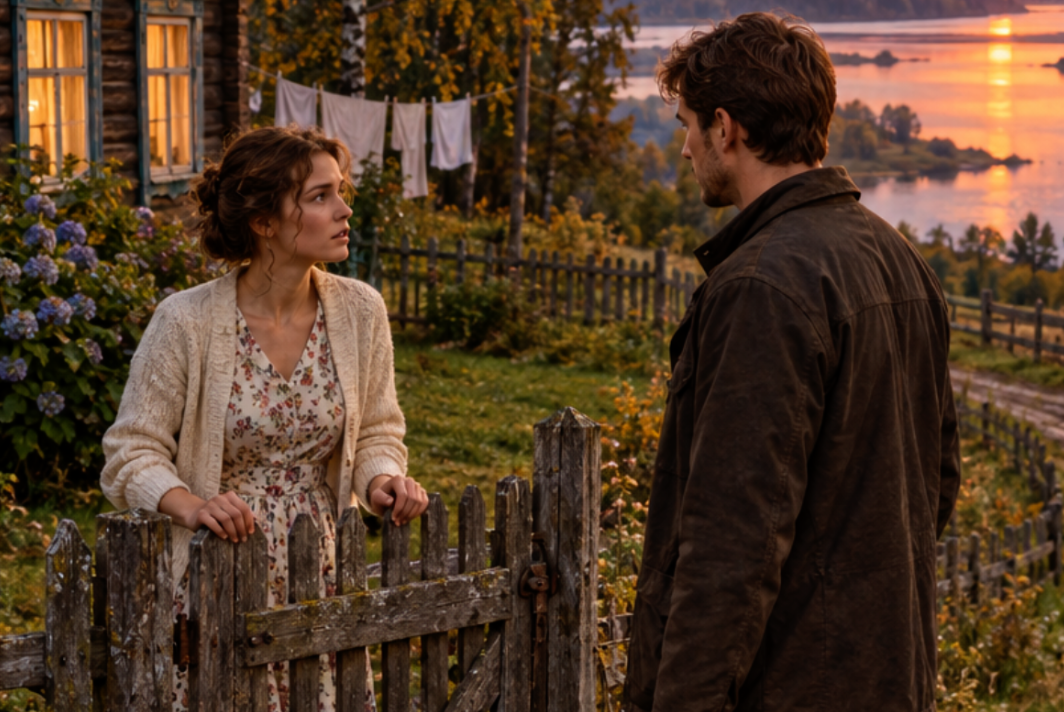
As Egor Sinitsyn stepped into the village of Novaya Kosa, he was greeted by the scent of wet wood, seaweed, and smoked fish.
That smell was the scent of his childhood.
It was the same smell as the old pier where he spent his boyhood days catching gobies on a rusty hook.
It was the same smell as the life he carried with him for four years across northern seas, lonely white stations, and metal cabins where the wind made the bulkheads ring.
The bus dropped him off at a closed fish market and went on down the broken road, leaving behind a cloud of gray dust.
Egor adjusted the strap of his duffel bag and looked around.
Everything was almost as it used to be.
The club with its peeling columns.
The store called ‘Prichal,’ beside which old men argued about the price of diesel.
The old water tower.
Wooden houses darkened by dampness.
And over it all, the wide, murky river flowing into the bay.
But the people looked at him differently now.
Not with joy.
Not with surprise.
With caution.
As if he was bringing with him not a suitcase, but a question nobody wanted to answer.
At the water pump, two women were filling their buckets. When they saw Egor, they fell silent. One quickly lifted her bucket, and the other averted her eyes.
“Hello, Aunt Raya,” Egor said.
The woman nodded.
“So, you’ve come back.”
“I’ve come back.”
“Well… welcome home.”
And then she left right away, as if afraid to say too much.
Egor stood for a few seconds, then headed toward Alyona’s house.
He had waited four years for this journey.
At the polar station, where for three months at a time you see nothing but snow, masts, and gray sky, a person holds on to simple things.
A letter.
A photograph.
A voice on the phone.
A promise: “I’ll wait.”
At first, Alyona wrote to him often. She wrote about her work in the port clinic, about the village, about how the lower street was flooded in spring. Then her letters became less frequent. The last one arrived almost a year ago.
“Egor, things are complicated here. We’ll talk when you return. Please, don’t trust people right away. I’m begging you.”
He reread those lines so many times that the paper wore thin at the folds.
“Don’t trust people right away.”
A strange request.
Now he was starting to understand that it wasn’t accidental.
Alyona’s house stood behind the clinic, right by the edge of the old orchard. Her aunt used to live there, then her aunt died, and Alyona stayed alone. She didn’t want to move to the district center; she said there were too many elderly, sick, and children in Novaya Kosa to leave the medical station to just one nurse.
Egor approached the gate.
On the clothesline hung small children’s tights.
Pink ones.
With a patch on the knee.
He stopped.
Then he saw a toy on the porch—a rubber duck with a bitten-off beak.
His heart gave a dull thump.
Once.
Twice.
The door opened.
Alyona was standing on the doorstep.
Thin, pale, in an old blue dress. Her hair was tied in a bun. There were shadows under her eyes that hadn’t been there before.
But it was her.
His Alyona.
The woman for whom he’d come back through snow, through long shifts, countless nights at the radio station, and foreign shores.
But in her arms was a little girl.
About three years old.
Dark-haired, with serious eyes.
The girl hugged Alyona’s neck and looked at Egor so intently, it was as if she’d also been waiting for him for years.
“Hello,” Alyona said.
Her voice trembled.
Egor didn’t answer right away.
He was looking at the child.
For children’s tights.
For a toy.
For Alena’s hands, holding the little girl not as a stranger, not as someone just passing through, but as if she were the most precious thing in the world.
“Hello,” he finally said.
Alena swallowed hard.
“You arrived earlier than expected.”
“They let me go. The ice melted faster this year.”
“I see.”
They were silent.
Suddenly, the girl buried her face in Alena’s shoulder.
“This is Maya,” Alena said quietly.
Yegor nodded.
“That’s a beautiful name.”
She looked at him as if she was bracing herself for a blow.
Not a physical one.
A word.
A question.
An accusation.
He could have asked, “Whose is she?”
He could have said, “I see.”
He could have turned and walked away, the way men do in those sad stories—proudly, loudly, leaving behind only a door and hurt feelings.
But he remembered her letter.
“Don’t trust people right away.”
And he asked something else instead:
“Have you eaten today?”
Alena blinked.
“What?”
“Have you eaten?”
Suddenly, she closed her eyes.
And tears rolled down her face.
Not the beautiful kind.
Not the quiet kind.
The tired kind.
The kind someone holds back for far too long.
“Yegor…”
“Later,” he said. “Let’s eat first. Then you can tell me everything.”
He stepped into the house, took off his duffel bag, set it by the wall, and as if nothing had happened, as if betrayal hadn’t driven him away, he was simply back where he always belonged.
In the kitchen, it smelled of medicine, children’s soap, and an empty fridge.
Yegor opened the cupboard.
A bag of grain.
Salt.
An opened can of tea.
Two potatoes.
He took off his jacket, rolled up his sleeves, and started peeling potatoes.
Alena stood in the doorway, hugging Maya close.
“Aren’t you going to ask anything?”
“I will. When the child falls asleep.”
“She doesn’t…”
“Alena,” he turned to her. “For four years, I’ve been listening to radio static during storms. Do you know what that taught me?”
“What?”
“First, you receive the signal. Then you figure out where it’s coming from. If you respond with shouting right away, you’ll miss the most important part.”
She covered her face with her hand.
“I was afraid you would hate me.”
Yegor looked at the little girl.
She was still hiding, but one eye peeked out, watching him.
“For now, I have no reason to hate you,” he said. “But I have plenty of reasons to feed both of you.”
Maya fell asleep right after dinner, lying on the bench with her hand nestled under her cheek.
Yegor carried her to the small room, covered her with a blanket, and came back to the kitchen.
Alena was sitting at the table.
In front of her was a cup of untouched tea.
“Now, tell me everything,” he said.
She was silent for a long time.
Then she began.
A year ago, there was a fire in the port dormitory.
Not a big one, like they later reported in the local newspaper.
“A domestic fire incident.”
“No one was hurt.”
“The situation is under control.”
In reality, the old northern annex was burning, where the fish plant kept its seasonal workers. Women would arrive to process fish and load boxes, sleeping six to a room. Half of them didn’t have proper papers filed. Wages were delayed. They were afraid to complain.
In that annex lived Zulia—a quiet woman from a distant village beyond the swamps.
With her was little Maya.
“Zulia came to me the day before the fire,” Alena said. “The girl had a cough and a fever. I told her she had to see a district doctor. She began to cry, saying she wouldn’t be allowed to leave until her shift was over. And then she handed me an envelope.”
“What kind of envelope?”
Alena stood up, pulled out a tin cookie box from under the floorboard, and placed it on the table.
Inside, there were neatly folded papers, a tiny flash drive, and a delicate chain holding a child’s medallion.
“She told me that if anything happened to her, I should take this to the prosecutor’s office. At the time, I thought she was just scared.”
Yegor picked up the papers.
Among them were copies of statements.
Lists of people.
Amounts of money.
Signatures.
Photos showing cracks in the walls of the dormitory.
And most importantly—several pages with notes confirming that the old wiring had been declared hazardous two years ago, but the repairs were only done on paper.
The director of the fish factory, Saveliy Kruglov, received the money for the repairs.
He funneled it through his wife’s contracting company.
The repairs were never actually done.
And when the fire broke out, all the documents disappeared.
Except for those that Zulia managed to pass on to Alyona.
“Did Zulia die?” Yegor asked quietly.
Alyona nodded.
“She got Maya out first, then went back for the bag with the documents—and didn’t make it out.”
Yegor gripped the papers tightly.
“And the child?”
“I took her to the clinic. Then I wanted to apply for temporary guardianship. But that’s when Kruglov showed up. He said that if I opened my mouth, Maya would be sent to an orphanage as a child with no documents. And I would be accused of kidnapping. Then they started a rumor that Maya was mine. That I secretly had a child while you were away serving. People in the village quickly picked that up.”
“And you kept quiet?”
“I was scared for her.”
Alyona glanced toward the other room.
“Maya has no one but me. Zulia left a note in the envelope. She asked not to give the girl to strangers. She asked, if possible, to raise her here by the river. She said Maya is afraid of big cities.”
Yegor stood up.
He walked over to the window.
Outside, the street was cloaked in darkness. In the distance, the harbor lights glowed. Somewhere a chain clanked, a dog barked, and the store’s door slammed shut.
“And the village?”
“The village knows half the story. It’s enough for gossip, but not enough for anyone to stand up for us.”
“Kruglov threatened you?”
“Yes.”
“With what?”
Alyona didn’t answer right away.
Then she said quietly:
“He said if you come back and start digging, they’ll find a reason to send you away again. Only this time, not to the North.”
Yegor turned to her.
“I see.”
“He’s dangerous, Yegor.”
“It’s not the ones who roar loudly that are most dangerous. It’s those everyone is used to trusting.”
“You don’t understand. He has people everywhere—in the administration, the police, the port.”
“And what about us?”
She gave a bitter smile.
“What about us?”
Yegor looked at the box of papers.
“We have the truth. And a radio station.”
The old radio room was on the top floor of the port’s control tower.
It used to be where weather reports came in, but everything moved to new digital systems later. Still, Yegor knew this place better than any office. As a teenager, he worked there with the old dispatcher, and it was from that very radio room that he headed off to his career.
The next morning, he came to the port.
With his duffle bag.
Still wearing his uniform; he hadn’t had time to put it away yet.
He was spotted immediately.
The dockworkers exchanged glances.
The crane operator waved to him.
Old mechanic Grishka, who once served with his father, came over and gave him a strong hug.
“You’re back, radio man?”
“I’m back.”
“Heard already?”
“I’ve heard plenty. I believe little.”
Grishka nodded.
“That’s right.”
“Is the radio room still around?”
“It is, but now it’s just for tea breaks and hiding cigarettes.”
“Let’s go.”
They headed upstairs.
The room was dusty, but the equipment was all there: the old transmitter, the backup channel, and a control panel with faded stickers showing the ships’ call signs.
Egor ran his hand across the panel.
Almost like saying hello.
“I need access to the district channel and a copy of the log from the night of the fire,” he said.
Grishka stared at him for a long moment.
“Do you even realize what you’re getting into?”
“I do.”
“Kruglov’s going to eat you alive.”
“Let him choke first.”
They didn’t find the log right away.
The official record was spotless.
Suspiciously spotless.
According to the documents, everything during the night of the fire happened in twenty minutes: “fire detected,” “firefighters called,” “no casualties.”
But Egor knew the real radio always leaves traces.
Fragments.
Call signs.
The call time.
Old automatic recordings in the backup unit.
They worked on it all evening.
And they found it.
On a magnetic tape no one had bothered to erase.
The recording hissed.
It crackled.
But the voices were clear.
First, the night watchman reported smelling smoke a whole hour before the official call.
Then, some rough voice ordered him “not to create panic” and to wait for the boss.
Then a woman started screaming that there were children in the north wing.
Then, silence.
Then Zulia’s voice.
Far away, hoarse, almost impossible to make out:
“Take the girl… Alena has the documents… if something happens to me…”
The tape cut out with a burst of static.
Grishka sat there, pale as a sheet.
“God…”
Egor took off his headphones.
“Make a copy.”
“Where will you take it?”
“I won’t take it anywhere. I’ll send it.”
“To who?”
Egor looked at the old transmitter.
“To everyone.”
In polar service, he had learned a simple rule: if you send a distress call to just one person, it might get lost. Send it wide—someone will hear.
He reached out to an old acquaintance, a journalist from the regional newspaper. Then an inspector from Rostruad, who he had once helped during a harbor accident. Then a woman from an organization that helped migrant workers. Lastly, to the district investigator—but not through the official line; he called directly, on the number Grishka gave him.
By nightfall, the documents had gone out to four different places.
By morning, everyone in Novaya Kosa knew: the silence was over.
Kruglov showed up at Alena’s house after lunch.
In a black SUV.
With two burly guys.
He was big, red-faced, wearing an expensive jacket and a gold ring on his finger. He had started out at the bottom once too, but now acted like everyone in town owed him, even for the air they breathed.
Egor stepped out onto the porch.
Alone.
Alena stood behind the curtain, holding Maya in her arms.
“So, radio guy,” Kruglov said, not bothering to greet him. “Played the hero, huh?”
“Is that a question?”
“That’s a warning.”
“Too late.”
Kruglov smirked.
“You think you can take me down with paperwork? I’ve seen dozens like you. Come back, puff out their chests, try to save someone else’s kid. Mr. Noble.”
“She’s not someone else’s kid.”
“Oh yeah? So whose? Yours?”
Egor looked at him calmly.
“She’s mine now.”
Kruglov stepped closer.
“You really have no idea what you’re doing. That girl could have been saved. You could’ve just said there was a mistake—who hasn’t made one? But you had to dig into a fire that was put out long ago.”
“It’s not put out. It’s just smoldering under your roof.”
Kruglov’s face hardened.
“Leave, Sinitsyn. Today. Pack your things and go back to your icy lands. I’ll take care of her. I’ll take care of the girl too.”
“To an orphanage?”
“Wherever she needs to go.”
“So there won’t be any loose ends?”
Kruglov punched Egor hard in the stomach.
Fast.
Without warning.
Egor doubled over, but didn’t fall.
One of the guys stepped forward, but then a voice suddenly called out from behind the fence:
“Savely Petrovich, you’re standing very nicely. The lighting is perfect.”
A woman was standing by the gate with her phone.
A journalist from the regional newspaper.
Next to her were Grishka, the local policeman, and a few other port workers.
Kruglov turned around.
For the first time in many years, confusion flickered across his face.
“What’s going on here?”
The journalist raised her phone higher.
“Recording the continuation of your conversation. Very expressive.”
“I’ll sue you.”
“You’ll answer for what happened in the dorm first.”
Kruglov wanted to say something, but just then Alyona came out of the house.
With Maya in her arms.
The little girl clung fearfully to her neck, but stared straight at Kruglov.
Alyona was trembling.
But she stood firm.
“I won’t be silent anymore,” she said.
Her voice was quiet.
But everyone heard.
“Zulya came to me the day before the fire. She was afraid of you. She said you were going to take her documents. I didn’t believe her then. But now I do.”
Kruglov looked at her with hatred.
“You’ll regret this.”
Maya suddenly raised her hand and pointed at him.
“That man yelled at mom,” she said.
Everyone fell silent.
The child’s voice was so clear that even the wind seemed to stop.
Kruglov turned pale.
“What is she talking about?”
Alyona held the girl tighter.
“She heard everything that night. She just didn’t talk about it. She hardly spoke at all after the fire.”
The journalist moved the camera to Maya, then quickly lowered her phone, as if she realized a child shouldn’t be put on display.
The policeman cleared his throat.
“Savely Petrovich, come with me.”
“Are you out of your mind?”
“I said, come with me.”
That day, Kruglov wasn’t taken away.
People like him rarely fall in one go.
First, they cling to phones, connections, favors owed, other people’s fears. At first, they insist it’s all a “check,” a “provocation,” a “political setup.”
But that evening, people from the district arrived in the village.
The next day, authorities from the region.
Then they sealed the fish plant’s archive.
Soon after, they found the contractor’s accounting records.
They discovered that the funds for the dorm repair had been spent three times: paperwork claimed the walls had been painted, wiring replaced, fire extinguishers bought, alarms installed.
In reality, in the annex, even the fire escape door was locked shut by a rusty chain.
The village was buzzing.
Those who had whispered about Alyona just yesterday now approached her with pies, jars of jam, little dresses for Maya.
She didn’t accept all of it.
Not out of pride.
Simply because not all kindness can erase what people said behind your back.
Egor understood this.
He wasn’t quick to smile at the neighbors either.
But Maya adapted quickly.
The little girl strolled around the yard with her rubber duck, collected pebbles, handed Egor nuts and bolts when he fixed his old motorcycle, and first called him, “Uncle Gor.”
Then she started saying “Egor.”
And one day, sleepy after her nap, she said:
“Dad, I want a drink.”
He froze.
So did Alyona.
Maya stood barefoot at the doorway, rubbing her eyes with a small fist, confused why the adults suddenly seemed to stop breathing.
Egor slowly walked over, poured some water into a little mug, and knelt down in front of her.
“Here you go, Captain.”
“I’m not a captain.”
“Not yet.”
She drank the water.
Then she handed him the mug.
“Thank you, Dad.”
Alyona turned away toward the window.
Egor pretended he was just setting the mug on the table.
But his hands were shaking.
In autumn, when the first chills came, Alyona finally asked:
“Do you regret it?”
They were sitting on the porch.
Maya was asleep inside the house.
The river was dark and heavy. Gulls screamed over the port. In the distance, a red beacon flashed.
“Regret what?” Egor asked.
“That you came back to a life different from the one you hoped for.”
He thought for a moment.
“I waited four years for a home. I just didn’t realize my home would have children’s tights hanging on the clothesline.”
Alyona smiled through her tears.
“I never asked you to stay.”
“I know.”
“And I had no right to.”
“I never asked for the right.”
She looked at him.
“Egor…”
“Alyona, I’m no saint. It hurt—when I saw you with Maya, it felt like something broke inside me. But then I watched you hold her. And I realized: when a woman holds a child like that, it means she didn’t betray anyone. She was saving someone.”
Alyona covered her face with her hands.
“I’m so tired of being afraid.”
He hugged her.
Gently.
Not like a bride from the past.
But like someone who had stood alone against the world for far too long.
“Now we’ll take turns being afraid,” he said. “Tonight, you sleep. I’ll keep watch.”
In the winter, Kruglov was arrested.
It wasn’t loud or dramatic.
One morning, two cars stopped by the fish plant. He was led out without his ring, without his expensive jacket, just a grey sweater. He was still trying to call someone, but they took away his phone.
No one shouted.
No one threw stones at him.
People just watched.
The silence was heavier than any curse.
After the trial, it turned out that Zulia had managed to file the paperwork to recognize her late husband’s paternity, but the documents hadn’t made it to the district. Maya got her birth certificate, benefits, and the right to the housing owed to the family of the deceased worker.
Alyona became her legal guardian.
Egor married her three months later.
There was hardly a wedding at all.
They signed the papers at the district registry office. With them were Grishka, the old nurse, the journalist—who Maya now called “the lady with the phone”—and Maya herself in a yellow dress.
When the registrar asked if they had any witnesses, the girl raised her hand:
“I’m the witness.”
Everyone burst out laughing.
And Egor picked her up and said:
“The most important one.”
That spring, he took a job as head of the port’s radio service.
Not because he had nowhere else to go.
He was invited back to the North.
They promised a good salary, perks, rotations.
But for the first time in years, he had no desire to leave.
He installed a new transmitter in the radio room, organized the archives, hung a map of the bay on the wall, and put up an old photograph of Zulia that Alyona had found in a box of documents.
In the photo, Zulia was standing by the river with little Maya in her arms, smiling as if she still believed everything could work out.
Underneath the photo, Egor stuck a little note:
“Signal received.”
Sometimes in the evenings, he would go out onto the pier.
Alyona and Maya would come looking for him.
A little girl dashed across the wooden boards, bouncing playfully over every gap.
“Dad!” she yelled. “I saw the lighthouse!”
“Where?”
“Over there!”
She was pointing at a red buoy.
“That’s not a lighthouse, captain. It’s a marker.”
“It still lights up.”
Egor burst out laughing.
Alena stood nearby, the wind tossing her hair.
Novaya Kosa was slowly getting used to their happiness.
People stopped whispering.
Then they started saying hello.
And then, they began inviting them over.
But Egor knew the most important thing hadn’t happened in the village.
The real turning point was the day he stood by the gate, thinking he might believe the worst.
But instead, he chose to believe her.
Not because he was naïve.
But because sometimes love isn’t about closing your eyes to the truth.
It’s the opposite.
It’s about opening them and seeing more than the rumors say.
A year later, Maya went with him for the first time on their little boat out into the bay.
Wearing a life vest, a serious expression, and a toy duck tucked in her pocket.
Alena waved to them from the pier.
Egor turned on the radio.
“Novaya Kosa, this is ‘Lastochka’. We’re heading out for a short trip. Captain Maya is on board.”
Grishka’s voice buzzed through the speaker:
“‘Lastochka’, copy that. Safe travels.”
Maya frowned.
“I’m not the captain. I’m the radio operator.”
“Why’s that?”
“Because radio operators can hear everyone.”
Egor looked at her.
At the river.
At the morning sunlight stretching over the water in a long golden path.
And he realized the little girl had expressed it better than he ever could.
Radio operators really do listen to everyone.
Even those whom others long ago decided to tune out.