“Inga, why do you want to drag yourself to this evening reception? You’ve barely left your home office in ten years, you don’t know anyone in these circles, and you’d barely manage a couple of words at a buffet with ministry-level folks! I’m taking Violetta with me—she’s our head of PR, at least she knows how to act in front of the cameras!”
Stanislav stood in front of the mirror in our Moscow apartment on Profsoyuznaya, adjusting his dark blue silk tie. On the little table in front of him lay two thick embossed invitations with the gold crest of the industry almanac—one for a laureate, and one for their guest.
I stood in the doorway of my office, holding my glasses and a printout of the third and final chapter of the annual analytical report on the Moscow region’s transport hubs. On my desk, the monitor glowed with open spreadsheets of freight flow calculations.
“Wait a minute, Stanislav. Yesterday you asked me to steam your suit and said the invitations were for both of us. Now you’re telling me that I’m not going to the award ceremony for our article series—Violetta is going instead?”
“Not ‘our,’ it’s my article series, Inga!” my husband said irritably, fixing his cuffs. “The journal’s credits list my name and my job as deputy director of the consulting center!”
Exactly ten years ago, when Stanislav was struggling with his dissertation and I had been moved to a remote scientific editor position after thyroid surgery, I wrote his first major article for the departmental journal. The piece caused a stir, and Stanislav was then invited to be deputy director of an analytics center.
Since then, it became our unspoken arrangement: I sat at home with two monitors, gathering initial statistics on stations and warehouse hubs, building mathematical models for logistics spans, while my husband put his name on the title page.
“You’ve promised me for ten years, Stanislav: ‘Once we get the almanac’s top prize and a contract for a year-long monograph, I’ll finally list you as an official co-author.’ Today, you’re getting that very prize—for six of my articles on suburban freight transport reforms.”
“And I will keep my promise—when the time is right!” he waved me off, glancing at his watch. “But tonight at the banquet the chief editor of the almanac, Grigory Matveyevich Kazantsev, and the sponsors will be there. You need to make small talk, smile, network—and you’re a behind-the-scenes person, not a public one!”
I looked at my husband. Thirty-three-year-old Violetta had joined their center six months ago, and she couldn’t tell the difference between a rail junction’s throughput and the pallet turnover of a warehouse.
“So I don’t know anyone in these circles and can’t manage two words, Stanislav? Not even about the articles where I personally calculated every formula and drew every diagram?”
“Oh, please, don’t start with scenes about jealousy and unrecognized genius!” my husband grimaced, spraying cologne on his wrists. “Crunching numbers quietly and representing the center in front of Kazantsev are two totally different things! Violetta’s already downstairs waiting in the taxi.”
He grabbed both invitations from the table, stuffed them into his jacket’s breast pocket, and just as he reached the door, he turned around:
“By the way, did you proofread the third chapter of the annual report? Tomorrow at 10 am Kazantsev has the final council meeting, where we will sign the contract for a monograph worth nine hundred thousand rubles. Send me the final draft in the cloud by 9 am!”
The front door closed behind him. I walked over to the fifth-floor window and looked out into the courtyard. Parked by the entrance was a black executive sedan taxi: as soon as Stanislav stepped out onto the porch, the back door opened and Violetta, dazzling in an emerald cocktail dress, stepped out to meet him, happily taking my husband by the arm.
I slowly returned to my office and sank into the chair in front of my two monitors. Ten years of my work, all those sleepless nights spent pouring over raw Ministry of Transport reports and my original methodologies, had just driven off to a restaurant with a glamorous PR woman, while I’d been instructed to “send the final draft of the third chapter by 9 am.”
“No, Stanislav,” I said out loud as I opened the corporate cloud storage. “You won’t get another word from me ever again.”
Instead of uploading the polished third chapter with its checked calculations to the shared folder, I completely revoked Stanislav’s access rights to my cloud drive. And as for the intermediate version of the second chapter that he’d managed to download to his tablet three days ago, I left a special trap untouched—a deliberate discrepancy in the pendulum migration coefficient in Table Four, which I always fixed only at the very last step before typesetting.
Then I dialed the direct work number of the almanac’s editorial secretary, whose number I knew well from years of email exchanges when sending proofs from my husband’s account. The duty managing secretary was still there before heading out for the ceremony.
“Good evening, this is Inga Valeryevna, wife and scientific editor of Stanislav Borisovich. Please let Grigory Matveevich Kazantsev know that a secure archive with the original sources for all six award-winning articles, along with an important note for tomorrow morning’s council, is about to be sent to his personal email.”
“Of course, Inga Valeryevna, Grigory Matveevich always checks his personal email before the morning board meeting, I’ll make sure to forward him the message!”
I compiled all of the original files for the six articles from the past two years into a single archive—complete with version histories by date, my handwritten calculations in the margins of scanned documents, primary database tables, and audio recordings of my phone interviews with depot managers (in which I introduced myself by my own name)—and sent the package directly to Kazantsev. In the email, I asked the chief editor to ask Stanislav just two questions at tomorrow’s 10 am meeting: about the methodology for calculating Table Four and about the content of the final third chapter, which would be delivered to the editorial office by its real author.
Stanislav returned from the banquet just before 2 a.m.—noisy, pleased, and carrying a crystal statuette in a velvet case. I was already lying in the bedroom with the lights off and didn’t say a word.
And at eight o’clock Monday morning, an enraged scream came from his study:
Inga! Why is the ‘Final Report’ folder in the cloud password-protected?! Where’s the third chapter?! I have to leave for Kazantsev’s office at the editorial office in forty minutes!
I stepped out of the kitchen with a fresh cup of tea, already dressed in a sharp graphite pantsuit, and grabbed my leather briefcase from the chair.
The folder is locked because it belongs to the author of the research, Stanislav. And today, you’re heading to see Grigory Matveevich with your second chapter, which you already have on your tablet.
My husband dashed into the hallway with his tablet in hand, eyeing my suit and packed briefcase.
Why are you causing such a mutiny on board first thing in the morning?! Unlock the access now and give me the flash drive with the third chapter! That’s a nine hundred thousand contract on the line—Violetta has already finished the presentation!
Since Violetta has made the presentation and already has connections at ministerial level, let her go with you and present the third chapter to Kazantsev. I’ll head to Profsoyuznaya in my own taxi.
Who would even let you into the editorial boardroom without a pass, dreamer?! Stanislav laughed angrily, grabbing the case with the statuette from the table. Everyone at the council would take my word for it—I’ve built my reputation for ten years. They’ll just turn you around at the security desk!
He rushed out of the apartment, certain I was just bluffing out of some womanly resentment after yesterday’s banquet.
At 9:50, I walked into the spacious lobby of the publishing house on Profsoyuznaya. The desk administrator checked the list and respectfully handed me a guest pass:
Inga Valeryevna? Grigory Matveevich Kazantsev is waiting for yo
u in the small conference hall on the third floor. Please, go ahead.
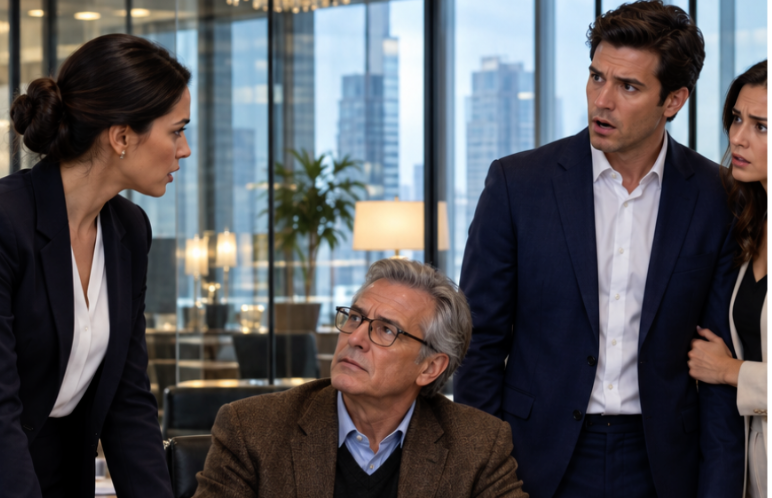
When I opened the heavy oak doors to the conference room, the editorial board meeting was already in full swing. At the head of the long oval table sat the silver-haired, fit Grigory Matveevich Kazantsev, glasses on, with my night’s charts open on his laptop and the printed second chapter in front of him. By the interactive screen stood Stanislav and a chicly dressed Violetta in a white jacket—both looking like the floor was burning under their feet.
…I’ll repeat my question once again, Stanislav Borisovich,” Kazantsev said in a calm but very clear voice, tapping his pencil on the page. “First, why is citizen Violetta Arturovna listed in the draft contract for the annual monograph—for which the fee is nine hundred thousand rubles—as the head of the author’s team and recipient of sixty percent of the royalties, despite her background in public relations and not a single scientific publication to her name?
I stopped at the door. So that’s why Violetta was dazzling beside my husband at yesterday’s award ceremony! Stanislav hadn’t just brought her to the banquet—he’d already listed his protégé as co-author and primary recipient of the nine-hundred-thousand-ruble contract for the book I was supposed to write for free at home all year!
Grigory Matveevich, well, Violetta Arturovna coordinated the collection of departmental data and prepared the visualizations… Stanislav tried to wriggle out of it, wiping his sweaty brow with a handkerchief.
“Excellent!” Kazantsev nodded. “Now, secondly, could you please explain to me and the rest of the editorial board, right here at the board: how did you use a reduction factor of 0.4 in table number four on page eighteen, when calculating the freight haulage through the Lyubertsy junction, if according to the Kleinrock formula, at peak load, it should be 1.7? Where did this figure come from and how does it relate to chapter three, which I still haven’t seen on my desk?”
continued in the comments
Stanislav helplessly opened his mouth and turned to Violetta:
“Violetta… for which quarter did you use the Lyubertsy data set in your source files?”
Violetta blushed deeply and backed away from the screen towards her seat:
“Stas, what Lyubertsy? You sent me the finished slides from your folder just last night, I only changed the fonts and headers! How should I know what the Kleinrock formula is?!”
“But I know, Grigory Matveevich,” I said calmly, walking up to the editorial board table and opening my leather briefcase.
Stanislav spun around sharply. When he saw me inside the editorial board hall with a badge on my jacket lapel, he turned white as a sheet.
“Inga?! How did you get in here?!”
“By personal invitation of the chief editor, Stanislav,” I replied, placing a bound original of the third chapter and five years’ worth of calculation notebooks in front of Kazantsev. “The 0.4 coefficient in table four is a verification marker I always put in draft versions to protect against unauthorized copying before submitting the final version. In the actual model, which is on page six of the third chapter, a dynamic coefficient of 1.5 is used, accounting for the nighttime sorting windows at Perovo station.”
Grigory Matveevich took the third chapter, scanned through the formulas and tables, and then nodded with satisfaction to the other board members:
“Definitely the same style, those are the original summaries and file metadata that were sent to me last night in the archive. So, it’s all confirmed. For ten years, Stanislav Borisovich, we’ve wondered why you only speak in generalities during oral debates, yet written reports under your name are of the highest analytical quality!”
Stanislav tried to raise his voice, though his lips were trembling:
“Grigory Matveevich, she’s my wife, we worked on the materials together at home! She’s just the technical editor, she only formatted my ideas into the tables, and now, because of a domestic argument, she’s trying to claim my work as her own!”
“She formatted your ideas?” Kazantsev smirked and turned his laptop screen toward him. “Every one of the 140 tables and text documents since 2019 has been authored on Inga Valeryevna’s computer account, plus there are audio recordings of her interviews with the chief engineers of sorting stations—calls you never once made yourself. And after all this, you bring a random lady to receive the prize and list her in the contract for 900,000 rubles instead of the actual author?”
Violetta didn’t wait for what would happen next—she grabbed her presentation folder from the chair and swiftly slipped out of the editorial board meeting room. Stanislav was left standing alone by the now-dark screen.
“The editorial board has made the following decision,” Grigory Matveyevich declared. “The contract project with your consulting center and Ms. Violetta Arturovna is hereby annulled. We offer a direct author contract for the preparation of an annual monograph with a budget of nine hundred thousand rubles, and the position of in-house head of analytics for our almanac, directly to the author—Inga Valeryevna. And as for the article series, as of today, the magazine will publish an official editorial clarification about the primary authorship.”
Half an hour later, I signed my first direct author contract in ten years in Kazantsev’s office and received keys to a workspace on the fourth floor of the publishing house. That evening, Stanislav came by my apartment to collect his suits along with the empty case from the statuette, then moved out to a rented place, and a month later our marriage was officially dissolved.