Friday evening spread quietly through the apartment, accompanied by the scent of fried potatoes and onions, when Dmitry announced without looking up from his phone:
“Anya, Mom called today… She says her joints hurt so badly that she can’t even hold a cleaning cloth. I promised her you’d stop by tomorrow morning and help her tidy up a little.”
Anna sat at the table, slowly stirring her cold tea. She had been waiting for those exact words, just as she knew Saturday always followed Friday.
“No,” she said, her voice dropping into the kitchen’s cozy silence like a stone into still water.
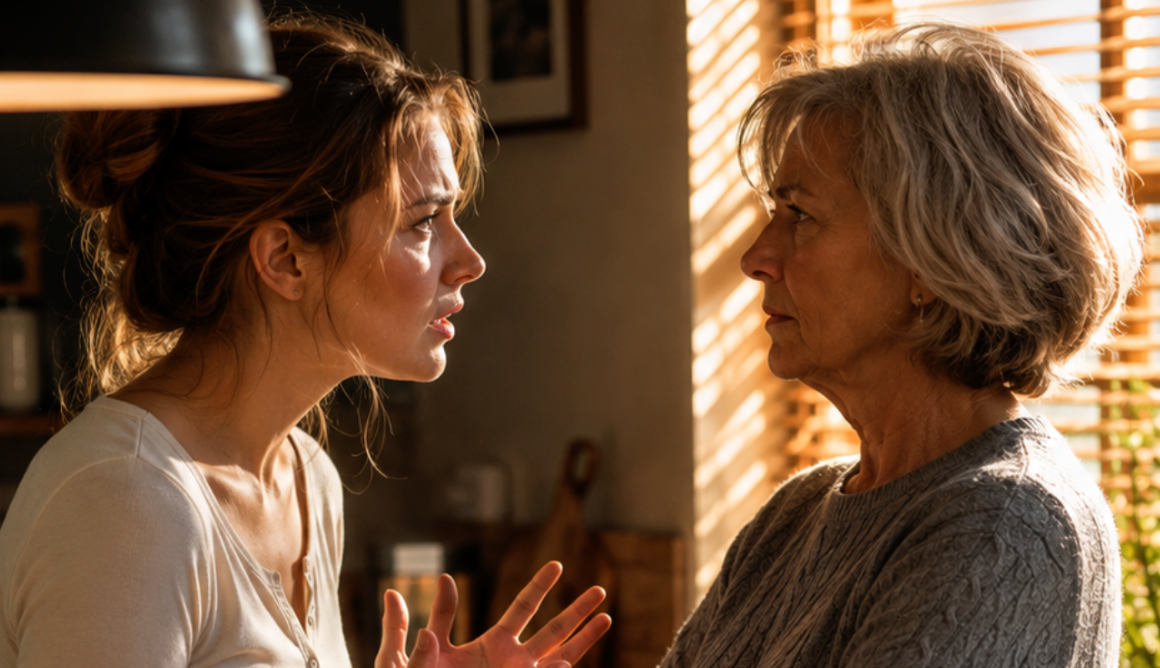
Confused and instantly defensive, Dmitry put his phone away and demanded an explanation. Anna pointed out the absurdly predictable timing: on Mondays, his mother traveled across the city to the market for the best tomatoes; on Wednesdays, she walked through the park for hours with friends; but every Friday evening, her limbs magically stopped working.
Dmitry snapped, repeating rehearsed excuses about “remission” and accusing Anna of having zero compassion for a woman who had sacrificed her health. As his pressure mounted, months of accumulated exhaustion and irritation finally erupted within Anna:
“Your mother is healthy enough to plow a field! She lies to you, and you believe her! I’m not going to keep going over there to do her housework. I’m not a servant!”
“My mother never lies!” he shouted back.
When Dmitry walked out of the kitchen, his face set like stone, Anna knew she had burned a bridge. For the first time in a very long time, she did not care.
Saturday arrived with gray, indifferent light. Dmitry woke first, performing a theatrical, accusing silence—making coffee strictly for himself and waiting for Anna to crack under the pressure, apologize, and accept her duty toward his mother.
Anna remained entirely unbothered. She silently drank her tea, dressed in jeans and a sweater, and watched as Dmitry put on his shoes, preparing his final scene as the abandoned, noble son heading off to perform hard labor alone.
“Wait,” Anna said calmly in the hallway. “Get your jacket. We’re going together. I want to show you something.”
Unsettled by her cold, steely certainty, Dmitry obeyed.
She drove in complete silence, heading north toward the old industrial districts instead of south toward his mother’s apartment. When Dmitry finally exploded, accusing her of taking revenge and demanding she stop the car, Anna pulled into the courtyard of the decaying Rassvet Cultural Center.
“We wait,” she said briefly. “Just be quiet and watch the main entrance. Five minutes.”
During the third minute of waiting, the heavy doors opened, and a group of elderly women spilled out onto the steps in bright tracksuits, laughing animatedly.
At the front of the group, wearing a bright pink windbreaker and black leggings, energetically swinging Nordic walking poles, was his mother—Raisa Petrovna.
Flush with health and boundless energy, she barked orders to her group:
“Come on, ladies, keep up! Backs straight! Use those poles properly! Longer strides!”
Her strong, ringing laughter carried all the way to the car.
Dmitry sat frozen as the world he had built—a world of a dying mother who needed his protection and a heartless wife—crumbled into dust. He had not merely witnessed a lie; he had seen the director of the performance leading her troupe.
Anna looked at Dmitry’s motionless, pale face as the group disappeared around the corner.
“Any more questions?” she asked with icy precision. “You can join her training session. I’m going home.”
She drove off, leaving him alone with his collapsed illusion.
Dmitry returned late that night, slamming the door and walking straight into the living room in his dirty outdoor boots. His face was gray with exhaustion, but his eyes burned with a dry, angry fire aimed entirely at Anna for destroying his fantasy.
“You enjoyed that little performance you arranged, didn’t you?” he hissed. “Dragging me there like a puppy and rubbing my nose in it? You spied on my mother to humiliate me!… Her doctor said she needs to exercise, even through pain! You only saw what you wanted to see!”
Anna closed her book, stood up, and looked at him without fear or hatred. She simply saw a stranger desperately trying to glue a shattered lie back together.
“Enough, Dima. Don’t humiliate yourself any further,” she cut in, her voice mercilessly even. “This isn’t really about her lying. Everyone lies sometimes. The problem is that you want her to lie. You need it.”
He froze.
“You need her weakness,” Anna continued, dissecting his soul with terrifying accuracy. “You need her to be sick, helpless, and ‘dying.’ Because only against that background do you feel strong, necessary, and like a real man—a protector, a savior. Her lies are fuel for your ego. And me? In this little game, I was nothing more than a function—household staff maintaining the scenery.”
Dmitry stared at her with pure, powerless hatred because every word was true.
“You didn’t choose her today or yesterday. You chose her a long time ago,” Anna concluded. “You chose to live inside a comfortable lie where you’re the hero and she’s the victim. But the truth is cold and uncomfortable—it demands that you behave like an adult. And you don’t want to.”
A heavy, absolute silence settled over the room—not the silence of an ongoing argument, but the cold silence of an ending between two complete strangers who had nothing left to say.