My Husband Rolled Out His Suitcase: “I’ve Decided Everything. I’ll Live With My Mother for Three Days and With You for Four”
“I have decided everything.”
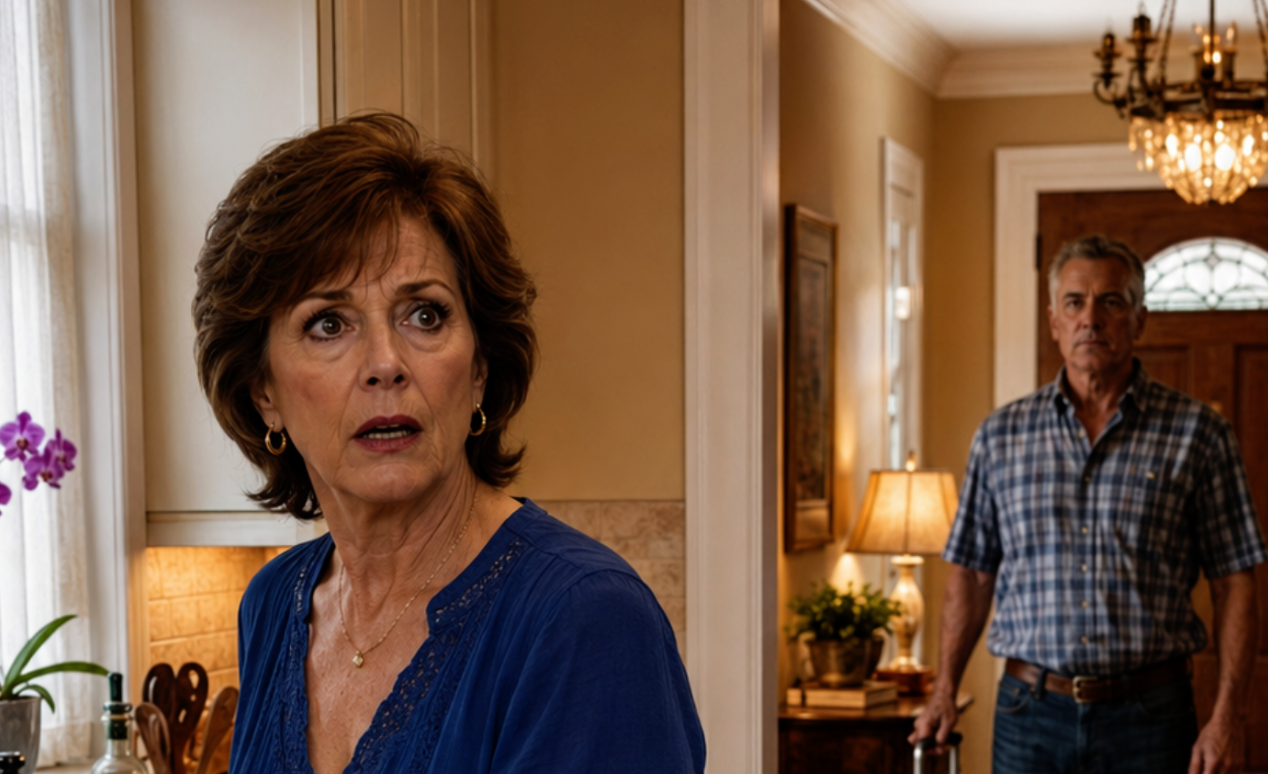
The proclamation hung in the dense, onion-scented air of the kitchen, heavy and utterly incongruous against the comforting, domestic soundtrack of sizzling meat. Boris rolled out the suitcase with such profound, deliberate ceremony that it appeared as though he had not merely retrieved it from the dusty, forgotten depths of our bedroom wardrobe, but had carefully excavated it from the sacred, immutable pages of national history. Its small, plastic wheels rattled aggressively over the metal threshold, a jarring mechanical intrusion into a space governed by soft fabrics and warm aromas. On the stove, the evening’s cutlets were finishing their slow, methodical transformation beneath the heavy cast-iron lid, sputtering softly in the rendered fat. Against that utterly ordinary, greasy, and profoundly intimate sound, Boris declared his intentions with the grave, self-important expression of a weary diplomat who had just negotiated a historic treaty.
“I will live with my mother for three days, and with you for four.”
At first, my brain simply refused to process the sentence. I did not even realize he was not attempting a bizarre, deadpan joke. The frying pan was exceptionally hot, its thick handle securely wrapped in a faded, floral oven mitt, and the kitchen window was thoroughly fogged with opaque steam from the cooking meat. Meanwhile, he stood rigid in the narrow hallway. He was clad in his familiar, softly worn plaid shirt, gently stroking the retractable handle of his luggage as though the entirety of human wisdom were safely zipped inside its nylon compartments.
The entire scene was so profoundly absurd that, acting entirely out of an old, ingrained female habit cultivated over decades of marriage, my first instinct was to frantically search for some hidden, rational meaning beneath it. Perhaps his blood pressure was acting up again, clouding his judgment with invisible internal storms. Perhaps his mother, Zinaida Pavlovna, had invented yet another highly creative, supposedly fatal, heart-related medical emergency to command his immediate attention. Perhaps Boris had simply cracked under the weight of some unspoken crisis at the office.
“What exactly is it that you have decided?” I asked, keeping my voice carefully neutral, anchoring myself to the solid edge of the counter.
“How we are going to live from now on,” he replied, lifting his chin with a surge of misguided pride.
Now, that finally caught my genuine interest. I was not hurt yet. The profound, stinging hurt of such moments always arrives on a delay, waiting until the true meaning of the words finally manages to crawl all the way through the logical defenses of your mind and settle heavily into your chest. At first, I was simply consumed by a morbid, anthropological curiosity. Having lived on this earth for fifty-six years, I truly believed I had heard every conceivable variety of male deflection and exhaustion: “I am tired,” “Please do not start,” “We will discuss this later,” and the eternal classic, “My mother’s blood pressure is spiking.”
But this? This was remarkably fresh, as crisp and unexpected as newly picked dill at the morning market.
I slowly lifted the heavy glass lid from the frying pan. The rich, savory, unapologetic smell of fried onions instantly filled the kitchen. It was an aroma so deeply honest, so deeply rooted in the straightforward, unpretentious reality of sustaining life, that Boris’s crisp, businesslike tone sounded especially ridiculous and small beside it.
“Borya,” I said, looking at him through the rising steam, “are you dividing yourself up like an inheritance, or like a winter coat?”
He frowned, his brow furrowing in deep, offended disapproval. “Please do not be sarcastic, Lyuba. I approached this matter very calmly and logically.”
“I gathered that.”
“Mother is not getting any younger. She requires consistent physical and emotional assistance. At the same time, I absolutely do not want to abandon my family. Therefore, I have found a reasonable compromise.”
He pronounced the word compromise with the exact same breathless, ideological reverence he had likely used as a young pioneer when reciting a patriotic pledge. I carefully placed the frying pan onto a wooden trivet, wiped my hands meticulously on my apron, and looked at him much more closely.
No, he was not drunk. His eyes were perfectly clear, lacking the glassy, unfocused sheen of alcohol. His cheeks held their normal color. He had even smoothed down his thinning gray hair with water, a nervous, boyish habit he always exhibited right before initiating an important, difficult conversation. He had not simply pulled this bizarre idea out of thin air on his way home from the grocery store. He had been actively nurturing it, watering it in the dark like a strange psychological houseplant.
“And how, precisely, did you divide these days?” I asked, leaning back.
“Rationally,” he stated, his chest puffing out slightly. “Monday through Wednesday at Mother’s apartment. Thursday through Sunday here.”
“And why four days here?”
“What do you mean, why? This is my home, after all.”
I nodded slowly. In moments like these, after words like those are spoken aloud, something inside your mind suddenly clicks securely into place, like a vault locking. Until that exact second, you desperately harbor the fragile hope that you are merely witnessing a brief, passing spell of temporary insanity. But then, the person standing before you calmly places the final, most devastating piece of the puzzle directly onto the table, completely unprompted.
“And what is your mother’s place, then?” I asked.
“My duty.”
“And mine is convenience?”
He was silent for a long, heavy moment. “Do not twist my words, Lyuba.”
But I was not twisting anything. Life itself was doing the twisting, and it was executing the maneuver with remarkable, brutal skill. Twenty-nine long years of shared marriage were currently standing directly across from me, calmly explaining that, apparently, three decades of shared history, mutual sacrifices, and intertwined lives could be neatly sliced and distributed according to the days of the week, much like a dietary meal plan at a cheap, provincial health resort.
I poured myself a cup of tea from the ceramic teapot. It had already sat too long, becoming dark, strong, and slightly bitter on the tongue. Boris stubbornly refused to sit down. He remained standing awkwardly in the hallway, clutching his luggage like a traveling salesman about to sprint for the last outbound train, which lent him a strangely triumphant, yet ultimately pathetic, appearance.
“Mother understood everything perfectly, by the way,” he added, a hint of smug vindication in his voice. “She fully supported my logistical approach.”
“I never doubted it for a second.”
“She has already prepared a dedicated space for me.”
“Oh, how wonderful. A space is already prepared.”
“And a schedule.”
I paused with the teacup halfway to my mouth, looking up. “What other schedule?”
Boris cleared his throat defensively. “A normal, highly practical one. So there will not be any confusion between us. I spend three nights at Mother’s and four nights here. Some of my belongings will remain permanently there, and some here. We will separate my medication into two distinct stashes. We will divide the dress shirts appropriately. We will also need to make strict, binding arrangements concerning food.”
That was the precise moment I finally sat down.
Not because my legs were trembling or giving way beneath me, but because it was simply too intellectually inconvenient to listen to such concentrated, monumental nonsense while standing upright. Great absurdity requires the grounding presence of stable furniture. I sat on the old wooden kitchen stool, right where the floral cushion had long since been flattened into a dense pancake by years of shared meals, and thought to myself that Zinaida Pavlovna could never, ever have limited herself to originating a single, simple idea. Whenever my mother-in-law seized upon a new project, it always came accompanied by a physical folder, an itemized list, and endless verbal appendices produced in triplicate.
“Make arrangements concerning food?” I repeated, letting the absurd words roll around in the quiet kitchen.
“Yes. To avoid any unnecessary financial expenses and logistical misunderstandings.”
“Borya, doesn’t it bother you even slightly that you sound exactly like a man desperately trying to be divided evenly between two competing cafeterias?”
He scowled once more. “You turn absolutely everything into a joke, Lyuba. This is a highly serious matter.”
“Oh, I assure you, I can see that clearly. Especially the part about the shirts.”
A glass lid clattered sharply on the counter. I have always maintained that when true foolishness takes root in a home, the inanimate objects—the dishes, the pots, the silver—are the very first to hear it. They are the first to lose their patience.
At last, he abandoned his post in the hallway, entered the kitchen, and sat down at the table, carefully folding his hands. At that precise moment, I definitively stopped seeing the man who was my husband. Instead, looking back at me was an overgrown schoolboy who had dutifully memorized someone else’s prepared speech, eagerly waiting to be awarded top marks for his bravery and innovation.
“Lyuba, this arrangement is strictly temporary.”
“Until when?”
“Until things finally settle down.”
“What things?”
“The situation.”
“What situation?”
He exhaled with sharp, visible irritation. “At Mother’s apartment.”
“And what about the situation here?”
Boris looked at me as though I were a broken machine actively interfering with a perfectly calibrated, reasonable system. “You are strong, Lyuba. You will understand.”
It was not a blow to the heart. People only strike at the heart when true, passionate love is still the primary currency involved. No, this was a precise, calculated strike at everyday life, at comfortable habit, at that deeply rooted part of a woman’s existence where she instinctively knows exactly which drawer holds his winter socks, what specific blend of black tea he requires on a dark winter morning, and the exact psychological reason why he invariably goes silent on Tuesday evenings.
In the coded language of a stagnant marriage, the phrase “You are strong” rarely functions as a genuine compliment. Rather, it is a convenient, cowardly translation for, “It is simply easier to dump this entirely on your shoulders.”
I remembered a piece of profound wisdom my own mother used to share when I was a small child: When a person comes to you wielding a ready-made decision, do not rush to argue with them. Let them finish talking. Give people enough rope, and the vast majority of them will eagerly tangle themselves in it.
“All right,” I said smoothly. “Please, go on.”
He visibly brightened, eagerly taking my quietness for submission. “I always knew you were a reasonable woman. So, look. We completely cleared out Mother’s small storage room. There is a sleeper sofa in it.”
“You mean the ancient one with the broken metal spring that violently digs into your lower back?”
“At least it is physically nearby.”
“Nearby to whom?”
“To Mother.”
I nodded once again. “Continue.”
“I will leave my primary documents, my good clothes, and my garage tools here with you. At Mother’s, I will maintain a secondary stash: some casual house clothes, a pair of slippers, a light jacket, half of my blood pressure medication, and a spare phone charger. Now, we also vitally need to settle the issue of the borscht.”
“So, this is the glorious destination where modern progress has brought us. The borscht question.”
“Do not laugh, Lyuba. It is important.”
“Oh, I assure you, I am not laughing anymore.”
Deep inside my chest, something had crystallized, becoming as sharp and perfectly clear as a bitter winter morning when the earth has frozen entirely solid and the very air seems to ring with cold. The man sitting directly opposite me, the man I had spent three decades loving, was audibly speaking about our sacred marriage as though he were conducting a quarterly warehouse inventory. And he was doing it without shouting, without a shred of visible guilt, armed only with an almost righteous, bureaucratic conviction.
“Where is your mother right now?” I asked calmly.
“At her home. Waiting for me.”
“So, you have already thoroughly discussed every aspect of this with her?”
“Of course I have.”
“And did she, at any point, pause to ask what I might think about it?”
“Lyuba, it is my personal choice.”
At that point, a harsh, dry laugh almost escaped my throat. Not a malicious laugh, but one born of pure disbelief. It is simply a universal truth that when a man rapidly approaching the age of sixty sincerely describes himself as a choice, the situation rapidly crosses the boundary from tragedy into avant-garde art.
I stood up slowly and decisively turned off the gas burner beneath the cutlets.
“Let’s go to your mother’s apartment,” I commanded softly.
He looked utterly bewildered. “Why?”
“Because I wish to hear the complete, unedited version. Perhaps there is an addendum to the schedule, or a seasonal allowance I need to be aware of.”
Zinaida Pavlovna’s apartment smelled exactly as it always had: a suffocating, dense mixture of harsh mothballs, dried dill, and aging crystal. The air in any healthy home should not smell like that, but in the apartments of domineering elderly women, the atmosphere somehow manages to absorb the entirety of the wooden wardrobe, the heavy china cabinet, and three generations of unvoiced resentments all at once.
The television muttered a low, steady stream of news from the cramped living room. Pristine white lace covers lay draped meticulously over the worn velvet armchairs. Zinaida Pavlovna herself sat regally at the dining table, wrapped tightly in a thick robe violently patterned with purple flowers. She was vigorously stirring her tea with a silver spoon, churning it so violently it looked as though she were attempting to summon a drowned sailor from the bottom of the glass.
“Oh, you’re here,” she announced, not bothering to hide her immense satisfaction. “I always knew Lyuba was a highly sensible woman.”
She utilized the pronouns we and our rapidly, weaving them into the conversation almost unconsciously.
“Well, did Boris explain everything to you properly?” she demanded.
“He explained the outline. But I am a woman who deeply enjoys the finer details.”
My mother-in-law visibly swelled with animation. Dictatorial personalities like hers always bloom into vibrant life when finally given a captive audience to expand upon their own brilliance. Boris sat sideways on his chair, cowardly adjusting his shirt sleeve and avoiding my gaze. Resting perfectly on the sleeper sofa, I noted a neatly folded, preemptive pile: plaid pajama trousers, a thick wool house sweater, and two pairs of gray socks. This coup had clearly not been plotted merely yesterday.
“This is what we decided,” Zinaida Pavlovna began grandly. “Borenka will stay with me for three full days. I am not young anymore, Lyuba. Anything catastrophic could happen at any moment. I desperately need a strong man’s shoulder.”
“Of course you do,” I murmured.
“And he will spend four days with you. Everything is mathematically fair.”
“Fair?”
“Naturally! We aren’t taking him away from you entirely. We are simply distributing him.”
That specific we sounded especially cheerful, bordering on gloating.
“Boris,” I said, turning my gaze sharply to my husband, “who exactly constitutes this ‘we’?”
“Why are you persistently picking at words?” he deflected.
“I am genuinely curious. If you are actively distributing something—or someone—then my name must surely have been entered somewhere in your master ledger. Which specific column am I located in?”
Zinaida Pavlovna pursed her thin lips into a tight, unhappy line. “Lyuba, please do not make a theatrical tragedy out of this logical solution. A good man is simply torn between his sacred duty and his family.”
“And that, of course, is precisely why he created a calendar.”
“What exactly is wrong with maintaining order?”
“Absolutely nothing is wrong with order, Zinaida Pavlovna. The severe problem only begins when you attempt to mercilessly staple a living, breathing human being to it.”
“During my four allocated days,” I continued relentlessly, “does Boris receive only standard accommodation, or are full meals included in his package?”
Zinaida Pavlovna blinked, momentarily derailed. “What kind of sarcastic tone is that?”
“The exact same businesslike, transactional tone you are both using.”
“Of course meals are included at your residence! My state pension is certainly not limitless.”
“And the laundry?”
Boris coughed nervously into his hand. “Lyuba, please…”
“No, wait, Borya. Since we are meticulously dividing responsibilities, we must properly complete the bureaucratic process. Where exactly will his dirty laundry be washed?”
My mother-in-law raised her drawn-on eyebrows. “Your German washing machine is significantly better than mine.”
“And the ironing?”
“You have always ironed his collars much better.”
I looked deeply at both of them. In that singular moment, their grand, logical arrangement appeared before me as starkly and clearly as a stone resting in the palm of my hand. The three days spent at his mother’s apartment were purely about the optics of duty, designed entirely so Boris could look noble and self-sacrificing to the outside world. The four days spent with me were purely about parasitic comfort, designed entirely so Boris could continue to eat familiar, delicious food, sleep deeply in his own high-quality bed, and wear crisply ironed shirts to the office.
And neither of them found a single ounce of shame in this reality. That was the truly astonishing part.
“And what happens if I simply do not agree to this?” I asked quietly.
Zinaida Pavlovna snorted loudly. “Where exactly would you go? You are his wife.”
I allowed a genuine, icy smile to grace my face. “Zinaida Pavlovna, that may have been a remarkably powerful argument forty years ago. However, these days, its batteries are completely dead.”
Boris straightened his spine. “Lyuba, do not push this too far.”
“Me? You boldly marched home with a packed suitcase and a printed schedule, acting like a district doctor making clinical house calls.”
My mother-in-law looked deeply offended. “I am not taking my son away from you, you know.”
“Who ever said you were taking him? You are simply accepting delivery.”
The cramped room became perfectly quiet. Only the television continued cheerfully reporting the evening weather. I stood up, deliberately adjusted my leather bag on my shoulder, and said:
“Fine. Live exactly as you have decided. But let us avoid any future confusion. Since you have aggressively implemented a new arrangement, we will absolutely not touch the old one.”
“What does that mean?” Boris asked, a flicker of genuine fear in his eyes.
“It means, Borya, that I also need to spend some time thinking about exactly how I am going to live from now on.”
On the quiet car ride home, I remained entirely silent. Boris was silent too, but for a completely different reason. I was silent because I already understood the finality of everything. He was silent because he still foolishly hoped that the most difficult part of the negotiation was over, expecting only the standard, manageable female grumbling to follow, after which everything would neatly return to normal. Men sometimes possess an astonishing, deeply flawed faith in the gravitational power of habit. They genuinely believe that pots, clean shirts, and wives are endlessly renewable natural resources.
At home, I pulled a plaid canvas travel bag down from the highest shelf. It was the same one we had taken to the seaside when our son, Artyom, was small, when every joy in life could fit inside sandwiches and two towels. I began packing his things with terrifying calmness. Trousers, undershirts, pills, charger, slippers, and nail scissors.
“Leave the shirts,” he said quickly. “I need them here for work.”
“I am learning your method. Some things there, some things here.”
“Lyuba, stop nitpicking.”
“I am not nitpicking. Three days there means you stay there. Four days here means strictly by prior agreement.”
He looked at me differently now. Not like a wife who would grumble and then serve soup, but like a person who had suddenly revealed an inner, iron door he never knew existed. And that door was clearly closing.
The next two days passed with a strange, hollow quietness. Boris stayed at his mother’s. He called occasionally, irritated, demanding to know the location of his warm socks or pill organizer. “In the life where you lived at home without a schedule,” I replied evenly.
On the third day, Irina, our busybody neighbor, knocked. “Lyuba, I have news. Your mother-in-law was telling the entire entrance this morning that her son now lives fairly: wherever his care is needed most, that is where he stays.”
I nodded. The final screw clicked into place. It is one thing to endure nonsense in your kitchen; it is another to realize it has been triumphantly paraded into the public sphere as family wisdom.
On the fourth day, Boris arrived with his suitcase, looking haggard and irritated. “It is utterly impossible at Mother’s,” he announced from the doorway, making a beeline for the kitchen. “She listens to the television all night. She constantly needs something. Is there soup? Home is still infinitely better.”
“Better for whom?” I asked.
Before he could answer, the front door opened. Our grown son, Artyom, walked in to retrieve some tools. Behind him lingered Irina, clutching an empty bowl, pretending to be a casual bystander.
“Dad, are you seriously doing this?” Artyom asked, staring at the packed bag.
Boris made the fatal mistake of justifying his greed. “I cannot split myself in two! Mother has demands, and there are demands here. This way, it is convenient for everyone. At Mother’s, I help. Here, I can rest properly, eat decent food, and enjoy peace. Your mother has everything organized. My shirts are washed, there is always soup. What is wrong with that?”
The ensuing silence was devastatingly honest.
“So,” Artyom summarized quietly, “Grandma needs you as help, while Mom is just supposed to service your lifestyle?”
“Do not twist my words,” Boris snapped.
“Like a civilized person?” I repeated quietly, stepping forward. “Is that when you put your wife on a schedule somewhere between laundry and soup?”
I took out the manila folder I had prepared. The apartment belonged solely to me, purchased long before our marriage.
“Since the schedule is paramount to you, Boris,” I said, my voice steady, “let us ensure we do not confuse the boundaries. Three days, four days, clean shirts, soup—none of those will ever be discussed without my explicit consent again. And I do not consent. Today, you will take your belongings and go live permanently where a place and a schedule have already been prepared for you.”
He stared, draining of color. “Are you throwing me out?”
“No. I am refusing to participate in the distribution of myself.”
Without another word of grand negotiation, Boris slowly picked up the handle of his bag. He was no longer a statesman delivering a decree; he was merely a tired man clutching plaid luggage, realizing his brilliant compromise was nothing but thinly veiled selfishness announced out loud in front of witnesses.
The front door clicked shut softly behind him. In the kitchen, the kettle hissed quietly. It was an utterly ordinary afternoon, but as I looked around the room, one strange schedule was no longer in effect, and the apartment suddenly felt remarkably, beautifully spacious.