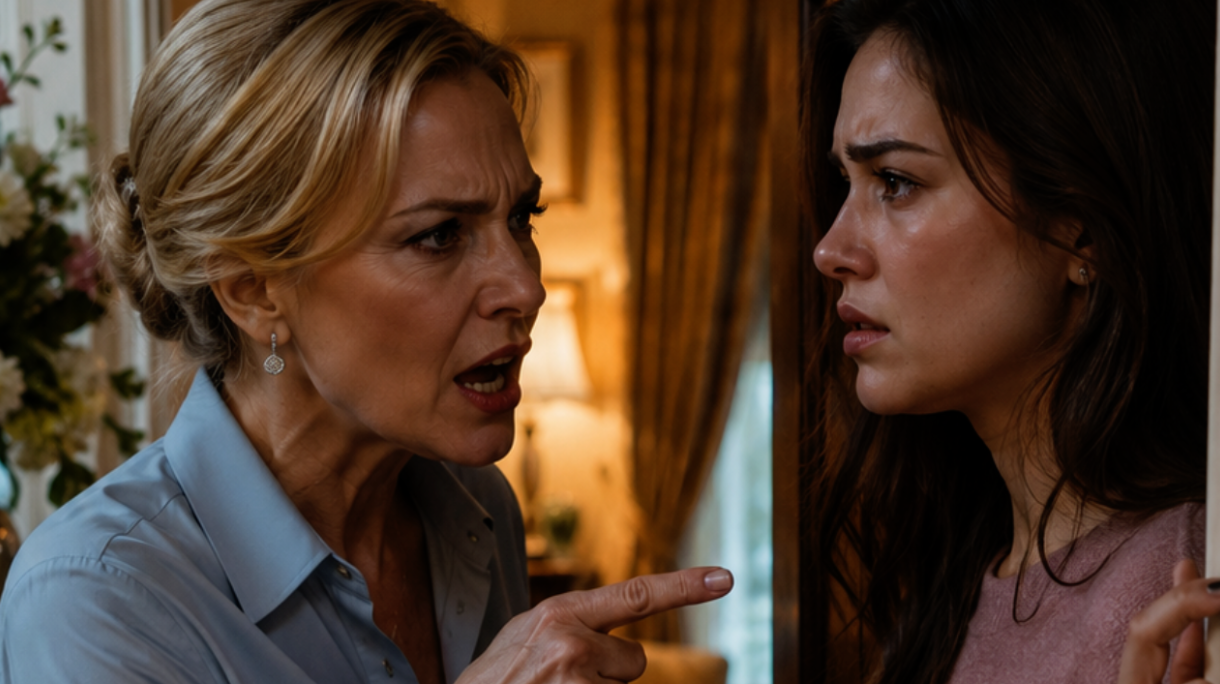
“It doesn’t matter that he used to hit you — you’re obligated to take care of him!” her mother-in-law declared.
November arrived without warning that year — all at once, like an uninvited guest who slams the door and drags a draft in behind him.
Marina Sokolova sat by the window with a cup of coffee, looking out at the wet roofs of the neighboring houses. She loved evenings like this: no movement, no noise, only the rain and Phil the cat, curled up on the windowsill like a tight ginger roll.
It had taken her four years to reach this silence. She had walked toward it through scandals, through tears in the bathroom with the water running so no one would hear. Through nights when she waited for his footsteps on the stairs and could already tell from the sound whether he was sober or not.
Now there were no footsteps. Now there was silence. And she protected it like something fragile — with both hands, holding her breath.
Her phone vibrated on the table. Marina glanced at it — an unknown number. She hesitated for a second and declined the call. Unknown numbers rarely brought anything good.
A minute later, a message arrived.
“Marina, this is Valentina Andreevna. We need to talk. It’s urgent. It’s about Andrey.”
Marina set the mug down on the table. Slowly. Carefully. The way people put down something heavy when they are afraid of dropping it.
Valentina Andreevna. Her former mother-in-law. A woman who, in six years of marriage, had never once said Marina’s name without a tone of condescension. A woman who could smile and, at the same time, say something that made you want to shrink, become smaller, become invisible.
“You cook fairly well, of course. For a city girl.”
“Marina, dear, there’s that look again. Like an offended cat. Andrey doesn’t like that, remember.”
“You’ll forgive me, but our family has different traditions. You’ll get used to it. Or you won’t — but that will be your problem.”
Marina turned the phone face down. She stood up, walked into the kitchen, and poured herself more coffee. Phil jumped down after her — softly, almost soundlessly — and rubbed against her ankle.
“Everything is fine,” she told the cat. “We’re not answering.”
But the next morning, they called again — from another number. Marina answered by mistake, thinking it was work.
“Marina!” Her mother-in-law’s voice was familiar enough to make her teeth ache: soft on the outside and hard on the inside, like caramel filled with gravel. “Finally. I was beginning to think you had disappeared completely. How are you?”
“Valentina Andreevna,” Marina said evenly. “What happened?”
A pause. A rustle. Then a sigh — deep and theatrical, rehearsed over many years.
“Andrey is in the hospital. It’s serious. His liver. You understand, all of this has… built up. The doctors say it’s cirrhosis. He’s in a bad way, Marinochka. A very bad way.”
Marina listened. She waited for the continuation — because there was always going to be one.
“We need help. You understand, I’m no longer young, I have blood pressure problems. His sister Karina is on maternity leave; she has no time for this. You’re a medical professional, you understand these things. And after all… you were his wife. You were together for so many years.”
“I was,” Marina agreed. “Three years ago, I stopped being that.”
“So what now?” Her voice hardened slightly, losing its syrupy sweetness. “You abandoned a person and washed your hands of him? He drank because of you, you know that. You didn’t understand him. You didn’t support him. So he…”
Marina looked out the window. A raindrop was sliding down the glass — slowly, as if thinking.
“Valentina Andreevna,” she interrupted quietly but clearly, “I hear you. And I’m sorry that Andrey is ill. Truly sorry. But this is not my conversation. Goodbye.”
She ended the call. Her hands were not shaking. That was new — her hands were not shaking.
They came on Thursday.
Marina saw them through the peephole — three of them, like a delegation bearing bad news. Valentina Andreevna stood in the center, wearing a dark coat with an astrakhan collar, straight as a pointing finger. On the left was Karina, her sister-in-law, who had shown up in full battle makeup despite being on maternity leave, with an expression that suggested she was already offended by the answer in advance. On the right was Gennady, Andrey’s uncle, whom Marina had seen at most three times during all the years of her marriage, but who always managed to appear precisely when someone needed to apply pressure with authority.
Marina did not open the door. She stood in the hallway, leaning her back against the wall, and breathed.
Before, she would have opened it. Before, she would have told herself: it’s awkward, they came all this way, I should at least listen, I should be polite, I must, I must, I must. That word — “must” — had lived in her head for six years like an illegal tenant. It took up a lot of space and paid nothing.
The intercom rang. Then again. Then there was a knock at the door — soft at first, then more insistent.
“Marina,” Valentina Andreevna’s voice sounded muffled through the door, but still recognizable. “We know you’re home. Your car is in the yard. Open the door, please. We’re not leaving.”
That part is true, Marina thought. They won’t leave. They never left on their own.
She picked up her phone and sent a message to her neighbor, Tamara Ilyinichna from the third floor — an elderly woman with a sharp tongue and absolutely no fear of other people’s awkward situations.
“Tamara Ilyinichna, there are people standing at my door and they won’t leave. Could you come out onto the landing?”
The reply came twenty seconds later: “I’m on my way.”
Marina exhaled. She opened the door slightly, leaving the chain on.
Valentina Andreevna stepped forward with a prepared smile — the very same smile Marina had once mistaken for kindness.
“There we go, good girl. We won’t be long, we just need to talk…”
“Talk like this,” Marina said. “I’m listening.”
The smile trembled slightly. Behind her, Karina folded her arms.
“You can’t discuss something like this through a door,” her mother-in-law began. “This is a family matter, it’s…”
“We are not family,” Marina said calmly. “We stopped being family three years ago. Speak.”
At that moment, confident footsteps sounded from the stairwell. Tamara Ilyinichna stepped onto the landing in her house robe, wearing the expression of a person who had both the time and the desire.
“Oh, visitors?” she said in a polite, social tone, looking over the delegation. “For Marinochka? I don’t think I’ve seen you before.”
Gennady glanced at her with the look of a man whose work was being interrupted.
“We’re here on a personal matter,” he muttered.
“Personal matters are good,” Tamara Ilyinichna agreed, not moving from her spot. “I just came out for some air. Don’t mind me.”
Valentina Andreevna realized that the audience had expanded, and she did not like it. Her voice became quieter and harsher at the same time — the way it does when a person moves from persuasion to business.
“Marina, you’re a medical worker. You have skills. Andrey needs care — dressings, IVs at home, diet supervision. A caregiver costs money, and we don’t have any. You live alone, you work shifts — you have time. We’re not asking you to live with him. Just come by. Two or three times a week. It’s not much.”
Marina looked at her. At that face she had once tried so hard to please. At those eyes, where behind the show of suffering lived the usual certainty: she will agree, she always agreed, we know how to handle her.
“No,” Marina said.
Karina couldn’t hold back.
“What do you mean, ‘no’? He’s sick! He has cirrhosis! Do you even understand what that is?”
“I do,” Marina nodded. “I’m a medical worker, as you yourself said. Cirrhosis is the result of many years of alcohol abuse. It is not an accident and it is not someone else’s fault. It is the consequence of his choices.”
“You drove him to it!” Karina shouted, her voice breaking into that special tone that was supposed to signify righteous anger, but only showed a habit of not taking responsibility for her words. “He drank because of you! You didn’t understand him, you didn’t support him, you nagged him every day!”
Marina felt something familiar tighten inside her — an old reflex developed over years. Maybe it’s true? Maybe I did something wrong? Maybe if I had…
She stopped the thought. Firmly, the way one closes a small window in the freezing cold.
“Karina,” she said quietly. “For six years, I tried to support a man who came home drunk and blamed me for it. I took him to an addiction specialist — he left after the first session. I begged, pleaded, cried. Once, he pushed me so hard that I walked around for a week with a bruise on my shoulder. After that, I left. That is not called ‘abandoning.’ That is called surviving.”
The landing became quiet. Even Tamara Ilyinichna did not move.
Gennady cleared his throat and began speaking — heavily, deliberately, like a man used to being listened to.
“Here’s how it is. There is a law. A former wife is obligated to support her former husband if he becomes unable to work. We’ve consulted someone. We’ll file for alimony — and you’ll pay. If you don’t want to pay, you’d better come and help yourself. Understood?”
Marina looked at him. For a long moment. Then she said:
“Gennady, a former spouse is obligated to pay support only if the former husband became unable to work within one year after the divorce and needs assistance. We divorced three years ago. In addition, the court considers the causes of the disability and the financial situation of both parties. Go ahead and file. I’ll come with a lawyer and medical documentation about the nature of our marriage. It will be interesting.”
Gennady turned red. Karina opened her mouth and then closed it.
Valentina Andreevna was silent — and this silence was different. Not a pause before the next argument, but something that resembled an ending.
“Marina,” she finally said, and her voice suddenly sounded old, tired, without caramel and without gravel. “Are you not afraid at all?”
“Of what?” Marina asked.
“Of being left alone. Of having no one to turn to later. Of the fact that people don’t forgive things like this.”
Marina looked at this woman — no longer young, already frightened, already having lost her son in some sense long before the hospital — and felt something unexpected. Not anger. Almost pity. But pity was not guilt.
“Valentina Andreevna,” she said quietly, “I wish Andrey recovery. Honestly. But I cannot be his salvation. I barely saved myself. And it took three years.”
She closed the door.
She stood in the hallway, listening. Behind the door, there were voices — quiet ones — then footsteps going down. Then silence.
Phil came out of the room and sat by her feet, looking up at her with the expression of a creature that understood everything and would never judge.
Marina crouched down and buried her face in his ginger fur.
“That’s it,” she said. “That’s it.”
That evening, she opened her laptop. On the desktop lay an unfinished textbook on the psychology of crisis states — she had enrolled in advanced training courses two months earlier. There was a bookmark in the chapter titled “Boundaries as a Form of Self-Respect.”
She read for a long time, making pencil notes in the margins. Outside the window, the rain was falling — familiar November rain now, without demands.
At some point, her phone vibrated again. An unknown number. Marina looked at the screen, held the phone in her hands — and set it aside without answering.
Then she added the number to the blacklist.
Then she returned to her textbook.
In the margins of the chapter about boundaries, she wrote three words in pencil, slowly and carefully, as if signing an agreement with herself:
My life. Mine.