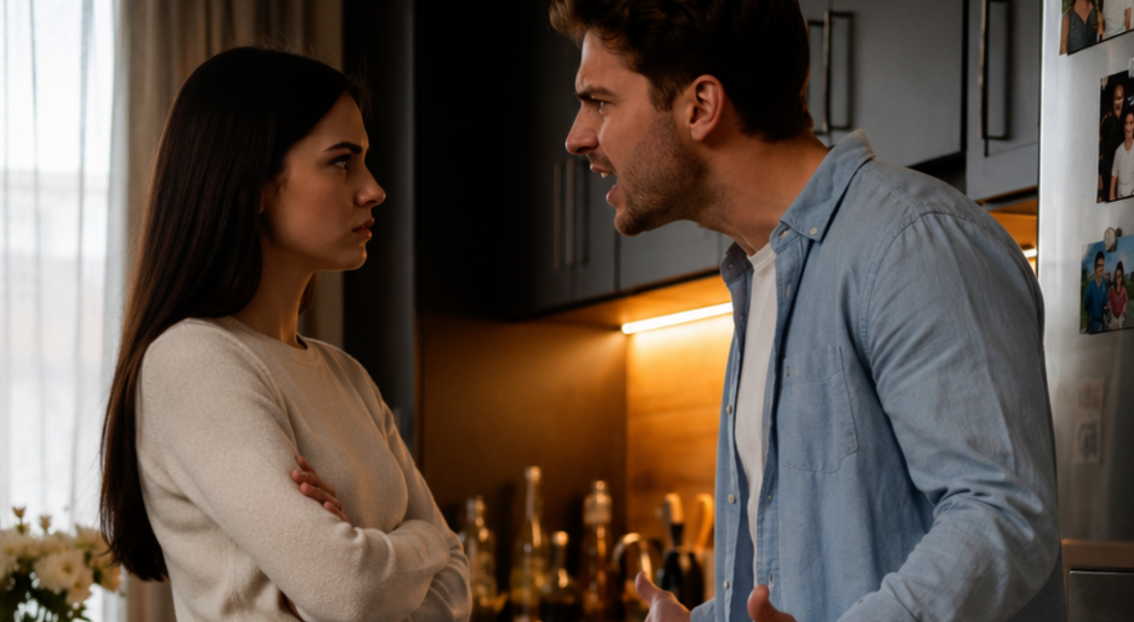
“Stop right there, Misha! I’m not leaving this apartment! Your parents and mine both paid for it, so we’re going to divide it equally.”
“That’s it! I’m sick of this! Pack your junk and get out to your mommy!” Misha’s voice, breaking into a shriek, struck the walls and bounced off them, filling the small hallway with the smell of ozone, like after a thunderstorm. He stood with his legs apart, jabbing his thick finger toward the front door, his whole face red and swollen with rage, like an overripe tomato ready to burst at any moment. “This is my apartment, understand? Mine!”
Until that moment, Svetlana had been leaning against the doorframe, silently listening to his half-hour tirade. Then she suddenly straightened up slowly. Her movement was smooth, almost lazy, but there was awakened strength in it. Her back became straight, like a taut string. Her chin lifted slightly, and her shoulders squared. Her gaze, tired and indifferent until now, focused on him and became firm, like tempered steel, and unpleasantly cold. For a moment, Misha even faltered, feeling that sudden stab of chill.
“Sit down, Misha. And shut your mouth,” she said sharply. Her voice was even, without a single trembling note, and because of that calmness, his own fury suddenly seemed pathetic and cheap, like a market squabble.
“What? Who do you think you are?!” he tried to flare up again, but the fire had already gone out. “I’m telling you, get out of here!”
“Stop right there, Misha! I’m not leaving this apartment! Your parents and mine both paid for it, so we’re going to divide it equally, no matter what nonsense you’ve decided to invent for yourself right now!”
She took a step forward, and Misha involuntarily backed up toward the wall. The gap between them seemed to fill with ice.
“So listen carefully, because I won’t repeat myself,” Svetlana continued, looking him straight in the eyes, and he suddenly felt not like the master of the situation, but like a guilty teenager who had been caught misbehaving. “From this minute on, we are not husband and wife. We are neighbors. Neighbors in a communal apartment, forced to share the same space until it is sold and the money is divided. And I strongly advise you not to touch my things. You don’t touch my half of the fridge. You don’t look inside my pots. And God forbid you eat anything from my food. Because from this second on, everything shared between us is over. The division of property has begun. Is that clear?”
He blinked silently, unable to find words. The entire scenario he had prepared, in which she cried, begged, and he magnanimously threw her out, crumbled into dust. Standing before him was a completely unfamiliar stranger.
Svetlana walked around him without giving him another glance and went into the kitchen. Misha heard the cabinet door click confidently. She returned to the room with an open pack of oatmeal cookies in her hands. Without hurrying, she walked to the sofa where, just five minutes earlier, he had been sitting and feeling like a king and a god, and settled on its edge. With a distinctive click, she turned on the television. Some foolish quiz show appeared on the screen.
She bit into a cookie. The loud, defiant crunch sliced through the tense atmosphere in the room. Svetlana looked at the screen, at the lifelessly smiling host, and her face showed absolutely nothing except mild boredom. She had completely and demonstratively erased him from her world.
Misha stood in the middle of the room like a statue. Air burst noisily from his lungs. The war he had started with such confidence had just entered a completely new, cold, and incomprehensible stage for him. And with horror, he realized that in this war, he was unarmed.
A week passed. A week of thick, viscous silence, louder than any screaming. The apartment, once their shared nest, had turned into a demarcation zone, divided by invisible but absolutely real borders. They moved through it like two feuding ghosts accidentally locked inside the same crypt. In the mornings, they acted in the kitchen with the precise caution of bomb disposal experts, trying not to cross paths, not to meet each other’s eyes, not to accidentally touch someone else’s cup.
The refrigerator became a clear map of their split. The right side, belonging to Svetlana, was a model of order: containers of food labeled with a marker, neat packages of vegetables, a bottle of expensive wine. The left side, Misha’s, turned into a chaotic pile of yesterday’s pizza in a box, a lonely bag of dumplings, and an opened pack of sausages. For the first couple of days, out of old habit or petty spite, Misha took her milk. She did not say a word. The next morning, a new carton appeared on the shelf with “SVETA” written on it in black marker. He snorted, but he did not touch it again.
The bathroom became another battlefield. He deliberately left splashes on the mirror and the toothpaste tube uncapped. When she returned from work, she silently wiped everything clean and then placed his towel out in the hallway, as though it were something contagious. Small jabs, soundless blows, irritated him and drove him mad far more than open arguing would have. He felt himself losing control, felt his status as master of the house evaporating with each passing day. He tried to assert himself by turning football on at full volume when she sat down to read in the living room. Svetlana simply got up, took her headphones, and returned to the sofa, sinking into her own world and leaving him alone with the roar of the stadium, which now seemed stupid and out of place.
The breaking point came on Thursday. Misha came home from work angry and exhausted; at a meeting, he had been scolded like a schoolboy. He entered the apartment, threw his keys onto the small cabinet, and out of habit headed to the bedroom to change. His hand, moving automatically from years of routine, landed on the cold brass door handle.
It did not give way.
He pressed harder. Nothing happened. The door was locked. For a moment, he froze, unable to believe it. Then he yanked again, with such force that he nearly twisted his wrist. The dull knock of wood against the frame confirmed the obvious. He looked more closely and noticed what he had not seen at first: in place of the old, loose lock, a new, shiny cylinder gleamed.
A cold wave of rage rose from his stomach, burning his insides. He turned around and burst into the living room. Svetlana was sitting in an armchair with a laptop on her knees. She looked up at him, and there was neither fear nor surprise in her eyes. Only calm expectation.
“Have you completely lost your mind?” he hissed, trying to speak quietly, though his voice trembled with anger. “You changed the lock? On our bedroom!”
“Yes, I changed it,” she answered evenly and lowered her gaze back to the screen, as though their conversation mattered no more than an email.
“What the hell? On what grounds did you do that? This is my apartment too! I have the right to enter any room!”
Then she closed the laptop. Slowly, with a soft click that sounded like a gunshot.
“First of all, it is no longer ‘our’ bedroom. It is my room. You chose yours yourself when you dragged your things to the sofa. And second,” she paused, looking straight at him, “I don’t want a neighbor who thinks it’s normal to scream in the middle of the night and throw me out of my home to have access to my things while I sleep. Call it a precaution. For peace of mind.”
He opened his mouth to shout, to pour out everything boiling inside him, but the words stuck in his throat. She had disarmed him with her icy, impenetrable logic. To her, he was not a husband, not an enemy, but simply… a potential threat. A stranger. And he stood in the middle of the living room, looking at this woman who, with one decision, had locked him not only outside her room, but outside their entire past life.
Misha paced around the apartment like a lion locked in a cage too small for him. The sofa, which had become his forced domain, creaked beneath him every night, reminding him of his shameful exile. The bedroom wall, behind which there was now someone else’s inaccessible territory, seemed monolithic and mocked him with its silence. He tried everything: he ignored Svetlana, tried to make sarcastic remarks, spoke loudly on the phone with his friends, complaining about “bitchy women,” but she remained impenetrable, like bulletproof glass. His pitiful attempts to wound her simply bounced off, leaving not even a scratch.
After losing every small battle, he realized he could not take this fortress alone. He needed heavy artillery. A force that, as he was certain, no woman could withstand. And on Saturday morning, that force materialized on the threshold of their apartment.
The doorbell rang long, insistently, possessively. Svetlana, who was drinking coffee in the kitchen, did not even move. She knew who it was. Misha rushed to the door and flung it open. On the threshold stood his mother, Galina Semyonovna, a stout woman with a tall tower of hair and a face frozen in an expression of offended virtue. She entered without taking off her shoes and swept her gaze over the hallway as though conducting a sanitary inspection.
“Well, hello, son. I take it things are lively here?” she said, looking over his shoulder straight toward the kitchen.
“Come in, Mom,” Misha muttered, feeling a surge of strength. Reinforcements had arrived.
Galina Semyonovna marched into the kitchen like an icebreaker and stopped opposite Svetlana. Svetlana slowly placed her cup on the table and raised her calm gaze to her mother-in-law.
“Hello, Galina Semyonovna.”
“Hello, Sveta, hello. And how long is this circus going to continue?” her mother-in-law began without preamble, planting her hands on her hips. “Misha told me everything. Changing locks, of all things. Not letting your husband into his own apartment! Who do you think you are?”
“I don’t think anything of myself. I’m simply ensuring my safety,” Svetlana replied in an even tone.
“Safety? From whom? From your own husband?” Galina Semyonovna’s voice began to rise in volume. “Did he raise a hand to you? No! Did he say something rude to you? Well, maybe he did, but you drove him to it yourself! A normal wife should smooth things over, be wiser, and what have you done? Started a war!”
Misha stood in the doorway, watching the scene with satisfaction. This was it. His mother would now put everything in its place. She knew how to press on guilt, conscience, and public opinion. Svetlana would surely not withstand that.
“Galina Semyonovna, my relationship with Misha is between Misha and me. We will resolve it ourselves,” Svetlana spoke as though explaining a basic truth to a child.
“You’ll resolve it? You’ve already resolved everything!” her mother-in-law threw up her hands. “You just took a person and crossed him out of your life! And did you forget that we, the parents, worked ourselves to the bone to buy you this apartment? My husband and I put in our last penny, lost sleep at night, thinking it was for a family, for grandchildren! And what are you doing? Destroying the nest!”
She paused, waiting for the effect. Tears, remorse, anything. But Svetlana only tilted her head slightly.
“No one has forgotten your contribution. Just as no one has forgotten my parents’ contribution. They, by the way, invested exactly the same amount. So when the apartment is sold, you will receive your part back. Down to the last kopek. No one is laying claim to what is yours.”
For a moment, this businesslike, cold tone stunned Galina Semyonovna. Her manipulations, polished over the years, shattered against calm logic.
“Oh, so that’s how you’re talking now! You’ve already counted everything! Planning to sell it, are you?” she exclaimed, boiling over. “And have you thought about my son? Where is he supposed to go? Onto the street? You’re throwing him out!”
“I am not throwing anyone out. I am suggesting a civilized division. Each person will receive what is theirs and go their own way,” Svetlana stood up, took her cup, and headed to the sink. “And now, excuse me, I have things to do.”
That was the last straw. Galina Semyonovna turned crimson, her face twisting.
“You… You are simply ungrateful! We put our souls into you, treated you like a daughter! And this is what you turned out to be! Cold, calculating! Misha, do you see? Do you see who you married? She’ll drag all of you through the mud and won’t even blink!”
Seeing that his trump card had been beaten and his mother had been driven white-hot with rage, Misha felt a fit of helpless fury. The two of them stood in that kitchen, shouting and accusing, while she simply washed her cup, and the sound of running water was the only answer to their hysteria. Svetlana turned off the tap, carefully dried her hands with a towel, and, without looking at them, left the kitchen.
The united front had suffered a crushing defeat.
His mother’s visit brought Misha no relief. On the contrary, it only worsened his position. When Galina Semyonovna left, throwing a bitter “Deal with your shrew yourself!” over her shoulder, he felt a sticky, powerless despair. His last hope, his unquestionable authority, had been ground to dust against Svetlana’s calm indifference. He was left alone with an enemy who did not fight by his rules. An enemy who won simply by existing.
He spent several days in apathy, wandering aimlessly from the living room to the kitchen and back. He watched her when she cooked dinner for herself and saw not a wife, but a stranger, a self-sufficient person. She chopped vegetables, and the knife moved confidently and precisely in her hands. She brought home delicacies from work, ate them alone while reading a book, and in her world, there was simply no place for him. His anger burned out, leaving behind only a cold, heavy emptiness in which something new and ugly began to grow: the desire not merely to win, but to destroy. To ruin what was dear to her, since she had ruined his world.
His gaze began to stop more and more often on the kitchen. Not the entire kitchen, but specifically the cabinetry. Light solid-wood fronts, clever little drawers, the perfect fit of the countertop. Her father, a cabinetmaker and fine woodworker, had made that kitchen. He had spent three months on it, coming after his main job, drawing, sawing, varnishing. Back then, Svetlana had fluttered around him, proud and happy. That kitchen was not just furniture. It was a tangible piece of her former happy life. A monument to her father’s love. And Misha knew it.
On Friday evening, he waited until she went to the shower. The sound of running water became his signal. He took his pack of cigarettes from the shelf, went to the table, and lit one. For several moments, he looked at the smooth surface polished to a shine. Then, slowly, with sadistic pleasure, he pressed the glowing tip against the wood. The sharp smell of burned varnish and scorched timber hit his nose. He held the cigarette there until it went out, leaving an ugly black burn on the flawless surface. But that was not enough.
He found a screwdriver in the toolbox. He went to one of the upper cabinets, inserted the metal tip into the gap near the hinge, and pressed with force. The wood creaked in protest, and the door cracked and hung crookedly on one hinge, pitiful and distorted. He stepped back, assessing the result. Better already. Then he took his keys from his pocket and dragged the bunch across the front of the lower drawer, leaving a deep, jagged scratch. He did it without shouting, without rage on his face. His actions were cold, methodical, and frightening in their awareness.
When Svetlana came out of the bathroom, he was already sitting on the sofa, staring blankly at the television. She went into the kitchen to pour herself some water and froze. Misha heard her breath suddenly cut off. He waited. For screaming, shrieking, dishes smashing. But the kitchen was silent. Thick, dense silence, more terrifying than any scandal. A minute later, she appeared in the living room doorway. Her face was white as a sheet, and her eyes, in which there was no longer a trace of coldness, had turned into two dark pits, with icy rage rippling at the bottom.
“What is this?” Her voice was quiet, but it sliced through his nerves like a scalpel.
Misha shrugged without taking his eyes off the screen.
“What is what? I don’t know what you’re talking about. Maybe it happened on its own.”
She slowly approached and stood directly in front of him, blocking the television.
“I’m asking what that is in the kitchen,” she repeated, and new notes appeared in her voice — notes of metal.
“Oh, you mean that,” he drawled lazily, finally granting her a glance. “Nothing special. Opened the cabinet door badly. And dropped a cigarette. Happens.”
He expected anything, but not what followed. She did not scream. She smirked. A terrible, twisted smirk.
“You are pathetic, Misha. So pathetic and insignificant that you cannot even imagine it. You thought you ruined my furniture? You missed the main point. With your own hands, you just burned and broke the last thing connecting you to the concept of being human. You are not a warrior, not a man, not even an enemy. You are a petty saboteur. A vandal who can only damage what he did not create. Because you do not know how to create anything.”
She spoke evenly, stamping out every word. And he sat there, understanding that this was the end. Not the divorce, not the separation. This was a sentence.
“Now you can take everything,” she continued in the same murderously calm tone. “All your things. And leave. Because tomorrow I am changing the lock on the front door. And if you try to come in here, I will not call the police. I will call my father. And I will simply tell him what you did to his work. And unlike you, he is a simple man. He will not explain for long.”
She turned and went to her room. Misha remained sitting on the sofa, staring at the black screen of the television she had turned off. He stood in the middle of the apartment he himself had destroyed and, for the first time in all this time, realized with terrifying clarity that he had lost.
Finally and irrevocably.