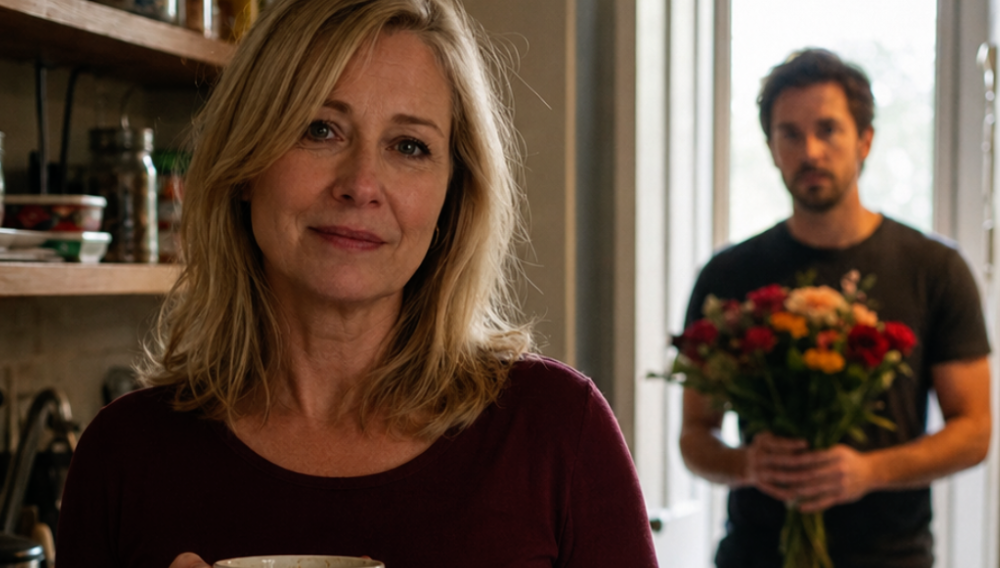
“No, Elena Sergeyevna, I am not your cook. And I am not your caregiver.”
Olga flipped the cutlets in the frying pan and sighed. The kitchen smelled of fried meat, onions, and just a little bit of disappointment. That tile by the sink had chipped back in winter, and Dmitry kept promising to find a handyman. And inside her soul, the little pot was already rattling from overheating: for the third day in a row, Elena Sergeyevna had been calling — first with “kind” advice on housekeeping, then with some new announcement:
“We’ve been thinking here, Alexey and I, Olechka… Times are difficult now. We have to rent out our apartment. And some support wouldn’t hurt you either, right? After all, I’m Dmitry’s mother, not a stranger…”
“Support is when someone comes and washes the floors, not gives orders,” Olga muttered, turning off the stove.
In her head, the picture had already formed: her mother-in-law on the sofa, Alexey shuffling around the kitchen in nothing but socks, Dmitry politely suggesting that they stay a little longer, “until things get better.” And knowing Alexey, things would never get better.
When Dmitry came home — with a half-withered little bouquet from the metro and the guilty expression of a Labrador on his face — Olga already knew this would not be an ordinary evening.
“Olya… things are really bad for Mom and Lyokha. They’re without an apartment, and they only have enough money for a couple of months. Well… could they live with us for a little while?”
“How long is ‘a little’?” Olga did not look at him, carefully placing the cutlets into a plastic container.
“Well, until they sort things out with the apartment. Mom says the tenants are there for at least three months…”
“And Alexey, excuse me, is he disabled? He can’t work? Or does he come as a package deal with your mother?”
Dmitry scratched the back of his head. It was obvious he had prepared for this conversation, but everything in his head had still turned into mush.
“Why are you starting? Lyokha is between projects right now, and Mom… well, it’s hard for her alone. You know she has blood pressure problems. She has nowhere else to go.”
“She can go to the devil for all I care!” Olga turned around, looking him straight in the eyes. “Do you know what will happen? She’ll tell me how to salt cucumbers. Alexey will sit in front of the TV and whine that life is unfair. And you’ll stand in the middle like a scarecrow in a vegetable garden, throwing up your hands.”
“That’s enough!” Dmitry suddenly threw the bouquet onto the table. “This is my family. You could at least be more humane!”
“And you could be a man,” she said quietly, turning back toward the sink.
A week later, the apartment smelled of cleaning spray, boiled eggs, and Black Pearl perfume — Elena Sergeyevna’s signature scent. Alexey had settled into the guest room, which Olga had once wanted to turn into an office. All day long, he lay around in sweatpants and played on his phone.
“Olechka, the timer on your oven doesn’t work, does it? It should be fixed. In my old apartment, everything worked like clockwork. The oven even had convection…” her mother-in-law breathed down her neck while Olga took out a casserole.
“Our oven here has no convection and no interference,” Olga answered through clenched teeth.
“Oh, come now. I only want to help. You’re still a young girl, an inexperienced housewife. Do you know how much Dmitry loved my goulash?”
Olga silently raised an eyebrow. Goulash was a code word. Just like “my apartment.” And “I only want to help.”
By Saturday morning, four pots cooked by Elena Sergeyevna had taken up residence in the refrigerator. Alexey complained of insomnia, which meant he got up at one in the afternoon and watched action movies at full volume. Dmitry left for work earlier and came home later.
And in Olga’s head, anger kept building up like an inflatable mattress — the kind that already makes you dizzy, but you keep blowing into it so you “don’t lose face.”
In the kitchen, her mother-in-law was already tugging at the tablecloth for the fourth time that morning.
“Olechka, dear. I don’t want to interfere, but you really should buy new curtains. These… well, they don’t make the place feel cozy.”
“The curtains make you uncomfortable, Elena Sergeyevna?” Olga put her spoon down on the table. “Maybe you’d like a new apartment too? Or better yet — return to your old one, and I’ll calmly get my life back.”
Dmitry appeared closer to midnight. Tired, with a wrinkled tie and the face of a man who had realized storm clouds were gathering.
“We had a fight,” Olga said.
“Who?”
“Your mother and I. Well… ‘fight’ is a strong word. I said what I had to say, and she pretended to be offended. She said that ‘women like me’ should be raised properly at school.”
“Well, you understand, she’s an elderly person, it’s hard for her…” he began.
“You know,” Olga interrupted, “it’s hard for me when my husband is incapable of protecting our home. This home. Ours. But judging by your expression, maybe it isn’t exactly ours anymore, is it?”
Dmitry sat down on a stool. He was silent. He looked at his hands.
“I just don’t want quarrels. We’re family…”
“We? Or you?” She looked at him directly, without trembling. “Because right now, I’m the only one in this family trying to keep the balance. And I’m tired of it.”
She barely slept until morning. She cleaned. Washed the bathtub. I laundered the towels. Tried to wash away her anger and resentment too, but they clung stubbornly, like grease on a kitchen stove.
The next morning, she went up to the mirror. She looked at herself — disheveled, with bags under her eyes and the stubborn smell of another woman in her home.
“That’s it, Olya. Enough,” she told herself. “Today we start differently.”
The morning began with Alexey spilling coffee on the sofa.
“Ol, you won’t believe it, it happened by itself somehow! I just reached out my hand, and then — splash!” He stood in the middle of the living room, frozen like a schoolboy with a bad grade in his diary. A stupid smile on his lips, an empty mug in his hands.
“Take a rag. Soap, water — and scrub it. This isn’t a hotel,” Olga answered shortly, walking past.
Her mother-in-law was already waiting in the kitchen — in a leopard-print robe and with a bowl of boiled oatmeal.
“Good morning, Olechka. I was thinking: it wouldn’t hurt for you and Dima to move closer to work — closer to his mother. You never know… blood pressure, headaches, Lyoshka…” she began with a smile, as if persuading Olga to take another helping of Olivier salad.
“Elena Sergeyevna, you’ve already moved in. Let’s have no new initiatives,” Olga poured herself tea and sat down at the table. “This is not a communal apartment.”
“Don’t be offended. I’m just worried, as a mother. About you too. Dmitry, by the way, complained that dinner was a bit too greasy. My stomach also doesn’t accept your cutlets. Maybe your frying pan isn’t the right kind? At my place, everything was cast iron.”
“Maybe you should go back there? Together with the cast iron?” Olga suggested calmly, without raising her voice. “And I’ll somehow survive here with aluminum.”
That evening, when Dmitry came home, Olga was waiting for him with a notebook in her hands.
“What’s that?” He took off his jacket and glanced at the neatly set table. Olga had deliberately placed glasses and a candle on the table, as if they were dining in a restaurant and not in a besieged fortress.
“This is a list. Of the ‘normal life’ you promised me when we got married.” She tapped the notebook. “First: freedom in my own home. Second: respect. Third: order. Not a single point has been met.”
“Ol, you’re exaggerating everything. Mom won’t be here forever, it’s hard for her right now… Lyokha — yes, he’s irresponsible, but he’s my own brother. How long can he possibly stay?”
“Until you grow old and start secretly carrying him money from your pension,” she said sarcastically. “And while he’s living here, there’s no place for me. In my apartment. Notice — mine. Because it was bought with my money, before the wedding.”
“What, am I supposed to get on my knees and apologize to you for my family?” There was steel in Dmitry’s voice now.
“No. Just explain: who are you in this house? The man of the house? Or your mother’s errand boy?”
He fell silent.
The whole evening passed in silence — except for the roar of the television, where Alexey was watching Cop Wars, and the clanging of pots in the kitchen, where Elena Sergeyevna was making “proper soup,” because “that borscht of yours has no soul.”
A couple of days later, an episode occurred that became the breaking point.
Olga was coming home from work, barely dragging her feet. In her bag were groceries and a utility bill. Alexey was smoking outside the entrance.
“What are you doing here? Forgot your keys?” she asked, already sensing trouble.
“Nah, Mom kicked me out. Like, go get a job, then come back. Can you imagine?”
“Uh-huh. Brilliant. After two months of living together, she figured out that her son is thirty-six and doesn’t work anywhere.”
Alexey shrugged and took a drag.
“What do I care? I’ll go to Lyokha’s, crash there for a while. You hang in there, Ol. You’re normal, even if you’re strict. But my brother — he can’t argue with Mom, you know that yourself.”
When Olga entered the apartment, the hallway was quiet. Only muffled sobs came from the kitchen. She looked in — Elena Sergeyevna was sitting on a stool, wiping her nose with a handkerchief.
“Well?” Olga asked cautiously, without irony.
“I’m old. Nobody needs me. I ruined one son. Completely failed the other. And you… you hate me, don’t you?”
Olga sighed. She sat down beside her. Not touching her — just beside her.
“I don’t hate you. I’m tired. Do you understand? You came here, and everything in this home changed. I feel like a guest. I’m not allowed to breathe the wrong way, cook the wrong thing, live outside your schedule.”
“But I wanted what was best… I thought we were family…”
“Exactly. And in a family, people respect boundaries. They don’t crawl with their feet into someone’s soul, closet, and refrigerator.”
That evening, she and Dmitry talked.
“Your mother is not a monster. But she isn’t a saint either. She interferes. Constantly. And you don’t stop her,” Olga spoke calmly, without hysteria, point by point. “And I didn’t work myself to the bone for twenty years just to share a bathroom with your family.”
“What do you want?”
“For them to leave. In a week. I’m not throwing them out onto the street. I’m giving a deadline. You decide. Them or me.”
He was silent for a long time. Then he said:
“I don’t know how it turned out this way. I thought it was temporary.”
“Everything temporary becomes permanent if it isn’t stopped.”
The week passed like a fog. Elena Sergeyevna stopped interfering — she cooked separately and did not comment on the food. Alexey spent nights at friends’ places and then somehow disappeared from the apartment on his own.
On Sunday, Dmitry got up early and sat down at the kitchen table. His passport and bank card lay in front of him.
“We’ll move out,” he said without lifting his eyes. “Mom will stay with an acquaintance. I’ll be with her. If you ever want to… well, call.”
Olga nodded. And went into the bedroom.
She did not cry. She simply washed the floors and thought about how she would live alone. Quietly. Calmly. Without other people’s voices, without the smell of another woman’s perfume, and without endless hints.
He did not knock on the door. He only left the keys on the table.
A week passed. The apartment was so quiet that at first Olga flinched at the sound of her own breathing.
Now she woke not to the smell of fried onions in the kitchen and not to the clanging of pots, but to her alarm clock. She made coffee in her favorite mug with the chipped edge — the very one Elena Sergeyevna had once “accidentally” thrown away, calling it “ugly.”
There was no fatty aspic in the refrigerator, bought “for Dmitry,” and no one commented that dinner was too spicy or that the borscht was not “like in childhood.”
“And now, Olga Yuryevna, we live like adults,” she whispered to herself, taking out laundry detergent. “And we breathe freely.”
On Saturday, for the first time in a long while, she invited a friend over. Galka — lively, thin, always with a short haircut — opened a bottle of white wine and sat down on a stool with the air of a psychoanalyst.
“So what now? Divorce?”
“For now, just silence,” Olga sighed. “He left without a scandal, he didn’t even take all his things. As if it’s a pause.”
“And what do you want?” Galya asked, looking straight at her.
Olga froze. She had no answer.
The answer came two weeks later, when a notary called her.
“Olga Yuryevna? You need to come in. It concerns an inheritance.”
“Excuse me, what inheritance?”
“An apartment. Your grandmother’s. According to the will, you are the heir.”
It turned out that her paternal grandmother — with whom Olga had barely communicated in recent years — had left her a two-room apartment in Cheryomushki. Old, run-down, but with windows overlooking a park.
When Olga went there, her heart tightened. Cracked ceilings, tea-rose-colored wallpaper, furniture from the Brezhnev era. But in the wardrobe, there was an old photo album where little Olya sat on a stool in a kerchief, holding a plush teddy bear in her hands.
On the last page was a photograph of her grandmother and a note: “So that you always know — you have your own place in this world.”
When Olga returned home, she called Dmitry.
“Hi. I… received an apartment.”
“Really?” He fell silent. “And what are you going to do?”
“I don’t know. For now, I’m fixing it up. Maybe I’ll move. I think she understood everything about me. Even when we weren’t talking.”
“Are you happy?”
“For now — I’m calm. That’s already enough. And you?”
Dmitry did not answer. He only exhaled quietly.
“Mom… Mom is planning to leave for my aunt’s in Sochi. Alexey… disappeared somewhere. I’m here… alone. And I realized that without you, everything is empty.”
“You realized that when the refrigerator stopped filling itself?”
“No, Olya. I realized it when I started drinking coffee every morning from a disposable cup. Without you.”
Three days later, he came over. He stood at the threshold with a bouquet of yellow tulips, his shoulders hunched, wearing jeans that always made him look too boyish.
“If you don’t let me in, I’ll understand,” he said. “Just let me say one last thing.”
Olga silently opened the door. He came in, looked around, and paused at the empty hook where his backpack used to hang.
“I know I was spineless. I thought that if I didn’t argue with Mom, if I waited, everything would sort itself out. But you were right: what you tolerate stays forever.”
“And?”
“I want to live differently. Without Mom behind my back. Without guilt toward everyone. Only with you. If it’s still possible.”
Olga did not answer right away. She looked at him as if he were a stranger. And then suddenly she understood: yes, he had changed. A little. But he had changed. And there was something of her merit in that.
“Are you ready… to move?”
He was surprised.
“Where?”
“To Cheryomushki. Everything there starts from scratch. No habits, no past. Just you, me… and old tile that needs to be torn off.”
He smiled. Truly smiled, without that routine guilt in his eyes.
“I’ll tear it off. And repaint the walls.”
“Then we’ll try. But don’t invite your mother. Not even as a guest.”
“I promise.”
They moved a week later. With their belongings, a new frying pan, and a couple of boxes of books. Olga no longer looked back.
And yes, her favorite chipped mug appeared in the kitchen of the new apartment. Now in a place of honor.
A symbol.