My Mother-in-Law Decided That My Husband’s Grandson from His First Marriage Would Move into My Apartment — My Response Took Only a Couple of Hours
It was Thursday, the end of April. I had just come back from a teachers’ meeting, kicked off my shoes, and gone to the kitchen to put the kettle on when someone’s key turned in the lock.
I froze.
Only Dima, Sonya, and Lyudmila Petrovna had keys. My mother-in-law usually called first — “so I don’t catch anyone off guard.” But this time she used the key straight away, without warning.
“Tanyush. I’m moving in with you.”
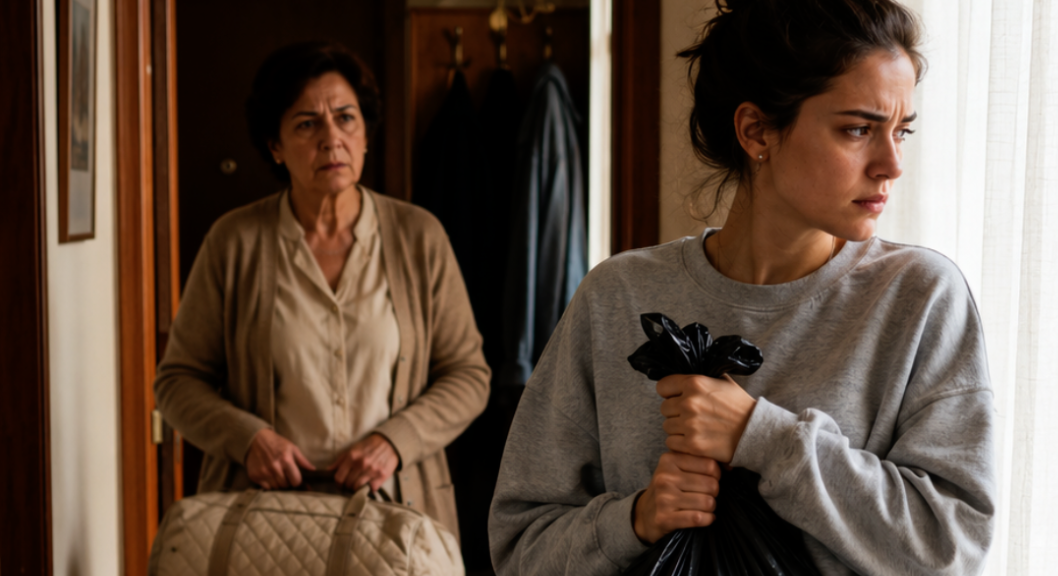
My mother-in-law stood in the doorway with a travel bag and a Magnit shopping bag. The corner of a cotton blanket stuck out of the bag — hers, the one she had been dragging around for twenty years. It smelled of mothballs and warm bread.
“What happened?”
“Artyomka has come. He has nowhere to live. I’ll give him Sonya’s apartment, and I’ll move in with you.”
I put my bunch of keys on the small cabinet. They clinked louder than usual.
“Artyom — Dima’s eldest?”
“Who else? My first grandson. The boy is twenty-four and has no roof over his head.”
Sonya came out of her room. Sixteen years old, slender, holding an algebra notebook in her hand. She heard “Sonya’s apartment” and froze in the hallway.
“Grandma. What about me?”
“Sonechka. You’re still a schoolgirl. Your father and mother provide you with a home. Artyomka has no one.”
Sonya looked at me. I looked at my mother-in-law.
“Lyudmila Petrovna. Let’s go to the kitchen.”
“Oh, I was just going to have some tea…”
“No tea. Just come.”
My mother-in-law put down her bag. She went in and sat on her usual chair by the window. I closed the door so Sonya wouldn’t hear. Our door is thin, so of course she heard anyway — but at least it created the appearance of privacy.
“That apartment is registered in my name.”
“Tanyush. There you go again with those papers. You and Dima share everything.”
“This isn’t about papers. It’s about a fact. We bought the two-room apartment on Begovaya for Sonya. All the money came from the sale of my mother’s one-room apartment in Liski and from my designated inheritance. Dima and I have a prenuptial agreement regarding that property. The title is in my name. Legally, that apartment is mine.”
My mother-in-law pursed her lips.
“And what do you suggest?”
“That Artyom went to his mother. Larisa is in Liski, she has a two-room apartment. Twenty years ago she didn’t give Artyom to you to raise, remember? She took him herself. So let her take him now too.”
“She has no conscience.”
“She has enough conscience when it comes to her own son. Twenty-four years ago she gave birth to him and didn’t abandon him. She won’t throw him out now either.”
“Tanyush. Artyomka works in Voronezh. At an Ozon pickup point. He can’t travel a hundred kilometers from Liski every day.”
“Then he can rent a place. Ozon pays around forty thousand. A room costs fifteen. It fits.”
“You’re cruel.”
“I can count. Let’s go.”
“Where?”
“To that apartment. I’ll help you pack your things.”
My mother-in-law looked at me as if I were insane.
“Pack what?”
“Your things. I’ll help you. All the furniture there is ours, bought by me, so we’ll pack only your clothes, dishes, and personal belongings. We’ll manage in a couple of hours.”
“Tanyush. I’m seventy-three years old. Where am I supposed to go? I have tenants living in my apartment on Chkalovsky!”
“I’ll handle that. Get dressed.”
Sonya peeked into the kitchen. She said evenly, like an adult:
“I’m coming with you.”
“Sonia. Do your homework.”
“I’m coming with you.”
I didn’t argue. I know that when she speaks like that, there’s no point arguing. While my mother-in-law groaned in the hallway, I quickly opened an app on my phone, found an inexpensive apartment hotel near Chkalovsky, and booked a room for thirty days. I paid with my credit card.
We waited for the taxi outside. My mother-in-law stood leaning on her bag, staring somewhere past me. Sonya held onto the sleeve of my jacket with her thin fingers, the way she had when she was little and afraid to cross the road.
In the car, my mother-in-law was silent. When we drove out onto the avenue, she began:
“Tanyush. Let’s be humane. Artyomka is family. Larisa traumatized him as a child, left him with his grandfather for the summer and didn’t come back. The boy has had it hard. Don’t you understand?”
“Is Sonya not family?”
“Sonya is family too. But Artyomka is the first. He had a difficult childhood.”
“Stop carrying that trauma around like a medal. The guy is twenty-four.”
“You have no conscience.”
Sonya squeezed my sleeve tighter.
We arrived. Went up to the fifth floor. I opened the door with my key. The two-room apartment smelled of my mother-in-law’s perfume, Climat — she gets it somewhere from a “second-hand perfumes” shop. The light was on in the kitchen. She must have run out without turning it off.
“Sonia, get the plaid duffel bags from the mezzanine. And the 120-liter construction bags — they’re in the storage closet.”
My mother-in-law stood in the doorway.
“First: clothes from the wardrobe. Second: kitchenware — I’ll separate yours from mine. Third: the bathroom.”
I was looking for another bag in the middle drawer of the dresser when I came across a blue photo album. I opened it automatically.
Artyom in first grade, wearing a uniform and holding a bouquet, with his mother Larisa beside him. Artyom on a bicycle, around ten years old. Artyom with his grandfather — my father-in-law. Artyom at graduation, nineteen, in a blue jacket, with Lyudmila Petrovna hugging his shoulders and looking at him as if he were an icon.
There were sixty pages in the album. I flipped through them. Artyom at the seaside, Artyom with a dog, Artyom in a café.
Not a single photo of Sonya.
Sonya looked over my shoulder.
“Mom.”
“Don’t look.”
But she had already seen. She said nothing. She closed the album herself. Put it back in the drawer. Put a bag on top of it. Just like I would have done.
And I remembered the summer of 2018. We had just bought that two-room apartment; renovation hadn’t even started yet. Bare walls, plastic sheeting on the floor. Dima, Sonya, and I — she was eight then — came with a tape measure to order curtains. My mother-in-law came right after us. She walked around the apartment and said:
“Dim. Why did you make a prenuptial agreement? You have a son too. Artyomka — he’ll be eighteen in two years. Let him be included in the title. This is his apartment too.”
Dima answered quickly:
“Mom, stay out of it. Tanya bought this apartment with money from her mother.”
“I’m not interfering. I’m speaking as a mother. You’re one family. Artyomka will also need somewhere to live one day. A man needs his own corner.”
Back then, I said quietly:
“Lyudmila Petrovna. This apartment is Sonya’s. Sonya is my daughter. Artyom is also Dima’s child, but he is not mine. That’s a big difference.”
Dima took his mother by the elbow and led her into the kitchen. My mother-in-law came out twenty minutes later with pursed lips. She said to Sonya:
“Sonechka, come to me.”
Sonya lifted her head from the floor.
“Grandma. I don’t want to. You said this apartment isn’t mine.”
My mother-in-law looked at me. Her eyes became small, like buttons.
“You turned her against me,” she said quietly.
Six months later, she moved into that apartment. By verbal agreement — until Sonya turned eighteen. Dima insisted: “Mom has a hard time living alone, we’ll rent out her one-room apartment and she’ll have extra money for her pension.” I agreed. I thought: five years, then she’ll move out.
Eight years passed.
Sonya is almost seventeen.
And now this.
While we packed things into duffel bags, I called Dima. I heard his breathing — he was at work, in the workshop.
“Dim. Your mother came to our place two hours ago. She said she was moving in with us and settling Artyom in Sonya’s apartment. I’m with her in Begovaya. I’m packing her things.”
Silence.
“Tanya, wait, don’t act rashly! Have you lost your mind? Where will she go? She has tenants in her place in Chkalovsky!”
“I rented her a studio room in an apartment hotel near her building. For thirty days. Paid with my card. During this month, her tenants will move out. I’ll give them notice today.”
“Tanya… damn. Give me half an hour, I’ll come now.”
“No need to come. I’ll handle everything myself. Do you agree or not?”
I counted silently: one, two, three, four, five.
“Tanya. Do what you think is right. I really didn’t know about Artyom.”
“I know.”
Twenty minutes later, it wasn’t Dima who called. It was Artyom.
“Aunt Tanya. This is Artyom. Grandma just called me, crying. She’s shouting that you’re throwing her out onto the street. I… I didn’t know you were against it. She said everything had been agreed. That I could move in.”
His voice was confused. He was a decent guy; we had seen him recently at a relative’s wedding.
“Nothing was agreed, Artyom. No one discussed it with me.”
“Aunt Tanya. I won’t come. I called my mom. I’ll rent a room in Voronezh, and for now I’ll go to her in Liski and manage somehow. I’m sorry. I really didn’t know.”
“I believe you. This isn’t on you.”
He hung up. It wasn’t his fault that his grandmother had used him as a battering ram.
Two hours later, six huge bags and three duffel bags filled with clothes and dishes stood on the floor.
“Lyudmila Petrovna. I ordered a cargo taxi. We’re going to your place on Chkalovsky.”
“And the keys to Begovaya?”
“Leave them in the cabinet.”
My mother-in-law looked at me with red eyes.
“You have no conscience.”
“Possibly.”
We were carrying the duffel bags out to the stairwell when Zinaida Mikhailovna, the neighbor with the dachshund who always fed my mother-in-law pies, came out of the apartment across the hall.
“Tatyana! What are you doing? Are you throwing your mother out?”
“Not my mother. My mother-in-law. And I’m not throwing her out; I’m helping her move.”
“Oh, monsters. God will punish you, Tatyana. An old woman — out onto the street! What kind of people are you?”
I stopped with the bag in my hands.
“Zinaida Mikhailovna. The apartment is mine. My mother-in-law lived here for eight years for free while renting out her own apartment. The lease is over. All the best.”
The neighbor waved her hand.
“Just don’t cry later when your mother dies from all the stress you caused.”
Sonya said loudly and clearly:
“She is not her mother.”
Zinaida Mikhailovna stopped short. Then she closed the door.
At Chkalovsky, the tenants — a young couple — didn’t open the door right away. I explained the situation: force majeure, the owner was returning.
“Under the contract, you have thirty days to move out. Here is the written notice. Live through the paid month calmly and look for other options.”
The girl looked confused but nodded. My mother-in-law stood behind my shoulder.
“And where am I supposed to go for this month? To the train station?” she asked sarcastically.
“To the Tourist apartment hotel, two stops from here. I’ve paid for everything. Tomorrow I’ll help you move the bags there from the entrance.”
She silently pulled the bunch of keys to the Begovaya apartment out of her pocket. Put it in my palm. The keys were warm.
Dima hadn’t come home yet when we returned. Sonya said:
“Mom. Let’s go have dinner somewhere. I don’t feel like cooking.”
We walked to Shokoladnitsa. Ordered pancakes and tea. It was drizzling outside.
Sonya was silent for a long time. Then she said:
“Mom. Can I paint the walls in my future room not white, but turquoise? Like the sea.”
“You can.”
“Mom. Did you know Grandma never loved us?”
“Sonia.”
“I knew. When I was eight, she had just moved into that apartment. She came to my birthday and gave me a wrapped package — a gray mohair sweater. I went up to hug her. And she said into my shoulder, ‘I knitted the same one for Artyomka, only blue. The yarn suited Artyomka better. Your shoulders are narrow, this will do for you.’ I didn’t understand everything then, but I remembered the tone.”
I looked at my daughter. Her serious face, her gray-green eyes — Dima’s eyes.
“Sonia. Why didn’t you tell me?”
“You already had enough trouble. Paying the mortgage, putting up with Grandma. Why add more?”
I took her hand.
“Sonia. Forgive me. For the eight years I tolerated it.”
“Mom. Today you didn’t stay silent.”
When we came home, Dima was sitting in the kitchen, eating dumplings. He looked up.
“Sonya, go finish your homework.”
Sonya left. Dima put down his fork.
“Tanya. I told her on the phone: I won’t let her back into Begovaya. And she shouldn’t drag Artyom into this. Forgive me. I knew Mom would start pressuring us eventually, but I hoped it would pass.”
“It didn’t.”
He nodded. Washed his plate and went to check Sonya’s homework.
I sat alone in the kitchen, looking at my hands. They weren’t shaking.
Tomorrow I’ll take the mohair sweater I found today on the mezzanine, in a bag at the very back, to the charity collection box.
Gray, scratchy color — not ours.
Did I do the right thing by packing her up in a couple of hours, without giving her a day to “think it over,” without offering a compromise? Should I have let Artyom move in “temporarily” — for six months, for a year? Or should I have endured it all for the sake of “a bad peace”?
We will have turquoise paint. And gray-blue. We will have any colors Sonya chooses.
Twenty years ago, no one asked me what color my walls should be.
Today, my daughter asks me, and I ask her.
And that was worth one sharp turn of a key in the lock.