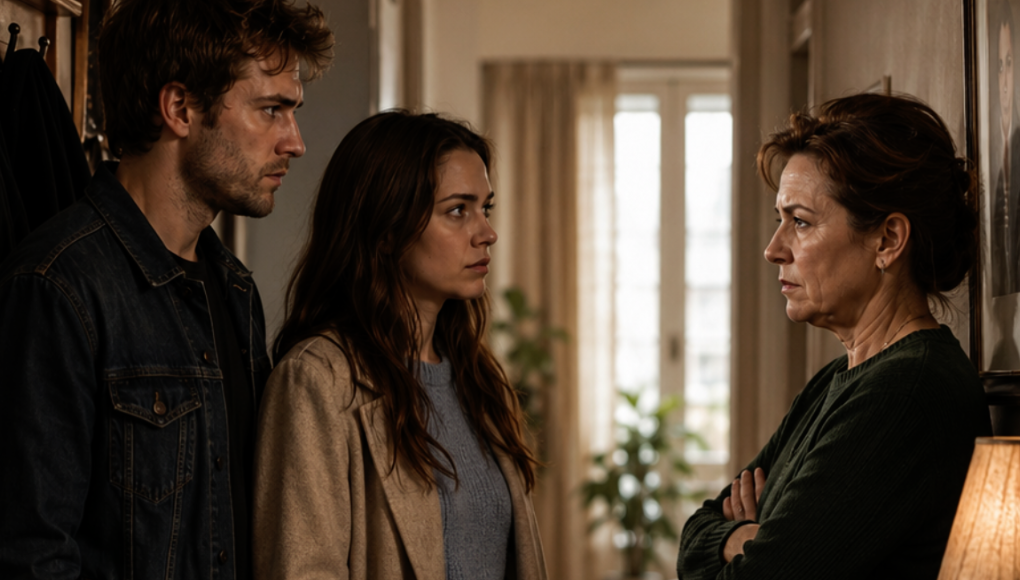
“We’re Going to Live With You,” My Son Announced from the Doorway, Not Suspecting What His Insolence Would Cost Him 14 Days Later
“So, you’re going to cook dinner now?” My son’s girlfriend placed a box of sushi on my kitchen table and smiled as if she were sharing wonderful news with me.
At first, I didn’t even realize the question was meant for me.
It was Friday, the end of November. A fine drizzle was falling outside, and I had just returned from school, where for the second month in a row I was covering two positions at once.
By day I worked as deputy principal for academic affairs; in the evenings I checked class registers, dealt with parents’ complaints, and dreamed of only one thing: taking off my shoes, drinking hot tea, and sitting in silence for at least half an hour.
But there was no silence left in my two-room apartment.
My son, Artyom, opened the door with his key and came in not alone. Behind him, a long-legged girl with snow-white manicured nails, large curls, and two wheeled suitcases floated into the hallway. Behind her rolled a round pink case with the handle of a ring light sticking out of it.
“Mom, meet Vlada,” Artyom said cheerfully, without even thinking to pause. “We decided to live together. She’s having problems with her rental place; the landlady raised the price, and, well… she’s moving in with us.”
Not “May we?” Not “What do you think?” Not “Let’s discuss it.” He simply presented me with a fact.
I silently looked at the suitcases, then at my son.
Artyom had recently turned twenty-six. He worked at a phone repair service center and earned decent money, though not consistently.
One month he brought home a bonus, the next he complained that “business had slowed down.” I didn’t take money from him for food or utilities.
I kept hoping he would save up for a down payment and move on into his own life without resentment.
As it turned out, the only thing he had saved up was the confidence that I would be happy to live with him and his little girlfriend.
“Nice to meet you,” I said evenly. “Could you have warned me in advance?”
Vlada looked at Artyom with faint mockery.
“Oh, I told you she wouldn’t like the surprise.”
“This isn’t a surprise. It’s a move,” I replied. “Things like this are usually discussed.”
My son winced, as if I had ruined a beautiful picture for him.
“Mom, don’t start. We’re all adults here. Vlada didn’t come to the train station. We’ll live here for now. There’s enough space.”
“For now,” translated from adult-child language, usually means “until Mother gets used to it and stops objecting.”
I didn’t make a scene. At my age and with my job, scandals are a luxury. I simply nodded, helped them clear one shelf in my son’s wardrobe, and went to the kitchen.
At dinner, everything fell into place.
Vlada sat down beside me, carefully spread a napkin on her lap, and looked into the pot of buckwheat and stewed chicken as if there were something inside that personally insulted her.
“I don’t eat that,” she announced.
“What do you mean, ‘that’?” I asked.
“Well… that kind of heavy food. I eat clean. No fried food, no sauces, preferably no gluten. And I don’t tolerate dairy either.”
Artyom immediately joined in:
“Mom, since we’re all living together now, we need to adjust somehow. Vlada will be home during the day. She’s in an important phase right now.”
“What phase exactly?” I put down my fork.
“I’m launching a blog about femininity and style,” Vlada explained softly. “And I also want to create a course on self-presentation. It requires resources. That’s why I try not to get distracted by household chores.”
“I see,” I said. “And what does that have to do with me?”
My son said it with complete confidence in his own correctness:
“Well, you cook anyway. Now you’ll just cook for three. And preferably something lighter. Fish, turkey, salads and stuff, without mayonnaise or sauces. Vlada needs to watch her figure.”
I looked at him as if I were seeing him for the first time.
“Artyom, are you serious right now?”
“What’s the big deal?” he asked, sincerely surprised. “You’re the woman of the house. You’ve got everything set up. It’ll be easier for us to adjust to you if you just cook for everyone at once.”
“Not ‘easier for us,’ but ‘more convenient for you,’” I said quietly. “And no. I am not obliged to be a free cook for any adults. If you want to live here, you live by normal rules. Everyone cleans up after themselves. We buy groceries separately or agree in advance. I cook when I want and what I want. I don’t take custom menu orders.”
Vlada pursed her lips.
“Elena Andreevna, you’re being so harsh right away…”
“This is still me being very gentle,” I replied. “Harsh would have been not letting you through the door at all.”
My son was offended, but stayed silent. Even then, I felt that this was only the beginning.
And I was not mistaken.
For the first two days, Vlada behaved cautiously. She walked around the apartment on tiptoe, smiled, and called me “Elena Andreevna” with so much sugar in her voice that it made my teeth ache. On the third day, she stopped pretending.
My hair dryer disappeared from the bathroom and was found in her room by the mirror. Then my new facial serum vanished. Then I couldn’t find the container of baked fish in the refrigerator, which I had prepared for myself for two dinners.
“Artyom, have you seen my container?” I asked that evening.
My son looked up from his phone.
“Oh, that? We ate it. Vlada thought it was shared.”
“Shared means something we agreed on in advance.”
Vlada wasn’t even embarrassed.
“It looked so appetizing, I thought it was okay. I’m almost family now.”
In three days, “almost family” managed to rearrange the jars in the kitchen, spread her face masks across my bathroom shelf, and explain to my son that his mother was “too tense a woman.”
After a week, they had fully settled in.
In the evenings, Vlada filmed videos with her ring light right in the living room because “the lighting is best there.” I would come home from work, and my room already had a tripod, a reflector, and an open makeup bag the size of a paramedic’s case in it.
“This is my room, and I want to rest,” I said once.
“It won’t take long,” she waved me off. “I have a twenty-minute livestream. I’ll put everything away afterward.”
She didn’t.
Two days later, I came home and saw two of her friends on the sofa.
There were plastic cups of coffee, a box of pastries, and delivery wrappers on the coffee table. The girls were loudly discussing men, money, and the “old energy of apartments” that interferes with personal growth.
I stopped in the doorway.
“Good evening. Did anyone want to warn me that there’s a salon operating in my home?”
One of the friends looked at me with a bored expression. Vlada stood up and smiled condescendingly.
“Elena Andreevna, don’t worry, we’re just finishing up. The girls only stopped by for half an hour.”
I looked at the clock.
“It’s nearly nine in the evening. I get up at six. Half an hour ended a long time ago. The girls are leaving now.”
Vlada turned red.
“You’re constantly putting me in an awkward position.”
“No, Vlada. You’re the one behaving as if someone else’s home is a hotel with no rules.”
Her friends retreated quickly. And my son burst into the kitchen a minute later.
“Mom, why did you humiliate her in front of people?”
“And why did she bring people into my apartment without asking?”
“Why do you keep saying ‘my apartment, my apartment’! We’re not strangers!”
At that, something unpleasant trembled inside me.
Not “You’re tired.” Not “Sorry, we went too far.” Not “Let’s come to an agreement.” No. Just one thing: stop reminding us that you have boundaries.
The next day, something happened after which I stopped having doubts.
I took half a day off at my own expense because I needed to go to the education department and pick up some documents. I finished earlier than expected and returned home around two. I opened the door quietly. Voices were coming from the kitchen.
Apparently, Artyom had dropped by for lunch, and Vlada was sharing her plans with him.
“No, it’s impossible to live like this,” she was saying. “Your mother has everything under control, like in a barracks. It’s hard for me to breathe.”
“Just put up with it a little,” my son answered tiredly. “Money’s tight right now. I can’t rent us a proper apartment tomorrow.”
“Why rent?” Vlada’s voice took on a businesslike dryness. “You need to think strategically. This apartment will be yours eventually anyway. You’re her only son.”
I froze in the hallway.
“Vlada, don’t start,” Artyom muttered.
“What am I saying wrong?” she snapped. “Your mom is alone. She’d be better off outside the city anyway. Fresh air, quiet. She has that house in Zavidovo, doesn’t she? A normal one, with heating. Let her live there. We need the city more. We’re young.”
“She won’t agree.”
“She will if you present it properly. Put pressure on her pity. Say we’re cramped, that you want a family, a child. Then gradually lead her to the idea that it would be better to transfer the apartment to you in advance. So everything is calm and without unnecessary formalities. You’re her son, not some stranger from the street.”
I leaned against the wall. Life hadn’t told me anything new.
I had worked for many years with teenagers and their parents. I had seen how people justify the most ordinary greed with beautiful words. But it’s one thing to read it in explanations and official reports. It is quite another to hear silence instead of outrage from your own child.
Artyom was silent.
That meant he was thinking it over.
“All right,” he finally said. “I’ll try to talk to her this weekend.”
At that moment, something inside me cracked. Love for a child doesn’t switch off, unfortunately. But the pity that had kept me from seeing the obvious for years switched off completely.
I quietly left the apartment, closed the door again, and went downstairs.
The rain had already stopped. The air was damp and cold. I sat in my car for about ten minutes, just staring at the courtyard. Then I started the engine and drove to a home improvement hypermarket.
The plan formed immediately. Cold, simple, and very educational.
I really did have a house in Zavidovo. Not a collapsing dacha, but a small warm house inherited from my parents. I went there in the summer and on long weekends.
It had everything a person needed for life and silence. And if my son and his chosen one dreamed so much of getting rid of me, well, I decided to help them grow up to the fullest extent.
On Friday, they left for some “city festival.” I knew this because Vlada had been chattering about her photo outfit for two days straight.
At eleven in the morning, a moving crew’s truck pulled into the yard.
I didn’t put on a circus show or clear out half the apartment. I took only what truly belonged to my comfort and my care, the very things they had used so disdainfully.
From the kitchen, I took the coffee machine, multicooker, microwave, good electric kettle, set of frying pans, my favorite knife block, and almost all the food supplies.
From the bathroom disappeared the quality hair dryer, household chemicals, my towels, and all my cosmetics. From the living room I took the television, the router, and the cordless vacuum. From the storage room I took the drying rack, steam generator, and a box of bed linens.
I left everything basic and necessary for life: the stove, refrigerator, old stovetop kettle, dishes, one set of bed linens for my son, the sofa, wardrobe, table, and chairs. Living beautifully and conveniently at my expense was no longer an option.
I left a note on the table.
“Artyom, Vlada. Since you consider yourselves an adult couple, it is time for you to live independently. I have gone to Zavidovo for two weeks. The apartment is at your disposal. I have taken with me the groceries and things I bought. You are responsible for this month’s utility bills and cleaning up after yourselves. I will return in two weeks.”
The phone rang four hours later.
“Mom, what was that?” Artyom’s voice was breaking. “We don’t have a TV, we don’t have internet. Vlada wanted to heat up food, and there’s no microwave. Why did you do this?”
“I didn’t do anything,” I answered calmly, already sitting on the veranda in Zavidovo. “I simply stopped serving you.”
“This isn’t normal!”
“What isn’t normal is discussing how to evict me from my own apartment for your convenience.”
There was a pause on the other end.
“Were you eavesdropping or something?”
“I happened to hear it and drew conclusions.”
Vlada’s voice cut into the receiver:
“Elena Andreevna, this is childish! You’re taking revenge! Normal mothers don’t act like this!”
“Normal adult girls don’t plan where to relocate their boyfriend’s mother without even asking her consent.”
“We were just discussing options!”
“Now you have a wonderful option: to live independently in the conditions you create for yourselves.”
I hung up.
For the first three days, they held up bravely.
My son sent dry messages: “When are you bringing back the router?” “Where is the laundry detergent?” “Can I order water with your card? I’ll pay you back later.” I didn’t answer.
On the fourth day, he called without irritation.
“Mom, we’re out of money. We spent way too much on delivery. Vlada says it’s impossible to cook at home because there are no normal frying pans.”
“Then it’s time to buy your own,” I replied.
“I have a week until payday.”
“Then plan your budget, Artyom. It’s a useful skill for a man who was preparing to decide the fate of someone else’s apartment.”
He got offended and hung up.
On the eighth day, my neighbor Lyudmila Pavlovna called. We had been friends for many years, and she always knew more than any concierge.
“Lenochka, you’ve got quite a show going on over there,” she reported with obvious pleasure. “Your beauty caused a scandal at the store checkout yesterday over the price of avocados. And this morning I saw your Artyom with a bucket. Looks like he was mopping the floors himself. His face looked as if he were scrubbing barracks.”
For the first time in a week, I truly laughed.
But the amusement didn’t last long. On the eleventh day, they came to see me.
I was just raking dry leaves near the apple tree when a taxi pulled up to the gate. My son and Vlada got out. Neither of them looked good.
Artyom had grown gaunt, shadows under his eyes. Vlada was without her usual polish: her hair was tied up messily, there was a stain on her jacket, and in her hand she held a crumpled paper cup from a cheap coffee shop.
I opened the gate but did not invite them inside.
“Why have you come?”
Vlada stepped ahead of my son.
“To talk. Because it’s impossible to live like this. Your apartment is empty, dirty, and completely uncomfortable. Artyom works, and I’m under constant stress too. We’re always fighting because of you.”
“Not because of me,” I said. “Because neither of you knows how to live independently.”
“You deliberately want to break us up,” she hissed.
“No. I simply don’t want to be free household staff.”
My son lifted a heavy gaze to me.
“Mom, maybe that’s enough? You punished us. We understood.”
“What exactly did you understand?”
He fell silent.
Vlada answered for him:
“That you’re a woman with character. But this isn’t right. You were supposed to help Artyom arrange his personal life.”
“I have been helping him for twenty-six years,” I replied. “Feeding him, giving him a roof over his head, handling household matters so he could get on his feet. But supporting an adult son is one thing. Allowing him, together with a person who is a stranger to me, to push me out of my own life is something else entirely.”
Vlada smirked.
“A stranger? I’m his woman, actually.”
“That is your status to him, not to me.”
She turned pale with anger.
“You know what, Artyom? I’m not going to tolerate this anymore. I told you from the start that your mother was abnormal. But this much… You promised you’d be able to persuade her. You promised she would eventually give in. And what? You couldn’t even force the router back out of her!”
My son flinched.
“Vlada, stop.”
“No, I won’t stop! I’m not going to live humiliating myself in front of her! You have no apartment, no savings, no backbone! Just talk. Is that why I left for you?”
I watched them and understood that exactly what needed to happen was happening. As soon as someone else’s support disappeared, the “love boat crashed against everyday life.”
“You said we were a team,” Artyom said hoarsely.
“A team?” Vlada almost laughed. “A team is when a man solves problems. And you couldn’t even pull your mother over to your side. What’s next? Are we going to hunt for chicken discounts and take turns mopping the floors?”
She turned to me.
“Congratulations. You got what you wanted!”
“No, Vlada,” I answered calmly. “I simply stopped preventing you from seeing each other without my service and my help.”
She spun around sharply and walked back to the taxi.
My son remained standing on the path. For the first time in a long while, he didn’t look like an offended boy, but like a confused man whose life had shoved his face into the consequences of his own decisions.
“Mom…” he began.
“Not now, Artyom. Right now, you’d better go home and think. Alone.”
He left silently.
I returned to the city three days later.
The apartment greeted me with the smell of stale air, dirty dishes in the sink, and so much clothing on the chairs that it seemed not a couple had lived there, but an entire touring theater troupe.
Vlada had already taken her things. Artyom had left two backpacks and a box of tools.
On the kitchen table lay a note in his handwriting.
“I rented a room from a colleague. The keys are on the nightstand. Forgive me. I think I’ve only just now understood how much was held together by you.”
I sat down on a chair and looked out the window for a long time.
I felt neither amused nor joyful.
Victory over your own child is a questionable feeling. But I felt calm. A mother’s love is not a soft pillow under the head of an adult son, but a solid floor on which he must learn to stand with his own feet.
A week later, Artyom came by himself. Without Vlada. With a grocery bag.
“May I?”
I silently stepped aside from the door.
In the kitchen, he placed fruit, tea, and a box of my favorite oatmeal cookies on the table.
“I didn’t know what to bring. Before, I never even noticed what you liked,” he said, then gave a bitter smile. “Funny, isn’t it?”
“Not funny,” I replied. “Sad.”
He nodded.
“I thought that because you’re my mother, you would always understand, always move over, always cook, clean, and forgive. And when you left, it felt as if the support under me had been knocked away. For the first time, I understood how much you carried on yourself. And how convenient it was for me to use that.”
I listened silently.
“Vlada left the same day,” he continued. “She said she wasn’t ready to build a life ‘in economy mode.’ At first I was angry with you. Then I realized it wasn’t about you.”
“And now?”
“I’m working more. I rented a cheap room for now. I pay for it myself. I cook for myself, if you can call it that. I even iron my own shirts. Turns out it isn’t fatal.”
“A useful discovery.”
For the first time during the conversation, he smiled.
“Mom, I’m not asking to come back. Honestly. I want things to be different. Just… can I visit sometimes?”
That was when my eyes began to sting.
“You can, Artyom. But only as an adult son. One who remembers that his mother has not only a heart, but personal boundaries too.”
“I’ll remember,” he said quietly.
Almost a year has passed.
At first, Artyom rented a room, then a one-room apartment closer to work. He learned to count money, go grocery shopping with a list, and stop expecting someone to magically fill the refrigerator.
He started coming over on Sundays, not empty-handed, but with cake, fruit, or simply a bag of groceries. Sometimes he fixed shelves in my home, sometimes he changed a faucet, sometimes he simply sat in the kitchen and told me about work.
Our relationship became honest.
And I understood one more thing. It is very frightening to admit that your adult child loves not you, but the convenience of being near you. But it is even more frightening to pretend nothing is happening just so you don’t become a “bad mother.”
A bad mother is not the one who sets boundaries in time. A bad mother is the one who raises her son into a consumer incapable of respecting another person’s labor.
Sometimes an empty refrigerator teaches better than the most proper conversations.
What do you think: where is the line between motherly help and voluntarily turning yourself into service staff for adult children?