“I’m Not Giving This Apartment to Anyone, Come What May,” I Answered My Mother-in-Law Directly at the Notary’s Office for the First Time
“Sign here, Valentina Petrovna,” the notary said, sliding the sheet toward me. “A deed of gift is drawn up only of your own free will, so I’m asking you once again: are you absolutely sure you agree?”
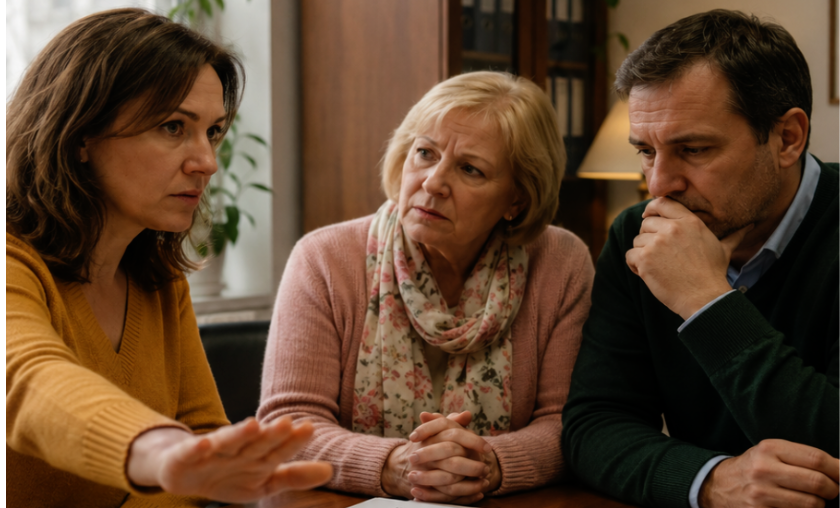
My mother-in-law immediately leaned over the table toward me, as if she were afraid I might manage to read one line too many. Her handbag stood by the leg of the chair, her phone lay on the edge of the table, and she had advised me not to take out my glasses back in the hallway.
“She agrees, she agrees,” Nina Vasilyevna said. “She’s just nervous, sitting there like a schoolgirl during an exam.”
“Mom is right,” Igor added quietly, touching my elbow. “We discussed everything at home, Valya. Don’t make people wait.”
I looked at the pen near my hand and at the sheet where my apartment already seemed to be waiting for someone else’s name. That is how people give away their home: not loudly, not all at once, but under someone else’s breath over their shoulder.
“No,” I said, pushing the paper away. “I’m not giving this apartment to anyone, come what may.”
The notary raised her eyes, and Igor froze with his hand on the table. Nina Vasilyevna did not even immediately understand that I had answered her.
“What do you mean, you’re not going to?” she asked. “Are you in your right mind, Valentina?”
“I am,” I answered. “That is exactly why I’m not signing.”
“We came to the notary,” my mother-in-law said, tapping her fingernail on the table. “People set aside their time, the documents were prepared, I paid for the taxi.”
“The taxi cost seven hundred and eighty rubles,” I said. “The apartment is not worth the same as a taxi.”
Igor coughed awkwardly and looked at the notary, as though asking her not to listen to us too closely. But the notary sat calmly and no longer pushed the pen toward me.
“Valya, let’s not use harsh words,” Igor said. “Mom isn’t asking for herself. You understand that.”
“Then for whom? For order, as she says?” I asked.
Nina Vasilyevna immediately straightened up, as if I had finally said the word she needed.
“Exactly, for order,” she said quickly. “I’m sixty-nine years old. I’ve lived my life, and I know how things should be done.”
“The apartment must be registered in my name,” my mother-in-law continued. “And then I will distribute everything myself.”
“You are going to distribute my home?” I asked. “And you call that order?”
“Not your home, family property,” she replied. “You are my son’s wife, which means you are obligated to think about the family.”
“I am thinking about the family,” I said. “That is exactly why I’m not giving away the apartment.”
The notary closed the folder and moved it slightly away from the edge of the table. She did not raise her voice, but after that movement, it became clear to everyone that there would be no signature today.
“Valentina Petrovna, if you do not have a firm desire to sign the agreement, the document cannot be executed,” she said. “A deed of gift cannot be made under pressure.”
“She does have the desire,” my mother-in-law said quickly. “She just got confused because she has always been afraid of paperwork.”
“No,” I answered. “I have no desire, and I am not confused.”
Igor leaned closer to me. He tried to speak gently, but his fingers nervously picked at the edge of the folder.
“Valya, why are you doing this?” he asked. “We said this was temporary.”
“There is no word ‘temporary’ in the agreement,” I said. “It says that I transfer the apartment to your mother free of charge.”
“That is a standard form,” Nina Vasilyevna interrupted. “Don’t cling to words if you don’t understand these things.”
“I understand the word ‘gift,’” I replied. “It means that what is mine stops being mine.”
My mother-in-law pressed her lips together and adjusted the light scarf over her shoulders. She always wore that scarf when she wanted to look especially decent and calm in front of strangers.
“Do you understand what you’re doing right now?” she asked. “You are turning my son against his mother.”
“No,” I said. “I am putting my signature where it belongs.”
“Not in front of outsiders,” Igor said. “Let’s go out into the corridor and talk.”
“No,” I answered. “In the corridor, the two of you will start persuading me again.”
“We’re not persuading you, we’re explaining,” Nina Vasilyevna said. “You’re not a young girl. You’re fifty-one. It’s time to think ahead.”
“I am thinking ahead,” I said. “That is why I’m reading what I sign.”
“There’s nothing to read there,” she snapped. “Normal people in a family trust each other.”
“Normal people don’t bring the owner to a notary with an agreement she has never seen,” I replied. “And they don’t call a gift deed protection.”
The apartment was mine. Not Igor’s, not my mother-in-law’s, not family property in words, but mine according to the documents, payments, and every thousand rubles I had set aside.
I bought it nine years ago, when I sold my old room and added my savings. The down payment was one million six hundred thousand rubles, and after that I paid for it myself while Igor changed jobs and said that everything would soon get better.
Nina Vasilyevna was not happy for me then. She said over the phone that she did not understand why a woman would register housing only in her own name.
“A family should be one united fist,” she used to say. “But you, Valya, immediately created a separate palm for yourself.”
Back then I kept silent. It seemed easier to stay quiet than to argue with someone who heard only herself anyway.
Then my mother-in-law began coming over more often. She looked at the cabinets, at the bills near the mirror, at my folders with papers, and sighed every time.
“There is no order in your home,” she would say. “Everything is in your name, while my son is treated as if he were a guest.”
“He is a husband, not a guest,” I answered. “No one is driving him out of here.”
“A man must have support,” she repeated. “But you keep the apartment in your fist and think that is right.”
At first, Igor kept silent. Then he began repeating her words, only more quietly and with more resentment.
“Mom is worried,” he said, taking off his shoes in the hallway. “She would feel calmer if the housing were registered to the older person.”
“And I feel calmer when what is mine remains mine,” I replied. “That is not against the family. That is for me.”
“It’s like you don’t trust us,” he said. “It hurts to hear that.”
“And it hurts me that I’m being prepared for a signature as if I were an object attached to the apartment,” I replied. “And every time, you still speak with your mother’s words.”
He would go into the kitchen and rattle a cup for a long time. Two days later, Nina Vasilyevna would call again and ask whether my passport was ready for the notary.
“We’re only going for a consultation,” she said. “We’ll listen to what the specialist says. There’s nothing frightening about it.”
“Then why do we need a draft agreement?” I asked. “And why do you talk about it as if everything has already been decided?”
“A notary doesn’t talk without a draft,” she replied. “Don’t complicate things, Valya. We’re doing everything for your own peace of mind.”
I went not because I intended to give away the apartment. I went because I wanted to see how far they had already gone with the paperwork without me.
And now that paper was lying on the table. There was not one word in it about temporary arrangements, not one word about peace of mind, not one word about the apartment ever returning to me.
It was written simply and dryly: I was transferring the apartment to Nina Vasilyevna. And she accepted that gift.
“Valentina Petrovna, did you see the draft agreement before today’s meeting?” the notary asked. “Was it shown to you in advance?”
“No,” I answered. “It was not shown to me.”
The notary looked at Igor. He lowered his eyes, and that was almost a confession.
“Who provided the information for the draft?” she asked. “The owner must understand exactly what is being prepared.”
“I handled it,” my mother-in-law said. “Because my head is on straight, and Valya is always afraid of papers.”
“I’m not afraid of papers,” I replied. “I’m afraid of people who call someone else’s signature family order.”
“Oh, stop clinging to words,” Nina Vasilyevna said irritably. “Everyone does this.”
“Who is everyone?” I asked. “Those who find it convenient to take someone else’s home without an argument?”
Igor rose from his chair. He clearly wanted to stop the conversation before the truth became too plain.
“Valya, please don’t talk like that in front of outsiders,” he said. “We wanted what was best.”
“Best for whom?” I asked. “For me, who loses the apartment, or for you, who get leverage?”
He did not answer. Nina Vasilyevna answered for him, no longer hiding her irritation.
“For my son, of course,” she said. “He is the man of the house, yet he lives in his wife’s apartment.”
“So it isn’t about protection?” I asked. “It is about the fact that the apartment is registered in my name?”
“A man must have support,” she said. “And a wife must not humiliate him with her separateness.”
“Let him buy his own support,” I replied. “My apartment is not suitable for that.”
Igor turned sharply toward me. There was not only hurt in his face, but also fear that I was now speaking past the point of no return.
“You just humiliated me in front of everyone,” he said. “I have lived in this apartment for nine years.”
“You have,” I said. “But that does not make my signature yours.”
“I bought groceries, helped around the house, did repairs,” he said. “Don’t make me look like a stranger.”
“I’m not making you a stranger,” I answered. “I am not allowing your mother to become the owner of my apartment.”
Nina Vasilyevna flared up. She leaned forward, but the notary calmly raised her hand.
“Please, no pressure,” she said. “I will record the refusal if Valentina Petrovna confirms that she does not wish to sign the agreement.”
“I confirm it,” I said. “I refuse to execute the deed of gift.”
“Don’t you dare,” my mother-in-law said sharply. “You are destroying trust in the family.”
“You destroyed trust when you prepared an agreement without letting me read it,” I replied. “I only refused to sign it.”
The notary took out a register and a blank sheet. My mother-in-law jumped up so abruptly that the handbag at her feet swayed and fell onto its side.
“You have no right to ruin our transaction,” she said. “We came here to formalize it, not to listen to her whims.”
“There is no transaction,” the notary answered. “A deed of gift cannot be executed without voluntary consent.”
“She is simply under the influence of fear,” Nina Vasilyevna said. “At home she was normal.”
“Under whose influence?” I asked. “Mine or yours?”
My mother-in-law stopped short. Igor sat back down and rubbed his forehead, as if only now realizing how our arrival looked from the outside.
“Valya, don’t make them put that note down,” he said. “We’ll leave, talk, and decide everything calmly.”
“No,” I answered. “I will go home with confirmation that I refused to sign the agreement.”
“You don’t trust us,” he said.
“After today, no,” I said. “And this did not happen suddenly, Igor.”
Nina Vasilyevna took a small envelope out of her bag. She placed it on the table as if presenting proof that she was right.
“Here is the receipt,” she said. “I paid three thousand five hundred rubles for the preparation.”
“I’ll pay it back,” I said. “And I’ll pay back the taxi too.”
She clearly had not expected agreement. For a second, she even looked lost.
“Are you mocking me?” she asked. “Do you think you can buy respect with small change?”
“No,” I replied. “I’m removing the last reason for you to say I owe you anything.”
Igor said quietly:
“Valya, why so cold? We can do this like human beings.”
“Like human beings would have meant showing me the agreement in advance,” I answered. “Not waiting for me to sign it under your stare.”
The notary made an entry and asked me to sign the register confirming my refusal to proceed. Then she returned my passport and a copy of the draft agreement.
“Take the copy,” she said. “It will confirm exactly what you were being asked to sign.”
“Thank you,” I said. “I really need that.”
“Don’t thank her,” Nina Vasilyevna muttered. “She just wants to feel important.”
“This appointment is over,” the notary said. “Please vacate the office.”
My mother-in-law turned pale with anger, but in front of a stranger she still did not continue. She grabbed her handbag and left first.
In the corridor, she stopped by the window. People sitting on the chairs held folders, receipts, and passports, and no one was looking at us, but she still wanted to speak more quietly.
“You are going back in there right now,” she said. “You’ll apologize and sign while they’re still willing to see us.”
“No,” I answered. “I have already said everything that needed to be said.”
“Igor, tell her,” she ordered. “She really is about to leave with the documents.”
Igor looked at me tiredly. He was no longer giving orders, but he still hoped I would back down on my own.
“Valya, maybe we should really go back and ask about another option?” he asked. “Without a gift deed, just for peace of mind.”
“Ask without my apartment,” I said. “My signature is not going anywhere today.”
“You’re stubborn.”
“I’m the owner,” I replied. “That is different.”
“There it is,” Nina Vasilyevna said. “Do you hear that, Igoryok? She is no longer a wife, she is an owner.”
“I can only be a wife where I am not erased,” I said. “Today you tried to erase me at the notary’s office.”
My mother-in-law stepped closer. Her voice became almost a whisper, but there was more pressure in it than in loud words.
“Remember this, Valentina,” she said. “If the apartment is not in the family, then neither are you.”
“A family does not begin with a deed of gift,” I answered. “And it does not end with my refusal.”
Igor raised his hand as if he wanted to stop us both. But this time I was no longer waiting for him to choose the right words.
“Let’s go home,” he said. “Let’s at least not continue this here.”
“You will take Nina Vasilyevna home,” I said. “I will go by myself.”
“Valya, don’t make a separate trip out of this,” he said. “We came together.”
“Together, you brought me here to sign an agreement I had not seen,” I replied. “I will go back on my own.”
Nina Vasilyevna snorted and walked toward the stairs. Igor lingered beside me and lowered his voice.
“Are you really going to check everything now?” he asked. “Papers, drawers, every copy?”
“Yes,” I said. “Because before this draft agreement appeared, someone had already given away my information.”
“Mom only handled the paperwork.”
“Exactly. My apartment, my documents, and your mother handled it.”
He wanted to answer, but my mother-in-law called him from the stairs. Igor went after her, and I remained in the corridor with my passport, a copy of the agreement, and a strange, empty lightness in my hands.
At home, the first thing I did was place my bag on the stool in the hallway. I did not even take off my coat. I only took the folder out of the top drawer of the dresser.
Before, the folder with the apartment documents had been lying on a shared shelf. I had thought that at home, one did not need to hide documents from one’s own people.
I took out the purchase agreement, the certificate that the loan had been paid off, the receipts, and the statements. Everything was in place, but the fact that the papers lay neatly no longer reassured me.
In the second drawer, I found copies of my passport and a sheet with the phone number of the notary office, written in Nina Vasilyevna’s handwriting. She had even written the numbers large, as if she had been leading me in advance to the place she herself had chosen.
The key turned in the lock closer to evening. Igor came in alone, placed his shoes carefully as one does in someone else’s home, and went into the kitchen.
“Mom is home,” he said. “She is very upset.”
“Don’t start with her feelings,” I answered. “Start with the draft agreement.”
I placed the copy in front of him. He looked at the sheet, then turned his eyes away.
“I’ve already seen it,” he said. “It’s a standard deed of gift.”
“Then read it as my husband, not as Nina Vasilyevna’s son,” I said. “And tell me where it promises to return the apartment.”
He sat down and ran his eyes over the page again. Then he slowly pushed it away from himself.
“Nowhere,” he said. “But Mom said everything would be honest.”
“It is not on paper,” I replied. “And that means it does not exist at all.”
“You reduce everything to paperwork.”
“Because they tried to take my apartment from me with paperwork,” I said. “Not with a kitchen conversation, but with an agreement.”
He closed his eyes tiredly. I could see that it was hard for him, but that could no longer become a reason for me to keep silent.
“I didn’t want to take your apartment from you,” he said. “I wanted Mom to calm down.”
“You wanted to calm your mother down with my property,” I replied. “And you sat beside me while I was being pushed toward a signature.”
“I thought you agreed.”
“I was silent,” I said. “Once again, my silence was mistaken for consent.”
He stood up and paced around the kitchen. Near the window, he stopped and finally said what he should have said at the notary’s office.
“I knew there was no temporary condition in the agreement,” he said. “But I thought Mom would do everything properly afterward.”
“Thank you for your honesty,” I said. “Now I understand why I cannot leave my documents on a shared shelf.”
Igor turned to me. There was not only irritation in his face, but also tired shame.
“What do you want now?” he asked. “For me to stop communicating with my mother?”
“No,” I said. “I want you to take back from her all copies of my documents that she took for this transaction.”
“She’ll say she has nothing.”
“Then let her say it to me over the phone,” I replied. “Right now.”
Igor took out his phone. It rang for a long time, and every tone seemed to drag our kitchen silence along with it.
“Mom, do you have copies of Valya’s documents?” he asked when Nina Vasilyevna answered. “Passport, extract, purchase agreement, everything you took for the notary.”
I gestured for him to turn on speakerphone. Igor grimaced, but turned it on.
“What copies?” my mother-in-law said. “Is she interrogating you again over there?”
“Nina Vasilyevna,” I said, “you will give Igor all my documents and copies. Without explanations and without conditions.”
“Have you lost all shame?” she asked. “I was trying for your sake.”
“Your efforts ended with a deed of gift,” I replied. “Now return what does not belong to you.”
“Igor, do you hear how she is speaking to me?”
“I hear,” Igor said. “Mom, give back the copies.”
“Oh, so that’s how it is,” she said. “She didn’t gift the apartment, and now she’s cutting a son off from his mother too.”
“The copies,” Igor repeated. “I’ll come by.”
She hung up. Igor looked at the phone for a long time, then placed it on the table.
“I’ll go now,” he said. “It’s better right away.”
“Yes,” I answered. “Better right away.”
He left without arguing. I stayed in the kitchen with the open folder and, for the first time, saw how many years I had called simple carelessness trust.
Igor returned with a gray envelope and placed it on the table. He did not sit down, only unzipped his jacket and looked at the folder.
“Here,” he said. “A copy of the passport, the extract, a copy of the purchase agreement, and papers for the notary.”
“Did she give them willingly?” I asked.
“After we talked,” he replied. “I told her I would no longer discuss your apartment with her.”
“My words finally reached her through you,” I said. “Too bad they didn’t earlier.”
He nodded. He did not make excuses, and that was better than any long explanation.
“I will file a ban on any actions with the apartment without my personal participation,” I said. “And the documents will no longer lie somewhere anyone can take them.”
“I won’t argue,” Igor replied. “After today, I don’t have the right.”
“Good.”
“And what about us?” he asked. “How are we going to live now?”
I closed the folder and looked at him calmly. The question was big, but the answer to it no longer had to cover up the main thing.
“I don’t know,” I said. “But definitely not as if your mother has the right to decide my fate.”
In the morning, I went to the center that accepts real estate applications. This time, there was no mother-in-law’s handbag beside me, no Igor’s whisper, and no one else’s expectation of my signature.
When I was called, I placed my passport and documents on the counter. The employee asked what action I needed.
“A ban on any registration actions with the apartment without my personal participation,” I said. “There was an attempt to execute a deed of gift under pressure.”
She nodded so calmly, as if for her it was an ordinary work phrase. But for me, it was a door closing from the inside.
I signed the application and received a receipt. Now, in my bag, there was not only a copy of the unsigned agreement, but also confirmation that without me, my apartment would no longer move anywhere.
At home, I placed the unsigned draft deed of gift into a metal box between the purchase agreement and the receipt from the center. Now my signature was no longer lying on someone else’s table.
Then I removed my mother-in-law’s old keychain from my keys, put it into the gray envelope with her papers, and asked Igor to return it without conversation. Nina Vasilyevna no longer had access to my documents, nor the ability to decide the fate of the apartment through her son.
My home remained mine not because of loud promises and not because of family persuasion, but because I stopped confusing family order with someone else’s control over my property.
Can those who ask for trust, yet begin by pressuring you over the most personal thing you own, truly be called family?