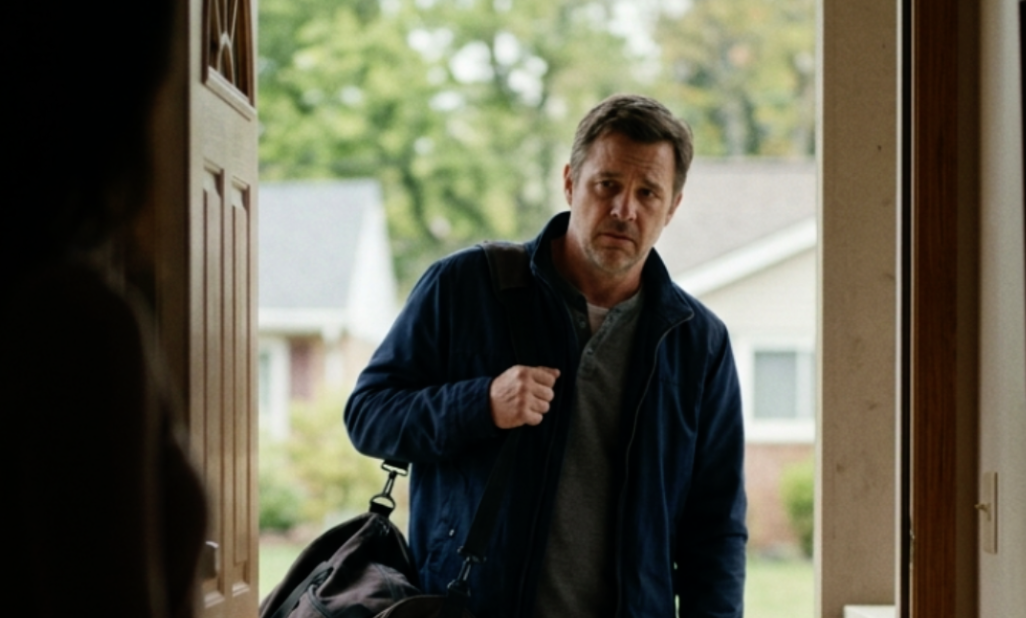
The doorbell rang at ten in the evening. On a Wednesday. In January.
I had just taken a casserole out of the oven — an ordinary cottage-cheese one, made according to my grandmother’s recipe, with raisins. The smell was so cozy it almost made you want to cry. The kettle was whistling on the stove. Pozner was quietly murmuring on the television.
I thought it was the neighbor. Aunt Zina from the fifth floor had probably forgotten her glasses again and had come to ask me to read her utility bill.
I opened the door without looking through the peephole.
Sergey was standing on the threshold. My ex-husband. With a large travel bag over his shoulder. And at his feet, leaning against the wall and sleeping soundly on a suitcase, was a little girl of about two, in a pink snowsuit. Fair-haired. Curly. Very beautiful.
Sergey was wearing his old coat. The very one I had bought him for his fiftieth birthday. Eight years ago.
He had aged. A lot. There were bags under his eyes. The gray at his temples was no longer “noble,” but somehow tired and dirty-looking.
“Lena,” he said. “Open up. I’m here with my things and a child.”
I was silent for ten seconds. Maybe fifteen.
Then I stepped aside.
“Come in. Just quietly. Don’t wake the girl.”
But three years earlier, everything had been different.
I was forty-seven. Sergey was fifty. Twenty-four years of marriage. Our son Kostya was already living separately in Saint Petersburg; he was a programmer, married, and they were expecting a baby.
Sergey and I had reached that wonderful stage when the children had grown up, the mortgage was paid off, work was stable, weekends meant the dacha, and evenings meant TV series. I thought: this is it, deserved happiness. We will grow old together.
Sergey thought otherwise.
I found out about Lika by accident. Not from lipstick on his collar — he was careful. From a restaurant receipt in the pocket of his jacket. “Cheese, wine, two desserts.” He and I hadn’t eaten desserts together in ten years — he was diabetic, and I was on a diet.
I didn’t make a scene. I had never known how to shout. I simply sat down in the kitchen that evening and said:
“Sergey. Who is she?”
He looked at me — and I understood that he had been waiting for this. And, it seemed, even wanted it.
“Lena, I’ve fallen in love,” he said solemnly, as if announcing a Nobel Prize. “Her name is Angelika. She’s twenty-five. It’s serious.”
I blinked.
“Twenty-five?”
“Yes. And she’s expecting a child.”
I said nothing. The kettle was boiling. I got up and turned it off.
“Lena, try to understand. I’m suffocating in this life. You and I… well, we’re like neighbors. But with her — I live. I laugh. I feel like a man again.”
“Congratulations,” I said. “When are you moving out?”
“Lena, don’t be like that. Let’s do this like decent people. I want a divorce. The apartment, the dacha, the car — we’ll divide everything.”
That was where he made his mistake.
You see, Sergey had always considered me “just a little accountant.” A quiet wife beside the director of a construction company. He liked telling his friends how “everything in the family depended on him.” And I would smile and put more salad on his plate.
But I was the chief accountant of a large auditing firm. With a salary twice as high as his “director’s” salary. I simply never boasted about it. It wasn’t my style.
And I knew everything. About his finances. About his apartment — which he considered “his,” though it had been bought during our marriage. About his dacha — registered in his mother’s name, while the construction and renovation had been paid for from the family budget, and I had kept every receipt for twenty years. About his car — bought with a consumer loan that he and I had paid off together.
“Fine,” I said. “We’ll divide it. But first, tell me one thing.”
“What?”
“Does Angelika know that you have type 2 diabetes? And that you have a scheduled knee-joint surgery in March? And that your ‘director’s’ salary is ninety thousand, while the rest is bonuses that will be canceled as soon as the new owner comes into the company — and he will come in two months, I know that from the auditors?”
Sergey froze.
“How did you…”
“I’m an accountant, Sergey. Just an accountant. I know everything. Go to your Angelika. Just make sure you don’t disappoint her.”
The divorce went faster than I expected.
I didn’t cling to him. I didn’t cry. I hired Igor Mikhailovich, the best family lawyer in the city, and placed a folder in front of him. With receipts. Bank statements. Contracts.
Sergey was in shock. He had come to “divide things,” thinking my hands were empty.
What he received was: half of a one-room apartment in the Moscow region — our investment property, which I had suggested selling back in 2018, while he had refused, and now its value had fallen by thirty percent; his old Toyota, which fell apart completely a year later; and half of the dacha, after lengthy expert evaluations and proof of joint investments — the court recognized my right, the dacha was sold, and the money was divided.
What I received was: our three-room apartment in the city center — I proved that seventy percent of the purchase had come from my premarital contribution after selling my parents’ apartment, and I only had to pay him a little for his thirty percent; all the savings I had kept in my own accounts — he hadn’t known about them, though they were not a secret, he had simply never taken an interest in my money; and peace. Priceless.
At the final hearing, in the courthouse corridor, he came up to me.
“Lena, how could it be like this? Twenty-four years.”
“There’s nothing to it, Sergey. You left — I closed the door. That’s normal.”
“You’ve become hard.”
“I’ve become myself. You just never saw it before.”
He left. To his Angelika, who by then was already eight months pregnant.
I went home. Made tea. Turned on Pozner. And for the first time in twenty-four years, I realized that my apartment felt spacious.
The first year after the divorce, I lived as if inside a cocoon. I worked. Walked. Read. Signed up for yoga, then Spanish. I traveled to Georgia alone — alone for the first time in my life, without him, without my son, without friends. I was trembling with fear. I came back a different person.
A year and a half later, Andrey appeared in my life.
A widower, fifty-three years old, a design engineer. Quiet, reliable, with golden hands. We met at Spanish classes — both of us were learning the language “for the soul, for travel.” There was no passion. No fireworks. There was a calm, slow getting to know each other. First coffee. Then dinners. Then he stayed the night.
We didn’t move in together. Each of us had our own place. He had his apartment; I had mine. But three or four times a week, we were together. On weekends — at my place. I would make casserole, he would fix things in my apartment that hadn’t worked for a year, we would watch movies, sleep in my bedroom on my big bed, under my blanket.
A life I had not dared even dream of.
And then — on a Wednesday, in January, at ten in the evening — that doorbell rang.
Sergey came in without taking off his coat. He carefully laid the girl down on the bench in the hallway and covered her with his scarf. I closed the door behind him.
“Will you have tea?”
“Lena, thank you. Yes.”
I led him to the kitchen. Poured tea. Put a small bowl of dry bread rings in front of him. Sat opposite him.
He was silent for two minutes. Warming his hands around the mug.
“Lena. I understand that I’m the last person I should have come to. But I have nowhere else to go.”
“What happened?”
“Angelika… left. A month ago. For her fitness trainer. She took her things and left Masha. She said she was tired of ‘babysitting two old people’ — me and the child.”
I did not smile. Though I could have.
“And the apartment?”
“The apartment is hers. She registered it in her name, I paid the mortgage. The lawyer said there’s almost no chance; all the documents are in her favor.”
“And work?”
“I was laid off. Six months ago. You told me, remember — the new owner. He came in and cleared out all the ‘old’ employees. I looked for work for three months. Found a job in a small firm, salary sixty thousand.”
“And your mother?”
He lowered his head.
“Mom died in August. I thought you knew. Kostya was supposed to tell you.”
Kostya had told me. I had gone to the funeral. I stood at a distance. Angelika was there — in a black dress one size too small, demonstratively pressing little Masha to herself. Sergey saw me — and pretended he hadn’t.
I said nothing about it.
“And you came here to do what? Live?”
He raised his eyes to me. The same eyes I had looked into for twenty-four years.
“Lena. I was a fool. I understood everything, but too late. Forgive me. I know I have no right. But I have nowhere to go with the child. Kostya is in Saint Petersburg himself, he has his own children, Angelika’s mother hates me, and I have no money to rent a place. I… I can live in any room. On a folding bed. I’ll help. Cook. Fix things. I just… I’m tired. I’m very tired.”
I listened and looked at him. And I felt nothing. No gloating, no pity, no love, no hatred. Just emptiness. As if sitting in front of me was some distant relative I knew, someone who had suffered a misfortune.
And, as a human being, I felt sorry for him. But not enough to let him back into my life.
“Sergey,” I said. “I’m going to show you one photograph. Wait.”
I got up and went into the bedroom. On the dresser stood a frame — Andrey and I in Barcelona last spring. He had his arm around my shoulders, I was laughing, the wind tossing my hair. A good photograph. I love it very much.
I brought the frame and placed it in front of Sergey.
He looked at it for a long time. Then slowly raised his eyes.
“Who is this?”
“This is Andrey. My man. We’ve been together for a year and a half.”
“Does he… live here?”
“Not permanently. But often. And he was supposed to come today too; he’s just been delayed at work. He’s probably on his way already.”
Sergey lowered his head. He was silent for a long time. Then he ran a hand over his face.
“Lena, I… I didn’t know.”
“And you weren’t interested, Sergey. Not once in three years. Not one call, not one message. Only when things got bad did you remember that Lena existed. Kind Lena. Backup Lena.”
“I didn’t think that way…”
“Yes, you did. Exactly that way. You’re not the first, and you won’t be the last. It’s a typical story — I recently read an article about it on Facebook.”
He raised his eyes. For the first time, without masks, without posturing, without that solemn tone of his.
“What should I do?”
I exhaled.
“Sergey. Now you’re going to finish your tea. I’ll call you a taxi. You’ll go to Kostya — I’ll call him, he’ll let you in, they have a guest room. Tomorrow morning you’ll contact social services — there’s a support program for single fathers, I’ll send you the contacts, I have a client who works there. For the first period, I can lend you one hundred thousand. Not give — lend. With a written receipt. For six months. So you and Masha can rent a room and get back on your feet.”
He looked at me.
“Why are you helping me?”
“Not you, Sergey. Masha. She isn’t guilty of anything. And — for the sake of the Sergey I lived with for twenty-four years. He was not a bad person. Up to a certain point.”
He began to cry. Quietly. Burying his face toward the mug.
I turned away. Gave him a minute.
The intercom beeped in the hallway. It was Andrey.
“Lena, I’m downstairs, open up!”
I pressed the button. Sergey wiped his face.
“I’ll go.”
“No. Finish your tea. Meet him. It’s normal. We’re all adults.”
Andrey came in. Saw Sergey. Saw the sleeping girl in the hallway. Raised his eyebrows.
“Lena?”
“Andrey, this is Sergey, my ex-husband. He’s in a difficult situation. He’s leaving for our son’s place now. Will you help walk him to the taxi?”
Andrey — a golden man, as I said — nodded. No questions. No scenes. Just:
“Of course. Sergey, let me help you with the bag.”
Twenty minutes later, a taxi took Sergey and Masha to Kostya, to Kursky railway station.
I stood by the window, watching the car drive away. Andrey came up behind me and put his arms around my shoulders.
“Everything all right?”
“Yes. It’s just… one very long chapter has closed.”
“Is the casserole still warm?”
“Warm.”
“I’m about to die of hunger.”
I laughed.
And we went to have dinner.
Sergey returned the money to me seven months later. All one hundred thousand, down to the last kopeck. He rented a room with Masha in Balashikha and found a simpler but stable job. They found a kindergarten for Masha. Once, he brought her to visit me — Masha turned out to be lovely, a little chatterbox. She hugged me and asked, “Are you a grandma too, like Grandma Zoya at kindergarten?” I laughed and said, “I’m Aunt Lena.” Sergey smiled — for the first time without guilt.
As I heard, things didn’t work out between Angelika and the fitness trainer after a year. She went back to her mother. She pays child support for Masha with great reluctance, through bailiffs.
Andrey moved in with me a year after that story. Living together turned out not to be frightening, but very good. On my bed. Under my blanket. With my tea in the mornings.
Last year we got married. No wedding — just the registry office and dinner with Kostya and his family. Kostya made a toast:
“To Mom. For teaching me one thing: happiness is when you are chosen. And when you choose for yourself.”
I cried. The good kind of crying.