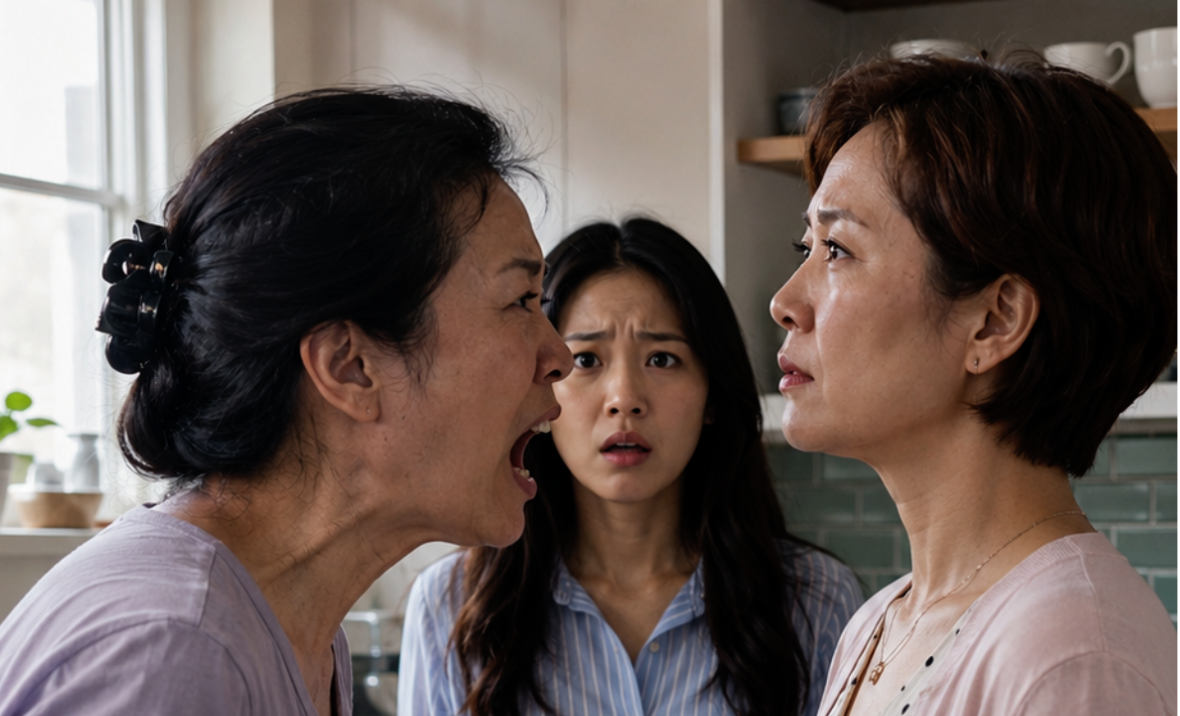
“So they transferred it,” Vera said—not aloud, but to herself, into the emptiness of the kitchen. “Quietly transferred it. While I was at work.”
The sheet of paper lay on the table—an ordinary printout from the Rosreestr website. She had ordered the extract three days earlier almost by accident, just to check the cadastral value for a tax deduction. And now she had received it.
Owner of the dacha plot in Ilyinskoye: Lyudmila Petrovna Gromova.
Her mother-in-law.
Before, there had been another name there.
Her name.
Vera sat and stared at the sheet the way people look at something they cannot believe, even though their eyes have already understood everything. Then she stood up, poured herself water from the tap, and drank it standing there. She put the glass down. She looked out the window. Down below, cars were driving past, some man was walking a dog, life was flowing along as usual, as if nothing had happened.
But inside her, something was slowly and coldly turning over.
Her husband came home at half past seven. He took off his jacket, hung it crookedly as usual, and tossed his sneakers by the door. Vera heard all of it from the kitchen—every sound, every step in the hallway. She had already set the table, although she did not want to eat at all.
“Pash,” she called.
“Mm-hmm,” he answered from the bathroom.
“Come here.”
Apparently, something in her voice was different. He came out with a towel still in his hands, looked at her, then at the table, then back at her.
“What happened?”
Vera silently placed the printout in front of him.
The pause was long. He read it—or pretended to read it. Then he set the paper aside and rubbed the bridge of his nose, the way he always did when he did not know what to say.
“Mom asked,” he finally said. “She says she feels calmer this way. Well, you never know what might happen.”
“You never know,” Vera repeated. “Pash, this is my dacha. My grandmother left it to me.”
“Well, we’re one family.”
“Your mother is our family?”
He rubbed the bridge of his nose again. He stared at the table.
And in that exact moment, Vera understood: he had known.
He had known in advance.
Maybe he had even helped.
Lyudmila Petrovna called her herself the next morning, while Vera was on the metro. Her mother-in-law’s voice had that tone people use when they have prepared a speech in advance and are now delivering it with the proper intonation.
“Verochka, don’t worry. The dacha isn’t going anywhere. I simply feel more secure when it’s registered in my name. You understand, don’t you? Anything can happen, God forbid, of course.”
“Lyudmila Petrovna,” Vera said, “do you understand that this was my property?”
“Well, we’re family,” her mother-in-law said with mild bewilderment, as if Vera had said something strange. “Why are you being so official? Nobody stole anything. We simply transferred it within the family.”
“Without my knowledge.”
“Pasha gave his consent.”
Vera got off at the next station, before her own, just so she would not have to continue the conversation in the crowd. She stood by a column. People passed her—holding coffee, wearing headphones, carrying backpacks. An ordinary Moscow morning.
Within the family.
She repeated that phrase to herself for the rest of the walk—three stops on foot, through the market, past the old library, past the pharmacy where there was always a line. She walked and thought.
She made the appointment with the lawyer herself, without telling anyone. The office was in a business center on Taganka—small, without unnecessary luxury, but the lawyer had been recommended by a colleague who had gone through a similar situation three years earlier.
The lawyer was a woman of about forty-five, wearing glasses, with a notebook in front of her. She listened to Vera without unnecessary emotion. Then she asked:
“How exactly was the transfer formalized? As a gift?”
“I don’t know. They only gave me this.” Vera placed the printout on the table.
“I see. We need to request the transaction history. If it was a gift transfer—and you did not participate, did not sign anything—then this becomes a very interesting case. A gift transfer is impossible without your signature.”
“What does that mean?”
“It means either your signature was forged, or a notarized document was used—one you may have signed earlier without thinking carefully about what it was. A power of attorney, for example.”
Vera leaned back in her chair.
A power of attorney.
Three years ago, Pasha had asked her to sign some papers—something about joint property, technical needs. She had not read them carefully. He had said it was for the bank, a standard procedure.
She had signed.
That evening, she came home different. Not angry—that would have been easier. Just very calm. With the heavy kind of calm that comes when you have already understood everything and now only need to decide what to do.
Pasha was sitting on the sofa with his phone. When he saw her face, he put the phone away.
“You went to a lawyer?” he asked.
He had guessed it himself.
“Verka, don’t do this. Mom just wanted…”
“Pash,” she interrupted, “I don’t want to talk about Mom right now. Tell me one thing. Three years ago, you gave me papers to sign. Do you remember? You said they were for the bank.”
He was silent.
“What were they?” she asked quietly.
And from the way he looked away, she understood: he had known.
He had known from the very beginning.
He had simply carried it out.
Mama’s boy.
She had always pushed that phrase away from herself as unfair. Now it stood beside her and would not leave.
That night she lay for a long time with her eyes open. On the other side of the wall, Pasha was quietly snoring—somehow he had managed to fall asleep, as if nothing special were happening. Outside the window, the city hummed.
Vera thought about the dacha. About how she and her grandmother had painted the fence there—she had been about twelve, the paint was green and stank across the whole plot. How her grandmother had said:
“This is yours. Remember that. It will always be yours.”
Her grandmother had been gone for six years.
And now the dacha belonged to someone else.
But Vera already knew something Lyudmila Petrovna did not know.
The lawyer had found a clue.
A small one, but real.
And tomorrow, a completely different story would begin.
In the morning, Lyudmila Petrovna arrived without calling.
She simply rang the doorbell at half past ten, when Vera was already getting ready to leave. She stood on the threshold in her beige coat, with a handbag over her shoulder, looking as if she had come for a scheduled inspection of someone else’s apartment.
“I’ll only be a minute,” she said, already stepping inside.
Vera moved aside. Simply because she had not yet figured out how to refuse her mother-in-law entry into her own hallway without making a scene.
Lyudmila Petrovna walked into the kitchen, looked around, placed her handbag on a chair—the very chair where Vera always hung her jacket—and began:
“I heard you went to a lawyer.”
Pasha had told her.
Of course.
“I did,” Vera confirmed.
“And why? What will people think? We’re family.”
Vera looked at her mother-in-law and thought: there she stood—a large, self-assured woman of sixty-two, with smoothly styled hair and the gaze of someone who had spent her whole life getting what she wanted. Simply because she pressed until she got it.
“Lyudmila Petrovna,” Vera said evenly, “let’s not put on a performance. You transferred my property into your name. I am looking into the situation.”
“Looking into it, are you?” her mother-in-law smirked slightly, as if it were funny. “Verochka, don’t do anything stupid. The dacha is registered in my name. Everything is legal. The notary certified it. You signed the papers—or have you forgotten?”
“I haven’t forgotten,” Vera said. “That is exactly why I am going to a lawyer.”
Something in her tone must have alarmed her mother-in-law. She narrowed her eyes slightly, was silent for a second, and then changed her approach. Her voice became softer, almost hurt.
“I don’t understand what you have against me. I have always treated you well. Pasha is my son. I’m doing this for him. For both of you.”
“For us,” Vera repeated. “Good. Then return the dacha.”
A pause.
“No,” Lyudmila Petrovna said simply, without apology. “This will be better.”
She took her handbag from the chair and left—calmly, the way people leave when they believe the conversation is over. The door closed. The smell of her perfume remained in the hallway—heavy and floral.
Vera stood there for a moment, then took her jacket and went out after her.
The lawyer called her herself around lunchtime, while Vera was sitting in a café across from her office, staring at her plate without touching the food.
“Vera Sergeyevna, I have news. Can you talk?”
“Yes, go ahead.”
“We received the transaction history. The transfer was done through a power of attorney—the very one from three years ago. But here is the issue: the power of attorney was issued in the name of Pavel Gromov, your husband. In other words, formally, he was the one who carried out the transaction on your behalf. He gifted your property to his mother.”
Vera said nothing.
“Vera Sergeyevna?”
“I’m listening,” she said. “Can this be challenged?”
“We can try. But there is a nuance. The power of attorney was general—broad powers. Formally, your signature is there. The question is whether you understood what you were signing. That is harder to prove, but not impossible. Especially if we find something else.”
“What do you mean, something else?”
“I can’t say yet. Just don’t throw away any documents. Absolutely nothing. Agreed?”
Vera hung up. She looked out the window. People were walking along the street, buses were passing, a girl at the bus stop was scrolling through something on her phone.
An ordinary day.
And her husband had given her dacha to his mother.
The unexpected came from where she least expected it.
That evening, a woman she did not know wrote to her in a messenger app. Briefly:
Are you Vera Gromova? I need to talk to you. It’s important. It concerns your mother-in-law.
Vera stared at the message for a long time. Then she wrote:
Who are you?
The answer came five minutes later:
My name is Svetlana. I was married to Lyudmila Petrovna’s brother. We sued each other seven years ago. I know how she operates.
They met the next day in a small shopping center near Paveletskaya, in a café on the second floor. Svetlana turned out to be a woman of about fifty-five, thin, with short hair and tired but very attentive eyes.
She got straight to the point.
“Lyudmila has done this before,” she said, stirring her coffee. “The same thing happened with my ex-husband. He inherited an apartment from his father. Lyudmila convinced him to transfer it to her temporarily—supposedly for convenience, for taxes. Then she refused to give it back. We were in court for three years.”
“Did you win?”
Svetlana was silent for a moment.
“No. But I found something during the process. Documents she did not expect. The notary who handled my case—he still works now. And I am almost certain he handled your power of attorney too. It is the same man. He does this regularly—draws up documents in a way that makes sure a person does not understand what they are signing. For an extra payment.”
Vera slowly placed her glass on the table.
“Can you prove it?”
“I have correspondence,” Svetlana said. “Old correspondence. But I have it. I did not use it back then—I didn’t manage to, and my lawyer advised another strategy that failed. But now I can give it to your lawyer.”
They sat there for another hour. Vera listened and thought about how Lyudmila Petrovna had entered her kitchen in that beige coat with complete calm. Because she had always done this. Because she had always won.
But this time, something was changing.
When they said goodbye near the escalator, Svetlana held Vera’s hand for a second.
“She does not expect you to fight. They never do.”
Vera nodded. She got on the metro. She looked at her hands.
Her grandmother had said:
“This is yours.”
And for the first time in several days, Vera felt that it was true—despite any extract from Rosreestr.
The lawyer, Anna Vyacheslavovna, slowly and carefully leafed through the correspondence Svetlana had brought. From time to time, she stopped and reread something.
Then she lifted her head.
“This is serious,” she said shortly.
The correspondence was old—seven years old, from a messenger almost no one used anymore—but Svetlana had saved screenshots and printed them out. The notary, Boris Yevgenyevich Kalashnikov, had discussed the details of preparing a power of attorney with Lyudmila Petrovna—and the text made it perfectly clear that he understood the person signing the papers did not grasp their real meaning.
He had written it directly:
“She won’t look into it. She’ll simply sign. Don’t worry.”
“Is this the same notary?” Vera asked.
“The same one,” Anna Vyacheslavovna confirmed. “I checked. Boris Yevgenyevich Kalashnikov, office on Taganka. He handled your power of attorney three years ago.”
Vera looked at the printouts.
“And now?”
“Now we file a complaint with the Notary Chamber—alongside a lawsuit challenging the transaction. We have grounds: the power of attorney was obtained by misleading you. That falls under the law. And the notary in this scheme is not merely a witness—he is a participant.”
Pasha found out about everything himself—through his mother. Lyudmila Petrovna called him in the middle of the day, and that evening he came home different: agitated, red-faced, with the expression people have when they are angry but feel guilty, and are even angrier because of that guilt.
“You filed a lawsuit,” he said from the doorway.
“A complaint,” Vera corrected him. “The lawsuit will come later.”
“Vera, do you understand what you’re doing to the family?”
She looked at him—at this man with whom she had lived for eight years, the man she had trusted enough to sign papers without reading them.
“Pasha,” she said calmly, “you gifted my dacha to your mother. Using my own signature.”
“Mom asked! She explained that it would be safer!”
“Safer for whom?”
He fell silent. He looked to the side, toward the wall where their shared photo from some old vacation hung: the sea, both of them laughing.
“She wanted what was best,” he said quietly.
“She wanted the dacha,” Vera said. “And she took it.”
They barely spoke again that evening.
The Notary Chamber responded quickly—unexpectedly quickly, as if this was not the first complaint against Kalashnikov. An investigation began two weeks later. Anna Vyacheslavovna called Vera from the hallway of the chamber, almost in a whisper.
“They found three more similar cases involving him. This is not the first time. His license will almost certainly be suspended.”
Vera was sitting on a bench by a fountain in a small square near the metro. It was a quiet weekday. Nearby, a woman was walking with a stroller; on the neighboring bench, an old man was reading something on a tablet. Ordinary life all around.
“And the transaction?” she asked.
“The transaction is being challenged. The court hearing has been scheduled for next month. The chances are good—especially now that the chamber has confirmed violations.”
Lyudmila Petrovna came one more time—three days before the court hearing. This time without the beige coat, without the confident gaze. She rang the intercom, and Vera opened the door simply because she was no longer afraid of this conversation.
Her mother-in-law looked different. Not broken—no, she was not that kind of person. But something in her had shifted. She came in, looked around, and this time did not put her handbag on someone else’s chair.
“I want to talk,” she said.
“Talk.”
“Do you understand that if you win in court, Pasha will never forgive you? He will not be on your side.”
Vera looked at her carefully.
“Lyudmila Petrovna, did you come to warn me or to ask me?”
A pause.
Long and uncomfortable.
“To ask,” her mother-in-law finally said, and the word seemed to cost her effort. “Let’s settle this without court. I’ll return the dacha. We’ll formalize everything properly.”
“Why now?”
“Because Kalashnikov is already giving testimony,” she said quietly. “And my name is in it.”
There it was.
Not remorse. Not realization.
Just cold calculation.
Lyudmila Petrovna had played it safe all her life, and now, for the first time, she saw that the cards were not in her favor.
“I’ll consult my lawyer,” Vera said evenly.
Anna Vyacheslavovna told her:
“Agree, but only through the court, by a settlement agreement—so everything is officially recorded, without verbal promises.”
And that was what they did.
The court hearing was quick. Lyudmila Petrovna sat two rows away—straight-backed, with a stone face. Pasha did not come at all. The settlement agreement was approved: the dacha would be returned to Vera within twenty business days, and all re-registration expenses would be paid by the elder Gromova.
When Vera left the courthouse, it was an ordinary gray day. She walked to the nearest café, bought an Americano, and sat by the window. She called Svetlana.
“We won,” she said.
There was a pause on the line, then:
“Good,” Svetlana answered simply. “I’m glad.”
With Pasha, everything resolved itself—slowly, without loud words. He moved in with his mother a month later and took his things in two trips. When leaving, he said something about how she had destroyed the family.
Vera did not argue.
Simply because there was nothing left to add to what had already been said.
Notary Kalashnikov lost his license. In the professional community, it passed quietly, but everyone who needed to know found out.
Lyudmila Petrovna never called again.
On the first weekend after the re-registration, Vera went to the dacha alone. She opened the lock and walked around the plot. The grass had already grown high, the fence had sagged in one place, and the apple tree in the corner had put out new branches.
In the shed, she found an old can of green paint—dried up, of course, from her grandmother’s time. She simply stood there for a while, holding it in her hands.
Then she put it back. She opened the window in the house to air it out. She placed the kettle on the old stove.
The dacha smelled of wood warmed by the sun, and faintly of that distant summer when she and her grandmother had painted the fence together, and the paint had stunk across the whole plot, and her grandmother had said:
“Remember, this is yours.”
She remembered.
And now it was hers again.
Six months passed.
Vera got used to the silence in the apartment—at first unusual, then simply her own. Coffee in the morning without anyone else’s comments. A book in the evening without the television murmuring in the next room.
It turned out this was not loneliness.
It was space.
She went to the dacha every weekend. She repaired the fence herself, with the help of her neighbor, Uncle Kolya, who had long offered and whom Vera finally allowed to help. She painted it—not green, but white. She planted blackcurrants along the path.
Working with her hands calmed her. Soil, a shovel, a simple result: here she planted it, here it sprouted. No double meanings, no hidden documents.
Svetlana wrote to her occasionally—briefly, to the point. Once she told Vera that Kalashnikov had received an administrative penalty and that two more victims had filed lawsuits. Lyudmila Petrovna appeared in those cases as a witness. Unpleasant for her, but not fatal. People like her knew how to slip away.
Pasha called once—on a Sunday evening. He was silent on the line for a long time, then said:
“How are you?”
“I’m fine,” Vera answered.
“I… probably should have acted differently back then.”
“Probably.”
They did not speak about anything important after that. They simply said goodbye. Vera put down the phone and looked out the window. Beyond the glass, the sky was darkening, lights were coming on in neighboring buildings, and the city was living its vast, quiet life.
She was not angry.
Strange as it was, that was true.
The hurt remained—not sharp anymore, just a mark, like a scar that no longer aches but is still there. But something else had appeared: the feeling that she had done what she had to do. Not out of revenge, not out of principle, but simply because her grandmother had been right.
There are things that are yours.
And they are worth protecting.
The following Saturday, she would go to the dacha again. She would take a new can of paint—white this time. She would finish painting the corner section of the fence she had not managed to complete last time. She would put the kettle on. She would open the window.
And everything would be simply hers.
Quietly, firmly, and forever.