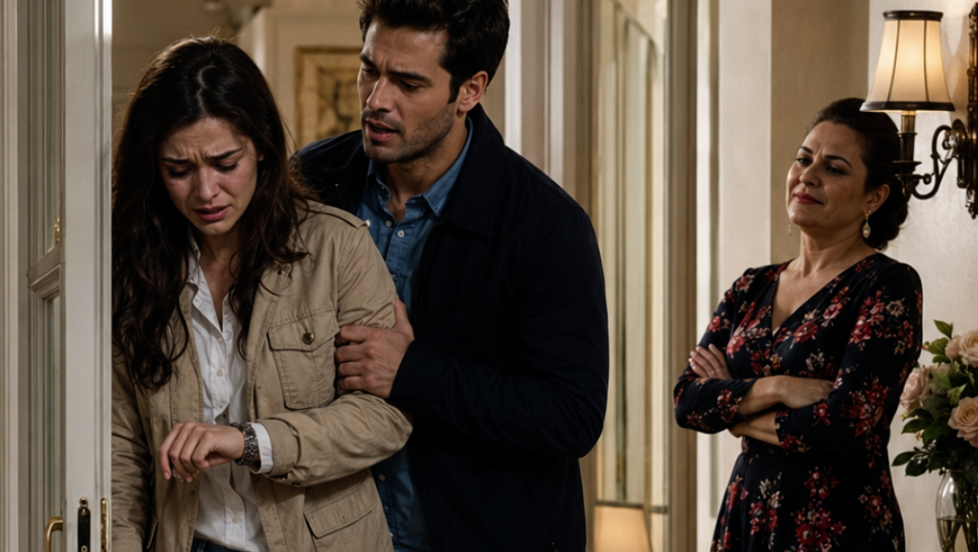
The evening in our three-room apartment stretched on like rubber. Outside, in the residential district, the windows in the neighboring buildings had long gone dark, but the light was still burning in our kitchen. I sat at the table, mindlessly scrolling through the news feed on my phone, listening to Katya clattering dishes in the kitchen. My mother sat across from me, lips pressed tight, drumming her fingers on the oilcloth.
“Dima, just look at her,” she said. “From morning till night she’s at work, and when she comes home, she goes straight to the kitchen. She could at least smile. Say one kind word. She walks around like a shadow.”
She spoke quietly, but loud enough for Katya to hear.
I said nothing. Arguing with my mother always cost more than it was worth. Valentina Ivanovna — or simply Mom to me — always knew what was best. After my father died, she raised me alone, fought to get this apartment, so her word in our home was law. Katya, my wife, had accepted that law five years ago when we got married. She accepted it silently, without argument. And since then, she had remained silent.
The smell of fried potatoes and cutlets came from the kitchen. An ordinary dinner. Nothing special. But today something felt wrong. Katya had been busy in the kitchen longer than usual. I heard her moving boxes, rustling papers. Probably sorting old bills, I thought. She was an accountant, always fussing over papers.
“Dima, did you tell her to clean up the kitchen?” my mother lowered her voice to a whisper. “I went in yesterday, and there was some junk in her cupboard. Boxes with certificates, folders. Why keep that in the apartment? It only takes up space.”
“Mom, leave it,” I said tiredly, without looking up from the screen. “It’s her work. Documents and things.”
“Work,” my mother snorted. “Her work is just for show. She sits in that office all day, and how much does she earn? Pennies. You’re the breadwinner here. You bring money into this house. And she… she hasn’t given you children, she doesn’t even keep a proper home.”
I sighed. The subject of children was the most painful one. My mother nagged Katya and me about it every day. And what could I do? Katya said we needed to get on our feet first, that her job was responsible, that it wasn’t the right time. I didn’t really pressure her. But my mother did.
“She’s not the right stock,” Mother continued, stirring sugar into her tea. “Weak, that’s what she is. Look at her: thin, pale. How could someone like that carry a child? At her age, I was already carrying you. And I worked, went out into the fields, managed the house. But this one… pah.”
“Mom, enough,” I muttered. “She’ll hear you.”
“Let her hear!” Mother raised her voice. “Let her hear the truth! I’m doing this for you, you fool! You’re thirty-five years old, and you’re still like a little boy. Your wife is neither fish nor fowl, and you’re happy to put up with it.”
I clenched my teeth and stared at my phone. Work had worn me out that day. My boss had yelled at me over a report I had supposedly failed to submit on time, even though I had submitted it. I came home furious, and then this started. I just wanted to eat and go to bed. But Mother would not stop.
“Son, listen to your old mother,” she suddenly switched to a coaxing tone, which immediately put me on alert. “I only want what’s good for you. You know I inherited my brother’s apartment. A two-room place in the center, in a good building, renovated.”
I raised my head. We had talked about that apartment many times. Mother had promised it to me, but she kept delaying the paperwork.
“I know, Mom. So what?”
“So,” she leaned toward me across the table, “I’ve been thinking. It’s a good apartment. Expensive. I’ll sign it over to you. But on one condition.”
“What condition?” I asked, already sensing the trap.
Mother nodded toward the kitchen, where the sound of running water could be heard — Katya was apparently washing dishes.
“Throw that freeloader out. I’m sick of looking at her. I’m disgusted. She gives you no happiness and gives me no peace. Throw her out, and I’ll transfer the apartment to you immediately. I’ll find you a new wife. I already have someone in mind, the daughter of a friend — money, status. There will be children, a proper household. But this one… why do you need her?”
Something inside me tightened. Not from anger at my mother, but from some sticky, vile weakness. An apartment in the city center was serious. It wasn’t our three-room apartment on the outskirts. It was money, status, the future. But Katya… she didn’t really get in the way. I was used to her. Quiet, calm, cooked well, kept things cozy. But Mother was right: no children, no special career, just work and housework.
“Mom, that’s not right somehow,” I mumbled. “We’ve been together five years. She’s not a cat or a dog.”
“And is this right?” Mother slammed her palm on the table, making the cups jump. “What has she given you? Happiness? Money? Children? Nothing! She only takes up space and poisons the air. You’re a rag, Dimka! Are you a man or not? Decide!”
At that moment, the kitchen door opened, and Katya came in. She was carrying a plate piled high with steaming cutlets and a bowl of potatoes. She placed them on the table, carefully as always, and froze. She was wearing an old faded housecoat, her hair tied in a bun at the back of her head. Her face looked tired, with shadows under her eyes. She looked from me to Mother and back again. I realized she had heard. Or hadn’t heard, but had guessed.
“Dinner is served,” Katya said quietly. Her voice was calm and even. “Valentina Ivanovna, shall I put a cutlet on your plate?”
“I’ll do it myself,” Mother grumbled. “I’m not a child.”
Katya nodded and, instead of sitting down, went to the sideboard. She opened the lower drawer, where old albums and documents were usually kept, and took out several battered folders tied with string. She placed them on the chair beside her.
“What are you doing?” I asked. “We’re about to eat.”
“I’ll eat later,” she replied without looking up. “I need to sort something out.”
Mother grimaced, looking at the folders.
“Your papers again? I’m sick of seeing them. You’ve cluttered the whole apartment. Dima, tell her!”
“Katya, put them back,” I said tiredly. “Sit down and eat properly.”
“I said later,” she raised her eyes to me, and I saw something strange in them. Not anger. No. Firmness. As if she had made a decision.
Mother and I exchanged glances. Katya had never spoken like that before. She had always been quiet, compliant, yielding. But now… I wanted to say something, but Mother beat me to it.
“How are you speaking to your husband?” Mother’s voice turned icy. “I see your tricks. You think that rustling your papers makes you smarter than everyone else? Remember this: I am the mistress of this house. And Dima is my son. You are nobody here. A hanger-on.”
Katya slowly straightened. The folders remained on the chair. She looked directly at Mother, and there was no fear in her gaze. There was exhaustion. Endless, draining exhaustion.
“I know, Valentina Ivanovna,” Katya said quietly. “You tell me that every day. Five years in a row.”
“And you thought I’d stay silent?” Mother jumped up from her chair. “You ruined my son’s life! No children, no money, no happiness! You sit on his neck, eat his bread, and now you dare open your mouth!”
“Mom, enough!” I roared. I jumped up without even noticing. Everything inside me was boiling. At whom? At Mother? At Katya? At myself? I didn’t know.
Mother fell silent, but only for a second. She looked at me with triumph in her eyes. As if saying: Come on, son, show her who is master of the house.
I looked at Katya. She stood with her arms lowered, looking at me. Waiting. For what? For me to defend her? To tell Mother to go to hell? Or to throw Katya out?
“Katya, go to the kitchen,” I said. My voice sounded dull, unfamiliar. “Don’t push this too far.”
She smiled faintly. Barely noticeable. Only the corners of her lips trembled.
“I’m not pushing anything, Dima. You are. You and your mother.”
“You’re talking back to me?” I stepped toward her. I don’t know why. Maybe I wanted to grab her by the shoulders, push her into the hallway, just so Mother would calm down.
But Katya didn’t step back. She calmly took off her apron, folded it neatly, and hung it over the back of the chair where her folders lay. Then she went to the coat rack in the hallway, took down her old wool coat — the one she had worn since university — and threw it over her shoulders.
“Where are you going?” I asked stupidly.
“I’m leaving, Dima,” she replied, tying the belt. “That’s what you wanted. More precisely, what your mother wanted. And you… you always do what your mother says.”
“Katya, stop it,” I felt something twist inside me. Fear? Pity? “It’s night outside. Where will you go?”
“That is no longer your concern,” she went to the front door and took the handle. Then she turned back. She looked at the clock hanging above the door in the hallway. “Remember this, Dima: I’m leaving not because you threw me out. I’m leaving because you closed the door behind me yourself. With your own hands.”
She opened the door and stepped onto the stairwell. I stood rooted to the spot. Mother jumped up from the table and ran to me.
“Dimka! What are you standing there for? Close the door! She’ll come to her senses and come back! Don’t let her back in!”
I stepped onto the threshold. Katya was standing by the elevator, her back to me. Her shoulders were straight, her head lifted. She did not turn around.
“Katya…” I called quietly.
She did not answer. The elevator arrived, the doors opened, and she stepped inside. Only then did she turn around. There were no tears on her face. No anger. There was something else. Calm. And a faint, barely visible smile.
“Close the door, Dmitry,” she said clearly, loud enough for the whole stairwell to hear. “Don’t let your mother catch a cold.”
The elevator doors closed, and the cabin went down.
I returned to the apartment. Mother stood in the hallway with her arms crossed over her chest, smiling with satisfaction.
“Well, thank God,” she said. “She left on her own, and good riddance. We didn’t even have to throw her out. Tomorrow we’ll change the locks so she doesn’t think she can come back for her things without permission. It’s all for the best, son. You’ll see.”
Without a word, I walked into the room, dropped onto the sofa, and stared at the ceiling. In my ears, I still heard the sound of the elevator doors closing and Katya’s calm voice: “Close the door.”
Something was wrong. I felt it in my skin. Katya had left too calmly. Too easily. As if she knew something I didn’t.
A minute later, I got up and went to the door. I looked through the peephole. The stairwell was empty, a dim bulb burning. Everything as usual.
But my heart was hammering somewhere in my throat. Then suddenly I saw her. She was standing below, on the landing between floors, near the big window. Standing and looking at her phone. Then she raised her head, looked directly at our door, and smiled. Not at me. To herself. Terribly, calmly, doomed.
Then she turned and went down into the night.
I stepped away from the door. It was 11:45 p.m.
The door closed behind Katya, and silence hung in the hallway. Mother stood with her back against the wall, watching me with a victorious smile. She did not yet know that this victory would soon turn to ash. And I stood there listening to my heart pounding loudly. Katya’s voice still echoed in my ears: “Close the door, Dmitry.”
“Well, why are you frozen?” Mother came to me and touched my shoulder. “Let’s go drink tea. Everything is fine, son. You did the right thing. The right thing.”
I silently went to the kitchen, sat on a stool, and stared at one spot. The potatoes were getting cold on the table, the cutlets covered with a whitish film of congealed fat. On the chair where Katya had sat, her folders still lay, tied with string. Mechanically, I reached out and touched the rough paper.
“Mom, what documents are these?” I asked, untying the knot.
“Oh, leave them,” Mother waved her hand, pouring herself tea. “Her junk. Tomorrow we’ll throw it out or take it to the basement. Why do we need it?”
I untied the string. Inside were old contracts, bank statements, payment receipts. I understood nothing about those papers. Katya had always handled all the finances. I only brought in money, and she distributed it among the bills, paid for the apartment, the loans. I didn’t even know how much we still owed the bank for the car. Katya would say, “Don’t worry your head about it. I’ll pay everything myself.”
“True, nonsense,” I said, tying the folders again. “We’ll deal with it tomorrow.”
Mother sipped her tea contentedly, closing her eyes. She wore her favorite warm robe, her hair loose, old felt slippers on her feet. So domestic, so cozy. And only I knew what a steel character hid behind that soft exterior.
“Dima, go to bed,” she said. “Tomorrow will be a hard day. We need to change the locks, pack her things so there’s no trace of her here. I’ll call Uncle Vitya. He’s handy, he’ll help.”
“What Uncle Vitya?” I was surprised. “We don’t have any Uncle Vitya.”
Mother looked away and began carefully stirring sugar in her cup.
“There’s one acquaintance,” she muttered. “An old one. You don’t know him. He’ll help as a neighbor.”
I wanted to ask more, but exhaustion took over. I just wanted to lie down and forget that evening like a bad dream. I got up, trudged to the bedroom, undressed, and collapsed onto the bed. My eyes were closing, but sleep would not come. Images spun in my head: Katya standing by the elevator, her calm smile, her words: “You closed the door behind me yourself.”
I tossed from side to side, kicked off the blanket, then pulled it back. The room was stuffy, the radiators burning at full power. I got up and opened the vent window. Cold air rushed in, carrying the smell of snow and exhaust fumes from the street. I looked at the clock on my phone: half past one in the morning.
I lay down again. And then I remembered how Katya once begged me not to get involved in shady dealings with friends. I had a buddy, Seryoga, who offered me the chance to buy a share in some business and make quick money. I had almost agreed, even withdrawn money from my account. Katya had come home from work, looked at me with tired eyes, and said, “Dima, don’t. It’s a scam. I’ve seen schemes like that; clients at our firm have fallen for them.”
Back then I yelled at her, saying she shouldn’t interfere in men’s business, that she understood nothing. A month later, Seryoga was arrested for fraud. I would have lost all the money. Katya said nothing. She didn’t even say, “I warned you.”
Or when Mother got sick two years ago. Very sick, with her heart, ended up in the hospital. Katya dropped everything, took unpaid leave, and sat with her in the ward. I came after work, and she would already be leaving for home to cook, wash, clean. Mother lay there pale and weak, and Katya fed her with a spoon, gave her water, changed her sheets. And Mother kept grumbling: “Go away, I can manage myself. I don’t need your help.” And when Mother was discharged, the first thing she said was, “Dima, you should give her a bonus for nursing me. Otherwise she’ll think I owe her for the rest of my life.”
I said nothing then. And Katya pretended not to hear.
Memories rolled over me one after another, and each one made me feel sick. I remembered how Katya tried to start her own small business. She wanted to bake cakes to order. She was good at it — decorated them beautifully, made them delicious. She asked me to help promote it, rent a small space, buy equipment. But Mother made a scene: “You want to throw money into the wind? She should sit at home and bake for the family, not for strangers!” And I refused Katya. I said, “Who needs your cakes? Better stay at your job.” She said nothing, only her eyes went dim.
I turned onto my other side and stared at the wall. The room was dark, only the streetlamp threw yellow stripes on the wallpaper. And suddenly I clearly understood: Katya had never complained. Not once in five years. She simply did her part silently and endured. She endured Mother, endured my indifference, endured the absence of children — though I knew she wanted them. Wanted them very much. But Mother said, “Why do you need children? You have no money, the apartment is small, you’re like children yourselves.” And so we didn’t have any.
At three in the morning, I finally fell into a heavy, sticky, dreamless sleep. At four, something woke me. I opened my eyes and listened. Silence. Only the clock ticking on the wall. Then I noticed a dim light from the hallway spilling into the room. Not bright like a chandelier, but flickering, as if someone were moving a flashlight.
I got up, found my slippers, and went toward the light. I stepped into the corridor. The light came from the kitchen — the bulb above the table was flickering. Strange. It had never flickered before. I looked into the kitchen. Empty. Katya’s folders still lay on the chair, and the dirty dishes still sat on the table. I was about to go back to the bedroom, but something made me approach the front door.
I checked the lock. Closed. Everything normal. Then I turned and bumped the coat rack with my shoulder. A jacket fell from it. I bent down to pick it up and froze. On the shelf under the rack, where we always left the keys, it was empty. I ran my hand over the wood — nothing. The car keys. My keys. They were gone.
My heart skipped a beat. I frantically searched the whole shelf, looked under the shoes, in the pockets of the jackets. Empty. Then I rushed into the room, turned on the light, and opened the wardrobe. There, in a shoebox, I kept my passport and some important papers. The box was in place. I lifted the lid and went cold. The passport was gone. All the documents were gone. Mine and Katya’s, which she also kept there. Empty.
I ran into the corridor and pounded on Mother’s door.
“Mom! Mom, wake up!” I shouted, not thinking what I was doing.
The door opened almost immediately. Mother stood there in her nightgown, frightened, eyes round.
“What is it? A fire? What happened?”
“Documents,” I breathed. “My documents are gone. And the car keys.”
Mother turned pale, pushed past me, and ran to her room. I followed. She rushed to the wardrobe, moved clothes aside, and reached into a hiding place — old, Soviet-era, in the wall behind a plywood panel. She always kept money and apartment papers there. I knew about it, but had never touched it.
Mother fumbled in the emptiness, and her face grew whiter and whiter.
“No,” she whispered. “It can’t be. They were here… the papers for the apartment, my mother’s, my brother’s apartment… and money… Dimka, there was money here!”
“What money?” I didn’t understand.
“Mine,” Mother turned to me, horror splashing in her eyes. “I saved for five years. For a rainy day. Half a million. It’s all gone. All of it!”
We stood opposite each other, staring into the emptiness. I felt my legs weaken. Half a million. That was a fortune. Almost a car. That was…
“Katya,” Mother breathed. “It was Katya. No one else.”
I wanted to object, to say Katya had left in the evening and could not have returned, but I remembered the flickering light in the kitchen. I remembered thinking someone was moving around. And then I remembered something else: Katya knew the code to my phone. And the password to Mother’s safe. Mother herself had shown it to her when she was sick and asked her to get documents for the hospital. Katya had written everything down in a notebook, saying she didn’t want to forget.
“Call her,” Mother held out my phone with trembling hands. “Call her immediately!”
I dialed Katya’s number. The phone beeped and disconnected. Again — the same. A third time — subscriber unavailable.
I called again and again. Silence.
“She turned it off,” I said dully. “She’s not answering.”
Mother collapsed onto the bed and howled. She didn’t cry — she howled like a village woman mourning the dead.
“We’re ruined, Dimochka! Ruined! No apartment, no money! What are we going to do now? We need to go to the police! Immediately!”
“The police?” I stared at her blankly. “And what will we say? That we threw my wife out in the middle of the night, and she took documents she herself had been handling? They’ll say it’s a family dispute and send us to court.”
“And the apartment?” Mother clutched my arm. “My brother’s apartment! The documents were there! If she took them, she can sell it!”
“Sell it to whom?” I tried to think logically, though my brain refused to work. “It’s not registered in her name. You’re the owner.”
Mother suddenly froze. She looked at me strangely.
“Dima,” she whispered. “Do you remember six months ago, when I was sick, Katya took me to the notary?”
“I remember,” I nodded. “You said you were making a power of attorney so she could collect your pension while you were in bed.”
Mother turned even paler, if that was possible.
“Dima, I don’t remember what I signed. She handed me papers, I couldn’t read well, I didn’t have my glasses. She said: sign here, sign here. And I signed. What if it wasn’t a power of attorney?”
A chill ran through me. I remembered how Katya had been sorting through folders in recent weeks, how carefully she studied documents, how she wrote something in a notebook. And her calmness tonight. Her smile on the stairs. She knew. She had known everything in advance.
“Let’s go to the police,” I said firmly. “Right now.”
We dressed any which way and ran outside. It was still dark, just beginning to gray. A cold wind cut to the bone. My car was not in the yard. At first I didn’t understand, then it hit me: the keys were gone. She had stolen the car. Katya had stolen my car.
We got to the police station by taxi. I sat in the back seat, looking out the window at the empty streets, the rare streetlights, the sleeping buildings. And suddenly a thought pierced me: I knew nothing about her. I had lived with a person for five years, and I didn’t know who she really was. Quiet, compliant, invisible. And it turned out… What had she turned out to be? A thief? A fraudster? Or simply a woman pushed to the edge?
At the police station, they listened to us without enthusiasm. A young lieutenant yawned tiredly and wrote down our statements.
“So, citizens, let’s go in order. You say your wife left? Did she leave herself, or did you throw her out?”
“She left herself,” Mother said quickly. “Herself, we didn’t throw her out.”
I said nothing. The lieutenant looked at me carefully.
“And when did the documents disappear? At night? And the keys? And the car?”
“At night,” I confirmed. “We discovered it around four.”
“Right,” the lieutenant put down his pen. “Are you going to file a report? Theft? Vehicle theft?”
“Yes,” I nodded.
“Then listen: theft is a criminal case. But if this is your spouse, then it’s not simple theft, it’s misappropriation between spouses. Different article. And also, did you throw her out or not? If you did, she could have taken what belonged to her. If it was your personal property, you’ll need to prove intent.”
Mother and I exchanged glances. I understood the lieutenant was right. Katya was legally my wife, she had keys, she knew the codes, she had access to everything. Proving that she stole something would be very difficult.
“And the apartment?” Mother asked. “My brother’s apartment! She could have taken the documents to transfer it!”
“Is the apartment registered to you?” the lieutenant asked.
“Yes,” Mother nodded.
“Then don’t worry. Nothing can be done without your personal presence and signature. Unless you signed some papers.”
Mother turned pale and fell silent.
We left the station when dawn had fully broken. The city was waking up, cars were moving, people were rushing somewhere. And we stood on the steps, two beggars, without money, without documents, without a car. Suddenly Mother clutched her heart.
“Dima, I feel bad,” she whispered.
I took her arm and sat her on a bench. She sat hunched over, trembling slightly. For the first time in my life, I saw my mother helpless. Always strong, domineering, confident, she had now turned into an ordinary old woman who had been robbed and abandoned.
“What are we going to do?” she asked quietly.
I didn’t know what to answer. I took out my phone to call a taxi and take Mother home, and then I saw a message. From Katya. It had arrived five minutes earlier.
“Don’t look for me. I didn’t touch your mother’s apartment; it’s yours. But the one you live in is now mine. On paper. Thank your mother for her signatures. And thank you for closing the door. I loved you, you know. Goodbye.”
I read the message once, twice, three times. The words swam before my eyes. The apartment we lived in was now hers? How? That couldn’t be. We had privatized it long ago, Mother was the owner. Or…
“Mom,” I turned to her, my voice trembling. “What did you sign six months ago?”
Mother looked at me with empty eyes and said nothing. And I already knew the answer. I knew because I remembered Katya once saying, “Dima, one day you’ll understand what I did for you. But it will be too late.”
That “too late” had come that morning.
We returned home before morning was fully over. The city had already woken up, tires rustled over wet asphalt outside the windows, a dog barked somewhere, the elevator doors thudded loudly. But our apartment was quiet and cold. Mother went to the kitchen, sat at the table, and stared into space. I stood in the hallway, looking at the empty shelf where the keys had always lain.
“Do you want tea?” I asked stupidly.
Mother didn’t answer. She sat hunched over, trembling. I poured water into the kettle and pressed the button. Ordinary morning movements, but my hands wouldn’t obey me. Everything felt unreal, as if I were watching a film about someone else’s life.
“Dima,” Mother raised her eyes to me. “Call her again. Maybe she turned her phone on.”
I took out my phone and dialed Katya’s number. Long rings started, and my heart jumped.
“Hello,” said a mechanical voice. “The subscriber is temporarily unavailable.”
I hung up and dialed again. Same thing.
“She’s not answering,” I said. “Or she blocked me.”
Mother covered her face with her hands and rocked from side to side.
“Lord, why is this happening to me? Why? I was like family to her. I accepted her, fed her, gave her a home… And she… what a bitch!”
“Mom, stop it,” I said tiredly. “Your wailing won’t help now.”
I sat across from her and stared out the window. A fine rain drizzled behind the glass, gray sky hanging over the roofs. I wanted to sink into the ground.
“We need to go to the bank,” I said. “Check the cards. What if she withdrew the money?”
I took out my phone and opened the banking app. Entered the password — wrong. Again — error. Third time — access blocked.
“What is it?” Mother raised her head.
“The password isn’t accepted,” I felt a sticky cold spread inside me. “She changed the password.”
“How could she change it? She didn’t have access to your phone.”
“At night she did,” I said quietly. “I slept like the dead. Apparently she came back.”
We looked at each other. I remembered the flickering light in the kitchen. I remembered feeling as though someone was moving around. It had been her. Katya had returned. She had taken the documents, the keys, the money, changed the password on my phone. And left.
My phone rang in my pocket. I grabbed it, thinking it was Katya, but an unfamiliar number appeared on the screen.
“Hello,” I answered.
“Dmitry Andreyevich?” a polite female voice asked. “This is the credit department of Avtomir car dealership. We have a problem with your car payments. You are two months overdue. We have been unable to reach you; we sent notices.”
“What overdue payments?” I didn’t understand. “I pay every month. My wife pays.”
“According to our records, the last payment was three months ago,” the voice said. “The debt, including penalties, is one hundred twenty thousand rubles. If you do not settle the debt within five days, we will be forced to go to court and repossess the vehicle.”
“Wait,” I jumped up from the chair. “That can’t be! Katya said she was paying! I gave her money!”
“Unfortunately, no money has been received,” the voice remained calm. “We recommend urgently contacting the bank and resolving the issue.”
I hung up and stared blankly at Mother.
“What?” she asked.
“The car loan hasn’t been paid for two months,” I breathed. “Katya took the money but didn’t deposit it.”
Mother clutched her heart.
“She robbed us! Completely robbed us!” she began lamenting. “Call the police, let them find her!”
“Mom, we already went to the police, you know that,” I paced around the kitchen. “They won’t do anything until Katya shows up.”
I called the bank servicing the loan. A long queue, automated voices, finally I got connected to an operator.
“Please check my loan agreement,” I said, giving my details.
“One moment,” the operator clicked keys. “Dmitry Andreyevich, you have two loans. One has overdue payments, the other is fully settled.”
“Two?” I was stunned. “I have only one, for the car.”
“According to our records, a year ago you took out a consumer loan for five hundred thousand rubles. The money was transferred to an account at another bank. The loan was fully repaid three months ago.”
“How repaid?” I shouted. “I never took any five hundred thousand!”
“The agreement was issued in your name, with your signature,” the operator said. “If you have doubts, you may visit a branch with your passport.”
I hung up. My hands were shaking. Five hundred thousand rubles. A year ago. I had taken nothing. It was Katya. She had taken out a loan in my name and transferred the money somewhere. And then repaid it three months ago. Where had she gotten the money to repay it? From Mother’s savings?
“Mom,” I said dully. “Katya took out a loan in my name a year ago. Half a million.”
Mother went white.
“What do you mean a loan? You said you didn’t take anything.”
“I didn’t! She forged my signature!”
“Then go to the police! Urgently!”
I was already dialing the number when suddenly I realized: proving forgery would be difficult. If the handwriting looked similar, if the bank hadn’t recorded video… And besides, Katya was my wife, she had access to all the documents.
The doorbell rang. We both flinched.
“Who is that?” Mother whispered.
I went to open it. On the threshold stood an elderly man in a strict suit, wearing a tie and carrying a briefcase. I recognized him — he was the notary who had handled the inheritance after my uncle’s death. We had met a couple of times.
“Good morning, Dmitry Andreyevich,” he said. “Sorry for the early visit. I was passing by and decided to stop in. You can’t imagine what a meeting I had!”
“Good morning,” I answered in confusion. “Come in.”
The notary stepped into the hallway and looked around.
“Is your wife home?” he asked. “The thing is, she came to my office this morning. She filed for divorce and division of property. I was surprised; I thought you would come together. She presented a deed of gift for your apartment, certified by me six months ago. A very competently drafted document. Your mother, Valentina Ivanovna, gifted the apartment to your wife on the condition that she provide care for the donor in case of illness. All signatures are genuine; I checked them.”
I leaned against the wall. My legs stopped holding me.
“What?” I asked again. “What deed of gift? Mother didn’t gift anything!”
“The document exists,” the notary shrugged. “I actually stopped by to warn you. Since the divorce has been initiated, the property will be divided. But since the apartment already belongs to your wife by right of gift, it is not considered jointly acquired property. In other words, the apartment remains hers. You may claim what was acquired during the marriage.”
“We didn’t acquire anything!” I shouted. “Everything belonged to my mother!”
The notary spread his hands.
“I am merely stating the facts. Your wife filed the documents in court this morning. Wait for the summons. Goodbye.”
He turned and left, closing the door carefully behind him.
I stood in the hallway and looked at Mother, who had crawled out of the kitchen and clung to the doorframe.
“Mom,” I said quietly. “What did you sign six months ago?”
She was silent. Her eyes darted around, her lips trembling.
“Speak!” I yelled, not expecting such a scream from myself.
“I don’t remember!” Mother wailed. “She brought papers, said they were for disability benefits, that my pension would be increased if I signed that I needed care! I couldn’t find my glasses, she read it aloud, and I signed! Dima, I didn’t know!”
“You didn’t know?” I grabbed my head. “You gifted our apartment to Katya! Do you understand? Our apartment! Where we live!”
“She said it was temporary, that she would transfer it back later!” Mother fell to her knees. “Dima, forgive your old fool of a mother!”
I looked at her and felt something inside me collapse. My mother, always so smart, so calculating, had been fooled by her daughter-in-law’s persuasion. And now we were left with nothing.
The doorbell rang again. I opened it, no longer surprised. Two men in uniform stood at the threshold — bailiffs.
“Sobolev Dmitry Andreyevich?” one asked.
“Yes,” I answered.
“We have a court decision to evict you and your mother from this residential property. The owner is citizen Katerina Sergeyevna Soboleva. The decision came into legal force this morning. You have one hour to gather your personal belongings.”
“One hour?” Mother screamed behind me. “Where are we supposed to go? This is our apartment!”
“Court decision, citizen,” the bailiff showed a stamped paper. “You may appeal, but for now we are enforcing it. Come on, pack. We’ll wait.”
I turned and went into the room. I took out an old bag and began throwing things into it. Mother rushed around the apartment, grabbing one thing, then another, throwing it down, grabbing again.
“Dima, what do we do?” she shouted. “Dima, call her, beg her, tell her we’ll give everything back, just ask her not to throw us out!”
I silently threw clothes into the bag. Shirts, trousers, toiletries. Why? Where would we go? To whom?
The bailiffs stood in the hallway and waited patiently. One looked at his watch.
“Forty minutes left,” he said.
I remembered that Mother had another apartment, the old one from her brother, the one she had talked about. But the documents for it were gone. And probably the keys too. But what if it hadn’t been sold? What if Katya hadn’t touched it?
“Mom, where are the keys to Uncle’s apartment?” I asked.
“I had them,” Mother patted her pockets. “They were in the safe… But the safe is empty.”
I closed my eyes. So Katya had taken that apartment too. Or at least the documents, to sell it.
An hour later, we stood in the courtyard with two bags and a plastic sack. It was drizzling, and it was cold. Mother wrapped herself in her old coat, which she had thrown over her robe. I looked up at the windows of our apartment on the fifth floor and could not believe it had happened.
“Where now?” Mother asked.
“I don’t know,” I answered.
Suddenly my phone rang in my pocket. I looked at the screen — Katya. My heart jumped. I answered.
“Hello,” I said hoarsely.
“Dima,” Katya’s voice sounded calm and tired. “I know you were evicted. Don’t call me and don’t ask for anything. Your uncle’s apartment, your mother’s, is yours. I didn’t touch it. I have the documents; I’ll return them when your mother signs a waiver of claims. And one more thing: the loan I took out in your name is repaid. So you won’t be left with debt. The car is at my office, the keys are with security. Pick it up.”
I was silent, unable to say a word.
“Do you hear me?” Katya asked.
“I hear you,” I forced out.
“I didn’t want to punish you, Dima. I just wanted you to finally understand who you are and who I am. You chose your mother. You always chose your mother. For five years I waited for you to wake up, to see how she humiliated me, how you ignored me. I’m tired of waiting. Goodbye.”
“Katya, wait,” I shouted. “Wait! Can we talk?”
“Too late,” she said. “Everything is decided. The divorce papers are already in court. Live however you want.”
And she hung up.
I looked at the dark screen. Mother stared into my eyes hopefully.
“What did she say? Will she give the apartment back? The money?”
I slowly turned to her and looked at her in a way I had never looked before.
“The car is at her office,” I said. “Let’s go pick it up. Then we’ll go to Uncle’s apartment. If she has the keys, then we’ll have to wait.”
“And where will we live?” Mother asked.
“I don’t know,” I answered. “Maybe with your acquaintances. With Uncle Vitya, for example.”
Mother flinched and looked away. I understood: that Uncle Vitya hadn’t appeared in her conversation for no reason. But now was not the time to sort that out.
We walked through the yard to the bus stop. The rain grew heavier, the wind threw cold drops into our faces. I looked back at our building, at the windows behind which so many years had passed, and suddenly felt a strange relief. As if a heavy burden had fallen from my shoulders. We had lost everything. But maybe this was a chance to start over? Without Mother’s orders, without eternal tension, without lies?
I looked at Mother, shuffling beside me, hunched and pitiful, and understood: from now on, everything would be different. I would never listen to her advice again. Never.
We reached the bus stop, soaked to the skin. Rain poured down in sheets, and we had no umbrella. Mother trembled, her teeth chattering, clutching a bag of some rags to her chest. I caught a taxi, loaded the bags, and we drove to Katya’s office. I knew the building — a glass high-rise in the business center where she had worked for the past three years. I had never been there before; somehow there had never been time.
The taxi stopped at the entrance. I got out and went to security. A young guard listened carefully to my confused request.
“Soboleva?” he asked again. “The one who resigned today? Yes, she left the car keys. Said her husband would pick them up. Are you Dmitry?”
“Yes, that’s me.”
The guard handed me a key fob and a plastic parking card.
“The car is in the underground parking, second spot from the entrance. Go ahead.”
I took the keys, returned to the taxi, and paid the driver. Mother and I trudged toward the parking lot. We found the car — my old but well-kept Lada, which I had bought on credit three years earlier. It was in place, whole, clean. I opened the door and sat behind the wheel. Mother plopped into the back seat and threw the bags beside her. The car smelled of Katya’s perfume — light, floral, so familiar. I gripped the steering wheel and exhaled.
“Where now?” Mother asked from behind me.
“To Uncle’s apartment,” I answered. “Do you remember the address?”
“Pushkin Street, building ten, apartment twenty-five,” Mother said quickly. “I’ve been there a hundred times.”
I started the engine, left the parking lot, and drove toward the center. The rain kept lashing down, the wipers barely coping. We were silent. Mother occasionally sobbed, but I didn’t turn around. Katya’s phone call kept spinning in my head. She said Uncle’s apartment was ours. So she had the documents, but the apartment was free? Maybe we could get in?
The building on Pushkin Street was Stalin-era, with high ceilings and decorative molding on the façade. We climbed to the third floor on foot — the elevator wasn’t working. I rang the bell of apartment twenty-five. For a long time no one opened. Then footsteps sounded, and the door swung open. An unfamiliar woman of about forty stood there in a house robe and hair curlers.
“Who are you looking for?” she asked suspiciously.
“Excuse me, where are the owners?” I asked. “This is my uncle’s apartment. Or rather, my mother’s.”
“What uncle?” the woman frowned. “I’m the owner here. I bought this apartment six months ago. All documents are in order. Who are you?”
My vision darkened. I turned to Mother. She stood white as chalk, clutching the railing.
“How bought?” I forced out. “From whom?”
“From a woman,” the owner said. “Young, pretty. She said she was selling her relative’s apartment by power of attorney. We processed all documents through a notary, everything legal. If you have questions, contact your notary.”
She slammed the door.
I stood and looked at Mother. She trembled slightly, her lips moving without sound.
“Did you hear?” I asked quietly. “Sold. Six months ago. Exactly when you were sick and signing papers.”
“Dima, I didn’t know!” Mother grabbed my arm. “I swear, I didn’t know! She said it was temporary, that it had to be done so I could receive benefits!”
“What benefits, Mother?” I pulled my hand away. “Are you completely stupid? Signing without looking!”
“I couldn’t find my glasses!” she sobbed. “She read it aloud, I believed her!”
I turned and went down the stairs. Mother hobbled after me, holding on to the walls. Outside, I got into the car and slammed my fist against the steering wheel. It hurt, but it didn’t help. Mother climbed into the back seat and cried quietly.
“What do we do now, Dima? Where do we go?”
I started the engine silently and drove back. Where? I didn’t know myself. I just circled the city, looking at the wet streets, people with umbrellas, buses full of passengers. Everyone was rushing somewhere, everyone had things to do, and we had nothing.
“Dima, maybe Aunt Klava?” Mother suggested timidly. “She lives in the region, has her own house. She might let us spend the night.”
“Call her,” I muttered.
Mother took out her phone and dialed. She talked for a long time, sobbing, then hung up.
“She doesn’t answer,” she said. “Maybe she’s at work.”
I stopped the car at the roadside and leaned back tiredly. My head was complete chaos. Then suddenly it hit me: Katya had said she had the documents for Uncle’s apartment. That meant she hadn’t destroyed them, just taken them. Maybe she hadn’t sold it? Maybe that woman in the apartment was lying?
I turned around and drove back to Katya’s office. The same guard was at the entrance.
“Listen,” I said to him. “Katya, Soboleva — was she at work today? Can I see her?”
“She was here this morning,” the guard replied. “Picked up her employment record and left. She left an envelope for you. I almost forgot. Wait.”
He went into the glass booth and returned with a thick yellow envelope. On it was written: “To Dmitry.”
I took the envelope and tore it open right there. Inside was a flash drive and a short note. I read: “You wanted to live with your mother? Live. I’m tired of being treated like an object. Watch the video and understand which one of us is the traitor.”
I put the flash drive into my pocket and went outside. Mother was waiting in the car. I sat behind the wheel, turned on the ignition, and drove wherever my eyes led me. I needed a place where I could calmly watch what was on the flash drive.
“What’s there?” Mother asked.
“Later,” I snapped.
I drove into some quiet street and parked by the curb. I took out my phone and connected the flash drive through an adapter. Mother leaned forward from the back seat.
“Don’t watch,” I said. “You can watch later.”
But she didn’t listen.
A video appeared on the screen. The quality was poor, but you could make things out. Our kitchen, the table, cups on the table. My mother sat at the table, and across from her was some man, unfamiliar, elderly, with gray mustache. I had never seen him before. They were talking about something, but there was no sound. Then the video changed — the same kitchen, Mother alone, talking on the phone, gesturing. Suddenly I heard a voice. Katya must have overlaid audio or turned on a microphone.
“…Do you understand?” Mother said into the phone. “We’ll sell my brother’s apartment, split the money. And I’ll drive that fool and his wife out. I’m sick of her. Let them go wherever they want.”
“And if your son finds out?” a muffled voice asked.
“What will he find out?” Mother laughed. “He’s a rag, a mama’s boy. I’ll twist him however I want. The main thing is that Katka doesn’t guess. But I keep her on a short leash. I promised her something that will make her work for me for the rest of her life. I’ll tell her I’ll transfer the apartment to her if she takes care of me. And after I die, the beggar won’t get anything. I’ll leave everything to Dima. But for now, let her slave away.”
My hands dropped. I stared at the screen and couldn’t believe my eyes. This was my mother? The one who raised me, who always said I was her only support? She had been playing with me all this time? And with Katya?
The next video showed Mother with the same man. They were sitting in a café, drinking coffee. This time there was sound.
“Vitya, the main thing is, don’t rush,” Mother said. “We’ll sell the apartment, get the money. By that time, I’ll have driven Katka out. I’ll tell Dima she’s a thief, that she stole the documents. He’ll believe me. He always believes me.”
“And if he doesn’t?” the man asked.
“He will,” Mother smirked. “I raised him for twenty-five years. He eats out of my hand. And he only tolerates that daughter-in-law because I allow it. As soon as I say so, he’ll throw her out. You’ll see.”
More clips followed. Mother discussing with this Vitya how to forge signatures, how to arrange the deed of gift for the apartment, how to later blame Katya for every sin. I watched and went cold. It turned out Mother had been preparing this plan for a long time. Katya must have installed hidden cameras because she sensed danger. Or simply wanted proof.
I turned off the video and turned to Mother. She sat with her mouth open, her eyes darting around.
“Well?” I asked quietly. “Are you going to explain?”
“Dima, it’s a montage!” she screamed. “She faked everything! Katya is a bitch, she did it on purpose!”
“Shut up,” I said.
Mother fell silent. I looked at her and saw a stranger. The person I had considered closest, dearest. All this time she had manipulated me, used Katya, lied, stolen. And I had been a blind puppy obeying her commands.
“Who is this Vitya?” I asked. “The Uncle Vitya you mentioned yesterday?”
Mother was silent, shrinking into the seat.
“I’m asking, who is he?”
“An acquaintance,” she whispered. “An old one.”
“Your lover?”
“That’s none of your business!”
“It is,” I raised my voice. “Because because of you and your lover, I lost my wife, my apartment, my money! Because of you I became homeless!”
“I didn’t know it would turn out like this!” Mother sobbed. “I wanted what was best! So you would have something, so you wouldn’t be lost!”
“So I would have something?” I laughed an ugly laugh. “You wanted me to stay tied to you. So Katya would leave, and you could keep commanding me. You never wanted what was good for me. You wanted only yourself.”
I started the car and took off. Mother screamed and grabbed the door handle.
“Where are you going? Dima, stop!”
I didn’t answer. I just drove wherever my eyes led me. Through streets, avenues, past houses and shops. I wanted to run from this nightmare. From Mother, from lies, from myself.
I stopped only an hour later, outside the city near some forest. The rain had stopped, the clouds were breaking apart, and the sun appeared. I got out of the car, leaned against the hood, and lit a cigarette, though I had quit five years ago. Mother stayed inside, crying quietly.
I looked at the wet trees and thought about Katya. About how she had endured all this. Five years silently, without complaints, without scandals. Enduring Mother, enduring my indifference. And all that time, maybe, collecting evidence. Preparing her escape. And I hadn’t even noticed.
I felt ashamed. Not before Mother, but before myself. For being blind, weak, worthless. For allowing my mother to control my life. For failing to protect Katya.
I returned to the car. Mother sat curled up in the back seat, looking at me with tearful eyes.
“Dima, forgive me,” she whispered. “I’m an old fool. I’ll fix everything.”
“How will you fix it?” I asked tiredly. “Will you return the apartment? The money? Katya?”
“I’ll talk to her,” Mother spoke quickly. “I’ll explain it wasn’t me, that Vitya invented everything. That I didn’t want this.”
“And the video?” I looked straight at her. “You said everything there yourself. Yourself. Without Vitya.”
Mother fell silent. Looked away.
I started the engine and drove back into the city. We needed somewhere to sleep. We had almost no money left, only some change in my pocket. The cards were blocked. I remembered I had a friend, Seryoga, with whom I had once worked. Maybe he would let us stay for a couple of days.
I dialed his number. Seryoga answered quickly.
“Dimka, hey! Long time no see!”
“Seryoga, help me out,” I said. “Something happened. Can I come to your place for a couple of days?”
“What happened?” my friend asked warily.
“I’ll tell you later. I’ll come and explain.”
“Come,” Seryoga sighed. “Do you remember the address?”
I remembered. It was a residential district on the outskirts, a Khrushchev-era building, cramped, but now I was grateful even for that.
An hour later, we were sitting in Seryoga’s kitchen. He and his wife, Natasha, gave us tea and listened to my confused story. Mother was silent, only occasionally sobbing. Seryoga looked at me with sympathy, Natasha with poorly hidden dislike toward Mother.
“Well, damn,” Seryoga drawled. “Did you go to the police?”
“I did. Useless. Katya arranged everything legally, and Mother signed.”
“And the flash drive?” Natasha asked. “That’s proof your mother and her lover had a conspiracy.”
“That’s against Mother, not against Katya,” I explained. “Katya has nothing to do with it. She was just defending herself.”
“So what are you going to do now?”
I didn’t know. I sat and looked into my mug of cold tea. Mother trembled beside me. Pitiful, old, crushed. And suddenly I understood: I would no longer live with her. Enough. Let her deal with her Vitya herself, with her problems. I was tired.
“Mom,” I said loudly. “Tomorrow you will go to that Vitya of yours. And you’ll settle everything with him. And I’ll go look for Katya.”
Mother raised her eyes to me.
“Why?”
“I want to understand whether anything can be fixed. If not, then at least apologize. For myself and for you.”
“She won’t forgive you,” Mother whispered.
“That’s my business,” I replied.
That night I lay on a folding bed in Seryoga’s small room and stared at the ceiling. Nearby, on a mattress on the floor, Mother snored softly. I thought about Katya, about her smile on the stairwell, about her calm voice on the phone. Where was she now? What was she doing? Had she already left the city? Or was she sitting in some apartment drinking tea, happy to have gotten rid of us?
I took out my phone and dialed her number. Long rings, then the answering machine: “The subscriber is temporarily unavailable.” I dialed again — the same.
The video flashed before my eyes, Mother saying about Katya: “I keep her on a short leash.” But it turned out Mother was the one on a leash — held by her greed and anger. And I was on Mother’s leash.
Tomorrow I would find Katya. Whatever it cost.
A month passed. A month that turned my entire life upside down. I rented a small room in a communal apartment on the outskirts, worked as a taxi driver, drove people around their business, and listened to their conversations about work, children, problems. Other people’s voices filled the emptiness inside me, but they could not drown out my thoughts of Katya.
Mother lived in a nursing home. I placed her there two weeks after we moved in with Seryoga. We couldn’t stay with friends any longer, and Mother became more unbearable every day. She cried, complained about her heart, demanded I find that Vitya and make him return the money. I found him. Vitya turned out to be an old acquaintance of Mother’s, someone she had had an affair with even while my father was still alive. When I went to him, he denied everything at first, but then, cornered by my questions and the flash drive, he admitted Mother had dragged him into the scam herself. They split the money from selling Uncle’s apartment, but Mother had taken most of it. And then, when everything collapsed, Vitya disappeared. He withdrew all his savings and left for another city to live with his daughter. Mother was left with nothing.
I did not pity her. For the first time in my life, I looked at her and felt nothing but exhaustion. She had destroyed my family, my life, my future. And for what? For money she never got in the end.
“Dima, don’t abandon me,” she begged when I drove her to the nursing home. “I’m your mother. I raised you.”
“You raised me,” I agreed. “So you could control me for the rest of my life. Enough, Mom. I’m grown.”
She remained there, in a clean but institutional building, among other lonely old people. I paid for her care from the money I earned driving a taxi. It was enough so she wouldn’t go hungry or freeze. But to love her — I no longer had that in me.
I searched for Katya. I called all her friends, went to every place she might be. No one knew anything. At her former company, they said she had quit and moved to another city. Where, they wouldn’t say, citing personal data privacy. I had almost given up when one evening, while driving orders, I saw her.
She was standing at a bus stop with a small suitcase, waiting for a bus. At first I didn’t believe my eyes, thought I was imagining it. But it was her. Katya. In that same old coat she had worn when she left that night. Only her face was different. Calm, peaceful, without a shadow of the exhaustion she used to carry.
I braked sharply, jumped out of the car, and ran to her.
“Katya!”
She turned around, and surprise flashed in her eyes. But not joy. More like regret.
“Dima,” she said quietly. “Why are you here?”
“I was looking for you,” I blurted. “All month. I wanted to talk.”
“We already said everything,” she turned away, looking at the road. “The bus will come soon.”
“Katya, please. Sit with me for five minutes. In the car. Don’t leave without hearing me out.”
She was silent for a moment, then slowly nodded. We got into the car. I turned off the engine and faced her. Inside the car, it smelled of gasoline and her perfume — the same floral scent.
“How are you?” I asked stupidly.
“Fine,” she answered. “I found a new job, rent an apartment. I’m living.”
“Where?”
“Far away. I won’t tell you.”
I nodded. I understood I had no right to ask.
“Katya, I wanted to apologize. For everything. For not protecting you, for allowing Mother to humiliate you, for being a blind idiot. You deserved someone else.”
She looked out the window at the cars passing by. She was silent.
“I know about Vitya,” I continued. “I know Mother invented everything herself. I know you’re not a thief or a fraudster. You were just defending yourself. I watched the video. Everything is clear.”
“The video,” Katya smiled bitterly. “Do you think I set them up to take revenge? No, Dima. I set them up because I was afraid. Your mother said every day that she would drive me out, that she had a plan. I wanted to know what she was plotting so I could protect myself. And you too.”
“Me?”
“You,” she turned and looked into my eyes. “Do you think I didn’t see how she manipulated you? You were like a child, catching every word she said. I tried to explain it to you, but you wouldn’t listen. You always chose her. Even when she was wrong.”
I lowered my head. It was true. Bitter, hurtful, but true.
“I didn’t take your apartment,” Katya said. “On paper it’s mine, but I won’t touch it. You can live there. I’ll send you authorization to manage it. And when your mother dies, I’ll transfer it back. I don’t need what belongs to someone else.”
“And Uncle’s apartment?” I asked. “The one that was sold?”
“Your mother sold it,” Katya said harshly. “Through Vitya. I only helped with the documents because she asked me. I thought she truly wanted to sell it to make life easier for you financially. And then she framed me. I have no proof, and she has my signature on some papers. So formally I’m an accomplice. But she and Vitya took all the money. I didn’t take a kopeck.”
“And the loan in my name?” I asked. “Did you take it?”
“I did,” Katya nodded. “But not for myself. Do you remember, a year ago, you wanted to invest in that stupid business with Seryoga? I knew it was a scam, but you wouldn’t listen. I took out the loan in my name so you wouldn’t have money for that adventure. And when you came to your senses, I repaid it from my own money. Then, when your mother began her games, I transferred it to you so that during the divorce you couldn’t claim my savings. Stupid, right?”
I looked at her and couldn’t believe it. She had been saving me from my own mistakes, and I hadn’t even known.
“Katya, forgive me,” I said. “I’m a fool. I understood everything. Too late, but I understood.”
“It isn’t too late, Dima,” she sighed. “Not for you. You’re still young. You can start everything again. Without your mother, without me, on your own. You’ll manage.”
“And us?” I asked hopefully. “Could we make it work?”
She shook her head.
“No, Dima. I loved you. Very much. For five years I endured, waited, hoped. But that night, when you pushed me out the door, I understood: it was over. I don’t want to wait anymore. I want to live. Without humiliation, without lies, without your mother. I’m leaving today. Forever.”
“Where?”
“To another city. A big one. I have a job there, an apartment, a new life. And maybe a new person. I don’t know yet.”
My heart tightened.
“Will you be happy?” I asked.
“I’ll try,” she smiled. “And you be happy too, Dima. You’re good, just weak. Go to a psychologist, sort out your relationship with your mother, start living with your own head. You can do it.”
She opened the door and stepped out. I watched her walk to the bus stop, watched her board the bus that arrived. At the last moment, she turned and waved. I waved back.
The bus drove away and disappeared around the corner. I was left alone in the car, on an empty street, under cold autumn rain.
I sat for a long time, gripping the steering wheel. Then I started the engine and drove. Where? First to the nursing home. I needed to tell Mother that I would no longer pay for her care unless she confessed to everything and returned the money she had stolen from me and Katya. Let her sell her jewelry, ask Vitya, work. I was no longer her little boy.
I entered her room. Mother sat by the window, looking at the rain. Seeing me, she brightened.
“Dimka, my son! Finally! I’m so lonely here. It’s unbearable. Take me away from here, please?”
“No, Mom,” I said. “You’re staying here.”
She froze, not believing her ears.
“What do you mean, no? Are you abandoning your own mother?”
“I’m not abandoning you,” I answered. “I’m simply stopping being your rag. You stole my wife, my money, my apartment. You destroyed my life. Now live with yourself.”
“How dare you!” she screamed. “I raised you! I did everything for you!”
“You did it for yourself,” I interrupted. “I know everything. About Vitya, about Uncle’s apartment, about your plans. Stop lying.”
Mother turned pale, then red. She opened her mouth to scream again, but I didn’t let her.
“If you don’t calm down, I’ll take you to court. For fraud. I have a video where you discuss everything. You’ll go to prison, Mom. And I don’t want my mother in prison. So live here. I’ll pay as agreed. But I don’t want to see you anymore.”
I turned and left, not listening to her screams. In the corridor, a nurse approached me.
“Is everything all right?” she asked.
“Yes,” I answered. “Please keep an eye on her.”
I went outside. The rain had stopped, and the sun peeked out from behind the clouds. I got into the car and looked at my phone. There was a message from Katya. I opened it.
“Dima, I left the apartment keys in our mailbox. Live there. And forgive me for everything. I didn’t want to hurt you, I was just tired. Be happy. Goodbye.”
I leaned back and closed my eyes. It was over. Truly over. Ahead lay emptiness that would have to be filled with something new. With what? I didn’t know yet.
I started the car and drove home. To our home, where I would now live alone. The keys really were in the mailbox, and with them a small note: “The apartment documents are with the notary. Come and they’ll give them to you. Katya.”
I went upstairs to the apartment. Everything was the same, except Katya’s things were gone. Emptiness, cleanliness, silence. I walked into the kitchen and sat at the table where we had eaten dinner so many times. On the table lay her photograph — the one where she was smiling, young, happy. I picked it up and looked at it for a long time.
Then I took out my phone and dialed the number of a psychologist Seryoga had once recommended.
“Hello,” I said. “I need help.”
That evening, I went to the railway station. Not to bring Katya back — her train had left in the morning. Just to look at the trains, the people, the rails stretching into the distance. I stood on the platform, drinking coffee from a paper cup, thinking that life goes on. That I was still young, that I had hands, a head, a car. That I could start again.
My phone rang in my pocket. I looked at the screen — Mother. I declined the call. The phone rang again. I declined and turned off the sound.
Then I finished my coffee, threw the cup into the trash, and walked to the car. I had to work. I had to live.
I started the engine and drove into the night. The headlights pulled wet asphalt, rare streetlights, and figures of passersby out of the darkness. I drove and thought about Katya. About who she had been, who she had become, who she would be without me. And suddenly I understood: I was letting her go. For the first time in my life, I was letting someone go without trying to hold on, without listening to Mother, without fearing loneliness.
I was letting go. And because of that, it felt lighter.
The next morning, I went to the notary. I picked up the apartment documents. Now it was officially mine. Katya had arranged everything correctly, without deception. She had simply transferred it to me, keeping only the right to divorce.
A week later, I received a court summons. The divorce was quick and calm. Katya did not come; she sent a representative. We divorced without dividing property because, in truth, there was no property to divide. The apartment she had left me was my personal property, the car too. There were no loans left.
After court, I went outside and stood for a long time, looking up at the sky. Freedom. A strange feeling, when you are alone, but free. Free from Mother, from her control, from constant tension. From lies.
I decided to sell the apartment. The very one where Katya, Mother, and I had lived. It held too much pain. I bought a small studio in a new district, far from those places. I put the remaining money into an account. I decided that in a year, once things settled down, maybe I would open my own business. Something small. Or buy a little house outside the city.
Mother called every day. I didn’t answer. Then she stopped. I paid for her care in the nursing home, but I did not visit. Maybe one day, many years from now, I will be able to forgive her. But not now. For now, inside me lived only emptiness and quiet sadness.
A year passed. I worked, drove a taxi, sometimes met with Seryoga, went to the cinema, read books. Gradually, life gained new colors. I even started seeing a woman named Nadya, divorced, with a child. She was kind, calm, didn’t demand the impossible from me. We walked in the park, fed ducks, talked about nonsense. I thought maybe this was happiness. Quiet, simple, without strain.
But sometimes at night I woke up and remembered Katya. Her smile, her scent, her voice. And then it hurt. Not like in the first month, but dully, aching. I knew I would never see her again. And that was right.
One day, while driving a passenger, I passed by her former workplace. Automatically, I slowed down and looked at the glass doors behind which she had once spent so much time. And suddenly I saw her.
She was leaving the building, a folder in her hands, wearing a beautiful coat, her hair done, smiling. Beside her walked a tall, gray-haired, respectable man. He opened the door of an expensive car for her. She got in and smiled at him. Then they drove away.
I pulled over and watched after them for a long time. My heart pounded somewhere in my throat. So she had returned. Or come on a business trip. Or maybe it wasn’t her at all, maybe I imagined it.
But I knew it was her.
That evening, I dialed her number. The phone was on. Long rings, then silence. I was about to hang up when suddenly I heard her voice.
“Hello, Dima.”
I nearly dropped the phone.
“Katya,” I breathed. “How are you?”
“I’m well,” she answered. “I’m passing through the city. Leaving tomorrow.”
“I saw you today,” I said. “With that man. Is he your…?”
“My husband,” Katya said simply. “We got married three months ago. He is a good man.”
I was silent. One thought beat in my head: too late. Forever too late.
“I’m happy for you,” I finally said. “Truly.”
“Thank you,” she paused. “And how are you?”
“Fine. Working, living. I don’t speak to Mother.”
“That’s right,” Katya said. “Dima, I have to tell you something. That loan I took out in your name a year ago… I didn’t tell you, but I gave part of that money to your mother. She asked, said it was for surgery. I believed her. And she gave it to Vitya. Later I found the documents. So formally, you owe me, but I forgive it.”
“Katya, why are you telling me this?”
“So you know. So you don’t think I was a complete bitch. I didn’t want to deceive you; I wanted to help. But it turned out the way it always did.”
“I know,” I said. “I know everything. About Mother, about Vitya. You are not guilty.”
“Thank you,” she sighed. “Well, be happy, Dima. Goodbye.”
“Goodbye, Katya.”
She hung up. I sat for a long time with the phone in my hand, then put it in my pocket and drove home.
That night I didn’t sleep. I lay and stared at the ceiling, remembering everything that had happened. Five years of life, five years of mistakes, five years of love I failed to protect. And suddenly I understood: I was grateful to Katya. For everything. For being in my life, for teaching me to see, for leaving at the right time. If not for her, I would have remained a mama’s boy, a rag, a failure.
In the morning, I called Mother. For the first time in a year.
“Hello,” I said. “How are you?”
“Dimka, my son!” she shouted. “You finally appeared! I thought I’d die without seeing you!”
“You won’t die,” I said. “I’ll come tomorrow. We’ll talk.”
I hung up and looked out the window. The sun was rising, bright and spring-like. A new day was beginning. A new life.
I went outside, got into the car, and drove off on my errands. Ahead were work, meetings, plans. And in the rearview mirror, the past remained. I looked at it and smiled. Because I knew: I had done everything right. Finally, right.
Six months later, I sold the studio and bought a small house outside the city. With a garden, a veranda, and a view of the forest. I moved Mother there from the nursing home. She had aged, weakened, stopped commanding. We lived nearby, but not together. Each of us had our own corner. Sometimes I visited her, drank tea, listened to her memories. She no longer spoke badly of Katya. She only sighed and said, “We were wrong back then, son. So wrong.”
I didn’t argue. I simply nodded and went back to my place.
And one day, while sorting old things, I found a photograph. Katya and I, young, happy, with the sea behind us. Our only vacation together. I looked at it for a long time, then put it into an album. Hid it far away, so it wouldn’t disturb my heart.
But sometimes, on quiet evenings, I take out that album and look. And remember. And thank fate that she was in my life.
Even if everything ended. Even if it will never return.
Thank you, Katya.
For everything.