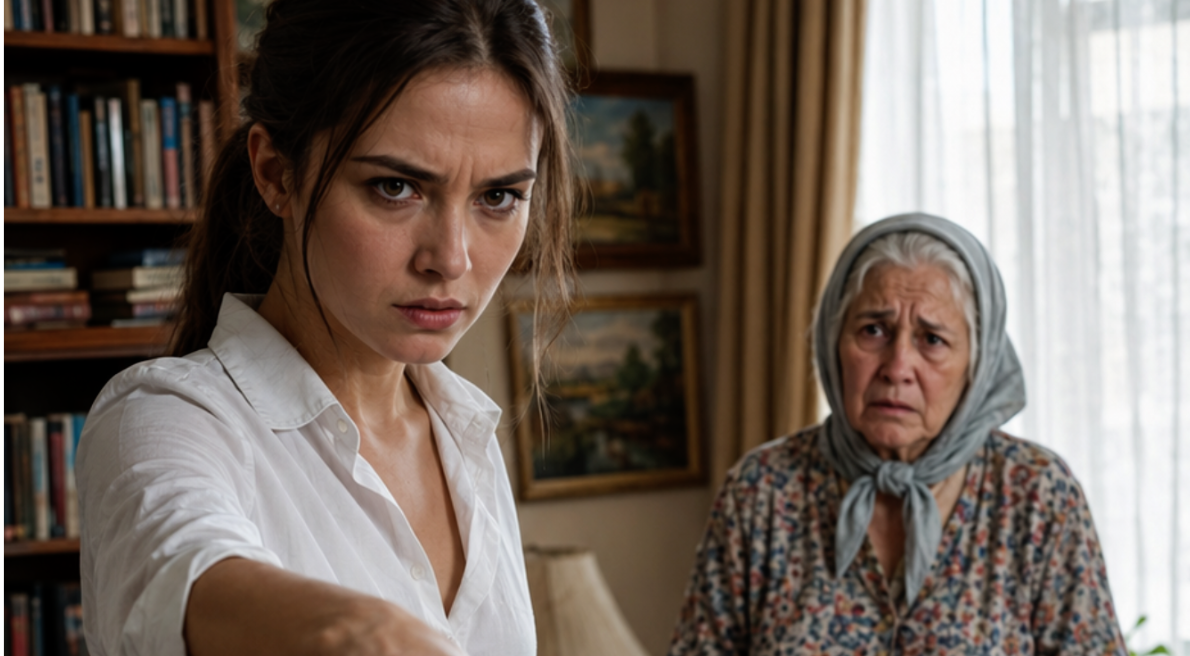
“Twelve thousand. For a week. For five people.”
Valentin placed the money on the edge of the table and did not even look in my direction. He took out his phone and tapped the screen.
I was standing by the stove. Three pots, the oven at 180 degrees. The youngest wanted pancakes for breakfast, the middle child wanted cutlets for school, and the eldest said, “Mom, can I bring a cake for my friend’s birthday?”
For twenty years, I had heard the same thing.
“That’s enough. Save money. I’m the only one working.”
It used to be fifteen thousand. Then he decided that was too much.
“Groceries have gotten more expensive,” I said. “Butter is already one hundred seventy rubles a pack.”
“Then buy it on sale,” he replied, without looking up from his phone. “Other wives manage.”
Other wives.
For twenty years, I had cooked breakfast, lunch, and dinner. I washed clothes, ironed them, drove the children everywhere. For twenty years, I had not had a single salary. Not one transfer to my card marked “for work.”
I did have a card. Valentin had issued an additional one linked to his account. Every evening he checked the expenses. Every single evening.
“Four hundred twenty rubles at Magnit. What did you buy?”
“Chicken, rice, vegetables.”
“Last week chicken cost three hundred ninety.”
I did not argue.
Arguing with Valentin was like explaining to a wall that it was standing in the wrong place.
He was deputy director of procurement at a construction company. He was used to counting other people’s money. And mine—well, mine was not really mine.
Then one day, my eldest asked for a cake.
Not to buy one. To bake one.
“Mom, your Napoleon cakes are better than the ones from the bakery. Bake one for Anya, please?”
So I baked it.
Anya tried it and posted a photo. Her mother wrote to me:
“Kapitolina, how much would a cake like that cost for my husband’s anniversary?”
I named a price at random.
Two thousand.
She agreed without bargaining.
Two thousand for one evening. For flour, butter, eggs, and four hours of work.
I hid the money in a tin tea can on the top shelf of the kitchen cabinet. Valentin never climbed up there. In general, he only entered the kitchen to eat.
During the first month, I baked seven cakes. During the second, eleven. Word of mouth worked faster than any advertisement.
I got a separate SIM card. I wiped my daughter’s old phone clean and installed a messenger app. I took orders during the day, while Valentin was at work. I baked during the day too. By the time he came home, the kitchen was clean and dinner was on the table.
The tea can kept filling up.
A year passed.
By then, I was baking thirty cakes a month. Sometimes forty. I bought a second oven—a small countertop one. I told Valentin the old oven did not hold temperature well.
“How much?” he asked.
“Nine thousand.”
“Expensive.”
“From the household money,” I said.
He waved it off. For him, nine thousand for an appliance was nothing. He spent more than that on his restaurant lunches.
I knew because once I saw a statement he had forgotten on the printer.
Eighty-five thousand a month—his personal expenses. Lunches, suits, fuel for the SUV, subscriptions, the barbershop. Eighty-five thousand for one person. Twelve thousand a week for four.
I did not make a scene.
I baked.
In 2020, I registered as self-employed. My friend Svetlana helped me—she was an accountant. I opened a business account in my own name. The money started going to a card Valentin knew nothing about.
Then he found a cake.
It was Saturday evening. He came home earlier than usual. I did not have time to put everything away. On the table stood a three-tiered wedding cake, white with gold. Eight hours of work.
“What is this?” he stopped in the doorway.
“For a friend. For her daughter’s wedding.”
“For a friend? Then why does our kitchen look like a factory?”
He opened the refrigerator. Inside were two prepared layers: sponge cake bases and cream in containers.
“Kapa, are you selling these?” he said it as if I were standing at a market with a suitcase full of stolen watches.
“I bake sometimes. For acquaintances.”
“Sometimes?” He pointed at the sponge cakes. “This is ‘sometimes’?”
He took the top container of cream.
Four hundred grams of buttercream with boiled condensed milk. Six hours in the refrigerator.
And he turned it over into the sink.
“Enough of this nonsense. You’re a wife, not a cook for hire.”
I watched the cream slide down the stainless steel. White with caramel.
“Valentin,” I said quietly, “that cream cost four hundred rubles. And the customer is expecting the cake the day after tomorrow.”
“What customer? You sit at home. The children are still in school. So sit at home.”
He went into the room.
I took out more condensed milk. Boiled a new batch. Whipped the butter. By two in the morning, the cream was ready.
In the morning, I delivered the cake to the customer.
Six thousand five hundred.
I put it on the card Valentin knew nothing about.
That evening, he called his mother. I heard him through the wall.
“Mom, can you imagine? Kapa decided to sell cakes. A housewife, and now she thinks she’s something. I put a stop to it quickly. Without me, she can’t do anything.”
Zoya Pavlovna, my mother-in-law, answered something that made him laugh. I did not hear what it was. But I could guess.
After that evening, I became more careful. I baked only during his working hours. I took orders through the second phone. I stored cream and cake layers at Svetlana’s place—she lived two buildings away.
By the end of the year, my income from cakes was one hundred twenty thousand a month.
Valentin gave me forty-eight.
In 2023, I opened an LLC.
“Kapitolina’s Pastry Workshop.”
Svetlana handled the accounting. I rented a small space—a former one-room apartment on the ground floor, three streets away. Equipment, health certificates, documents. I hired an assistant—Diana, twenty-four years old, a trained pastry chef.
The first year’s turnover was one million eight hundred thousand.
The second year’s turnover was three million two hundred thousand.
Thirty to forty cakes a month made by me alone. The same amount again made by Diana.
Valentin knew nothing.
He came home—dinner was on the table. Shirts were ironed. The children were fed.
What complaints could he have?
But he found complaints anyway.
It was November, a Saturday. We had guests—Zoya Pavlovna and two of Valentin’s friends with their wives. I set the table for eight people. Salads, hot dishes, appetizers, dessert. Five hours of cooking.
We sat down. Valentin poured wine. He raised his glass.
“To my girls,” he nodded toward me. “To my Kapa, who has stood at the stove for twenty years. Without her, I’d go hungry.”
Everyone laughed.
Zoya Pavlovna nodded.
“Kapitolina is a good housewife. She cooks decently.”
Decently.
Twenty years—and all I got was “decently.”
Then the conversation shifted to work. His friends asked Valentin about his position, about his projects. One of the wives, Elena, turned to me.
“And you, Kapa? Do you work anywhere?”
Valentin answered for me. He did not even let me open my mouth.
“Kapa? No, of course not. She’s a housewife. The perfect one. I tell her, why do you need a job? You have everything. A home, children, and a husband who provides.”
I silently cut the cake.
My cake, by the way.
A honey cake that cost four thousand eight hundred rubles per kilogram at my company.
“Without me, she’d be lost,” Valentin added. “Really, Kapa, what do you even know how to do? Borscht and cutlets.”
Zoya Pavlovna joined in.
“Valentin is right. A woman doesn’t need to work if her husband earns well. Kapitolina should be grateful.”
Grateful.
For twelve thousand a week for five people.
For him checking receipts every evening.
For the cream he threw away.
For “without me, you’re nobody.”
Elena looked at me.
I smiled.
What else could I do? Stand up and say, “My business has a turnover of three million a year, Valentin”?
I stayed silent.
Because I knew that soon, he would have plenty to listen to even without that.
Two weeks later, he announced the divorce.
Not to me—to his mother.
And I heard it over the phone, which he had left on speaker in the hallway.
“Mom, I’m leaving Kapa. I found a normal woman. Young, thirty-two. Kapa can live in the apartment for now, and then we’ll sort it out. The lawyer says she isn’t really entitled to much. She never worked.”
I stood behind the door. My fingers clutched the edge of my apron.
Twenty-three years of marriage. Three children.
And “she isn’t entitled to much.”
That evening, he came into the kitchen. He sat across from me.
“Kapa, we need to talk.”
“I know,” I said. “I heard.”
He was not embarrassed. He adjusted his watch—expensive, Swiss, one hundred twenty thousand rubles. A gift to himself for his fiftieth birthday.
“Well, good that you heard. Then I don’t have to explain. I’m filing for divorce. I’ll leave the apartment to you and the children. I’ll take the car. The dacha—we’ll split.”
“All right,” I said. “We’ll divorce.”
He was surprised. He had expected tears, pleading, a scandal.
And I calmly washed the dishes.
“What do you mean, all right?”
“All right, Valentin. We’ll divorce. We’ll see which one of us disappears.”
He snorted. Got up. Left.
I turned off the water.
My hands were not shaking.
For the first time in twenty-three years, they were not shaking.
The court hearing was set for March.
Valentin hired a lawyer—Iгор Petrovich, in an eighty-thousand-ruble suit and carrying a genuine leather briefcase. They both sat on the left side of the courtroom. Confident. Calm.
I sat on the right.
Alone.
Without a lawyer.
In an ordinary gray blazer, with a folder of documents on my lap.
Valentin looked at me and leaned toward his lawyer. I heard him; he did not bother whispering.
“She’s a housewife. She has nothing. Sat at home for twenty years. Didn’t earn a single ruble.”
The lawyer nodded. Took out his papers. Everything was going according to plan.
The judge—a woman of about fifty, with short hair and a tired look—opened the hearing.
Valentin’s lawyer spoke first. He spoke confidently, as if giving a presentation.
Twenty-three years of marriage. The sole breadwinner—his client. The wife did not work. The property had been acquired exclusively through his labor. The apartment—to the respondent and the children, but with his client’s right of residence. The car, the dacha, the savings—to his client.
“Your Honor,” the lawyer added, “the respondent is a housewife and has no income of her own. She has no property, no business, no savings. My client fully supported the family.”
Valentin nodded.
He adjusted his watch.
“Respondent, do you have anything to say?” the judge turned to me.
I stood up. Opened the folder.
“Your Honor, I have documents that I would like to submit to the case file.”
I handed the judge a stack of papers.
First, an extract from the Unified State Register of Legal Entities.
Then tax declarations for three years.
Then an income statement for LLC “Kapitolina’s Pastry Workshop.”
The judge took the papers. She read in silence. Then she raised her eyes.
“So. The respondent, Kapitolina Sergeyevna, is the sole founder and general director of LLC ‘Kapitolina’s Pastry Workshop,’ registered in 2023. According to the tax declaration, the company’s annual income for 2025 amounted to three million two hundred thousand rubles.”
The courtroom went silent.
Valentin stared at me.
His mouth fell open slightly.
He no longer adjusted his watch.
“What? What is this?” he turned to his lawyer.
The lawyer said nothing. He flipped through the papers the judge’s assistant handed him.
“In addition,” I continued, “since 2020, I have been registered as self-employed. Here are the income certificates for the four years before I opened the LLC. In total—about two million eight hundred thousand rubles.”
“Wait!” Valentin stood up. “Your Honor, this is some kind of mistake! She didn’t work! She sat at home! I would have known!”
The judge looked at him over her glasses.
“Please sit down. The documents are genuine.”
Valentin sat down.
He turned pale.
He looked at me as if he were seeing me for the first time.
“Kapa,” he said, forgetting that we were in court. “When did you—?”
“When you were checking my receipts from Magnit,” I answered. “Somewhere between the chicken and the rice.”
The judge did not smile, but I noticed the corner of her mouth twitch.
“Also,” I took out the final document, “I ask that the bank statement for the claimant’s account be added to the file. Valentin Olegovich’s personal monthly expenses amounted to eighty-five thousand rubles. At the same time, he allocated forty-eight thousand a month for the support of a family of five.”
“That’s my money!” Valentin jumped up again.
“Marital property,” the judge corrected him. “Sit down.”
The lawyer leaned toward Valentin. Whispered something quickly. Valentin shook his head. I saw his knuckles turn white on the armrest.
I folded my hands on my lap.
For twenty years, I had been silent.
For twenty years, he had said, “Without me, you’re nobody.”
For twenty years, I had written down every ruble in a notebook, and then in a spreadsheet. And then in a tax declaration.
The hearing continued for another forty minutes. Valentin’s lawyer requested a recess. The judge gave them a week to study the new documents.
In the hallway, Valentin caught up with me.
“Kapa! Wait!”
I stopped. Turned around.
“How could you?” he said quietly, almost in a whisper. “Eight years? Behind my back?”
“Behind your back,” I repeated. “Because in front of you, you threw my cream into the sink. Because in front of you, I was just ‘borscht and cutlets.’ Because in front of you, it was always ‘without me, you can’t do anything.’”
He was silent. His hands were in his pockets. His receding hairline shone under the lamp.
“I can, Valentin. Three million two hundred thousand a year. Without you.”
I turned around and walked toward the exit.
Outside, it was sunny. March, puddles, the smell of melting snow.
I got into the car.
My car.
A used Skoda I had bought two years earlier in cash. Valentin thought it belonged to Svetlana and that I just “borrowed it sometimes.”
My hands rested on the steering wheel.
I looked at them.
Tiny burns. A callus from the whisk on my right index finger.
In eight years, these hands had baked more than two thousand cakes.
Good hands.
I started the engine.
Two months passed.
The divorce was finalized.
The apartment was divided—three quarters to me and the children, one quarter to him. The dacha—half and half. His car remained his.
Valentin calls every other day. Sometimes he curses, sometimes he begs me to come back. He says the young woman is not the same. That he misses my dinners.
I do not answer the phone.
Zoya Pavlovna tells the neighbors that I am a “liar” and a “swindler.” That I robbed poor Valentin. That a normal wife would not act like that.
And in April, I rented a second premises. I hired another pastry chef. Orders for June already amount to four hundred twenty thousand.
Sometimes in the evening, when the children are asleep, I sit in the kitchen and count.
Not receipts from Magnit.
Not twelve thousand for a week.
Turnover. Taxes. Payroll.
For twenty years, he said:
“Without me, you’ll be lost.”
I was not lost.
But here is what still keeps me awake.
For eight years, I hid a business from my husband. For eight years, I lied—well, not lied, but stayed silent.
Does that mean I was dishonest too?
Or when someone does not let you raise your head for twenty years, do you have the right to raise it quietly, so they do not knock it back down?
Twenty years on twelve thousand a week, receipt checks, “without me, you’re nobody”—and after all that, was I still supposed to report to him?
Or was I right to keep silent?