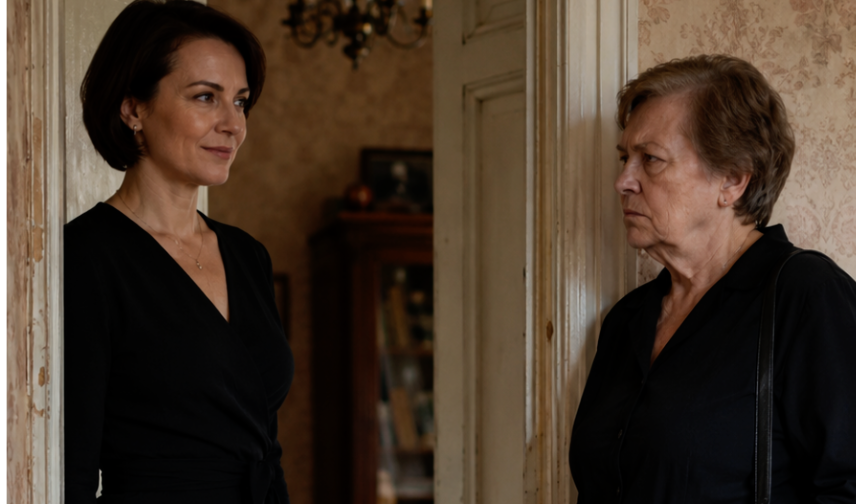
“Poverty suits you better than wealth,” her sister-in-law sneered as she evicted her from the apartment.
Raisa was packing her things into an old suitcase, wiping away tears from time to time. The room that had been her home for the past three years was empty now. Not a single book remained on the shelves, all the photographs had been taken down from the walls, and Alla had even forced her to remove the curtains.
Alla, her sister-in-law, the sister of her late husband, stood in the doorway and watched her pack with a cold expression. Her black dress made her look even gloomier, and her thin lips were pressed into a contemptuous line.
“Well? Are you ready?” she asked, glancing at her watch. “The car will be here in half an hour.”
“Almost,” Raisa answered quietly, closing the suitcase. “I just need to put the documents into my bag.”
“Don’t forget to leave the keys on the table.”
Raisa nodded. Outside the window, rain was falling. The gray November day matched her mood perfectly. She sat down on the edge of the bed, which no longer belonged to her either.
“Alla, maybe we could discuss this one more time? I’m willing to pay for the room.”
“Pay for what?” her sister-in-law raised her eyebrows mockingly. “You don’t have any money. Your pension is pitiful, and you have no job.”
“I can find work. Some kind of part-time job.”
“At your age? Who needs you? You’re fifty-eight, Raisa. It’s time you understood that yourself.”
Her words cut painfully. Raisa knew she looked older than her years. Her husband’s illness, his death, and constant worry had left their mark on her appearance.
“I’m not asking to live here for free. I’m ready to pay the full rent.”
“What rent?” Alla walked into the room and demonstratively opened the window. “They ask twenty-five thousand for a room like this in the city center. Do you have that much?”
“Not yet. But I’ll find a way to earn it.”
“Oh, sure. Keep dreaming.”
Raisa stood up and went to the window. Expensive cars were parked in the courtyard, and well-dressed people were walking their dogs. This neighborhood really was beyond her means.
“Alla, I understand the apartment is yours. But Victor would have wanted you to help me.”
“Victor would have wanted that?” her sister-in-law smirked. “And how do you know what my brother would have wanted? You only lived with him for seven years.”
“But we loved each other.”
“Loved each other? Or did you love his money?”
Raisa turned away from the window. In Alla’s eyes, she saw hostility that she no longer bothered to hide.
“What do you mean?”
“I mean that you married Vitya for calculation. He was a wealthy widower, and you were a divorced woman with no means of support.”
“That’s not true!”
“It is true. And we both know it.”
Raisa sat back down on the bed. Indeed, when she had met Victor, she had been in serious financial trouble. Her divorce from her first husband had left her with practically nothing. She had even had to sell her apartment to pay off his debts.
“Alla, yes, I was struggling back then. But I loved Vitya sincerely.”
“Of course you loved him. How convenient it was to love a man with an apartment and savings.”
“I cared for him when he was ill! For three years I barely left his bedside!”
“You were caring for your future inheritance.”
Those words struck Raisa like a slap. Did her sister-in-law really think that of her?
“Alla, how can you say such a thing? Vitya was my husband!”
“Vitya was my brother. And I knew him better than you did.”
“You knew him? Then tell me why he married me if I was so greedy?”
Alla went to the window and looked out at the rain.
“Vitya was lonely. After his first wife died, he needed a woman beside him. And you happened to be available.”
“Available? We met at a health resort, by chance!”
“By chance? You went there on purpose, knowing that wealthy men rested there.”
Raisa felt everything inside her tighten with hurt. Was that really how her meeting with Victor looked from the outside?
“Alla, it was a cardiac health resort. I went there for treatment after a heart attack.”
“A heart attack caused by nerves after your divorce?”
“Yes, exactly.”
“You see? It all fits. Divorce, debts, illness. And then a fortunate meeting with a well-off widower.”
Raisa stood up and approached her sister-in-law.
“Alla, if you really think that, then why did Vitya leave me the right to live in the apartment?”
“He didn’t leave it to you. He left the apartment to me, and allowed you to stay here until you got back on your feet.”
“But the will says…”
“The will says that you may live in the apartment temporarily. Temporarily, Raisa. Three years is already far too long.”
Raisa returned to her bag and continued putting her documents inside. Her hands were trembling, and tears welled up in her eyes again.
“Alla, where am I supposed to go? I have no other relatives, and almost no friends left.”
“That’s your problem. You should have thought about that earlier.”
“Thought about what earlier?”
“That beauty doesn’t last forever, men die, and life goes on.”
Raisa stopped and looked at her sister-in-law.
“Do you hate me?”
“I don’t hate you. I simply don’t consider you part of the family.”
“But I was your brother’s wife!”
“You were. The key word is were.”
The intercom rang in the hallway.
“That’s the car,” Alla said. “It’s time.”
Raisa picked up her suitcase and bag. She looked around the room one last time, the room where the best years of her life had passed. Here she had been happy with Victor, here she had cared for him during his illness, and here she had seen him off on his final journey.
“Poverty suits you better than wealth,” her sister-in-law sneered as she evicted her from the apartment.
Raisa stopped at the door.
“What did you say?”
“You heard me. Being poor suits you better. At least it’s honest.”
“Alla, why do you hate me so much?”
Her sister-in-law was silent for a moment, and then suddenly spoke with pain in her voice.
“You know why? Because you got what should have belonged to me.”
“What exactly?”
“My brother’s care. His final years. His money.”
Raisa understood then that this was not only about the apartment.
“Alla, you had your own marriage, your own family.”
“I did. But Vitya was the only person close to me after our parents died. And then you appeared.”
“I didn’t take your brother away from you.”
“Yes, you did. He started thinking only about you. About your health, your comfort. And he forgot about me.”
“That isn’t true! Vitya loved you very much!”
“He loved me differently. Like a sister who was supposed to take care of herself. But he loved you as a woman who had to be protected.”
Raisa suddenly understood the real reason for her sister-in-law’s hostility. She had been jealous of her brother, even if she had not fully realized it herself.
“Alla, we could have been friends. Vitya wanted that.”
“We could have. If you had been different.”
“Different how?”
“Honest. If you had admitted from the beginning that you were marrying him for his money.”
“But that wouldn’t have been true!”
“It would have been true. And Vitya understood that.”
“What did he understand?”
“That you didn’t love him. That you agreed to marry him because of money.”
Raisa lowered her bag to the floor.
“Alla, if Vitya understood that, then why did he marry me?”
“Because he didn’t care. He wanted a woman beside him. Which woman didn’t matter.”
“Then why are you angry with me? I gave him what he wanted.”
“Because you acted like it was love! You played the devoted wife!”
“I wasn’t acting! I truly came to love him!”
Alla laughed.
“You came to love him? When? After the wedding?”
“Yes! After the wedding! Vitya turned out to be a kind, caring man. I couldn’t help loving him.”
“But you didn’t marry him for love.”
“Yes, not for love. But that doesn’t make our marriage worthless.”
“It does. Because Vitya deserved more.”
Raisa picked up her bag.
“Alla, Vitya was happy with me. He told me so himself.”
“He said that because he didn’t want to upset you.”
“Or because it was true.”
They stood facing each other in the hallway, and between them lay a chasm of misunderstanding.
“Raisa, you can convince yourself as much as you want that you loved my brother. But I know the truth.”
“What truth?”
“That if Vitya had been poor, you would never have married him.”
Raisa thought about those words. Perhaps her sister-in-law was right. Perhaps she would not have noticed a poor Victor.
“Alla, you’re right. Maybe I wouldn’t have paid attention to a poor man. But that doesn’t mean I didn’t love him.”
“You loved his money.”
“No. I loved him. His kindness, his humor, his care.”
“Care he could afford because of money.”
“No! Care that was part of his character!”
The intercom rang again.
“The car is waiting,” Alla said. “Go already.”
Raisa took her things and headed toward the door.
“Alla, what will happen to the apartment?”
“I’ll sell it. I need the money more than memories.”
“That’s a pity. Vitya loved this place.”
“Vitya is dead. And I’m alive, and I want to live better.”
Raisa opened the door but turned around on the threshold.
“Alla, I wish you happiness. Sincerely.”
“Thank you. And I wish you to find your place in life. Without other people’s money.”
Raisa went downstairs and got into the taxi. The driver asked for the address, but she did not know what to say. Hotels were expensive, and rented housing was expensive too. The only thing left was to turn to social services.
“To the social service center, please,” she told the driver.
As the car drove through the city, Raisa thought about her sister-in-law’s words. Had Alla been right? Had her marriage to Victor really begun as calculation on her part?
Perhaps it had. But it had ended in sincere attachment, even love. Did that not matter?
Outside the window, the streets where she and her husband had once walked slid past. The café where they had met. The park where they had fed pigeons. All of it belonged to the past now.
The driver stopped in front of a gray building with a sign that read “Social Service Center.” Raisa paid and got out of the car. A new stage of her life was beginning. A stage in which she would have to prove to herself that she was capable of living without anyone else’s support.
Maybe her sister-in-law had been right, and poverty really did suit her better. But Raisa was ready to find out.
The taxi drove away, leaving Raisa standing before the building with peeling plaster. The Social Service Center looked as if it needed care itself. Inside, it smelled of cheap cleaning solution and dust.
A woman of about sixty sat at a desk by the window, with a tired face and a thick folder in front of her.
“Hello,” Raisa said, trying to keep her voice steady. “I need help with temporary housing.”
The woman raised her eyes and looked at the suitcase and bag.
“There are no available places at the shelter,” she said dryly. “We can offer you a bunk in a night shelter on the outskirts.”
Raisa shuddered. She had always thought that living in a night shelter was the very last thing she could sink to.
“Is there any other option?” she asked almost in a whisper.
The woman sighed.
“There is a program for older people — assistance with job placement and a temporary room attached to a church. But you have to help at least a little: care for the sick or do household work.”
That same evening, Raisa found herself on the grounds of an old monastery that had been turned into a shelter. White walls, silence, and the scent of incense. She was met by Mother Agnia, a woman with a gentle voice and attentive eyes.
“Everything here is simple, Raisa. There is a free room, but you will have to work. Heating the stove, cleaning, sometimes cooking. Can you manage?”
Raisa nodded. She was ready for anything, as long as she did not have to go to the night shelter.
The first days at the monastery passed in silence. She got up at six in the morning, helped in the kitchen, washed floors, and heated the stove in the neighboring wing. Physical exhaustion strangely dulled the pain in her soul.
But at night, lying on the hard bed, Raisa returned again and again in her thoughts to Victor. She remembered his hands, his warm voice, the way he teased her about her cooking mistakes.
And Alla’s words — “poverty suits you” — cut into her heart.
One evening, while she was sweeping the courtyard, an old Volga pulled up to the gates. A man in a long coat stepped out of the car, leaning on a cane. He looked around and approached Mother Agnia.
“This is Alexei Sergeyevich,” Mother Agnia introduced him. “A patron who has helped us for many years.”
The man nodded, and when he noticed Raisa, his gaze lingered on her.
“And this is your new helper?”
“Yes,” Mother Agnia replied. “She came to us recently.”
Alexei came closer.
“You’re not from the central district by any chance, are you? Your face seems familiar.”
“I lived there…” Raisa answered quietly.
He smiled slightly.
“Strange. I thought I remembered everyone from that courtyard.”
A few days later, Alexei appeared again. He brought food, books for the library, and… a bouquet of chrysanthemums, which he unexpectedly handed to Raisa.
“Just because,” he said, noticing her surprise. “You reminded me of a woman I once knew.”
Raisa took the flowers, but felt uneasy inside. It seemed to her that there was something more behind this attention.
Soon he began coming more often. He would sit with her on a bench by the wall and ask about her past. She told him little by little, leaving out the conflict with Alla.
But one day Alexei said:
“I actually knew Victor. We worked together at a design institute about twenty years ago.”
Raisa’s heart skipped a beat.
“You… knew him?”
“Yes. He was a good man. But always closed off. He hardly spoke about his personal life. I was surprised when I heard he had married.”
“Why?” she asked, trying to remain calm.
“Because after his first wife died, he used to say he would never be able to love again.”
Raisa lowered her eyes.
“And yet he did…”
“Perhaps,” Alexei said thoughtfully. “Or perhaps he simply wanted someone beside him to share his final years.”
Those words painfully reminded her of her conversation with Alla. But there was no contempt in Alexei’s voice, only regret.
In winter, snow covered the monastery grounds. One day Raisa slipped on the porch and badly hurt her arm. When Alexei found out, he insisted on taking her to a city clinic.
In the car, he suddenly said:
“You know, I don’t have a family either. My wife died ten years ago. My children moved away. And it seems to me that you and I… understand each other.”
Raisa felt everything inside her mix together — gratitude, fear, and some new, quiet hope.
In spring, Alexei offered her work: to look after his country house and help with the garden.
“You can live there,” he said. “It’s a spacious house. And there will be no rent.”
Raisa hesitated for a long time. It seemed to her that accepting someone’s help again meant admitting defeat. But Mother Agnia said:
“Sometimes the Lord sends people not to test us, but to support us.”
And Raisa agreed.
The house was bright, with a large garden where apple trees bloomed in spring. Alexei lived in a separate wing, but often invited her to drink tea on the veranda. They talked about books, music, and the past.
Gradually Raisa began to understand: beside him, she did not feel like a debtor. Their communication was quiet, without false passion, but with a warmth she had not felt in a long time.
One evening he said:
“You know, Raisa, I am not asking you to marry again. But… if one day you want to have a friend you can lean on, I am here.”
She remained silent, feeling tears rise in her eyes.
“Thank you,” she whispered. “But I need time.”
Epilogue
A year passed. Raisa stood in the garden, where the apple trees were blooming again. She had learned to care for the trees, plant flowers, and bake pies that Alexei called “medicine for loneliness.”
Sometimes she still remembered Victor, but now without that sharp pain.
During that time, Alla had sold the apartment and, according to rumors, invested the money in a failed business.
One day Raisa received a short letter from her:
“You were right — memories are sometimes more valuable than money.”
Raisa did not reply. But there was no anger in her heart, only quiet forgiveness.
That evening, Alexei came out onto the veranda holding two mugs of tea.
“The stars are especially bright tonight,” he said.
Raisa smiled.
“Probably because life has become bright again.”
And she understood: poverty had indeed suited her back then, because through it had come a new, quiet, but genuine joy.