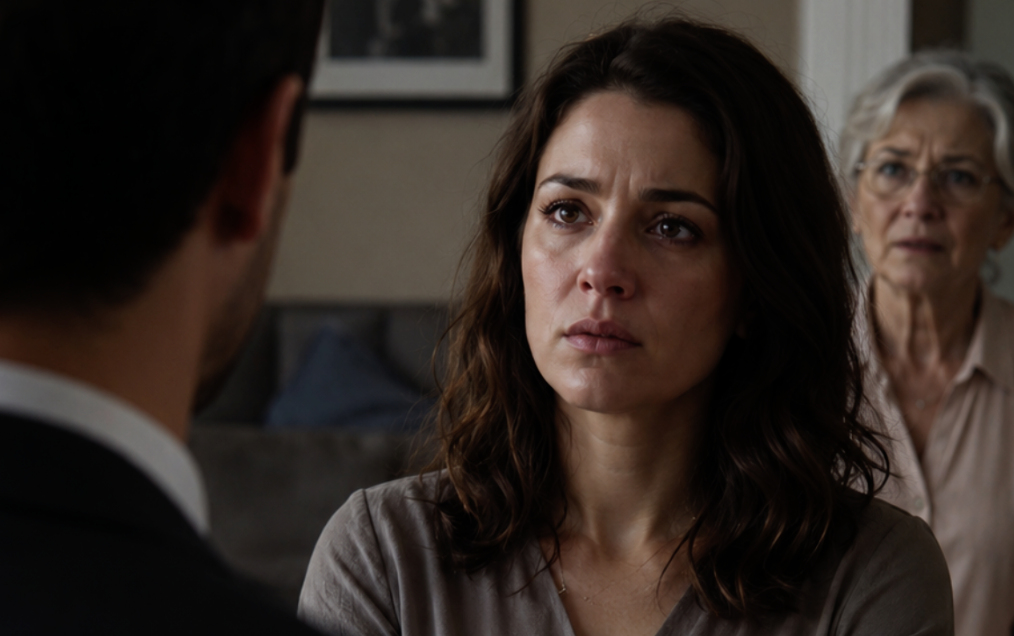
The day had turned out unusually quiet. Marina was sitting on the veranda of the country house, sorting herbs for drying. Her whole life had been measured, like a clock in a hospital corridor — one hand after another, day after day. Twenty years of marriage to Andrey had turned into a habit, like morning coffee — a little bitter, but without it the day would not begin.
Her phone vibrated, showing her husband’s name.
“Marin, I won’t come today. Too much work piled up,” his voice sounded as detached as usual. “Don’t get bored there. There’s everything you need in the fridge. Are you coming back to the city tomorrow?”
“I wanted to stay one more day. It’s quiet here,” she answered, winding a loose thread from her apron around her finger.
“Well, as you wish. Then we’ll see each other the day after tomorrow.”
The call ended as abruptly as it had begun. And in Marina’s head, like a worn-out record, one question kept spinning: “When did everything become just a function? When did love turn into a schedule?”
Evening descended slowly over the dacha settlement, wrapping the trees in twilight. Marina was making compote when she heard the sound of a car pulling up. “Could Andrey have changed his mind?” flashed through her mind. She looked out the window and froze: her husband was helping his mother, Galina Petrovna, out of the car.
Instinctively, Marina stepped back into the shadows. Twenty years of habit — giving in, not interfering, not irritating her mother-in-law — worked instantly. “Why did they come if they thought I was here alone?” the thought flashed through her mind, followed by a strange feeling that something was wrong.
Holding her breath, she walked into the far room, from where the conversations on the open veranda could be heard perfectly.
“Andryusha, you should open the windows in the house. It must be stuffy in there,” Galina Petrovna said in a commanding tone. “Good thing your wife didn’t come. At least we can sit calmly and have some tea.”
“Mom, don’t start,” Andrey replied tiredly. “Marina is a normal woman.”
“Normal?” Metal rang in his mother’s voice. “I’ve been looking at her for twenty years and still can’t understand how you live with her. No proper education, no interests, only her little cabbage patch at the dacha and that district hospital of hers.”
Marina flinched as if she had been slapped. Had she not refused advanced training courses for the sake of her family? Had she not given up her dream of becoming head nurse for her husband’s sake?
“Mom, let’s not,” Andrey said, something metallic clinking, apparently as he took out cups. “It’s hot today…”
“What do you mean, ‘let’s not’?” his mother would not stop. “You lived with that fool for the sake of registration and convenience, and you’ll keep living that way. She arranged everything for you, gave birth to children, and you thought someone decent would marry you?”
The silence that followed those words collapsed onto Marina like a heavy weight. Her heart was pounding somewhere in her throat, drowning out all other sounds. “For the sake of registration… fool… convenience…” echoed in her head.
“Yes, Mom, I’ve been thinking for a long time myself about how to wrap all this up,” Andrey’s voice sounded dull, as if he had turned away. “Only I hate the thought of the money — I don’t want to split anything with her.”
Marina pressed her palm to her mouth, holding back the scream that was tearing out of her. Twenty years… Twenty years had turned to ash in a matter of minutes. Images from the past flashed before her eyes: herself handing over her savings for the down payment on the apartment, taking extra shifts to pay for his retraining courses, patiently listening to yet another jab from her mother-in-law.
“What is there to split?” Galina Petrovna snorted. “The apartment is registered in your name. And that dacha… Well, give her the dacha, let her grow her cabbage there.”
“I bought the apartment with my own money,” Andrey lied so easily, as if he had been doing it all his life.
Marina laughed silently. Hysteria rose in her throat, but years of working in medicine had taught her to keep herself together even in the hardest situations. “Calm down,” she told herself. “Think like a nurse. The diagnosis has been made. Now you need a treatment plan.”
Meanwhile, on the veranda, the conversation shifted to some household trifles.
Marina carefully crept toward the back door. Her bag, phone, and documents — everything was with her. Slipping out of the house, she walked toward the bus stop, trying to stay in the shadows of the trees.
The bus appeared as if on command. Marina sat by the window, looking at the landscape passing by, but not seeing it. A clear plan of action was forming in her head.
“First — a lawyer. Second — bank statements. Third — gather all receipts and documents for the apartment,” she methodically listed to herself, as if making a list of necessary medications.
Her phone vibrated again. A message from Andrey appeared on the screen: “How are you? Not bored?”
Marina looked at those words, so ordinary and so false, and for the first time in twenty years of marriage, she did not answer immediately. Instead, she opened the browser and typed into the search bar: “Legal consultation for divorce.”
That evening, sitting in her city apartment, she methodically gathered documents. Every receipt, every payment slip, every bank statement went into separate folders. For twenty years, she had kept everything without knowing why. Now she knew.
“You came back early,” Andrey said in surprise when he appeared at home the next day. “You said you were going to stay longer.”
“I changed my plans,” Marina answered in an even voice. “I didn’t feel very well.”
She did not say that this “not feeling well” had a name — betrayal. Marina looked at her husband with new eyes, as if she had taken off rose-colored glasses she had been wearing for two decades. How had she not noticed these small gestures of disrespect before? How had she not seen the falseness in his care?
“And what about you? How did your business go?” she asked, trying to make her voice sound normal.
“Fine,” Andrey threw his keys onto the small table in the hallway. “Just tired. Mom sends her regards.”
“After everything I heard?” Marina almost laughed at the absurdity of the situation.
“Really?” she raised her eyebrows. “How sweet of her.”
Andrey gave her a strange look but said nothing. He was not used to irony in his wife’s voice. He was not used to the idea that she could be different — not a helpful shadow, but a person with her own thoughts and feelings.
“Will you have dinner?” Marina asked, and this simple question, which she had asked thousands of times during their life together, now sounded different. Like a question from a stranger.
“Yes, of course. What do we have?”
“We?” Marina allowed herself a slight smile. “We have nothing. You have reheated borscht in the microwave.”
She went into the bedroom, leaving her puzzled husband in the kitchen. Her heart was pounding somewhere in her throat, her hands were trembling, but along with it came a strange relief. As if she had been carrying an unbearable burden for a long time and had finally decided to put it down.
The next day, Marina took a day off from the clinic and went for a consultation with a lawyer.
“So,” the elderly attorney looked at her carefully over his glasses, “you claim that you contributed a significant part of the funds for the purchase of the apartment, but only your husband is listed as the owner?”
“That’s right,” Marina took out a folder with documents. “Here are the statements from my accounts. Here is information about my extra shifts. I took them specifically to save for the down payment.”
The lawyer methodically examined the papers, making notes from time to time.
“And why did you agree to register it only in your husband’s name?” he asked without judgment, simply in a businesslike way.
“He convinced me it would be easier with the mortgage,” Marina smiled bitterly. “He said it was just a formality. That we were family…”
“Family…” the lawyer echoed. “You know, Mrs. Marina, this is not the first case like this in my practice. But you have good chances. Especially with such a body of evidence.”
When she left the office, something inside her seemed to shift. All the doubts, all the insecurity that had been accumulating for years, retreated before one simple thought: “I deserve better.”
The following week turned into a strange game for Marina.
During the day, she was the same caring wife as before — she cooked dinner, asked about his affairs, kept up conversations. But inside her, a new light seemed to have been lit — the light of realizing her own worth.
In the evenings, when Andrey fell asleep, she worked on her plan. She studied the law, consulted with the lawyer, gathered evidence of her financial participation in the family budget. For twenty years, she had kept everything, as if sensing that one day these papers would become her shield and sword.
“Maybe we should go visit Mom this weekend?” Andrey suggested once over dinner. “We haven’t visited in a while.”
Marina raised her eyes from her plate and looked at her husband carefully. Before, she would have simply nodded, accepting the inevitable prospect of listening to her mother-in-law’s barbs. But now…
“You know, I think I’ll skip this visit,” she said, sipping her tea and watching his reaction. “I have other plans for the weekend.”
“What plans?” Andrey frowned, like a child whose toy had been taken away.
“Personal ones,” Marina answered simply.
“Personal?” he smirked. “Since when do you have any personal plans?”
There was so much contempt in that question that Marina physically felt something inside her break. No, not break — free itself. Like ice on a river in spring.
“Since I decided that I have the right to them,” she answered calmly.
Andrey looked at her in confusion, but he did not argue. He was used to Marina eventually agreeing with him, giving in, keeping silent. But his “convenient” wife was disappearing before his eyes, and he did not even understand what was happening.
On Saturday, Marina really did take care of her own affairs.
She made an appointment with the director of a private clinic and sent in her résumé.
“You’ve been working at the district clinic for a long time?” asked the gray-haired director, looking through her documents.
“Twenty-two years,” she answered with pride. “I started right after medical college.”
“And why did you decide to change jobs?”
Marina thought for a second. How could she explain that this was part of her new path? That she had finally decided to live for herself?
“I want to develop further,” she said simply. “The district clinic is too… predictable. And I realized that I can do more.”
The director nodded understandingly, as if he had heard something important between the lines.
“We actually need experienced medical staff in the diagnostics department right now. When could you start?”
“In a month,” Marina answered firmly. “I need to finish some matters.”
When she returned home, Andrey was sitting in the kitchen with a sour expression on his face. Beside him stood an unfinished cup of tea, and his phone lay nearby, which he glanced at from time to time.
“Where were you?” he asked in a tone strangely mixed with irritation and confusion.
“I had an interview,” Marina answered, taking off her coat. “At a private clinic.”
“At a clinic?” Andrey looked as if she had told him she had flown to the moon. “Why? You already have a job.”
“I decided to change it,” she shrugged, walking past him toward the refrigerator. “They offered better conditions and room for growth.”
“Why all of a sudden?” Andrey stood up, blocking her way. “You worked at the clinic for twenty years, and everything suited you. And now suddenly — a private clinic!”
Marina looked him straight in the eyes. Before, she would have stepped back, started justifying herself, explaining. But not now.
“People change, Andrey,” she said calmly. “I realized that I deserve more.”
“More?” he gave a nervous laugh. “And what now? Maybe you’ll find yourself a new husband too?”
For a moment, silence fell — heavy and oppressive. Marina felt a wave of bitterness and hurt rise inside her. But through that bitterness, a new voice, unfamiliar to her before, began to break through — the voice of her own dignity.
“You know, maybe I will,” she answered quietly. “Someone who won’t use me for twenty years ‘for the sake of registration and convenience.’”
Andrey’s face changed. From self-assured, it became confused, almost frightened.
“What are you talking about?” he asked hoarsely.
“About the conversation at the dacha,” Marina moved him aside and walked to the table. “When you and your mother thought I had gone back to the city.”
Andrey froze in place. Something like understanding flashed in his eyes, then panic, then anger.
“You were eavesdropping?” he said indignantly.
“I was making compote,” Marina’s voice remained even, though everything inside her was trembling. “When I heard the car. And then… then I learned the truth about my life. About our marriage.”
Silence. The ticking of the clock. The hum of the refrigerator. Their entire life together passed before her eyes like frames from an old film — black-and-white, with faded colors.
“Mom… sometimes she says too much,” Andrey finally mumbled in a conciliatory tone. “You know how she is…”
“This is not about your mother,” Marina interrupted him. “It is about the fact that you did not object. The fact that you confirmed her words. ‘Yes, Mom, I’ve been thinking for a long time myself about how to wrap all this up…’” she quoted him exactly, word for word. “‘Only I hate the thought of the money — I don’t want to split anything with her…’”
Andrey turned pale. His hands, lying on the table, trembled noticeably.
“Marina, listen…” he began in a conciliatory tone. “You misunderstood everything. I was irritated, Mom was pressuring me…”
“No,” she shook her head. “For the first time in twenty years, I understood everything correctly. And you know what?” Marina took a folder of documents out of her bag. “I also don’t want to share with you what doesn’t belong to you.”
She laid the papers on the table — neat stacks of bank statements, receipts, and contracts.
“What is this?” Andrey frowned, trying to make out the documents.
“Proof that half of our apartment was bought with my money,” Marina calmly explained. “Remember how you convinced me to register it only in your name? You said it would be easier with the mortgage. That we were family…”
She smiled bitterly.
“And I, like a fool, believed you. I kept all these papers without even knowing why. Now I know.”
Andrey grabbed the first page and ran his eyes over it.
“Are you going to sue me?” his voice shook. “Because of some conversation? Have you lost your mind?”
“No,” Marina shook her head. “For the first time in a long while, I have come to my senses. And yes, I am filing for divorce.”
She took out another envelope — containing the petition for divorce.
“You can’t do this!” Andrey jumped up from his chair. “We have a son! What will people say? What will Mom…”
“Our son is twenty-one. He lives separately and will understand everything perfectly,” Marina interrupted him. “And as for what people will say… You know, I’m more concerned about what I’ll say to myself if I stay with a man who used me for twenty years ‘for convenience.’”
Andrey paced around the kitchen like a trapped animal. One moment he tried to threaten her, the next he began to ingratiate himself, then he promised to change. Marina silently watched this performance, and inside her the certainty that she had made the right decision grew stronger.
“You won’t manage on your own!” he finally blurted out. “Where will you go? What will you live on?”
Marina smiled — for the first time during the entire conversation.
“I am a nurse with twenty-two years of experience. I have already been accepted into a private clinic, with a salary higher than yours. And as for where I’ll live…” she shrugged. “I’ve found an apartment. Small, but enough for me alone. After the sale of ours and the division of the money.”
“Sale?” Andrey turned white. “What sale?”
“That one, Andrey,” Marina spoke calmly, as if explaining a medication schedule to a patient. “The apartment will be sold, and the money will be divided. Or you will pay me my share — here are the calculations.” She pushed another sheet toward him. “Choose.”
He grabbed the paper and stared at the numbers. His face twisted.
“This is robbery! Where did this amount come from?”
“This is half of the market value, plus my share in the renovation, plus interest for the use of my money all these years,” Marina said like a professional accountant. “The lawyer calculated everything.”
“Lawyer?” Andrey collapsed onto the chair. “You’ve already hired a lawyer?”
“Of course. I’m the ‘fool with the vegetable garden,’ as your mother says. I needed professional advice.”
There was sharp irony in her voice, and Andrey winced at it.
“Marina, let’s discuss everything,” he tried to take her hand. “We’ve been together for so many years… Are you really going to erase everything because of one conversation?”
She gently but firmly freed her hand.
“No, not because of one conversation. Because of twenty years of lies. Because you allowed your mother to humiliate me. Because you used me as a free housekeeper and a source of money.”
Marina stood up from the table.
“You have one week to think. Either we sell the apartment, or you pay me my share. And for now…” she picked up her bag. “I’ll stay with a friend.”
“You can’t just leave like that!” panic sounded in his voice.
“I can,” she headed toward the door. “And you know what? I should have done it much earlier.”
In the hallway, Marina stopped by the mirror. The woman looking back at her seemed different — her back was straight, her gaze confident, her shoulders squared. No longer “the fool with the vegetable garden,” but a person who had finally found herself.
“By the way,” she turned back to her husband, who stood frozen in the kitchen doorway. “Send my regards to your mother. Tell her that she finally got what she wanted — she freed you from an unsuitable daughter-in-law.”
Marina barely slept the first night at her friend’s apartment. Thoughts circled in her head like autumn leaves in the wind — sometimes rising upward on a gust of determination, sometimes falling under the weight of doubt. What if she was making a mistake? What if twenty years was too long a time to cross everything out?
Her phone would not stop ringing and buzzing with messages.
Andrey alternated between threats, pleading, and promises of golden mountains. By morning, Marina simply turned off the sound and placed the phone face down.
“How are you?” asked Lena, her friend from medical college, handing her a cup of hot tea.
“Strange,” Marina answered honestly. “As if I had been tied to a pier my whole life, and now the rope has snapped. I’m free, but I don’t know where to sail.”
“You did the right thing,” Lena sat down beside her. “For twenty years I watched you dissolve into that marriage. I watched you become a shadow. And you know what?” She took Marina’s hand. “I’m glad you finally chose yourself.”