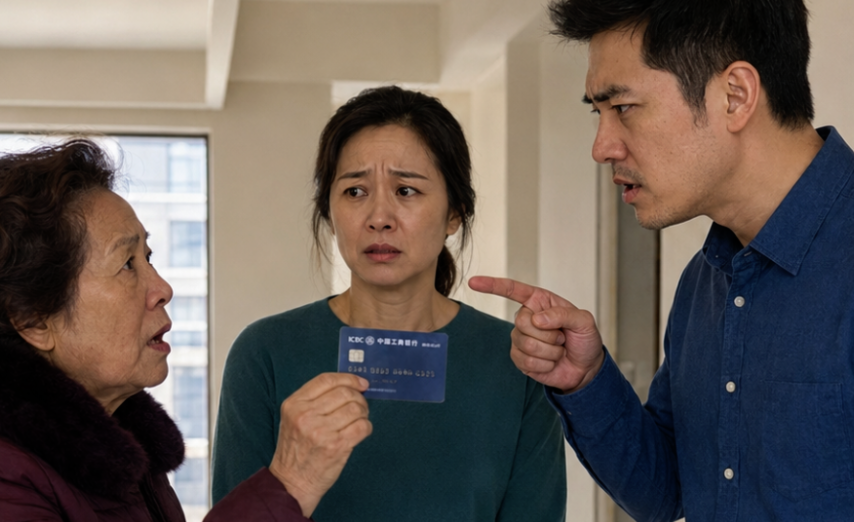
Why Is There No Money on the Card?!” “Because I’m Not Your ATM Anymore, Mom.”
Vera sat in the kitchen, staring at her phone. The message had arrived ten minutes ago, but she still didn’t know how to answer.
“Why is there no money on the card?”
Not “hello,” not “how are you?” Straight to: why is there no money? Vera placed the phone face down. Something tightened in her stomach—not from fear, but from exhaustion. The kind that had been building for years.
Oleg came into the kitchen, took a bottle of water from the refrigerator, and looked at her.
“Her again?”
Vera nodded. Oleg sat down across from her.
He had always known how to read her silence.
“I didn’t send her money this month,” Vera said quietly. “I just… didn’t.”
“So what?” Oleg shrugged. “We have the apartment, the renovation. We’re barely keeping ourselves afloat.”
Vera knew he was right. But knowing was one thing; feeling it was another. Her mother could summon guilt with a single message, a single sigh over the phone.
The phone vibrated again.
“I need it for medicine. You know how sick I am. Or do you not care?”
Vera put the phone back down. She remembered how, a month earlier, she had seen photos on social media of her mother with friends outside a restaurant. A new jacket with a fur collar. Laughter. No high blood pressure, no fever.
“She’s talking about medicine again,” Vera said, running a hand over her face.
“Then answer her,” Oleg suggested. “Honestly.”
Vera looked at him. She had never known how to say no to her mother. Even when she understood she was being used.
Vera had been sending her mother money every month. For years. Her mother hadn’t worked in ten years—first her back hurt, then her heart, then her legs. Vera had wanted to believe her. Because if she didn’t believe her, she would have to admit that her mother simply didn’t want to work.
Oleg once asked:
“What does she spend the money you give her on?”
Vera said nothing. Because she knew. Jackets, handbags, trips, restaurants. But whenever her mother asked, Vera transferred the money. Because otherwise the calls would begin, the tears, the accusations.
“I raised you alone. I gave my whole life to you. And now you’re abandoning me?”
Three weeks ago, Vera and Oleg had bought an apartment. Vera called her mother and told her. Immediately, she heard a dissatisfied sigh.
“Where is it? There’s a road right under the windows. It’ll be noisy. You should have bought one in my building. There’s an apartment for sale in the next entrance. Then I’d be close by.”
“We’re not asking you for a single kopeck,” Vera said, gripping the phone. “This is our decision.”
Her mother sighed—long and painfully.
“Fine. Do whatever you want. Just don’t complain later.”
The next morning, her mother called again. Her voice was trembling.
“Verochka, I felt so terrible last night. I thought I’d have to call an ambulance. My blood pressure shot up, I kept thinking about that apartment. Please, don’t buy it.”
Vera listened and felt everything inside her turn cold. Illness. Blood pressure. Fever. Always the same thing—whenever her mother didn’t get what she wanted.
“Mom, we’ve already signed the contract,” Vera said. “It’s settled.”
Her mother sobbed and hung up.
But this month, something clicked inside Vera. Maybe because of the apartment. Maybe because her mother hadn’t even asked how they were doing. Just: “Why is there no money?” And Vera didn’t send it.
The phone vibrated again. A call. Her mother.
Vera swiped her finger across the screen.
“Hello.”
“What, are you offended with me?” her mother’s voice was sharp. “I’m writing to you, and you’re silent. I need money, Vera. Urgently. For medicine.”
Vera said nothing.
“Vera, can you hear me?” her mother raised her voice. “Or have you decided you don’t need me anymore? Bought an apartment and forgot about your mother?…”
Continued just below in the first comment.
Vera sat in the kitchen, staring at her phone. The message had arrived ten minutes ago, but she still did not know how to answer.
“Why is there no money on the card?”
Not “hello,” not “how are you.” Straight away — why there was no money. Vera placed the phone face down on the table. Something tightened in her stomach — not from fear, but from exhaustion. The kind that had been building for years.
Oleg came into the kitchen, took water from the refrigerator, and looked at her.
“Her again?”
Vera nodded. Oleg sat down across from her.
He had always known how to read her mood by her silence.
“I didn’t transfer money to her this month,” Vera said quietly. “I just didn’t do it.”
“So what?” Oleg shrugged. “We have the apartment, renovations. We can barely breathe ourselves.”
Vera knew he was right. But knowing was one thing, feeling was another. Her mother knew how to cause guilt with a single message, a single sigh over the phone.
The phone vibrated again.
“I need it for medicine. You know how sick I am. Or don’t you care?”
Vera put the phone back down. She remembered how, a month earlier, she had seen photos of her mother on social media with friends outside a restaurant. A new jacket with a fur collar. Laughter. No high blood pressure, no fever.
“She’s talking about medicine again,” Vera said, running a hand over her face.
“Then answer her,” Oleg suggested. “Honestly.”
Vera looked at him. She had never known how to say no to her mother. Even when she understood she was being used.
Vera had been sending her mother money every month. For years. Her mother had not worked for ten years — first her back hurt, then her heart, then her legs. Vera had wanted to believe her. Because if she did not believe her, she would have to admit that her mother simply did not want to work.
Once, Oleg had asked:
“What does she spend the money you give her on?”
Vera had stayed silent. Because she knew. Jackets, bags, trips, restaurants. But whenever her mother asked, Vera transferred the money. Otherwise the calls began, the tears, the accusations.
“I raised you alone. I gave my whole life to you. And now you’re abandoning me?”
Three weeks earlier, Vera and Oleg had bought an apartment. Vera called her mother and told her. Immediately, she heard a dissatisfied sigh.
“Where is it? There’s a road under the windows there. It’ll be noisy. You should have bought in my building. There’s one for sale in the next entrance. Then I’d be nearby.”
“We’re not asking you for a single kopeck,” Vera said, gripping the phone. “This is our decision.”
Her mother sighed — long and strained.
“Fine. Do whatever you want. Just don’t complain later.”
The next morning, her mother called again. Her voice was trembling.
“Verochka, I felt so bad during the night. I thought I’d have to call an ambulance. My blood pressure shot up. I kept thinking about that apartment. Don’t buy it, please.”
Vera listened and felt everything inside her go cold. Illness. Blood pressure. Fever. Always the same thing — whenever her mother did not get what she wanted.
“Mom, we’ve already signed the contract,” Vera said. “Everything is decided.”
Her mother sobbed and hung up.
But that month, something clicked inside Vera. Maybe it was because of the apartment. Maybe because her mother had not even asked how they were doing. Just: “Why is there no money?” And Vera did not transfer anything.
The phone vibrated again. A call. Her mother.
Vera swiped the screen.
“Hello.”
“Are you offended with me or something?” her mother’s voice was sharp. “I’m writing to you, and you’re silent. I need money, Vera. Urgently. For medicine.”
Vera said nothing.
“Vera, can you hear me?” her mother raised her voice. “Or have you decided you don’t need me anymore? Bought an apartment and forgot about your mother?”
Vera closed her eyes.
“Mom, we have a mortgage. Renovations. We’re struggling ourselves.”
“Everyone is struggling!” her mother almost shouted. “But I am your mother! You are obligated!”
The word “obligated” stuck in Vera’s ears. Her fingers loosened around the phone.
“I’ll call you back,” she said, and hung up.
Oleg looked at her.
“She said I’m obligated,” Vera said softly.
He nodded.
“She always says that.”
Vera knew. But only now did she truly hear it.
The next day, her mother came over herself. Without calling, without warning. Vera opened the door and froze. Her mother stood on the threshold with a small suitcase.
“I’ve come to stay with you,” her mother said, stepping into the hallway. “Since you’ve abandoned me, I’ll live here.”
Vera stood by the door, not knowing what to say. Oleg came out of the room. Her mother took off her jacket — the very same one with the fur collar — and hung it on the coat rack.
“Aren’t you happy to see me?” her mother turned to Vera. “Or am I a stranger now?”
“Mom, you should have warned us…”
“Why? I’m your mother. Or do mothers now need permission?”
Oleg stepped forward. His voice was calm and firm.
“No.”
Her mother looked at him as if he had said something indecent.
“What do you mean, no?”
“You are not staying here,” Oleg said evenly. “This is our apartment. We did not invite you.”
Her mother opened her mouth, then closed it. She looked at Vera — waiting for her to defend her. Vera stood silently. Everything inside her trembled, but she said nothing.
“Vera,” her mother took a step toward her. “Do you hear what he’s saying? He’s throwing me out. Your mother. And you’re silent?”
Vera clenched her fists.
“Mom, Oleg is right,” she said quietly. “You can’t just come here and stay.”
Her mother recoiled.
“I can’t? I am your mother! I raised you! I gave my whole life to you! And now you’re throwing me out?”
“No one is throwing you out,” Oleg said, taking out his phone. “But since you’re here, let’s talk honestly.”
He opened a message thread and turned the screen toward her mother. Vera could not see what was there, but she saw her mother’s face change — first surprise, then confusion.
“What is this?” her mother asked, her voice suddenly sharp and frightened.
“These are your messages to me,” Oleg said calmly. “From six months ago. You offered to ‘help with the apartment’ if we bought one near you. I refused. You called me an idiot and said Vera had ‘chosen the wrong man.’”
Vera looked at her mother and did not recognize her. Her mother was silent.
“Six months ago, you were offering money for an apartment,” Oleg continued. “And now you’re writing that you have nothing to buy medicine with. Explain that.”
Her mother grabbed her jacket from the rack and pulled it on with a sharp movement.
“I don’t owe you any explanations!” her voice broke. “You turned her against me! She never behaved like this until you appeared!”
“Mom, enough,” Vera stepped forward. Her voice trembled. “Enough already. I’m tired.”
Her mother looked at her — with incomprehension, with offense.
“Tired? What are you tired of? I’m the one who’s tired! I gave you my whole life!”
“You didn’t give me anything,” Vera said quietly, but every word was like a stone. “You took. For years. Money, time, strength. You took and demanded more. And whenever I said no even once — you got sick.”
Her mother grabbed the suitcase. Her face was white.
“Well then, stay together!” she opened the door and turned back. “Just remember this, Vera: when you need help, don’t come to me. I don’t know you anymore!”
She slammed the door. Vera stood in the middle of the hallway and listened as the footsteps faded in the stairwell. Oleg hugged her from behind.
“You knew,” Vera said. “You knew she had written to you?”
“I knew,” Oleg said quietly. “I wanted to tell you, but you wouldn’t have believed me. You needed to see it yourself.”
Vera nodded. She felt emptied — but not in a bad way. As if something heavy had been taken off her, something she had carried for so long that she had forgotten what it felt like to be without it.
Later, they sat in the kitchen. Oleg showed her the entire conversation. Vera read it and felt everything inside her tighten. Her mother wrote to Oleg in a way she had never written to Vera — harshly, demanding, without fake weakness. She demanded that he persuade Vera. She promised to “help” if Vera lived nearby. And when Oleg refused, she insulted him and added: “Vera will regret getting involved with someone like you.”
“So she had money,” Vera said almost in a whisper. “She always had money. And she wrote that she didn’t have enough for medicine.”
Oleg placed his hand on her shoulder.
“It’s not your fault.”
Vera raised her head.
“I know. It’s just… so many years. For so many years, I believed I owed her. That I had to. And she was simply using me.”
“She won’t change,” Oleg said honestly.
Vera knew he was right. Her mother would not become different. She would not admit guilt. She would believe Vera had betrayed her. And someday she would try to come back — with a new story, new tears, a new illness. But now, for the first time in many years, Vera felt ready to say no. And not feel guilty.
Two weeks passed. Her mother did not call. Did not write. Vera checked her phone out of habit — but there was silence. At first, she waited. Then she stopped.
They began renovations. Wallpaper, paint, new furniture. For the first time in a long while, Vera felt she was doing something for herself — not for her mother, not out of duty. Just for herself.
One evening, while they were painting the bedroom wall, Vera said:
“You know, I keep waiting for her to call. To say she’s at death’s door.”
Oleg turned around.
“And what will you do if she calls?”
Vera thought for a moment.
“I don’t know. But definitely not what I did before.”
Oleg nodded and continued painting. Vera looked at him and thought about how easy it was with him. He did not pressure her, did not demand, did not manipulate. He was simply there.
Another week later, Vera received a message from Lyubov Mikhailovna, Oleg’s mother.
“Come over this weekend. I need to tell you something.”
When they arrived, Lyubov Mikhailovna greeted them with a serious face.
“Your mother called me,” she said, leading them into the kitchen. “She complained that you had abandoned her, that she was ill and had nothing to live on.”
Vera froze.
“I listened to her,” Lyubov Mikhailovna continued. “And then I asked her: do you remember how, three years ago, you asked me for money for surgery? She went silent immediately. I reminded her: a month after that ‘surgery,’ I saw you vacationing by the sea with your friends.”
Vera closed her eyes. Her mother had taken money not only from her. From her mother-in-law too.
“I told her I knew the truth,” Lyubov Mikhailovna said calmly. “That I would not give her another kopeck. She hung up.”
Vera sat there, feeling shame — for her mother, for herself, for not having seen the obvious for so many years.
“I’m sorry,” Lyubov Mikhailovna said quietly. “But you needed to know.”
Vera nodded. Everything inside her hurt, but she was grateful.
That evening, they returned home. Vera went into the kitchen and sat by the window.
Oleg sat beside her.
“I keep thinking,” Vera said, “about how many years I was buying her love. Sending money and thinking that was how it was supposed to be.”
Oleg was silent. Vera looked out the window — down below, the streetlights were glowing. The city lived its own life, and in that life, her mother was just one of millions of people. Not the center of the universe.
“She won’t change,” Vera said. “I understand that. She’ll try again. Maybe in a month, maybe in a year.”
“And what will you do?” Oleg asked.
Vera took out her phone and opened her mother’s contact. She looked at it for several seconds. Then she tapped Block.
Not forever. Just for now. Until she learned how to say no without guilt.
Oleg hugged her. Vera leaned into him and, for the first time in a long while, felt that she had exhaled. Truly. Without heaviness in her chest, without fear, without waiting for the next call.
She had chosen herself. And it was the right choice.
The next morning, Vera woke up and checked her phone first thing. No messages. No missed calls. Before, that would have made her anxious — what if something had happened? But now there was only relief.
She went to the window. Dawn was breaking beyond the glass. Quiet. Peaceful. Ahead of her were renovations, work, ordinary life. And in that life, there was no longer room for someone else’s guilt.
Vera remembered her mother’s words: “You’ll regret it.” Maybe she would regret it someday. Or maybe she wouldn’t. But right now, she felt only one thing — freedom.
Oleg came into the kitchen, sleepy.
“Why are you up so early?”
“I can’t sleep,” Vera smiled. “But it’s the good kind of ‘can’t sleep.’”
He nodded and hugged her from behind. They stood together by the window and watched the city wake up.
Vera thought about her mother. About how perhaps, someday, they might be able to speak differently. Without manipulation, without demands. But that would come later. If it ever came at all.
And right now — she was simply living. Without debt. Without guilt.
And for the first time in many years, that was enough.