The salt-heavy wind of the Chesapeake Bay had a way of cutting through even the most polished exterior, a sharp reminder of the unforgiving nature of the sea. As I drove my sedan across the towering arch of the bridge toward Annapolis, the sun danced off the water with a cruel, shimmering brilliance. It was a beautiful morning for a betrayal.
The United States Naval Academy sat ahead of us, its red-brick architecture a monument to a specific, rigid brand of American legacy. For my family, this was holy ground. My father, Captain David Hayes, lived and breathed the Navy’s traditions; my brother, Ethan, was the golden heir to that lineage. And then there was me—Sophia. In their eyes, I was the administrative footnote, the “paper-pusher” who had chosen the safety of a desk over the glory of the deck.
I found a parking space far from the main entrance, watching the sea of dress whites. The midshipmen stood with a geometric precision that mirrored the expectations I had spent thirty-four years failing to meet. I adjusted the collar of my beige trench coat, a garment chosen specifically for its anonymity. Beneath it, the crisp fabric of my uniform was hidden, along with the weight of the stars on my shoulders. I wasn’t here to upstage Ethan; I was here to survive another day of being invisible. At the security checkpoint, the atmosphere was thick with the scent of starch and authority. A young petty officer, his face a mask of disciplined focus, took my ID. He scanned his tablet, his brow furrowing as he scrolled.
“I’m sorry, ma’am,” he said, his voice polite but unyielding. “I don’t have Sophia Hayes on the guest list for Lieutenant Hayes’s party.”
He turned the screen toward me as if the digital void where my name should be was a physical barrier. “I have Captain David Hayes, Mrs. Margaret Hayes, and Mrs. Jessica Hayes. That’s it.”
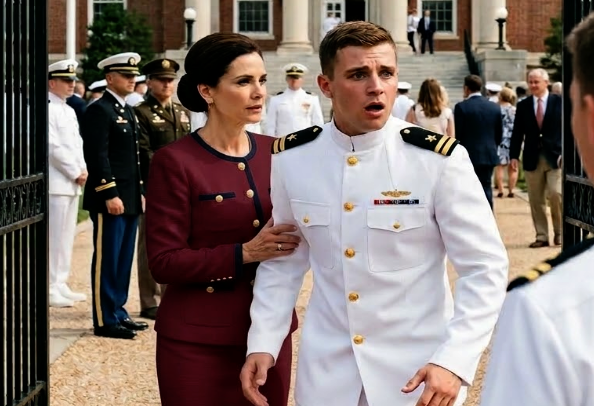
Before I could respond, the familiar, oversized black SUV my parents favored pulled up to the curb. Ethan stepped out, looking every inch the cinematic hero in his tailored dress whites. His skin was bronzed from his recent deployment, his posture radiating the easy confidence of a man who has never been told ‘no.’ He saw me standing there, saw the guard’s apologetic stance, and a slow, familiar smirk spread across his face.
“Problem, Soph?” Ethan asked, leaning toward his wife, Jessica. He didn’t look at me; he spoke at me. “Probably a paperwork mix-up. She’s probably got so many spreadsheets running she forgot to check the invite.” He chuckled, a sound that carried perfectly to the guard. “She should’ve married a real officer instead of playing with files in a basement.”
My mother, Margaret, suddenly became intensely occupied with the clasp of her pearl brooch, her eyes darting everywhere but toward her daughter. My father simply scowled, his face a map of impatient annoyance. He didn’t vouch for me. He didn’t even stop. They walked through the gate, leaving me behind like a piece of luggage they had decided was no longer worth the overhead fee.
“Ma’am, I’m going to have to ask you to step aside,” the petty officer said.
I didn’t argue. I didn’t protest. I simply stood there, my spine a rod of ice, and watched them disappear into the hallowed grounds that had rejected me on their command. The hurt didn’t vanish; it crystallized. It became a cold, hard decision. To my family, I was a “desk jockey.” They pictured me in a windowless cubicle, perhaps worrying over the procurement of office supplies or the formatting of memos. They had no concept of the “Tank.”
Deep beneath the Pentagon, the Tank is a world of recycled air and the low-frequency hum of high-end servers. It is a mosaic of thermal feeds, satellite imagery, and cascading lines of cryptographic code. That was my office. That was my battlefield.
I remembered a Tuesday that had bled into a Wednesday six months prior. We were tracking a high-risk hostage situation in the Red Sea. On the massive curved wall of screens, I watched heat signatures on a civilian oil tanker. My team was feeding me data in a rhythmic, focused cadence.
“Viper 1, confirm target. You are two mics out,” I had whispered into my headset.
My personal cell phone had buzzed in my pocket—a text from Ethan: “Enjoying your weekend in DC? Bet the museums are thrilling. Try not to get a papercut. SIS.”
I had ignored it. On the screen, I saw a flicker—an unlit trawler approaching the tanker from the stern. It wasn’t on the maritime charts. It was a ghost.
“Zoom in, Eagle Eye. Focus on that trawler. Now.”
The resolution sharpened. Six heat signatures. Armed. It was an ambush. They were waiting for the SEALs to board.
“Viper 1, abort. Abort,” I commanded, my voice cutting through the tension. “You have a secondary hostile force at your six. They’re walking you into a kill box.”
The mission was aborted. Lives were saved. But when I returned to my empty apartment at 3:00 AM, there were no medals waiting for me—only the silence of a secret life and a half-finished glass of bourbon. Solitude was the price of silent power. My family thought I pushed paper; they had no idea those papers held the fates of nations. The shift began in the office of General Miller, a four-star commander whose reputation for grit was matched only by his strategic brilliance. Two days after the Red Sea operation, he had summoned me.
“Captain, you look exhausted,” he’d said, handing me a heavy ceramic mug of black coffee. It was a rare moment of humanity in a world of protocol. He sat behind his mahogany desk and looked at me with a gaze that made me feel truly seen. “You saved twelve lives the other night, Sophia. And the entire SEAL team. The president knows. I know.”
He leaned forward, his eyes twinkling with a sudden, audacious idea. “The Joint Chiefs have decided to declassify parts of Operation Blackwater. It’s time we recognized the heroes in the shadows. The Navy has nominated you for the Distinguished Service Medal.”
I was stunned. The DSM was one of the highest non-combat honors in existence.
“Sir,” I’d whispered, “my family… they think I’m a paper-pusher.”
Miller let out a booming laugh that rattled the windowpanes. “A desk job? Well then,” he said, a master strategist seeing a new move. “Your brother has a ceremony in Annapolis next month, doesn’t he? How poetic would it be to recognize two Hayes children on the same day?”
That seed of hope was terrifying. I remembered the previous Fourth of July—my father at the grill, Ethan regaling the crowd with a heavily fictionalized version of a carrier landing, and my mother pulling me aside to suggest I date an orthopedic surgeon because “a career is fine, but happiness requires a husband.” I had spent my life building a fortress of ice to survive their dismissal. Now, Miller was offering me a way to melt it—or to shatter it completely. Back at the gate in the present, the sound of a government-issued black sedan interrupted the petty officer’s attempt to shoo me away. The engine had that distinctive, expensive purr. The door opened, and General Miller stepped out, his four stars burning in the morning sun.
He didn’t look at the guard. He didn’t look at the gate. He looked at me.
“There you are, Admiral Hayes,” he said, his voice carrying the effortless authority of a man who commands fleets. “We were about to send a search party.”
The petty officer’s face went through a spectacular transformation. The mask of discipline shattered into raw, unadulterated panic. His skin turned the color of parchment. He had just tried to eject a flag officer.
“Admiral, ma’am… my deepest apologies!” he stammered, snapping into a salute so violent it looked painful. He practically dove for the gate controls.
General Miller placed a hand on my elbow. “Are you all right, Sophia? Do I need to have a word?”
I looked past him to where my family stood a few yards away. They were frozen, their mouths slightly agape, like statues in a park. The old Sophia—the girl who kept her science fair medals in a wooden box—wanted to scream for validation. But that girl was gone.
“That won’t be necessary, General,” I said, my voice as calm as a deep-water trench. “I think they’ll figure it out today.”
He led me to a private waiting room behind the main stage. Alone in the silence, I walked to a full-length mirror. I stripped off the beige trench coat, folding the “civilian Sophia” away. Beneath it was the immaculate service dress white uniform. From a velvet box, I took my rank insignia: two silver stars for each shoulder.
Click. This is who I am. Click. This is what I have earned.
When I stepped back into the VIP section, the atmosphere had shifted. Senior officers—men who had seen me in the Tank, men who knew the cost of Operation Blackwater—rose to greet me. A Vice Admiral shook my hand. “Phenomenal work on Blackwater, Sophia. Long overdue.”
I sat next to General Miller, my hands resting calmly in my lap. I could feel my family’s gaze from across the aisle. It was a physical weight. My father was whispering urgently to my mother; Ethan was staring at the stars on my shoulders as if they were a glitch in reality.
The ceremony proceeded with the usual pomp. Ethan was called to the stage to receive a Navy Commendation Medal. He was brilliant—charming, humble, and perfectly polished. He thanked my father for teaching him to be a warrior. He thanked my mother for her prayers. He thanked his wife for being his anchor.
He never mentioned me. Not once. It was a public erasure, a final declaration that I did not exist in the ledger of his life.
As he walked off the stage, basking in the applause, General Miller stood and walked to the podium. The room fell into a sudden, expectant hush.
“Ladies and gentlemen,” Miller began, his voice a low rumble. “We have a special addition to today’s ceremony. For reasons of national security, this has been kept from the public until this very moment. We often honor the heroes we can see—the pilots, the sailors. But there is another kind of hero. Their battlefield is a global network of data and secrets.”
He paused, the silence in the auditorium absolute. “Today, we recognize the commander of Operation Blackwater, one of the most successful intelligence campaigns in modern history. It is my honor to ask her to the stage: Rear Admiral Sophia Hayes.”
The silence that followed was deafening. Then, like a wave, every uniformed person in the room rose to their feet. It was a reflex of respect.
All except three people.
My parents and Ethan remained seated, frozen in their chairs. My father’s face was a mask of incomprehension. My mother’s hand was pressed to her mouth. But it was Ethan’s face I watched—the golden-boy tan had been replaced by a sickly, ashen pallor.
As General Miller pinned the Distinguished Service Medal to my uniform, he leaned into the microphone. He didn’t just read the citation; he told the story. He spoke of strategic victories that had averted regional wars. And then he delivered the final strike.
“Just last year, actionable intelligence gathered and analyzed in real-time by Admiral Hayes’s unit resulted in a U.S. destroyer being saved from a catastrophic missile ambush in the Persian Gulf.”
I watched the truth detonate in Ethan’s eyes. He knew exactly which destroyer that was. It was his. My “desk job” hadn’t just been “paper-pushing”; it had been the only reason he was standing on that stage today. The reception was a blur of handshakes and high-level conversations, but the real conclusion happened in a private conference room down the hall.
Ethan’s rage exploded the moment the door closed. “Why?” he yelled, pacing the room. “You let us believe you were nothing! You made us look like fools out there! You were laughing at us!”
I poured a glass of water, waiting for the storm of his ego to break. “I was never laughing at you, Ethan,” I said. “I was doing my job. A job that required secrecy.”
I turned to my father. “Did you ever ask me about my work, Dad? Or did you just assume it was meaningless because it didn’t involve a cockpit?”
The silence that followed was the heaviest I had ever known. My father, the indomitable Captain Hayes, seemed to shrink. He bowed his head, looking every bit his age for the first time.
“I didn’t lie to you,” I said, walking toward the door. “I simply stopped trying to explain myself to people who had already decided not to listen. If we are to have a relationship, it starts with respect. Real respect. Think about it.”
Six months later, I visited my parents’ home. In the living room, there was a new display case of dark cherry wood. My father was polishing it. In the center, at eye level, sat my Distinguished Service Medal and a photo of the ceremony.
“Your father built that,” my mother said softly. “He said it was time the display case told the whole story.”
Dinner that night was different. There were no exaggerated stories. My father asked me about the complexities of Pentagon politics. Ethan spoke about risk analysis protocols, his voice devoid of his usual arrogance.
After dinner, Ethan and I sat on the porch swing. “I’m sorry, Sophia,” he said, looking at the tree line. “The way I treated you… it wasn’t about you. It was about my own insecurity. I needed to be the hero.”
“Thank you, Ethan,” I replied. “I used to think I needed your approval to be whole. I was wrong. My worth was always there. Having you see it is a gift, but it’s no longer a requirement.”
The peace we found wasn’t a victory in the traditional sense. It was something more profound. It was the dawn of a new era for our family—one built on the truth of what it means to serve.