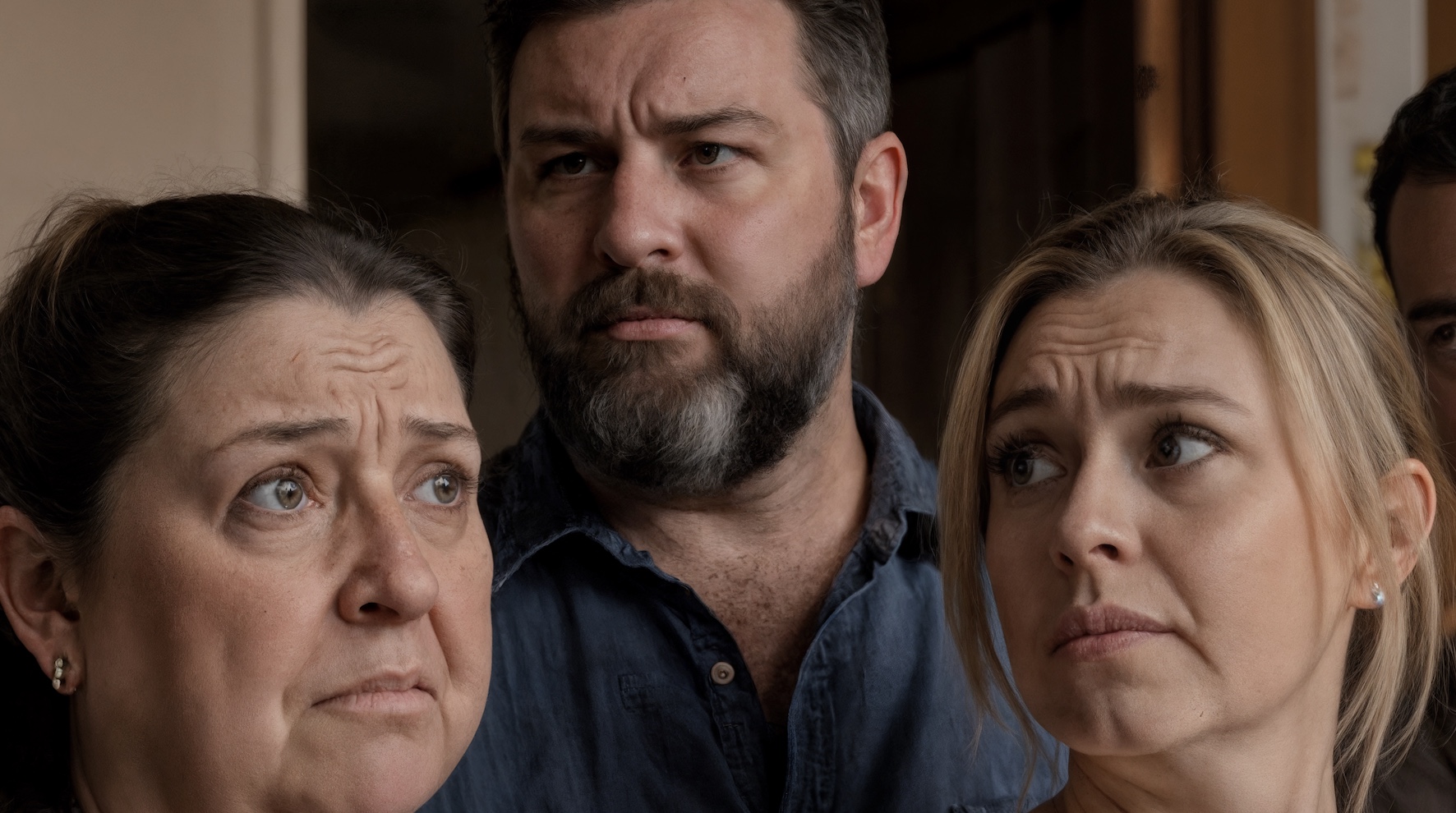
“Since you signed the apartment over to my sister, then go live with her. You’re not stepping foot in my home,” Katya told her parents.
“Katya, sweetheart… we have some news…” Her mother’s voice in the receiver was deliberately cheerful, even almost sing-song. That forced brightness made Katya’s stomach twist. She knew instantly she wouldn’t like what was coming.
“I’m listening, Mom,” Katya replied, shifting the phone to her other ear while continuing to stir porridge for her son. The morning routine—so familiar it ran on autopilot—didn’t stop her from straining to catch every shade of Antonina Pavlovna’s tone.
“Your father and I are selling the dacha!” her mother blurted, then went quiet, waiting for Katya’s reaction.
Katya froze with the spoon in her hand. The dacha. It wasn’t just a small plot of land with a crooked little house and apple trees. It was her childhood. It felt like every nail in that place had been hammered in with her help. Every garden bed had been dug by her hands—while her younger sister, Sveta, sat in the hammock with a book, sheltered from the sun and mosquitoes.
“You’re selling it?” Katya asked slowly. “Why? Did something happen?”
“Oh, what could happen!” her mother laughed it off. “We’re old now, it’s hard for us. Your father threw out his back last year, remember? And I can’t manage alone. Besides, what do we need it for now? We decided it’s time to finally live for ourselves. Move back to the city for good.”
There was logic in that. Her parents lived in their two-room apartment in an old building, and from May through October they practically lived at the dacha. But something in her mother’s voice kept scraping at Katya’s nerves.
“All right,” Katya said carefully. “If you’ve decided, then you’ve decided. And what about your apartment?”
“And that’s the big news!” Antonina Pavlovna’s voice turned even brighter. “We’re selling the apartment too! And buying one—just one, but a really good one—in a new building! For Sveta!”
The porridge in the pot began to scorch. Katya automatically turned off the burner, but the smell had already started to creep through the kitchen.
“For Sveta?” she said, not understanding. “And where will you live?”
“With her, of course!” her mother announced happily. “She’ll have a family soon, a baby. She needs more space. We’ll buy her a nice three-bedroom so your father and I will have a room too. And you, Katya, you’re our clever girl—you’ve got your life arranged. A good husband, your own place. You’re independent. But Sveta needs help. She’s so… gentle.”
Katya stared at the window in silence.
“Gentle.” She’d heard that word her entire life. Sveta was “gentle,” so she couldn’t carry buckets of water. Sveta was “gentle,” so after school she rested while Katya went to the store. Sveta was “gentle,” so they bought her a piano she dropped after a year—while there was “no money” for Katya’s skates. And now, with all their parents’ property on the line, Sveta was “gentle” again, and Katya was “independent” again.
“Mom…” Katya swallowed the lump in her throat. “So you’re selling your apartment and the dacha, giving all the money to Sveta for her place, and you’ll live with her. And me?”
“Katya, don’t act like a child,” her mother’s voice turned offended. “What do you have to do with this? We’re helping your sister—our own flesh and blood! You should be happy for her! Isn’t that what a sister does? You have everything. You have a husband, a son, and your mortgage will be paid off soon. You’re standing firmly on your feet. Sveta’s only starting her life. Her fiancé, that Vadim—he’s a decent guy, but he’s not wealthy. They can’t manage alone.”
And we managed, Katya thought bitterly. Andrey and I spent five years renting, denying ourselves everything just to save for the down payment. No one asked whether we were “gentle” or not.
“I understand,” she said dully. “I’m happy for my sister.”
She ended the call and stood for a long time, staring at the burnt porridge. She felt robbed—though not of money. Something far more important had been taken from her: the illusion that her parents loved their daughters equally.
That evening she told her husband everything. Andrey listened in silence, lips pressed tight. He’d never liked her relatives, always keeping a polite distance from their drama. He’d recognized the hypocrisy and the pretense from the beginning.
“They can do whatever they want with their property,” he said at last when Katya stopped talking. “But the way they’re doing it is vile. They’ve erased you.”
“She said I’m supposed to be happy,” Katya whispered.
“Then be happy,” Andrey smirked. “Be happy that now we don’t owe them anything. Not a penny, not a minute of our time. They made their choice.”
The next few months passed as if through fog. Her parents sold everything with enthusiasm. Katya stopped going to the dacha. She couldn’t. The thought of strangers walking through her childhood was unbearable. She barely spoke to her sister. Sveta called once or twice, chirping about what a wonderful residential complex they’d chosen, what the view would be like, and how great it was that “Mom and Dad will be close, always there to help with the baby.”
Katya listened in silence. What could she say? That it was betrayal? Sveta wouldn’t understand. She genuinely believed this was how it should be. The world had always revolved around her.
The deal went through. Their parents sold both the apartment and the dacha. The sum was substantial. Every last ruble went into a three-bedroom apartment for Svetlana in a new building. Sveta immediately married Vadim, and the two of them happily started building their nest. Her parents temporarily stayed with some distant relatives while renovations were underway.
Antonina Pavlovna called Katya regularly, but now her voice carried barely hidden triumph. She described in detail the expensive tile they’d chosen for the bathroom, the luxurious kitchen they’d ordered.
“It’s all for Sveta, for the future grandkids!” she repeated. “Everything has to be the very best.”
Katya listened and felt an icy wall growing between her and her mother. She no longer argued or asked questions. She simply filed the information away. Life went on. Her son Misha started first grade. At work, Katya was offered a promotion. Their mortgage really was nearing the finish line. Andrey and Katya planned to take the whole family to the sea in the summer—for the first time in years.
Then the first warning signs appeared. The renovation dragged on. Money, it turned out, had a way of running out. Vadim grew more and more irritable.
“Katya, could you lend us a little?” her mother called one day. “We’re short for wallpaper. Thirty thousand. We’ll pay it back as soon as—”
“Mom, you gave all the money to Sveta. Let her handle the wallpaper,” Katya answered calmly.
A stunned silence filled the line.
“I didn’t expect this from you,” Antonina Pavlovna finally said in an icy tone. “It’s for your sister!”
“Your sister has a huge apartment now. I have a mortgage and a first-grader. Sorry.”
After that, her mother didn’t call for a week. Katya felt guilty, but Andrey wouldn’t budge.
“Not a penny,” he said firmly. “They made their choice. Now they live with it. All of it—including Sveta.”
The renovation limped to the finish. Sveta, Vadim, and the parents moved into the new apartment. For the first few weeks Antonina Pavlovna called, overflowing with excitement. Everything was perfect. But very soon the tone shifted again.
“Vadim’s gotten so tense,” she complained to Katya. “Nothing suits him. He says your father plays music too loud. And apparently I get in his way in the kitchen. Where else am I supposed to be? I’m cooking dinner for everyone!”
Katya stayed quiet. What was there to say?
“And Sveta too…” her mother continued. “She used to be affectionate, and now all she says is, ‘Mom, don’t meddle.’ I’m only trying to help! I wiped the dust, and she got offended. She says I’m snooping through her things.”
Welcome to the real world, Mom, Katya thought, but aloud she only said, “Talk it out. You’ll adjust to each other.”
The problems snowballed. Vadim, it turned out, had never truly wanted to live with his in-laws. He tolerated them while they were pouring money into what was essentially his home. But once the financial stream dried up, the presence of two older people became openly unbearable to him. He came home gloomy, locked himself in a room, and answered every attempt at conversation with one-word replies.
When Sveta got pregnant, she became even more demanding. She was torn between her husband and her parents—and, as always in her life, she chose the path of least resistance. She began taking Vadim’s side.
“Mom, please don’t turn the TV up so loud, Vadim’s resting,” she’d say.
“Dad, don’t walk around the apartment in outdoor shoes!”
Small nitpicks became big fights. Her parents, used to being the owners of their home, suddenly became guests—unwanted guests. Their “cozy room for grandma and grandpa,” as it had been described, turned out to be the furthest, darkest room in the apartment.
The breaking point came half a year later. Katya’s mother called in tears.
“He’s throwing us out!” she screamed into the phone. “Vadim said he’s sick of us! He told us to pack up and leave!”
“Throwing you out?” Katya went cold. “And Sveta?”
“And Sveta is silent!” her mother sobbed. “She’s just standing there blinking! He told her, ‘I won’t live with your parents. Choose: either me or them.’ And she’s silent, Katya! Silent!”
“Where are you going to go?” Katya asked, already knowing the answer.
“To you, my girl! Where else? We’ll pack our things and come to you right now! You won’t abandon us, our own blood!”
Katya slowly set the phone down on the table.
“Our own blood.” She looked at her husband, who had heard everything. There was no smugness in his eyes—only heavy, tired understanding.
“It’s your decision,” Andrey said quietly. “But you know what I think.”
All day Katya moved like she wasn’t herself. She remembered everything—every injustice, every slight, that constant feeling that she was second-rate. She remembered saving for the down payment, refusing herself even a new dress. Remembered Andrey working two jobs. Remembered how proud they’d been of their small but theirs two-bedroom apartment—their fortress. And now people who had voluntarily given up their own home were trying to force their way into hers.
In the evening, the intercom rang.
“Katya, open up, it’s us,” her father’s voice came through, unusually pleading.
Katya pressed the button. On the monitor she watched two elderly, hunched figures with suitcases enter the building. Her parents. Minutes later they stood at her door—confused, humiliated.
“Well, sweetheart, here we are,” Antonina Pavlovna said, trying to smile, though her lips trembled. “Didn’t expect us?”
Katya stood in the doorway, not moving aside. Behind her, like silent backup, Andrey stood.
“Go to the kitchen,” Katya said evenly. “Leave your suitcases here.”
In the kitchen, she poured them tea. They drank silently and greedily. It was obvious they’d been through a crushing shock.
“We’ll stay with you for a little while, okay?” her mother broke the silence first. “Until we figure something out. We have nowhere to go. Sveta… she betrayed us.”
Katya looked at her mother. In her eyes there was no remorse—only resentment. Resentment at Sveta, at Vadim, at the whole world. She still didn’t understand what had happened. In her mind she was the victim.
“No,” Katya said softly, but firmly.
Her parents froze with their cups in midair.
“What do you mean, ‘no’?” her father, Nikolai Petrovich, finally spoke, still staring at the table. “Are you serious?”
“You won’t live here,” Katya answered. “Not for a little while. Not for a long while. Not at all.”
Antonina Pavlovna slowly set her cup down. Her face hardened like stone.
“What are you saying, Ekaterina? Have you lost your mind? We’re your parents!”
“Yes,” Katya nodded, and her voice filled with a strength she didn’t know she had. “My parents—the ones who, a few months ago, sold everything they owned and handed it to my sister. You made your choice. You chose her. You invested everything in her future, in her apartment. And you called me ‘independent’ and told me I should be happy.”
She stood up, her knees trembling, but her voice stayed steady.
“So here it is: since the apartment is in my sister’s name, go live with her. I’m not letting you move in with me.”
A ringing silence settled over the kitchen. The wall clock ticked loudly. Her mother’s face twisted.
“How dare you!” she hissed, and her old arrogance rushed back. “Ungrateful! We raised you, fed you! And now you won’t even let your own mother and father over the threshold!”
“And did you let me in?” Katya asked calmly. “Did you let me into your life when you were deciding your future? Did you think of me for even a second? No. You decided Sveta needed it more. So go where you’re needed. Her apartment is big. Plenty of space. Let her learn responsibility—for her wishes and for your gifts.”
“But Vadim…” her father murmured, lost.
“Vadim is Sveta’s problem,” Katya said. “And yours. Not mine. I have my own family—my husband and my son. This home is their home. And I won’t let it turn into a shelter for wounded pride and people who created their own disaster.”
She opened the kitchen door and pointed toward the hallway.
“Your tea is cold. I think it’s time for you to go.”
“You’re sending us out onto the street? At night?” her mother’s voice cracked with real fear now.
“I’m not throwing you out,” Katya corrected. “I’m not letting you in. This is my home, and you don’t belong here. You gave your home to Sveta. Go there. Settle it with her. Demand what you want. Sue if you want. Do whatever you need. But not through me.”
Her father stood up heavily, bracing himself on the table. He looked at Katya with a long, weighty stare. There was no love in it, no warmth—only cold distance. He understood.
“Come on, Antonina,” he said hoarsely. “We’re not wanted here.”
Her mother tried to shout about God’s judgment, about how Katya would come crawling back on her knees one day, but her father took her by the arm and almost dragged her out of the kitchen. They silently collected their suitcases. When the front door closed behind them, Katya slid down the wall to the floor, shaking. Andrey came over, sat beside her, and wrapped his arms around her tightly.
“You did the right thing,” he whispered into her hair. “You protected us.”
She cried for a long time—quietly, without sound, against his shoulder. Those weren’t tears of pity for them. They were tears for herself. For the little girl who had spent her whole life waiting for her parents’ love and never received it. She was mourning her lost childhood and the family she thought she had.
Her parents never called again. A couple months later, Katya heard from a distant relative that they’d rented a tiny room somewhere on the city’s outskirts. Sveta had given birth. She didn’t speak to the parents either, blaming them for nearly ruining her marriage. Katya never asked how they were living. She didn’t care. She cut them off—painfully, bleedingly, but completely.
Sometimes at night she dreamed of the dacha, the old apple trees, and herself as a little girl, waiting for her mother to praise her for weeding the garden bed. But her mother always walked past to the swing where Sveta sat. Katya would wake up, look at her sleeping husband, at the photo of her smiling son on the nightstand, and understand she had done the right thing.
Her family was here. And that other family died the day her parents decided one daughter was “gentle,” and the other was “independent.”