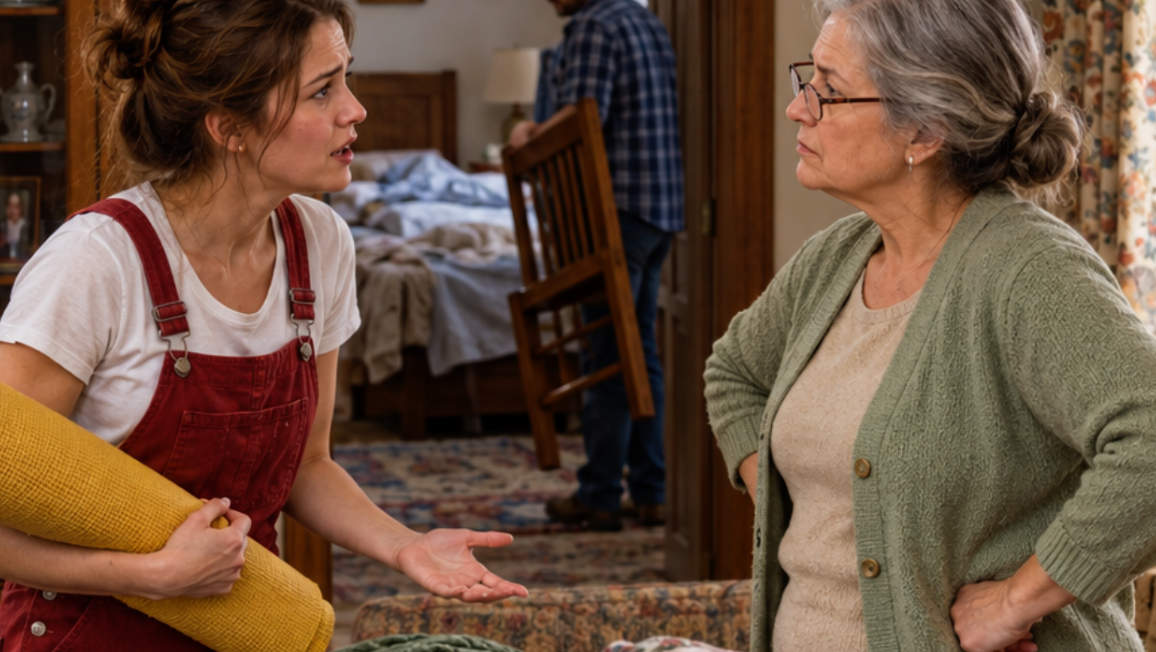
“Mom will stay in the small room, and you and the kids will be in the living room,” my husband announced, figuring out how to fit us all into the apartment—an apartment for which I pay the mortgage.
“Marina, Mom will be moving in with us. Starting October, for the winter,” Oleg said, spearing a cutlet with his fork, thinking, then putting it back down. “She’ll have the small room, and you and the kids can stay in the living room. The sofa folds out; I checked.”
I was just serving buckwheat to Varya when I froze, still holding the spoon above her plate. Eight-year-old Varya stopped swinging her legs, tuned in to our grown-up conversation.
“‘The kids’ means me, Styopa, and Varya, right?” I said. “Where will you be?”
“With you, of course.”
“All four of us on one sofa?”
“It’s a sofa bed,” Oleg repeated, as if that explained everything. “It’s an accordion model. It’s as big as a double bed.”
“It’s more like a large single—if nobody moves in their sleep,” I said. “And Styopa moves so much the neighbors’ chandelier shakes.”
Thirteen-year-old Styopa looked up from his phone at his dad, horrified.
“I’m not sleeping in the living room. There’s the TV there and people always walking through.”
“You will,” Oleg said. “Grandma’s sixty-nine and it’s a walk-up to the fourth floor. Her knees can’t take it anymore. When you’re her age, you’ll also want someone to care for you.”
“When I’m her age, I’ll live in a building with an elevator,” Styopa muttered, retreating to the small bedroom he shared with Varya—the same room they’d be giving up in three days.
I put down the spoon and sat.
“Oleg, are we actually discussing this or are you just informing me?”
“What is there to discuss, Marina? It’s my mom. She’s not a stranger.”
“No, not a stranger,” I agreed. “But what about her apartment? It’s just going to sit empty?”
“Ira will keep an eye on it,” Oleg said at last, eating his cutlet. “It’s on her way home from work anyway.”
Ira, Oleg’s younger sister, lived in the next neighborhood in a three-room apartment their parents had helped buy. Ira was great at keeping an eye on things—like which gifts everyone gave at New Year’s, and whether a present was cheaper than last year’s.
That night, after the kids went to bed, I opened my banking app. I liked to check the numbers—an old habit from my warehouse job. I was a logistics manager for a marketplace, making sure boxes got where they were supposed to and not where they wanted. The numbers were all familiar. 23,400, paid automatically on the 11th of each month. I’d taken the mortgage out on this two-bedroom apartment a year before we got married, back when I worked as a loader and ate one yogurt for lunch. Sixty-two payments left. I knew that number as surely as my shoe size.
Oleg paid for utilities and internet. And every time a relative asked how we managed, he’d say, “We’re chipping away at the mortgage.”
I used to smile at the ‘we’ in ‘We’re chipping away’. This time, I didn’t.
Tamara Ivanovna arrived Saturday in a taxi with three bags, a rocking chair, and a ficus in a bucket.
“What’s with the chair, Mom?” Oleg asked, lugging it up to the third floor.
“Where else would I sit? On a stool?” she replied, looking over the small room, still decorated with Styopa’s spaceship posters. “Marina dear, let’s take these down. I can’t look at them—they give me a headache.”
“They’re mine,” Styopa said from the hall.
“Then hang them in your own space,” Grandma allowed.
“I don’t have ‘my own space’ anymore,” Styopa muttered, taking his posters to the living room.
The rocking chair fit in the room only if Styopa’s desk got shoved to the closet, which now opened just wide enough for a hand. Varya discovered she could squeeze her arm in that gap and spent the evening fishing out socks, proud as if she was a magician pulling rabbits from a hat.
The first night, all four of us slept in the living room. I lay at the edge, Varya in the middle, Oleg by the wall, and Styopa defiantly stretched out on the floor with a camping mat.
“It’s just like camping,” Varya whispered, excited. “Mom, are we going to tell scary stories?”
“Daddy already scared you at dinner on Wednesday,” I replied. “Go to sleep.”
Oleg pretended not to hear.
The second week, we learned Tamara Ivanovna wasn’t mean—just extremely organized. She arranged all the grains by height, “so you see what’s running low.” She washed all the kitchen towels, “Marina dear, they’re supposed to be white, not gray.” She taught Varya patience by playing solitaire and lost to her with such enthusiasm that Varya, exhausted from winning, asked to go to bed early for the first time.
“Hey, your mother-in-law’s not so bad,” said Zoya, my work partner, during our lunch break in the locker room. Zoya was straightforward and didn’t waste words. “When mine lived with us, she’d tell my husband right in front of me I was feeding him wrong.”
“Mine does that too—she just tells me I’m overfeeding him.”
“Well, you are,” Zoya nodded at my double-portion lunchbox. “You gave him both cutlets and pasta last night.”
“That was for me. I can’t sleep in the living room and I eat from stress.”
“How long is she staying?”
“‘For the winter.’”
“Winter is long,” Zoya said, and left it at that.
On Sunday, Ira came to check on Mom. She brought a bakery cake, a box of candy “for Mom’s tea,” and showed off her fresh manicure to anyone she spoke to.
“Wow, how do you all fit here?” she said, poking her head into the living room where Styopa’s rolled-up mat was and three different-colored pillows lay on the sofa bed. “It’s cramped, but you’re used to it. You’ve always lived in a two-bedroom.”
“We’re living in it, not ‘used to it’,” I replied.
“That’s what I meant,” Ira said, breezing off to her mom’s room.
For about forty minutes, conversations from that room drifted: stories about old neighborhoods, boot prices, and some boss of Vadik’s who needed his mouth shut. Then Ira came out, put on her coat, and told Oleg in a hushed voice (not so quiet I couldn’t hear from the kitchen):
“Oleg, don’t rush Mom. She can stay as long as needed. Everything’s taken care of.”
“What’s ‘everything’?” Oleg asked.
“Her place. I’m checking in,” Ira reassured.
Oleg nodded like he’d just been told a state secret and closed the door.
“What’s she got under control?” I asked.
“Her apartment… watering plants, I guess.”
“Oleg, the ficus is here. In a bucket. The only plant she had.”
“Maybe she’s just dusting, then,” Oleg shrugged. “Why are you nitpicking Ira? At least she comes by sometimes.”
I didn’t argue. In 15 years, I’d never seen Ira dust her own place—she had a robot vacuum called Gena, whom she scolded like he was family.
That night, as we lay on the sofa bed, Varya suddenly piped up into the dark:
“Aunt Ira told Grandma that the ‘uncles’ are nice.”
“What uncles?” Oleg asked sleepily.
“Don’t know. She whispered. I only heard ‘nice uncles’ and ‘on time’.”
“Maybe she meant plumbers,” Oleg decided, turning to the wall. “Mom’s tap had a leak.”
Styopa snorted on the floor so emphatically that I mentally filed the conversation away for later, like I would a box without documents at work—maybe nothing, or maybe I’d be searching for it all day later.
By late November, almost December, Tamara Ivanovna remembered she’d left her winter boots at home.
“The brown ones, with the zipper,” she told me. “In the hall closet, bottom shelf. Oleg keeps meaning to go over—work or his back gets in the way.”
“I’ll go,” I offered. “It’s on my way. Our warehouse is out that way. Can I have the key?”
My mother-in-law hesitated just a second.
“I gave the key to Ira,” she said. “She’s watching the place. Call her.”
I called but Ira didn’t pick up, later texting, “At my manicure, I’ll call back tonight.” She never called. I figured the boots wouldn’t run off anywhere. After my shift on Friday, I stopped by. The five-story building was still there, fourth floor too. I climbed up, caught my breath, rang the doorbell so I could say I’d at least tried, then turned to leave.
A few seconds later, the door surprisingly opened.
A man in his thirties stood there, wearing sweatpants and holding a ladle. It smelled like fried onions behind him, and a TV was on somewhere inside.
“Who are you looking for?” he asked.
“I… I’m here for Tamara Ivanovna Golubeva. Well, she used to live here.”
“Oh, the owner!” he greeted me. “She moved out to stay with her son for the winter. We’re renting from her. I’m Ruslan, and that’s my wife Alsu,” he waved the ladle deeper into the apartment. “You must be here for the boots? Irina told us someone would come.”
That was the only thing I understood: everyone knew about the boots but me.
“How long have you been here?”
“Since October first. Lease is until May, Irina brought the paperwork herself,” Ruslan said cheerfully. “Twenty-five thousand, utilities separate, all to her bank card, right on time. Don’t worry, we’re neat. Alsu even wanted to keep the ficus but Irina said Grandma was taking it—she cares a lot about that plant.”
“The ficus is already with us,” I said. “In a bucket.”
“Great,” Ruslan said, honestly relieved. “That means it’s not lonely.”
He handed me the brown boots, carefully wrapped in a grocery bag, and even offered me a lift to the bus stop. I politely refused. I sat on the bench outside the building and opened my calculator app—I never liked feeling mixed up about the numbers…
Continued a little further down in the first comment
“Marina, my mom is moving in with us. Starting in October, for the winter,” Oleg said, picking up a cutlet with his fork, thinking for a moment, then putting it back. “She’ll stay in the small room, and you and the kids can be in the living room. The sofa folds out, I checked.”
Marina was just serving buckwheat to Varya and froze with the spoon over the plate. Varya, who was eight and never missed a single adult conversation, also stopped swinging her legs.
“When you say ‘you and the kids,’ you mean me, Styopa, and Varya?” Marina clarified. “And where will you be?”
“Well, I’ll be with you too, of course.”
“All four of us on one sofa?”
“It folds out,” Oleg repeated, as if that explained everything. “It’s an ‘accordion’ type. There’s as much room as a double bed.”
“There’s as much room as a one-and-a-half if nobody moves around,” Marina replied. “And Styopa moves so much the neighbor’s chandelier shakes downstairs.”
Styopa, who was thirteen, tore his eyes away from his phone and stared at his father in horror.
“I’m not going to sleep in the living room. There’s a TV there and people are always walking around.”
“Yes, you will,” said Oleg. “Grandma is sixty-nine, she has to go up to the fourth floor without an elevator and her knees aren’t what they used to be. When you’re her age, you’ll want someone to take care of you too.”
“When I’m her age, I’ll live in a building with an elevator,” Styopa muttered, and went off to the small room that he shared with Varya—and evidently, they only had about three days left in there.
Marina put down the spoon and sat down.
“Oleg, are we discussing this, or are you just informing me?”
“What is there to discuss, Marina? It’s my mom. She’s not a stranger.”
“She’s not a stranger,” Marina agreed. “But what about her apartment? Is it just going to sit empty?”
“Ira will keep an eye on it,” Oleg finally ate the cutlet. “It’s on her way home from work anyway.”
Ira was Oleg’s younger sister and lived in a three-room apartment in the next district, which their parents had helped her and her husband Vadik buy. Ira was good at keeping an eye on things on her way somewhere. For example, who gave what to whom for New Year’s, and whether the gift was cheaper than last year’s.
In the evening, after the kids went to bed, Marina opened her banking app. Her habit of checking everything by the numbers came from her job: she was a warehouse logistics manager for a marketplace, spending eight hours a day making sure boxes went where they were supposed to, not where they wanted. The numbers in the app were familiar. Twenty-three thousand four hundred, on the eleventh of every month, automatic payment. Marina had taken out the mortgage on their two-bedroom apartment a year before the wedding, back when she still worked as a picker and had nothing for lunch but yogurt. Sixty-two payments left. She knew this as well as her own shoe size.
Oleg paid for utilities and the internet. And every time a relative asked how they were managing, he’d say:
“We’re fine, getting by with the mortgage little by little.”
Marina used to smile at this “getting by.” For some reason, it didn’t make her smile now.
Tamara Ivanovna arrived on Saturday by taxi with three bags, a rocking chair, and a ficus in a bucket.
“Mom, why did you bring the rocking chair?” Oleg asked as he dragged it up to the third floor.
‘So where am I supposed to sit, on a stool?’ My mother-in-law looked around the small room that still had Stepa’s posters of spaceships on the wall. ‘Marina, we’ll take those down. I can’t even look at them, they make my eyes ache.’
‘They’re mine,’ Stepa called from the hallway.
‘Then you can hang them up in your own room,’ Grandma allowed.
‘I don’t have my own room anymore,’ Stepa replied gloomily and took the posters into the living room.
The armchair fit in the room, but only if Stepa’s desk was shoved up against the wardrobe, and then the wardrobe doors opened just wide enough for a hand. Varja quickly discovered her arm would fit through the gap, and spent the whole evening fishing out socks from inside, proud as if she were pulling rabbits from a hat.
The first night, all four of them slept in the living room. Marina took the edge, Varja was in the middle, Oleg was by the wall, and Stepa pointedly made his bed on the floor with a camping mat.
‘It’s like camping,’ Varja whispered, delighted. ‘Mom, are we going to tell scary stories?’
‘Dad already told you a scary story at dinner on Wednesday,’ Marina replied. ‘Go to sleep.’
Oleg pretended not to hear.
By the second week, it became clear that Tamara Ivanovna wasn’t mean, just very organized. She lined up the grains by height, saying, ‘That way you can see what’s running out.’ She rewrote all the kitchen towels, because ‘Yours are gray, Marina, they should be white.’ She taught Varja how to play solitaire and played with so much enthusiasm that Varja, for the first time in her life, actually asked to go to bed early—she was tired of winning.
‘Hey, she seems pretty normal,’ said Zoya, Marina’s co-worker, as they sat together during lunch. Zoya was a straightforward woman who didn’t say much except what mattered. ‘When my mother-in-law lived with us, she’d tell my husband every morning that I was feeding him wrong. Right in front of me.’
‘Mine complains too. Only to me. Says I’m overfeeding him.’
‘Well, it’s true,’ Zoya nodded at Marina’s lunchbox, which was double-sized. ‘Yesterday you packed him both meatballs and pasta.’
‘That was for me. I can’t sleep in the living room, so I eat from nerves.’
‘How long is she staying with you?’
‘”For the winter.”‘
‘Winter’s long,’ Zoya said, and left it at that.
On Sunday, Ira came to visit her mom. She brought a cake from the bakery, a box of chocolates ‘for mom’s tea,’ and a brand new manicure that she made sure everyone noticed.
‘Wow, how do you all fit in here?’ she said as she peeked into the living room, where Stepa’s rolled up mat was by the wall and three different colored pillows lay on the accordion sofa. ‘It’s tight, obviously. But you’re used to it, you’ve always lived in a two-bedroom.’
‘We live in it,’ said Marina. ‘We’re not getting used to it.’
‘That’s what I meant,’ Ira agreed easily and went to see their mom in the little room.
For the next forty minutes, talk drifted from an old neighbor, to boot prices, to some boss of Vadik who ‘needs his tongue clipped.’ Then Ira came out, put on her coat, and in the hallway told Oleg—in a lowered voice, but not so low that Marina in the kitchen wouldn’t hear—
‘Oleg, don’t rush Mom. Let her stay as long as she needs. Everything’s under control over there.’
‘Where is “there”?’ Oleg asked.
— Well, at her place. I’m keeping an eye on things.
Oleg nodded with a look like he’d just been entrusted with a state secret, and closed the door behind his sister.
— What exactly is she keeping under control? — Marina asked.
— The apartment. Probably watering the plants.
— Oleg, the ficus is with us. In a bucket. Mom didn’t have any other plants.
— Well, maybe she’s dusting or something, — Oleg shrugged. — Marina, why are you always on Ira’s case? At least she actually stops by.
Marina didn’t argue. She thought about how, in fifteen years, Ira hadn’t even dusted her own place: she had a robot vacuum named Gena for that, and would scold it like it was alive.
Before bed, Varja, lying in the middle of the “accordion” couch, suddenly spoke into the darkness:
— Aunt Ira told Grandma that the guys are nice.
— What guys? — Oleg asked sleepily.
— I don’t know. She whispered. I only caught ‘the guys are nice’ and ‘in time.’
— Probably about the plumbers, — Oleg decided, turning to face the wall. — Mom’s faucet was leaking.
From the floor, Styopa let out such an expressive snort that Marina made a mental note of this conversation, just in case. Just like at the warehouse, when she’d remember a box without an invoice: maybe it was nothing, but sometimes you’d spend all day looking for it.
At the end of November, or almost the end, Tamara Ivanovna remembered that she’d left her winter boots at home.
— The brown ones, with the zipper, — she explained. — In the hallway closet, on the bottom shelf. Oleg still hasn’t gone over—he always has work or his back pain.
— I’ll go, — Marina said. — It’s on my way, our warehouse is nearby. Can you give me the key?
Her mother-in-law hesitated for a second.
— Ira has the key, — she said. — I gave it to her, so she could check in. Call Ira.
Marina called, but Ira didn’t answer. Later Ira texted: “I’m at a manicure appointment, I’ll call tonight.” She didn’t call that evening. Marina decided the boots wouldn’t run away, and finally went on Friday after work. The apartment building was still there, so was the fourth floor. Marina climbed up, caught her breath, rang the doorbell just to be able to say she’d tried, and was about to leave.
A few seconds later, the door unexpectedly opened.
Standing there was a man about thirty in sweatpants, holding a ladle. It smelled like fried onions behind him, and somewhere deeper in the apartment the TV was on.
— Who are you here to see? — the man asked.
— I’m… well, I’m here for myself. I mean, not for myself, — Marina got a little flustered. — Tamara Ivanovna Golubeva lives here. Or used to.
— Oh, the owner, — the man brightened up. — She went to stay with her son for the winter. We’re renting from her. I’m Ruslan, this is my Alsu, — he waved his ladle somewhere behind him. — You must be here for the boots? Irina told us someone would come by for them.
Marina didn’t understand anything, except one thing: in this story, everyone knew about the boots except her.
— How long have you been here?
— Since October first. Lease runs until May, Irina brought it herself, — Ruslan was happy to talk, like someone with nothing to hide. — Twenty-five thousand, utilities separate, all transferred to her card, day by day. Don’t worry, we’re careful. Alsu even wanted to keep the ficus, but Irina said the grandma was taking it since it’s like family to her.
— The ficus is with us, — Marina said. — It’s sitting in a bucket.
“Well, that’s good,” Ruslan said, genuinely pleased. “That means he’s not bored.”
He brought out the boots—brown, with zippers—carefully wrapped in a Magnit store bag, and even offered to give Marina a ride to the bus stop. Marina politely declined. She went downstairs, sat on the bench by the entrance, and opened her calculator, since the numbers in her head were all jumbled up, and she didn’t like that.
Twenty-five thousand a month from October 1st to May—that’s eight months, totaling two hundred thousand.
Her mortgage for those same eight months: one hundred eighty-seven thousand two hundred.
It almost felt like someone set it up on purpose.
Then she called Zoya, even though Zoya hated talking on the phone after her shift.
“Zoya, there are tenants living in my mother-in-law’s apartment. Since October. Ira is renting it out.”
Zoya was silent, as though she was double-checking an invoice.
“And who gets the money?”
“It’s split half and half. Ira and my mother-in-law.”
“And you?”
“Me? I get Styopa’s mat.”
“Well,” Zoya said. “I told you, winters are long.”
“You said, ‘winters are long,’ not ‘your mother-in-law is renting to tenants.'”
“Same difference,” Zoya explained and hung up, because her TV show was starting.
At home, her mother-in-law sat in a rocking chair, knitting a scarf for Varya. Varya was sitting on the floor, counting stitches, because her grandma trusted her to “keep track of the count.”
“Here you go,” Marina announced, placing the bag down. “Your boots. Ruslan sends his regards. And Alsu too.”
Tamara Ivanovna stopped rocking. Varya looked at her grandma, then at her mom, and suddenly declared with the absolute confidence of someone who had overheard everything through the wall:
“Those are the uncles who are nice and always pay on time. I told you! Grandma said so to Aunt Ira on the phone. And Aunt Ira said half the money is hers and half goes to grandma’s savings book.”
“Varvara, go check if the kettle’s boiling,” her grandma said.
“It hasn’t been turned on,” Varya replied.
“Then turn it on.”
Varya left, but so slowly she probably could have eavesdropped for another half hour.
Tamara Ivanovna took off her glasses and set them on her knitting.
“Just so you know, I’m not here sitting pretty on everything prepared for me. I told Oleg: let me pay you for the electricity and water. But he said, no need, you two are both handling the mortgage, and my little bit won’t make any difference. He said he likes having his mom around.”
“And why does Ira get half?”
“Well, Ira has a car loan. You know Vadik wrecked the old one, so now they have a new car. It’s tough for them,” her mother-in-law sighed. “My half, twelve and a half thousand, goes straight into my savings. For funeral expenses. And for the grandkids later.”
“And for us?” Marina asked. She said it calmly, without resentment—just to tally things up.
“Why would you need anything, Marinachka? Oleg says you’re both doing well, almost done paying off the mortgage—he’s been paying for it for so many years, poor thing…”
Marina took out her phone, opened the payment history, and turned the screen toward her mother-in-law.
“Tamara Ivanovna, look here. This is my card. Here’s November eleventh. October eleventh. September. You can scroll back to 2011, though it’ll take a while. I bought the apartment a year before Oleg and I got married. Oleg pays for utilities and internet. That counts as money, I’m not arguing. But I pay the mortgage.”
My mother-in-law put on her glasses and slowly flipped through the pages. She did it so gradually, moving her lips as if she was reading letters, not just looking at numbers.
“I didn’t know,” she finally said. “He always said ‘we’. I thought ‘we’ just meant him.”
“He says ‘we’ to me too,” Marina replied. “I used to think the same thing.”
Suddenly, a loud and suspiciously cheerful voice called from the kitchen:
“Mom, the kettle is boiling!”
Oleg came back just before nine. Right away, he could sense something was off in the apartment: his mom wasn’t rocking in her chair, Varya wasn’t playing solitaire, and Stepa, unlike usual, wasn’t on his phone but instead was sitting in the kitchen with the most content look on his face.
“What’s going on?” Oleg asked.
“Sit down, son,” Tamara Ivanovna said. “We’re about to have dinner. Marina, could you please call Ira? She said she’d be here in twenty minutes.”
“Ira’s coming over? Why?”
“Because I invited her,” his mother replied in the same tone she probably used to call Oleg in from the yard thirty years ago.
Ira arrived forty minutes later, bringing Vadik with her—a peaceful guy who immediately took up position by the fridge, as if he was planning to guard it.
“Mom, what’s the big rush?” Ira kissed her mother on the cheek, only then noticing the Magnet store bag with boots on the table. “Oh… That. Marina, did you go there?”
“To get the boots,” Marina nodded. “They told me someone would come by for the boots, so I went and picked them up.”
“Well, that’s fine. So what if there are tenants? The apartment’s empty anyway, right, Mom? Better than letting it go to waste, isn’t it?”
“Exactly, better not let it go to waste,” Marina agreed. “But I’m talking about something else. Let’s do the math.”
She put her phone with the calculator app on the table, and Vadik sighed quietly from the fridge—being a foreman, he knew that when people start calculating out loud, someone’s about to have to pay.
“Tamara Ivanovna lives in our small room,” Marina began. “Stepa sleeps on the floor in the living room. Varya shares the accordion sofa with Oleg and me. Tamara Ivanovna’s apartment brings in twenty-five thousand. Twelve and a half to Ira for the car, twelve and a half into a savings account. For our room, our water and electricity, for me waking up to Stepa’s mat in the living room—nothing to pay. Because Oleg told his mom that he pays the mortgage and we’re living well.”
“Marina, why do you have to say all this in front of everyone…” Oleg started.
“Everyone already knew anyway,” Stepa pointed out. “Except Mom.”
“Stepa,” Oleg said.
“What about Stepa?” Grandma interrupted. “Stepa’s telling the truth. Oleg, you told me you pay for this apartment.”
“Well, I do pay… for the utilities,” Oleg said.
“I pay for Ira’s electricity too, when she can’t afford it,” their mother snapped. “Doesn’t mean Ira’s apartment belongs to me.”
Ira blushed all the way to her ears.
“Mom, whose side are you even on?”
“On my own,” Tamara Ivanovna said. “I’m old, I can do that.”
“So what do you suggest?” Ira turned to Marina. “Ask Mom for money? From your husband’s own mother? Are you out of your mind?”
“No,” Marina replied. “I’m not planning to take anything from Tamara Ivanovna. I want to give the kids their room back.”
The kitchen suddenly went so quiet you could hear the fridge humming. Vadik opened the fridge, peered inside, and closed it.
“We can’t just kick the tenants out,” Ira said. “They have a contract until May. I signed it myself. They’re good people, always pay on time.”
“And there’s no need to kick them out,” Marina agreed. “Ruslan even carried out my boots in a bag for me. You don’t evict people like that.”
“So where is Mom supposed to go? Back onto the streets?”
“Why onto the streets?” Marina shrugged. “You have a three-bedroom apartment. You’re getting money from Mom’s place. At least half, anyway. I think it’s only fair if Mom stays with you until May.”
Vadik, standing by the fridge, made a sound that could have been a cough or a laugh.
“We’re renovating the kids’ room,” Ira said quickly. “And Vadik works shifts.”
“I work shifts too,” Marina replied. “And Styopa’s in eighth grade, with finals coming up. He does his homework on the armrest.”
“On a stool,” Styopa corrected her. “The armrest broke off last week.”
Tamara Ivanovna took off her glasses, wiped them with the edge of her sweater, and put them back on.
“Ira,” she said, “was it twelve and a half a month you were taking from me?”
“Mom, that was for the car…”
“You took it,” her mother answered herself. “So now you can make up for it. I’m moving in with you. On Saturday. And I’m bringing my armchair. And the ficus.”
“Mom, why the ficus?”
“It’s like family to me,” Tamara Ivanovna said, and Marina realized her mother-in-law was barely holding back laughter. “That’s what the tenants told me.”
Ira glanced at Vadik. Vadik just looked into the fridge.
“Fine,” Ira said in a tone like she was agreeing to surgery without anesthesia. “But only until May.”
“Until May,” her mother confirmed. “And the half you’d been getting, you’ll be putting it back into my savings account. I’ll be keeping track.”
“She’ll keep track,” Varja said seriously, appearing in the doorway. “Grandma’s good with numbers. The only thing she’s bad at is Solitaire.”
After Ira and Vadik left and the kids went off, Oleg sat in the kitchen for a long time. Marina checked Styopa’s online gradebook on her phone. Of course, he’d gotten a C in physics.
“Marina,” he finally said. “It’s not like I meant anything bad. I just… felt awkward telling Mom. She always thought I was a failure. Ira married well—she’s got a husband, an apartment, a car. And me? The apartment is yours, the mortgage is yours. I just couldn’t say it.”
“And it was easy for me?” Marina turned off the water. “Listening to you telling everyone how you do all the heavy lifting?”
“But I really do pull my weight. I pay the utilities.”
“Oleg, paying the utilities is good. It’s honest. You should’ve just said, ‘I pay the utilities.’ No one would have called you a failure for that.”
Oleg was silent for a long time.
“Now Mom definitely thinks I’m a failure.”
“I don’t know,” Marina said. “Honestly, I think today was the first time in years she actually had some fun. Did you see what she said to Ira about the ficus?”
Oleg suddenly smiled.
“I saw. She said the same thing to Dad back in ’89, that she’d take the TV if he didn’t stop going to visit Uncle Kolya in the garage. And she did. Hauled it to grandma’s on a sled.”
“That’s where Varja gets it from,” Marina said.
On Saturday, Tamara Ivanovna moved out. The bags were carried downstairs, Vadik loaded the rocking chair into his car with a rope, and the ficus, Tamara herself carried in a bucket—she wouldn’t let anyone else touch it.
Before leaving, she hugged Varya, then Stepa, who accepted the hug like someone whose homeland had been returned to them.
“Stepochka, please hang the posters back up,” she said. “I thought about it, and they’re actually fine. Ships are just ships.”
“They’re not ships, they’re stations,” Stepa replied. “But thanks, Grandma.”
Then her mother-in-law turned to Marina. She hesitated, as if she were making an important decision.
“I’m sorry,” she said quietly, making sure Oleg by the car couldn’t hear. “I really thought you two were doing well. That he paid for everything, and you went along with him. I didn’t quite believe you when you got married the first time. I thought you were scheming.”
“And now?”
“And now I still think you’re clever,” Tamara Ivanovna admitted. “But in a good way. Give me a call in May, Marinotchka. I have something to return to you.”
“What is it?”
“We’ll see,” her mother-in-law said mysteriously and headed to the car with her ficus plant.
That evening, Stepa hung up the posters and closed the door to the small room with such a cheerful bang that the neighbors’ chandelier probably shook again downstairs. Varya was moving her toys into the room one by one, making a formal announcement for each as if at a train station: “The bunny has arrived. The building blocks have arrived.” In the living room, what was left was the accordion, finally just for the two of them, and Stepa’s rolled-up camping mat.
Oleg picked up the mat.
“Where should I put this? On the top shelf?”
“No need for the top shelf,” Marina said. “Just put it in your car. In the trunk.”
“Why?”
“Let it ride around with you. If you ever decide to move someone into my apartment again, start with yourself. You’ve already got the mat.”
Oleg stood there with the mat under his arm, opened his mouth as if to say something, then closed it again and went downstairs to the car. Varya watched him from the hallway.
“Mom, is Dad going to live on a camping trip now?”
“Not yet,” Marina replied. “But now he always has his gear ready.”
In May, Tamara Ivanovna called herself. She said the tenants had moved out and left her a new washing machine, since they broke the old one and replaced it. Ira had also paid everything back into her savings account, even if she grumbled about it. And that the twelve and a half thousand rubles a month she had been saving all winter ‘for her funeral,’ she had decided to use for something else.
“I put it towards Stepa’s computer,” she said. “He needs it more for ninth grade. And it’s too early for my funeral anyway—I still haven’t finished raising Irka until summer.”
Marina laughed, and Oleg, who was just passing by with the car keys, stopped and asked what was so funny.
“Your mom is calling,” Marina said. “She’s asking where your mat is.”
“In the trunk,” Oleg grumbled. “Where else would it be?”
“In the trunk,” Marina relayed into the phone.
“Let him keep it there,” the mother-in-law instructed. “Just as a reminder.”