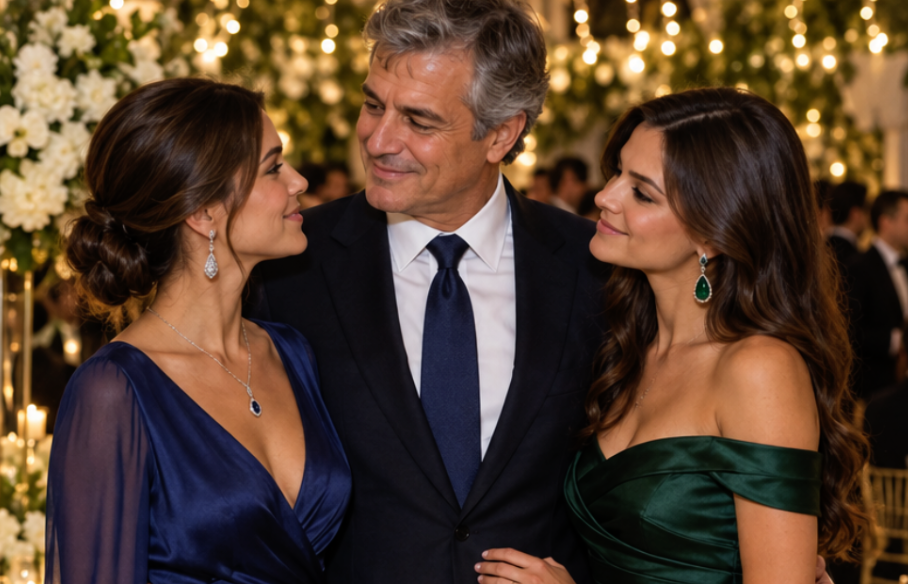
“Get this woman out of the hall! I have no idea how she got in here!” Andrey exclaimed loudly as soon as he saw his own wife near the festive table. He stood next to a young woman in an expensive emerald dress, whom he had just introduced to his colleagues as his future wife—now looking at Marina as if she was a complete stranger. Dozens of guests turned around, the music kept playing, a waiter froze with a tray of glasses, and Marina, holding a small box, calmly looked her husband in the eye. She didn’t plan to cause a scene, didn’t want to embarrass anyone, and only came here because she was invited by the one person Andrey feared most in the world. But the truly shocking moment for her husband came a few minutes later, when the company’s CEO approached them and said something that made Andrey slowly sink into the nearest chair.
continued in the comments
“Andrey Sergeevich, are you seriously claiming you don’t know this woman? Then please explain to me why, for the last eight months, you’ve been signing the documents she prepared for our company?”
Marina felt an unusual silence fall over the room, and for the first time in years, she realized she was no longer obligated to save a man who always treated her like his possession.
And yet, just this morning, she was planning to bake his favorite pie.
Marina Vorontsova was forty-three years old and had spent most of her adult life believing that a strong family is built, not on pretty words, but on the small daily routines that outsiders never notice. She knew which shirt her husband preferred for important meetings, how much sugar he liked in his coffee, why he was irritable on Mondays, and what tone to use with him after a bad day at work. Their two-room apartment on the fourth floor of an old brick building was always tidy, cozy, and a little old-fashioned: light curtains, a wooden table by the window, photos in matching frames, and a big ficus plant that Marina had tended for almost a decade. In the evenings, the place smelled like home-cooked dinners, freshly ironed clothes, and sometimes cinnamon, because Marina loved to bake, especially when she was anxious. And if someone had asked her a year ago if she was happy in her marriage, she probably would have said yes—though she would have stopped to think first.
Andrey was four years older than his wife and worked as the commercial director of the ‘Northern Oak’ furniture factory. He took great pride in working his way up from an ordinary manager to heading a major department. Tall, broad-shouldered, with neatly trimmed graying hair, he gave the impression of a confident and reliable man you could trust with any serious matter. In public, Andrey spoke calmly, smiled at the bosses, knew how to crack a joke at the right moment, and never raised his voice at subordinates in front of outsiders. But at home, he gradually turned into someone who was bothered by everything: the TV was too loud, dinner wasn’t hot enough, towels didn’t hang in the right places, and his wife asked too many questions. For a long time, Marina explained this away by his tiredness, stressful job, and age, not realizing that justifying her husband had become part of her own nature.
Twenty years ago, they met by pure chance—on a bus that broke down in the middle of a winter road. Back then, Andrey was a young engineer, and Marina worked as an accountant in a small construction company. Both were returning home after a hard workday. He gave her his gloves because she had forgotten hers, walked her to her building, and then showed up a week later with a bouquet of chrysanthemums and an invitation to the movies. They got married a year later, spent a long time saving for a place of their own, weathered money troubles, home renovations, their parents’ illnesses, and several unsuccessful attempts to have a baby. When the doctors finally told them pregnancy was unlikely, Andrey hugged her and said words she still remembered: “I need you, not a certificate from the maternity hospital.”
Now he almost never hugs her first.
Marina kept working as an accountant, though not at the construction company anymore. She worked remotely, serving several small businesses and private entrepreneurs. Over the years, she became a great specialist, able to spot errors in complex documents, notice suspicious numbers, and possessed that rare attention to detail so valuable where big money is concerned. Andrey was condescending about her profession, called her work-from-home job ‘shuffling papers,’ and often joked to friends that his wife spent her days at the kitchen table with her laptop. Still, Marina managed the family budget for years, helped him compile financial reports, checked contracts, and once even found an error in a contract that could have cost the factory millions of rubles. That night Andrey thanked her for hours, promised he’d tell the director, but within a week, he was telling colleagues that he had caught the mistake himself.
She didn’t argue.
After all, did it really matter who got the praise if the family benefited in the end?
Back in early September, Andrey started talking about the upcoming 20th anniversary of the factory. The company was planning a big celebration at a countryside restaurant complex, inviting executives, partners, local government representatives, and employees who had been with the company for more than ten years. Marina remembered all their past corporate parties—they always went together—so one evening, she carefully asked if she should start looking for a dress. Her husband was sitting at the kitchen table scrolling through his phone; he didn’t even look up when he heard her question. He just sighed irritably, as if his wife had asked for something completely impossible.
“Marina, what dress? Do you even realize the level of this event? There will be important people, international partners, local officials—not just neighbors from our floor.”
“I do understand, Andrey. That’s why I’m asking in advance.”
“That’s exactly it, you don’t understand. This time they’ve decided: no wives. Just employees and the official guest list. Don’t make a big deal out of it.”
Marina set a cup of tea in front of him and looked at his face for a few seconds, trying to figure out why such a simple conversation suddenly made him so irritable. In the past, Andrey himself used to ask her to join him at events like these—she was good at keeping the conversation going, never overindulged, and always made a pleasant impression on the bosses. In fact, the factory’s general director, Viktor Pavlovich Lebedev, had personally thanked Marina more than once for helping with financial documents, even though they’d only met twice. She wanted to remind Andrey about this, but noticed how he nervously turned his phone face down—and stayed silent. Lately, there had been too many little things like this, and each one left her feeling like one more door in their familiar home was quietly being closed, doors for which she once held the keys.
“Then why did they invite families last year?” she finally asked.
“Because last year, there was a different team organizing the event!” Andrey snapped. “Marina, do you really have to know every detail? I said there won’t be any wives, and that’s final.”
He pushed away his cup, got up from the table, and went to the bedroom, leaving dinner nearly untouched. Marina stayed alone in the kitchen, the refrigerator humming quietly while a light autumn rain drizzled outside. She wanted to go after him and explain that she wasn’t trying to control his life—she just wanted to remain a part of it. But instead, she silently cleared the dishes and wiped the table. It was right then she realized that almost every conversation with her husband over the past six months ended with her apologizing—even when she had nothing to apologize for.
A few days later, Andrey unexpectedly brought home an expensive perfume and handed the box to his wife like he had just achieved something heroic. Marina was surprised, thanked him, carefully opened the package, and was hit by a sharp floral scent—completely different from the light fragrances she had always worn. Her husband watched her reaction intently, then asked if she liked the gift. When she said yes, he seemed visibly relieved. That same evening, he told her they’d have to stay overnight at the upcoming anniversary party because negotiations with business partners were scheduled after the banquet. Marina nodded, even though she knew perfectly well that no actual business talks ever happen after midnight at those kinds of celebrations.
continued in the comments
The next day, she accidentally found a receipt from a jewelry store in the pocket of his jacket.
The receipt listed gold earrings with emeralds for a total of 187,000 rubles.
Marina stared at the numbers for a long time, trying to remember if any of Andrey’s female relatives had a birthday coming up. His mother had passed away years ago, he had no sisters, and none of their close friends were planning any sort of celebration. She carefully asked her husband about the jewelry store when he got back from work, and Andrey didn’t even look uneasy. He explained that he’d bought a gift on behalf of his team for the deputy general director—a woman who had worked with their factory for years.
“You know how this works,” he explained. “It’ll all be reimbursed by accounting later.”
Marina knew accounting far too well to believe that story.
But she still had no concrete proof.
The real changes started on Monday, when an email arrived in her work inbox from an unfamiliar sender. The woman introduced herself as Olga Sergeyevna Mironova, head of Internal Control at the “Severny Dub” factory, and asked Marina to get in touch about a possible collaboration. At first, Marina thought it must be a mistake—she had never officially worked at her husband’s company. But within minutes, she received a phone call. Olga Sergeyevna’s voice was deep and calm, with that unmistakably businesslike tone that lets you know this person always stands by her word.
“Marina Alekseevna, you’ve been recommended to us as a specialist in financial reporting. We have a few questions about some supplier contracts and need an independent expert. Would you be able to come in for a meeting?”
“Excuse me, who recommended me?”
“Viktor Pavlovich Lebedev. He remembers how you helped spot an error in a major contract several years back.”
Marina felt a mix of surprise and satisfaction. It turned out the director actually knew who had found that mistake, even though Andrey had insisted nobody was interested in the details. She agreed to meet, but warned them right away that her husband worked at the factory and this could pose a conflict of interest. Olga Sergeyevna replied that this was exactly why the job would be official—with restricted document access and a separate confidentiality agreement. Marina decided not to tell Andrey about the offer yet, wanting to see just how serious this potential partnership might be.
The meeting took place in a small office in the administrative building that smelled of fresh paint, coffee, and recently printed documents. Olga Sergeyevna turned out to be a woman in her fifties, with short hair, attentive gray eyes, and a habit of always listening to someone before asking questions. Next to her sat the factory’s attorney, a young man with glasses who spent most of the meeting typing notes into a laptop. Marina was told that the company was preparing to expand production, and before signing a big credit agreement, they needed to check a few old contracts. In recent months, internal auditors had found inconsistencies between actual deliveries and the amounts listed on the paperwork.
“We need someone who won’t turn a blind eye to mistakes just out of respect for titles,” Olga Sergeyevna said. “Viktor Pavlovich believes you’re the right fit.”
Marina took the folder offered to her and began to go through the documents. At first, everything seemed normal: invoices, acts, supplementary agreements, shipping invoices, and material acceptance reports. But after forty minutes, she noticed something odd—a small company was regularly supplying the factory with furniture fittings at prices well above market rates. What’s more, some of these deliveries were routed through an intermediary that had only been registered nine months earlier, and several acceptance reports were signed on days when the warehouse was officially closed. Marina carefully wrote down the organization names, dates, and amounts, then looked up at Olga Sergeyevna.
“Who approves these contracts from the commercial department?”
The woman across from her was silent for a few seconds.
“Andrey Sergeyevich Vorontsov.”
Marina felt her fingers turn uncomfortably cold.
That was her husband’s last name.
She came home later than usual, picked up bread and milk on the way, climbed to the fourth floor and struggled for a while to get her key into the lock. The apartment was dark except for the sound of the TV coming from the bedroom, and on the kitchen table lay a note from Andrey asking her to iron his white shirt for the morning. Marina set her bag down on a chair, turned on the light, and for a few minutes just stared at her own reflection in the window. She wanted to immediately call her husband, ask about the contracts, demand explanations, but her professional instincts were stronger than her emotions. For too many years, she had learned not to jump to conclusions until she saw the whole picture.
The next three weeks turned into a strange double life for her. In the mornings, she made breakfast, discussed everyday things with Andrey, and listened to his complaints about management, while during the day she checked company documents where his signature appeared more and more often. At first, Marina hoped her husband was just carelessly approving invoices, trusting his subordinates, but she gradually found several approvals that couldn’t be explained by simple negligence. The same goods were being paid for twice, delivery costs were inflated, and some payments were sent to a company with no warehouse, staff, or manufacturing facilities. What was especially concerning was that almost all the suspicious documents were prepared by one employee in the commercial department—Zhanna Krylovа.
Marina had heard Zhanna’s name before.
Andrey had mentioned the young manager several times, calling her talented, energetic, and promising. He said she was only thirty-one, but already skilled at tough negotiations, quick to build rapport with clients, and honestly, she understood modern business much better than most of the older employees. Once, Marina even joked that her husband talked about his subordinate too often, to which Andrey unexpectedly snapped. He claimed that his wife was just jealous of a successful young woman and saw a rival in any employee who knew how to dress well.
“Maybe you should focus on yourself,” he snapped back then. “You’re always at home in those stretched-out sweaters. Just look at how normal women dress.”
Marina didn’t respond.
The next day, she took her favorite blue dress out of the closet, tried it on in front of the mirror, and suddenly realized she didn’t want to be anything like Zhanna Krylova at all.
She just wanted to feel like herself again.
A week before the factory’s anniversary, Andrey announced that he might be promoted to deputy general director. He came home in an unusually good mood, brought a bottle of expensive wine, and even suggested ordering dinner from a restaurant, something he hadn’t done in months. Marina was sitting at her laptop finishing a report, carefully listening as her husband spoke excitedly about new opportunities, a salary raise, and a company car. According to him, Viktor Pavlovich would announce the staff changes at the anniversary celebration. Andrey was so confident, it sounded like the promotion was already a done deal.
“Just imagine, Marina, soon we’ll be able to move into a nice house outside the city. I’ve really earned it.”
“We?” she asked quietly.
“Of course, we. Though you’ll probably still find something to complain about. You never seem to have enough of anything.”
Marina closed her laptop and looked at her husband. Sitting in front of her was the man she had spent twenty years with—sharing their last pennies, caring for his ailing mother, and putting her own plans aside for his career. Not long ago, she would have accepted any excuse just to hold on to their familiar life, but now every gesture of his seemed part of a stranger’s act. Andrey didn’t notice her gaze; he was too caught up in telling stories of his own success.
“So, I still haven’t been invited to the anniversary?” she asked.
His smile faded.
“Here we go again? I already explained—wives aren’t invited.”
“Not even for the executives?”
“Especially not for the executives. There’s a business agenda, not a family gathering.”
“I see.”
“And also, Marina,” Andrey paused, searching for the right words. “Please don’t take it the wrong way, but I think you should stay out of my work more. You have your own life, and I have mine. We’re adults, after all.”
She nodded.
That phrase was the last straw, though Andrey didn’t even realize what he’d said.
The next morning, Marina met with Olga Sergeyevna to deliver the preliminary results of her audit. They sat in a small meeting room, with employees walking past behind glass walls, phones ringing, and the smell of freshly brewed coffee in the air. Marina explained in detail which documents were questionable and pointed out discrepancies in the figures, emphasizing that no final conclusions could be drawn yet about any particular employee’s involvement. Olga Sergeyevna listened carefully, sometimes asking clarifying questions, and suddenly she asked if Andrey knew about Marina’s work. When Marina replied no, Olga Sergeyevna sighed in relief.
“Then please don’t tell him for now. We need to finish the audit officially.”
“Do you suspect my husband?”
“We’re reviewing the documents, Marina Alekseyevna. We’ll only draw conclusions after the facts are confirmed.”
“I understand.”
“And one more thing. Viktor Pavlovich asked me to tell you that he’d be happy to see you at the factory’s anniversary. As a guest specialist who helped the company.”
Marina was taken aback.
“But Andrey said it’s a closed event and relatives aren’t invited.”
Olga Sergeyevna looked at her with clear surprise.
“That’s odd. As far as I know, executives are allowed to bring their spouses. In fact, your husband’s invitation is for two.”
Marina slowly set her pen down on the table.
“Two?”
“Yes. Andrey Sergeyevich plus a guest.”
She felt something inside her finally break.
Not because her husband lied.
But because she suddenly realized just how carefully he had prepared this lie.
Later that evening, Marina received a message from an unfamiliar number.
“If you want to know the truth about your husband, come to the café near the central park tomorrow at 4 PM. I’m not your enemy.”
She stared at the screen for a long time, uncertain if she should reply, but finally typed a short message: “Who are you?”
The answer came almost instantly.
“Someone who’s also tired of all the lies.”
The next day, Marina arrived at the café ten minutes early, ordered some tea, and sat by the window so she could watch the entrance closely. Outside, a cold rain was falling, people hurried under their umbrellas, and inside the air smelled of coffee, pastries, and damp coats. Exactly at four, a woman around thirty-five walked in—short, dark hair pulled into a tight ponytail, her face tired. She scanned the tables for a few seconds and then approached Marina.
“Are you Marina Vorontsova?”
“Yes.”
“My name is Tatiana. I’m a secretary in the commercial department at your factory.”
Marina didn’t correct her, even though the factory wasn’t actually hers.
Tatiana sat down across from her, took off her wet coat, and nervously folded her hands on the table. Her expression showed that talking wasn’t easy for her; before she began to speak, she glanced repeatedly at the entrance. It turned out she had worked at the company for eleven years, knew everyone well, and had accidentally witnessed something she would have preferred never to know. At first, she spoke cautiously, as if testing Marina’s reaction, but then she pulled out her phone and showed Marina a photo. On the screen was Andrei, standing next to a car, holding a young woman in a light coat by the waist.
Marina recognized Zhanna Krylov right away.
Not by her face.
By the gold earrings with emeralds.
“They’ve been seeing each other for almost a year,” Tatiana said quietly. “And that’s not even the worst part.”
Marina felt her heart painfully slam against her ribs.
“What could be worse?”
“He tells everyone you two divorced long ago. That you live separately and are just finalizing paperwork. Zhanna is sure that after the anniversary, they’ll announce their engagement.”
Marina closed her eyes.
Twenty years of marriage, their shared apartment, family photos, breakfasts, holidays, their daily life—all of it suddenly became a story her husband erased with just one sentence.
“Why are you telling me this?” she asked.
Tatiana lowered her head.
“Because he’s going to make me the scapegoat.”
It turned out strange things had been happening in the commercial department for several months. Tatiana had been processing documents on Andrei’s orders, but then found that some of her electronic approvals were recorded when she was on vacation. When she tried to look into it, the manager told her not to ask unnecessary questions, then unexpectedly suggested she resign of her own accord. When Tatiana refused, she got a disciplinary notice for a mistake she swears she didn’t make. She consulted a lawyer and started saving all her workplace correspondence, fearing she’d be blamed for some shady dealings.
“I honestly don’t know exactly what they’re up to,” Tatiana admitted. “But Zhanna is always talking to some man on the phone, demanding that money be transferred faster. And your husband keeps insisting that everything’s been cleared from above.”
Marina listened, feeling her sense of personal humiliation slowly turn into a cold, professional worry. She knew well that photos and an employee’s stories didn’t yet prove any financial wrongdoing, but she realized that the information about access to electronic documents had to be checked. She asked Tatiana not to delete anything, to save the original conversations, and to officially hand over the information to internal control. Afterwards, they sat at the small table for a long time, talking through dates, names, and events. It was only when it started to get dark outside that Tatiana got ready to leave—and Marina unexpectedly stopped her.
“Tell me—does Zhanna know that Andrey and I are still married?”
Tatiana gave a sad smile.
“She knows. I heard her myself telling him, ‘Your Marina isn’t going anywhere, women like that always put up with it.’”
Those words hurt more than any photograph.
Marina came back home, took off her coat, walked into the bedroom, and stood for a long time in front of the closet where her clothes hung beside Andrey’s expensive suits. On the top shelf was a box tied with a faded ribbon, containing their wedding photos, and a small porcelain figurine of two doves stood by the mirror—a wedding gift. She took out one photo and saw her twenty-three-year-old self, laughing, white flowers in her hair, beside a young man looking at her with such delight there was no doubting his love. Marina traced her finger over the picture and suddenly realized she was mourning not today’s marriage, but the person she once loved. The Andrey of today was almost a stranger to her now.
That night, she didn’t make dinner.
For the first time in twenty years.
Andrey came home after ten, annoyed and irritable, tossed his keys on the side table, and immediately asked why the kitchen was empty. Marina was sitting in the living room with a book, though she hadn’t managed to read a single page for half an hour, and calmly replied that she simply hadn’t had time to cook today. Her husband stopped in the middle of the room as if he’d heard something unbelievable, then checked the time and let out a dramatic sigh. He was wearing a new dark blue coat, smelled of unfamiliar cologne, and on his shirt collar Marina noticed a small shiny stain, like a trace of makeup. Before, finding something like that would have made her cry or demand explanations, but now she just felt tired.
“So what did you do all day?” Andrey asked.
“I worked.”
“You’re home all day.”
“Andrey, I work—and I earn money.”
“Here we go. Are we really going to argue again about who brings what into the house?”
“No. We’re not.”
He was clearly expecting the usual argument, but his wife’s calm only irritated Andrei even more. He walked into the kitchen, opened the fridge, slammed the door loudly, and returned to the living room with a look as if he was about to deliver a final verdict. Marina closed her book and braced herself to hear another complaint, but her husband unexpectedly sat down across from her. There was silence for a few seconds, then he started speaking in a businesslike tone—the same one he used with subordinates when discussing uncomfortable topics.
“Marina, I’ve been wanting to talk to you about this for a while. We’re not young anymore, it’s time to look at things realistically.”
“I’m listening.”
“We haven’t had a real family life for a long time. We’re just going through the motions out of habit. You know that yourself.”
“So what do you suggest?”
“Nothing for now. I just want you to stop acting like I owe you something.”
Marina looked at him intently.
“And you think you don’t owe me anything?”
Andrei smirked.
“I’ve supported you for twenty years.”
“We’ve both worked for twenty years, Andrei.”
“Let’s not even compare our salaries!”
She wanted to remind him about the years when her salary helped pay the mortgage, about the nights spent working on his reports, about the money she gave for his mother’s medical bills—but suddenly realized that this argument was pointless. The person sitting opposite her had already rewritten their family history so that only his achievements remained. Everything Marina did was considered her natural duty, while his contributions were seen as gracious help. So she simply got up and walked toward the door.
“Where are you going?” Andrei asked in surprise.
“To bed.”
“We’re not finished!”
“Actually, I think I’ve heard everything I needed.”
Three days before the anniversary, Marina was invited to a final meeting with the factory management. The audit was still ongoing, but it had already been confirmed that some of the deliveries had been processed with serious violations, and several electronic approvals required a separate official investigation. The company’s lawyer explained that the documents would be forwarded for further legal review and that no accusations could be made before the audit was complete. Marina submitted a detailed report, complete with tables, extracts, and calculations, and then answered questions from Viktor Pavlovich. The director was a tall, silver-haired man with a piercing gaze—he rarely raised his voice, but he knew how to make his counterpart feel the seriousness of the situation.
“Marina Alekseevna,” he said as he closed the folder, “I want to thank you personally. You’ve done a tremendous job.”
“I just checked the documents.”
“Sometimes that’s exactly what saves a company from big trouble.”
He paused, then looked at her carefully.
“I understand the situation you’re in. Andrei Sergeevich is your husband, and that complicates things.”
“I checked the numbers, Viktor Pavlovich. Not the family relationships.”
“That’s exactly why I wanted to work with you.”
The director offered Marina a permanent position as head of the financial control group after the audit was completed, but she asked for some time to think about it. She truly liked the work itself, yet she didn’t want her professional future to depend on circumstances related to her husband. Viktor Pavlovich quietly agreed, and then, quite unexpectedly, took an invitation to an anniversary celebration out of his desk drawer. On thick cream-colored paper, the date, time, and name of the restaurant were printed in gold lettering.
“Please come, Marina Alekseevna. We want to thank you in front of the whole team.”
“Andrey will be against it.”
“But is he the one who gets to decide who I invite?”
For the first time in a long while, Marina smiled sincerely.
On Saturday morning, Andrey woke up earlier than usual and spent almost an hour in front of the mirror. He took extra care shaving, changed his tie several times, pulled out a new suit from the closet and asked his wife to iron his white shirt, even though he could easily do it himself. Marina silently obliged, then made coffee and sat by the window, watching as her husband nervously checked his phone. The room was filled with the scent of expensive cologne, cufflinks in a velvet box lay on the bed, and a coat that Andrey had bought especially for the celebration hung over a chair. He looked almost happy.
“I’ll be home late today,” he announced. “I might even stay at the hotel by the restaurant. Don’t wait up for me.”
“Alright.”
“And don’t call me every half hour.”
“I wasn’t planning to.”
Andrey looked at his wife suspiciously.
“You’ve been acting strange these past few days.”
“I’m just tired.”
“Then take a break. Watch a show, go visit a friend. It would be good for you to take your mind off those pots and papers once in a while.”
Marina placed her cup in the sink.
“Andrey, if I did get invited to the anniversary, would you be happy?”
He turned abruptly.
“Marina, I told you! There’s nothing for you to do there. It’s a serious event, you understand? Only a certain kind of people will be there.”
“So, I’m not one of those people?”
“Why do you always twist things? Just please, don’t put me in an awkward position.”
Marina looked at him and calmly said:
“Alright. I won’t put you in an awkward position.”
Later, Andrey would remember those words more than once.
Once her husband left, Marina opened the closet and took out a dress she had bought five years ago for their wedding anniversary. Dark blue, with gentle pleats at the waist and an elegant neckline, it had hardly changed over the years because she’d only worn it twice. She stood in front of the mirror for a long time, then pulled her hair back into a low bun, put on a little makeup, and took out the silver earrings her late mother had given her. Fine lines showed on her face, and the traces of sleepless nights could be seen beneath her eyes, but her gaze was suddenly calm and determined. Marina no longer felt the need to prove to anyone—least of all to herself—that she deserved to stand beside her own husband.
At half past five, the taxi arrived for her.
The restaurant complex was set just outside the city, surrounded by tall pines, and looked especially festive in the twilight. Pathways were lined with lanterns, there were large arrangements of white flowers by the entrance, and through the glass doors you could see a spacious hall with long tables and warm golden lighting. Marina stepped out of the car, adjusted her coat, and paused for a moment when she heard music and the laughter of guests. Her heart was racing—not from fear of her husband, but because she knew tonight would change her life forever. She took out her invitation and approached the hostess.
“Marina Alekseevna Vorontsova,” the woman introduced herself.
The girl at the front desk quickly found her name on the list and smiled warmly.
“Of course, please go in. They’re expecting you.”
Marina took a few steps into the hall and immediately saw Andrey.
He was standing by the main table, chatting animatedly with colleagues, his arm around Zhanna Krylov. The young woman was wearing a long emerald dress, her hair styled in loose waves, and she wore the very earrings for which Marina had found the receipt in her husband’s pocket. Zhanna laughed, lightly touching his shoulder, looking so confident it seemed she already saw herself as the one in charge. Andrey leaned in, whispered something in her ear, and kissed her on the temple.
Marina stopped.
Not because what she saw was a surprise.
It’s one thing to know about an affair, but it’s something else entirely to see the person you’ve spent twenty years with gazing tenderly at another woman.
She was about to make her way to the table set for the invited specialists when Andrey looked up.
And saw her.
At first, his face showed complete confusion, then bewilderment, and after a few seconds, anger. He quickly removed his hand from Zhanna’s waist, said something to her, and headed over to his wife, trying not to draw attention. Marina stood calmly, holding a small gift box she had brought for Viktor Pavlovich: inside were old factory photos she had found in the company archives and carefully arranged into a commemorative album. Andrey approached her, grabbed her by the elbow, and leaned toward her ear.
“What are you doing here?” he hissed.
“I came for the anniversary.”
“I told you to stay home!”
“I was invited.”
“By who?!”
“The management.”
Andrey glanced around nervously.
“Marina, don’t cause a scene. Leave right now.”
“I’m not planning to cause a scene. Let go of my arm.”
“Do you even realize you could ruin my career?!”
Marina looked him straight in the eyes.
“Andrey, I’m not doing anything except coming here by invitation.”
At that moment, Zhanna approached them. She stopped next to Andrey, glanced Marina up and down, and raised her eyebrows slightly. Her face was beautiful and impeccably made up, but there was clear irritation in her eyes. Zhanna was used to Andrey handling any unpleasant situation quickly and confidently, so the appearance of an unknown woman who made him nervous clearly unsettled her. She took his arm and gave an overly forced smile.
“Andrey, darling, what’s happening? Who is this woman?”
Marina looked at her attentively.
“My name is Marina. I’m his wife.”
Zhanna froze for a moment, then laughed.
“Excuse me, but Andrey has been divorced for a long time.”
“Really?” Marina asked calmly. “I’d love to know when exactly that happened.”
Andrey turned pale.
“Marina, be quiet!”
“I’m just asking. We had breakfast together this morning and no one mentioned a divorce to me.”
A few people standing nearby started to listen in. Zhanna slowly removed her hand from Andrey’s arm, but instead of admitting what was obvious, he unexpectedly raised his voice. Apparently, his fear of losing his status was stronger than common sense. He suddenly turned to the administrator and demanded security be called.
“Get this woman out of the hall!” Andrey said loudly enough for everyone around to hear. “I have no idea how she managed to get in here!”
Marina felt dozens of eyes turn in her direction.
And right at that moment, a calm male voice sounded behind her.
“Andrey Sergeevich, what’s going on here?”
Viktor Pavlovich Lebedev stood by the entrance to the hall with Olga Sergeyevna and two board members. He wore a crisp gray suit, held a folder with the evening program, and his expression spelled trouble. Andrey immediately changed: he straightened up, tried to smile, and started speaking in that respectful tone Marina knew too well. Zhanna stepped back, and guests gradually fell silent, realizing they were witnessing something uncomfortable. Even the musicians on the small stage finished their piece and didn’t start another.
“Viktor Pavlovich, it’s just a small misunderstanding. Some random woman managed to get into the hall, I’m just sorting it out right now.”
The director looked at Marina.
Then at Andrey.
“A random woman?”
“Yes,” Andrey confirmed hastily. “Apparently, a mistake by the administration.”
Viktor Pavlovich slowly took off his glasses.
“Andrey Sergeevich, are you seriously claiming you don’t know this woman?”
The man swallowed hard.
“Well… she’s my ex-wife. We have a complicated relationship, you see…”
Marina felt a painful tightness in her throat.
Ex-wife.
Just like that, he turned twenty years of their life together into something in the past, as if it had never even existed.
“Very interesting,” the director said. “Because Marina Alekseevna was personally invited by me. And over the last few weeks, she’s been doing important work for the company—a financial audit.”
Andrey turned pale.
“What audit?”
— The very same matter, which I assume you’ll soon receive an official notification about.
The room fell completely silent.
Olga Sergeyevna walked up to Marina and gently took her by the arm.
— Marina Alekseevna, please come with me. Your place is at our table.
But Andrey didn’t hear a word of this anymore.
He looked at his wife as if seeing her true self for the very first time.
The evening went on, although the festive atmosphere was clearly ruined. Viktor Pavlovich asked everyone to return to their tables, the musicians started playing again, and Andrey stayed by a column, trying to explain something to Zhanna. Marina couldn’t hear what they said, but she saw the young woman abruptly pull away, take out her phone, and quickly leave the hall. Some employees exchanged glances, others pretended nothing had happened, and the waiters kept serving appetizers with that same calm professionalism that only comes from witnessing other people’s scandals. Marina sat down next to Olga Sergeyevna, suddenly realizing her hands had finally started shaking.
— Are you all right? — Olga Sergeyevna asked quietly.
— Not really.
— Would you like me to call a car for you?
— No. I want to stay until the end of the evening.
Olga Sergeyevna nodded understandingly.
— Then have some water. And try not to listen to any of the gossip.
Marina took a glass and had a few sips. She didn’t feel ashamed for herself but for the fact that the family life she had tried so hard to protect was now on display for strangers. She imagined how tomorrow her colleagues would gossip about the commercial director’s wife, his young companion, and the odd behavior of management. Yet, with the shame came a strange relief: she no longer had to pretend everything was fine. Andrey had said out loud what he’d been hiding for months.
Half an hour later, Viktor Pavlovich took the stage and began a formal speech. He thanked the employees, recalled the factory’s early days, and spoke about difficult times and the people who helped the company keep growing. Marina only half-listened, until the director suddenly began to talk about the importance of honesty, responsibility, and trust. Then he announced that the company was conducting an internal financial audit, and the results would be considered in due course.
— And today I’d like to give special thanks to the specialist who helped us sort out some complicated matters, — Viktor Pavlovich said. — Marina Alekseevna Vorontsova.
Marina was taken aback.
Olga Sergeyevna gently touched her shoulder.
— Go on. You’ve earned this.
The woman stood and walked toward the stage to restrained but genuine applause. She felt the eyes of the guests on her, noticed Andrey standing by the far table with a tense expression, and tried not to look his way. Viktor Pavlovich presented her with a letter of gratitude and a small bouquet of white roses. Marina thanked him, ready to step off the stage, when the director added a few more words.
— It’s especially admirable when someone stays true to their professional principles, no matter what’s going on in their personal life.
These words were spoken calmly.
But Andrey understood their meaning better than anyone.
The most unexpected thing happened closer to nine in the evening, when Marina stepped out onto the open terrace for some fresh air. The rain had stopped, the air was filled with the scent of wet pines, and in the distance, the windows of small hotel buildings glowed between the trees. She stood by the railing, wrapped in her coat, when she heard quick footsteps behind her. Turning, she saw Zhanna, who had changed into an ordinary dark coat and was holding a small bag. All self-confidence seemed to have vanished from her face.
— Marina, could I talk with you?
— Go ahead.
Zhanna came closer.
— I didn’t know you lived together.
Marina looked at her tiredly.
— But you knew we were married?
The young woman lowered her eyes.
— Andrey told me you had been strangers for a long time. That your marriage was just a formality and you didn’t want a divorce yourself.
— And you believed him?
— I wanted to believe.
Marina did not respond.
Zhanna was silent for a few seconds, then unexpectedly took out her phone.
— I need to show you something. But not here.
They moved to an empty bench under a canopy, where Zhanna opened a chat with Andrey on her phone. Among the usual messages, photos, and declarations, Marina noticed several conversations that had nothing to do with personal matters. Andrey was discussing suppliers, payment deadlines, and the need to close old documents by the end of the quarter. In one message, he asked her to contact a representative from an intermediary company and make sure they didn’t send any more invoices without approval. In another, he promised that after his promotion, he’d handle all issues with the audits.
— Why are you showing this to me? Marina asked.
Zhanna sighed heavily.
— Because just now, he claimed I handled all those contracts by myself. He said if there’s any trouble, he’ll say he knew nothing about it.
Marina looked at her intently.
— Do you understand that this conversation needs to be reported officially?
— Yes.
— And that it could involve serious violations?
— I understand.
Zhanna covered her face with her hands.
— I thought he loved me. He promised that after the anniversary, we’d leave together, buy an apartment, start a new life. But now he told me not to tell anyone about our relationship at all.
Instead of feeling any satisfaction, Marina suddenly felt a deep exhaustion. Sitting across from her was a woman who had knowingly entered into a relationship with a married man, and now was experiencing firsthand his willingness to sacrifice her for his own benefit. Marina wasn’t about to comfort her, justify her actions, or become a fellow victim. She simply advised Zhanna to consult a lawyer, keep the original messages, and be prepared to explain things to the official commission if needed. Then she got up from the bench and headed back toward the restaurant.
— Marina! Zhanna called after her.
Marina stopped.
— Will you ever be able to forgive me?
Marina looked at her for a long time.
I’m not sure I’ll ever be able to forgive myself for turning a blind eye for so long.
Andrey was waiting for her by the coat check. He looked completely different from that morning: his tie was loosened, his hair disheveled, and his face had taken on an unpleasant grayish color. As soon as he saw his wife, he quickly walked over and tried to take her hand, but Marina pulled away. Guests moved around them, you could hear the clinking of dishes and low conversations, but it seemed the man no longer paid any attention to any of it. He looked at his wife with that mix of fear and frustration you see in people who have suddenly lost control of what they thought was familiar.
“Marina, we need to talk.”
“Say what you need to say.”
“Not here. Let’s go home.”
“I’ve already called a taxi.”
“You don’t understand what’s happening! Someone’s trying to set me up!”
Marina calmly adjusted the strap of her bag.
“If you really did nothing wrong, the investigation will show that.”
“You know perfectly well how things work here! They’ll find someone to blame and hang all the mistakes on them! You need to tell the director I’m an honest man!”
She looked at her husband with genuine surprise.
“Andrey, just an hour ago you announced in front of everyone that you don’t know me.”
He looked away.
“I panicked.”
“You called me a stranger.”
“Because you showed up out of nowhere!”
“And was Zhanna supposed to show up?”
Andrey exhaled sharply.
“Don’t start about her. It doesn’t mean anything.”
Marina couldn’t help but smile.
“You know what’s the most surprising? I’m not even going to discuss your mistress right now. It’s enough for me that you tried to kick me out of the hall where I was invited because of my work.”
“Marina, please listen…”
“No, Andrey. Now it’s your turn to listen.”
She stepped closer and spoke in an entirely calm voice:
“For twenty years I tried to be a convenient wife. I supported you when we had no money, helped you with work, believed everything you said even when all signs pointed otherwise. And today, you showed me exactly what I mean in your life. And I finally understood.”
He tried to say something, but Marina stopped him with a gesture.
“I won’t save you from the consequences of your decisions anymore.”
With those words, she turned around and walked outside.
Marina got home around eleven. The apartment was quiet, a cup sat on the kitchen table—the same one Andrey had used for his morning coffee—and his house slippers were by the door. Everything looked exactly the way it had for years, and it was this familiar scene that suddenly made her break down in tears. She sat on the edge of the sofa, slipped off her shoes, and gazed for a long time at the family photographs hanging above the dresser. It hurt—not just because of the betrayal, but also for the time lost, for her own trusting nature, for all the years she’d tried to earn the respect of a man who saw her care as something to be taken for granted.
She didn’t cry for long.
Then she got up, washed her face with cold water, and opened the closet.
Marina packed several outfits, her documents, laptop, photos of her parents, and the silver earrings she wore on her anniversary into a large travel bag. She wasn’t planning to run away from her own apartment, let alone leave everything she and her husband had accumulated in twenty years behind. But she knew they needed to live apart for now. That evening, she called her old friend Irina, who lived alone in a spacious apartment and had long invited Marina to visit. When Irina heard her brief story, she didn’t ask any unnecessary questions—she just said, “Come over. I’ll make up the little room for you.”
Andrey returned home after midnight.
He walked into the apartment, saw the bag by the door, and stopped.
“What’s this supposed to mean?”
“I’m going to stay with Irina for a while.”
“Because of tonight? Marina, you’re acting like a child!”
“No, Andrey. I’m acting like an adult who finally made a decision.”
He threw his keys onto the nightstand.
“So what happens now? Divorce? Splitting everything up? Do you realize how many problems that brings?”
“I do. That’s why I’m going to handle everything calmly and legally.”
Andrey suddenly sat on a stool near the door and covered his face with his hands. He was silent for several minutes, then spoke in a different voice, quiet and almost pleading. He admitted that something had really happened with Zhanna, but called it a mistake—a temporary infatuation, brought on by constant stress at work. He insisted he was going to end it, that he never wanted to ruin his family, and that Marina was still the closest person in his life. Then he looked up and said the words that convinced his wife she was making the right decision.
“You’re not going to leave me now, when I have all these problems, are you?”
Marina looked at him for a long time.
“Andrey, when you left me by myself, did you think about the problems I’d have?”
He didn’t say anything.
The next few weeks were difficult, but not at all what Marina had imagined. She had expected endless tears, sleepless nights, and a longing to come home right away. Instead, she gradually felt a strange sense of freedom. In the mornings, she no longer had to tiptoe around her husband’s mood or try to guess what he wanted, or worry about whether he’d like the breakfast she made. Irina turned out to be a wonderful host, loved long tea chats, and never asked why Marina wanted to go to bed early or spend the evening with a book. For the first time in many years, Marina started to notice her own wishes, even the simple ones: taking a walk after work, buying flowers for no reason, listening to music, and not feeling guilty for taking time to rest.
Andrey called almost every day.
At first he demanded she come back, then he pleaded, then accused her of betrayal, and promised yet again to change. He told her Zhanna had resigned, that there was an investigation at the factory, that Viktor Pavlovich had temporarily removed him from contract approvals, and that now his colleagues were looking at him with suspicion. Marina didn’t discuss work matters with him; each time she repeated that all explanations should be made officially, with documentation, and, if necessary, with a lawyer present. She no longer wanted to be the go-between for his actions and their consequences.
continued in the comments
A month later, Andrey unexpectedly showed up at Irina’s place holding an enormous bouquet of red roses.
He stood on the landing, noticeably thinner, his face tired and his eyes dull. Marina came out to talk to him without inviting him in, and immediately saw how nervous he was. He spent a long time telling her how much he missed home, how hard it was for him alone, and how he finally realized how much she did for him. Then he held out the flowers and asked for another chance.
“I understand everything now, Marina. Really.”
She didn’t take the bouquet.
“What exactly have you realized?”
Andrey was at a loss.
“Well… that I was wrong. That I didn’t appreciate you.”
“And if there hadn’t been an investigation at the factory? If the director hadn’t seen me at the anniversary? Would you still be here with flowers?”
He stayed silent.
Marina felt a familiar ache rising in her throat, but she didn’t let herself turn away.
“Answer me, Andrey.”
“I don’t know,” he finally said.
And for the first time in a long while, that answer was honest.
The financial investigation ended a few weeks later. The company found violations in a number of contract documents and turned the materials over to legal experts, and in some cases decided to contact the authorities. Andrey lost his management position, but it would be others, not colleagues or his ex-wife, who would draw the final conclusions about his responsibility. Marina didn’t feel happy about these updates because she understood how many people might suffer due to others’ decisions, but for the first time, she didn’t feel responsible for intervening. She had done her job conscientiously and had no intention of justifying her husband or anyone else anymore.
She only accepted Viktor Pavlovich’s offer for a permanent position after the company’s lawyer confirmed that there were no obstacles to her appointment. Now Marina led a small financial control team, worked in a bright office with a big window, and was getting used to colleagues coming to her for advice not because she was someone’s wife, but because they trusted her expertise. She spent her first paycheck not on groceries or bills or family gifts, but on a trip to a small lakeside resort. Irina joined her, and for several days, the women walked through pine forests, drank tea on the open veranda, and talked about anything and everything.
It was there that Marina, for the first time in months, truly laughed.
Not politely.
Not to please anyone.
Simply because she was happy.
They weren’t rushing the divorce, taking their time to calmly sort out the property issues. The apartment was bought during their marriage, part of their savings sat in joint accounts, and Marina wasn’t about to give up her legal rights just to end this difficult chapter quickly. She contacted a lawyer, gathered all the necessary documents, and suggested to Andrey that they handle things without public accusations and endless arguments. To her surprise, he agreed, even though not long ago he had insisted she wouldn’t be able to do anything without his help. Maybe losing his position and the comfort he was used to finally made him see his own life from a new perspective.
One evening, they met at their old apartment to go through the last of their belongings. Snow was slowly falling outside, the clock ticked quietly in the kitchen, and on the windowsill stood the big ficus Marin had once grown from a tiny cutting. Andrey made tea, set two cups on the table, and unexpectedly took an apple pie out of the oven. It was uneven, with slightly burnt edges, but the scent of cinnamon filled the kitchen, reminding them of those distant years when they still knew how to find joy in simple things.
“I tried baking it,” Andrey said awkwardly. “Using your old recipe.”
Marina looked at the pie.
“I can see that.”
“It didn’t turn out very well.”
“For your first time, it’s fine.”
They sat down at the table and were silent for a few minutes. Then, unexpectedly, Andrey pulled an old wedding photo from the drawer—the one where Marina was laughing, white flowers in her hair. He stared at the picture for a long time, his finger tracing the edge, then quietly asked:
“Tell me, when did I become like this?”
Marina didn’t answer right away.
“I don’t know, Andrey. I guess it happened gradually. First, you stopped saying thank you. Then, you stopped noticing things. And then you decided I’d never leave.”
He lowered his head.
“But I really did love you.”
“I know.”
“And now?”
Marina looked out the window, watching snowflakes swirl slowly under the lamplight.
“Now I want to learn how to love myself.”
Andrey was silent for a long time, then nodded.
And, for the first time, he didn’t argue.
In the spring, Marina finally moved into a small, bright apartment she rented close to work, while the property settlement was still underway. The new place had large windows, a cozy kitchen with wooden shelves, and a little balcony that overlooked a yard with blossoming apple trees. She bought a soft armchair, hung up light curtains, and placed the same ficus by the window—the one Andrey had helped her move. In the evenings, she cooked herself dinner, sometimes invited Irina over, read books, and gradually got used to the idea that silence didn’t mean loneliness, but real rest.
One day at work, someone handed her a small, unsigned box.
Inside were silver earrings with blue stones and a short note from Andrey.
“I remembered you always loved this color. I’m sorry I never noticed before.”
Marina looked at the gift for a long time, then gently closed the box and put it away in her desk drawer. She no longer felt the sting of resentment, but she wasn’t about to go back to someone who only started noticing her after she was gone. Maybe Andrey had truly changed, maybe one day he would be able to build an honest relationship with someone else, but that was no longer her responsibility. She had no desire to spend the rest of her life endlessly testing someone else’s promises.
That evening, Marina stayed late at work, finishing an important report. When she finally stepped outside, the air was warm and filled with the scent of young leaves. By the bus stop, someone was selling the first spring flowers. On a whim, she bought a small bouquet of tulips, even though she’d always thought buying flowers was a waste of money. On her way home, she suddenly remembered the factory’s anniversary celebration. The memory flashed in her mind—the terrible moment when Andrey loudly demanded she be thrown out of the hall, and once again she felt the sting of dozens of eyes turning toward her.
But now, that memory didn’t hurt like it used to.
Because that evening, they really had tried to kick her out.
But not from the restaurant.
From her own life.
And for the first time, she refused to walk away from herself.
A few months later, Marina ran into Andrey by chance outside a supermarket. He was standing by his car, loading bags into the trunk, and he looked older than she remembered, even though not much time had passed. When he saw his ex-wife, he smiled, walked over, and asked how she was doing. They chatted calmly—like people tied together by a big past, but no longer sharing a future. Andrey told her he’d found a new job—even though it was a lower position than before, he was renting a small apartment and learning to take care of everything by himself.
“Guess what,” he said with a sudden grin, “Yesterday I washed my white shirt three times. Couldn’t get the stain out no matter what I did.”
Marina smiled.
“Try soaking it before you wash.”
“You always knew everything.”
She shook her head.
“No, Andrey. I just learned when I had to.”
He looked at her for a long moment, his eyes a little sad.
“You’ve changed.”
“Maybe.”
“You seem more confident.”
“I just don’t worry anymore about whether people will approve of me.”
They said goodbye without hugs or promises to call. Marina walked away, carrying her grocery bag, while Andrey lingered by his car, watching her go. She had no idea what he was thinking—if he truly regretted what happened, or just missed the comfortable routine of married life. But for the first time in twenty years, she realized she didn’t need to know the answer.
At home, Marina put on the kettle, opened the window, and took a small piece of apple pie she’d baked the night before from the fridge. It was golden and fragrant, with a thin, crispy crust and lots of apples. She poured herself some tea, sat by the window, and looked out at the evening courtyard, where children were riding bikes and neighbors were coming back from work.
She no longer waited for someone to tell her she was doing a good job.
She no longer waited for permission to buy a dress, go to a party, or choose her own path.
And she stopped being afraid of being alone.
Because she finally understood a simple truth: being lonely next to someone who doesn’t respect you is much scarier than a quiet apartment where you’re happy with yourself.
What do you think, dear readers?
Did Marina do the right thing by refusing to forgive her husband, even after his remorse? Or do you think twenty years together was worth giving Andrey another chance?
And in your opinion, what hurts more: the act of betrayal itself or the public humiliation when your husband acts like he doesn’t even know you in front of others?
Share your thoughts in the comments—especially if you think you could ever trust someone again after spending most of your life with them.