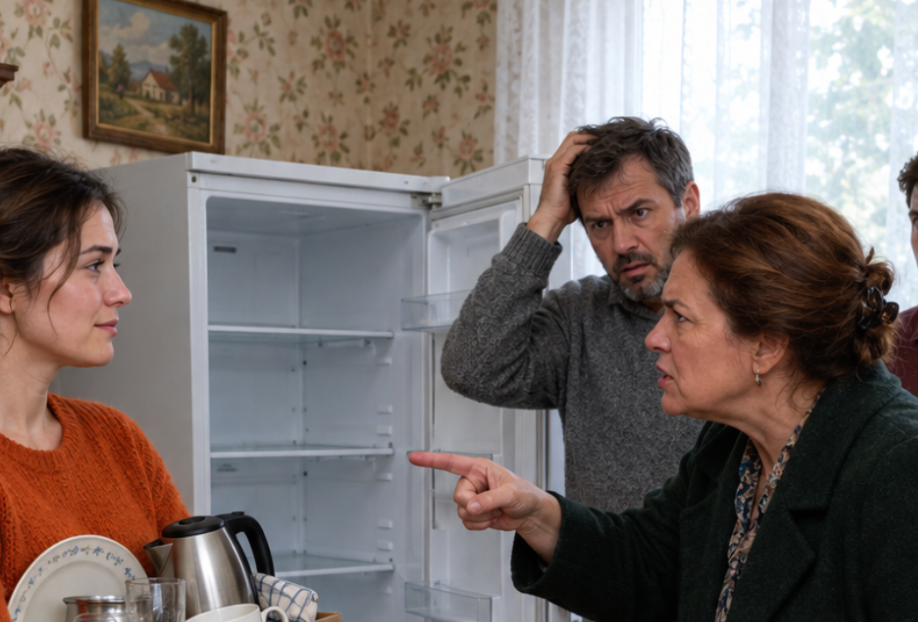
The phone rang on Saturday at 7:40. Olga Nikolaevna had been looking forward to this morning all week, hoping to catch up on sleep, so at first she thought about ignoring it. But the ringing wouldn’t stop, and Galina Stepanovna’s name was glowing on the screen. Her former mother-in-law only called when she considered something important—which was almost everything.
“Hello,” said Olga, trying to make her voice sound as if she’d been up for hours already.
“Olya, good morning. I’ll be coming next week to pick up the refrigerator.”
Olga sat up in bed and stared at her wardrobe.
“Which refrigerator?”
“My refrigerator. The one I gave you as a wedding gift. The marriage is over, so the gift isn’t needed anymore. Don’t worry, I’ll ask Tolik—he’ll come with his Gazelle van.”
w
“Galina Stepanovna, are you joking right now?”
“What joke, Olya? I’m seventy-four years old. Next Saturday by eleven, please be home.”
And she hung up. Galina Stepanovna always ended calls this way: never saying goodbye, just putting a period at the end.
Olga stayed sitting for a while, then went to the kitchen, put on the kettle, and looked at the refrigerator. The Stinol from 2003: white, but now a bit yellowed, like an old bathtub. It hummed so loudly that once the downstairs neighbor asked if they’d installed some sort of compressor station. At night, it sometimes shuddered and gurgled, and Igor always said the fridge was “talking.” The door hung on for dear life—and thanks to a magnet from Anapa. There were about forty magnets: Kislovodsk, Kazan, Kaliningrad, Suzdal, Minsk, two from Turkey, and a funny moose from Karelia that had lost its antlers long ago.
Twenty-three years ago, it was delivered right to this apartment, the day after the wedding, with a giant red bow on the door. Olga didn’t take the bow off for a whole year, until it finally faded.
“Well, old friend,” she said to the fridge. “Looks like they want you back.”
The fridge answered with a gurgle.
She and Igor had divorced two months ago. No dishes were thrown, no mistresses, none of those things people usually whisper about to friends. One evening, after twenty-three years of marriage, Igor just put his phone aside and said,
“Olya, I think I’ll leave.”
“Leave where?” she didn’t understand. “To the garage?”
“Leave completely. I’m suffocating. I’m forty-nine, and I feel like I haven’t really lived. Work, home, the dacha, your mom, Denis’s mortgage… I want to figure out who I am.”
“Igor, you’re Igor Valeryevich Somov, cost engineer, you have gastritis and a pool membership you never use. What else is there to figure out?”
“Exactly!” He was almost excited. “You’re always like this! I’m talking about my soul, and you’re talking about gastritis!”
He moved back in with his mother, to her two-room apartment on Gagarin Street, into his old childhood room. The apartment where Olga lived had once belonged to her grandmother, so there was nothing much to divide. They didn’t have underage children and nobody planned to argue, so they divorced at the registry office: filed the application, and a month later got their divorce certificates. At the registry office, Igor looked sad and handsome in his new sweater, while Olga’s only thought was that she had to be at work by 2 p.m.
Their son Denis, twenty-two, had been living separately with his wife Nastya for a while. He listened to the news over the phone and was silent for a long time.
— Mom, how are you doing?
— I’m okay, son. Honestly, it’s weird how okay I am.
— Well, if anything happens, call me right away.
At first, Olga was even mad at herself for not crying. Her friends expected tears, but in the evenings, she made pancakes, watched TV shows that Igor never liked, and one day she caught herself humming. The drill, the TV from the living room, the screwdriver, and half the towels disappeared from the apartment: Igor had neatly taken them all during the first week. Olga didn’t argue.
And now, it’s the fridge.
On Monday at work, Olga told everything to Svetka from the neighboring department. They had worked side by side for eighteen years, discussing husbands, kids, blood pressure, and every diet under the sun.
— Wait, — Svetka even put down her cup. — She wants to take the fridge that’s twenty-three years old?
— Twenty-three. It’s older than Denis.
— Olya, that fridge is part of the family by now. It needs a retirement party, not to be taken away.
— That’s what I think, too.
— But why does she want it? She has one of her own.
— I don’t know. Maybe just out of principle. Galina Stepanovna always says, “What’s mine is mine.” Remember when I told you how she demanded her cake tin back from the neighbor? After eleven years.
— Was that when the neighbor was moving to another city?
— Yep. Right on the day she left, at the taxi.
Svetka shook her head and reached for her phone.
— Listen, my Katya’s a lawyer, let me ask her.
Katya, Svetka’s daughter, called back about twenty minutes later. Olga turned on the speakerphone.
— Hello, Olga Nikolaevna. Legally, you can’t take back a gift. Article 578 of the Civil Code allows you to cancel a gift only in special cases: if the recipient tried to harm the giver or their family, intentionally caused injury, or if the thing that’s precious as a memory is being treated in a way that could destroy it for good. And even then, the court decides. Also, a gift given to both spouses at the wedding is their shared property. During a divorce, the ex-husband could claim half of its value, but not the mother-in-law. And now, that old fridge is worth about as much as a bag of potatoes.
— Thank you, Katya.
— Don’t mention it. But honestly, if you don’t care about it, it’s not worth the stress. Let her have it, your nerves are more valuable.
Olga put down the phone and fell into thought.
— Well? — Svetka asked. — Are you going to stand your ground?
— I don’t know, Svet. I’m not really attached to the fridge. What hurts is that I was her daughter-in-law for twenty-three years and now it just feels like I was storing her stuff all this time.
That evening, Igor called. Since the divorce, he’d only called once before to ask where his winter coat was.
— Hi, Olya. Mom said…
— About the fridge?
— Yeah. — He cleared his throat. — Listen, is it a big deal for you? Mom’s own fridge broke, the freezer isn’t freezing, and the repair guy says fixing it would cost more than getting a new one. Now it’s just the two of them, and there’s more food to keep…
— Igor, why don’t you just buy a new one?
— Olya, you know I’m going through a tough time right now.
— I know. You’re still searching for yourself.
— Don’t start. By the way, I actually quit my job.
Olga nearly dropped her spoon.
— You quit?
“Alright. I realized budgets just aren’t for me. Twenty-six years spent counting other people’s concrete. I want to do something real. Maybe work with wood. Make furniture by hand.”
“Igor, it took you three years to put up that shelf in the bathroom.”
“There it is again! That’s exactly why we got divorced!”
“We got divorced because you left, Igor.”
“Well, that too. Anyway, give the fridge to Mom. She did gift it, after all.”
“She gave it to us, Igor. To both of us.”
“Well, there’s no more ‘us’,” he said, as if that explained everything.
“So what, am I just supposed to live without a fridge now?”
“You’ll buy one. You have a job, don’t you?”
That’s when it really hit Olga. She’d worked all twenty-three years: in ‘08 when Igor’s bonus was ‘delayed’ for half a year, and through the pandemic too. She’d helped Denis with his mortgage down payment. The country house depended on her. And now her ex-husband, who had quit to pursue woodworking, was telling her to just buy herself a new fridge.
“Fine, Igor,” she said very calmly. “Let her come on Saturday.”
“Really?” He was actually surprised. “There you go. I knew you were sensible. Thank you, Ol.”
“You’re welcome. But you better come too. You’ll be hauling it.”
“Me? My back though…”
“Come over, Igor.”
Denis found out everything on Wednesday, when he stopped by his mom’s place to grab a jar of pickles.
“Mom, is this even legal?”
“No, son. Katya the lawyer says you can’t take back gifts.”
“Then just say no!”
“I don’t want to refuse. Then I’d have to listen to stories for the rest of my life about how greedy I am, how I kept my mother-in-law’s fridge from her.”
Denis looked over at the old Stinol, which started humming and shaking all over.
“Mom, just give them the old beast. I’ll buy you a new one.”
“With a mortgage? Don’t be ridiculous.”
“We can do it on installment.”
“Denis, I have a salary. I’ll buy it myself. And you know what…” Olga suddenly smiled. “I’ve wanted a new one for ages—one without frost, so I don’t have to defrost the freezer. Over twenty-three years, I’ve probably chipped off a ton of ice with a knife. Igor always said, ‘Why bother, it still works.’ Well, now I have a reason.”
“Alright then,” Denis said. “Just don’t stress about it.”
“I’m not stressing.”
“Sure. You’ve moved that jar of pickles three times already.”
Olga looked at the jar in her hands and burst out laughing.
On Friday evening she emptied the fridge. Two little pieces of cheese, some chicken, a pot of soup, pickles, her mom’s jam, her own eye drops, and a bag of dill she froze back in August. She packed everything into bags and took it to her neighbor Zinaida Petrovna, who had a second fridge on her enclosed balcony.
“Olechka, what happened? Did it break?”
“No, Zinaida Petrovna. My ex-mother-in-law is taking it back.”
Zinaida Petrovna, an eighty-year-old former chemistry teacher, slowly took off her glasses.
“Galya? The one who came to see you in that quilted coat in the spring, when everyone else was already in lighter jackets?”
“That’s the one.”
“Well, imagine that. What’s next, she’ll take back the bed? Didn’t she give you the bed too?”
“No, my parents gave us the bed.”
“Good, then. You’ll at least have somewhere to sleep, even if you don’t eat. Maybe you’ll lose some weight,” Zinaida Petrovna said, and they both laughed so hard someone on the stairs slammed a door.
At home, Olga started to take down the magnets from the fridge. This turned out to be the hardest part. Anapa: their first trip as a trio, Denis was three, ate too many cherries and cried all night. Kazan: Igor lost his passport, and they spent half a day running around the train station. Kaliningrad: their eighteenth anniversary, back when they still laughed together. She traveled to Suzdal alone with her work group—Igor said, ‘Walking around churches is boring.’ And the antlerless moose from Karelia: Denis brought it back at sixteen from summer camp.
Olga put the magnets into a cookie tin and sat for a while. Then she went to her room and packed another, bigger box.
On Saturday at exactly eleven, an old Gazelle van rattled up outside. First out was Igor’s cousin Tolik, a big, good-natured man of about fifty-five. Then Galina Stepanovna carefully stepped down from the passenger seat, wearing the same quilted coat even though it was twelve degrees outside. Last was Igor, with a face like he was headed to court instead of picking up a fridge.
Olga opened the door.
“Hello, Galina Stepanovna. Hi, Tolik. Come in.”
“Hello, Olya.” Her mother-in-law marched into the hallway without taking off her shoes and immediately peeked into the kitchen. “Did you clean it?”
“I cleaned it.”
“Good. I know how things were around here.”
“Mom,” Igor said quietly.
“What, Mom? For twenty-three years I’ve been visiting and I saw her defrost it maybe twice a year. I defrost mine every month!”
“Yours broke,” Olga pointed out.
“Mine broke from old age,” Galina Stepanovna replied with dignity. “It’s thirty-one years old.”
Tolik walked into the kitchen, tapped the ‘Stinol’ on the side and whistled in admiration.
“Wow, Olya. Now that’s a machine. They don’t make them like that anymore. Must’ve built it at a defense plant or something.”
“Anatoly, quit your chatter,” said Galina Stepanovna. “Come on, let’s get started.”
“Aunt Galya, we’ve got to unplug it first, let it thaw. Otherwise it’ll leak all over the stairs.”
“I unplugged it yesterday,” Olga said. “The water’s already drained. You can take it now.”
Galina Stepanovna looked a bit taken aback. It seemed she was expecting resistance: tears, reproaches, maybe even a scene. Olga knew she had a blood pressure monitor and heart pills in her bag. But instead, her daughter-in-law calmly pointed to the fridge: Go ahead, take it.
“Well,” said her mother-in-law, slightly flustered. “Alright then. This is the proper way to do it.”
“Of course, the proper way,” Olga nodded. “I thought, since we’re returning gifts, we should return all of them. Just to be fair.”
“What other gifts?” Galina Stepanovna asked, suddenly wary.
Olga brought a cardboard box from the room and set it on a stool.
“Here. Everything you’ve given us. The crystal vase for our tenth wedding anniversary. The ‘Madonna’ tea set—though it’s missing two cups: Denis broke one in first grade, Igor, the other in 2012. The towel set. The whistling kettle—it doesn’t whistle anymore. The tablecloth with roosters. And this…” Olga pulled out a thin, worn-out booklet, “‘How to Be a Good Wife and Homemaker’. You gave it to me the day after the wedding. Your notes are still inside.”
It went quiet in the kitchen. The only sound was Tolik’s heavy breathing.
“Olya, why are you acting like this?” Igor said.
“Like what?”
“This whole thing. As if we’re petty.”
“I’m not upset, Igor,” Olga replied gently. “I really don’t mind. Let Galina Stepanovna have everything that’s rightfully hers.”
Her mother-in-law picked up a book and flipped through it. Her lips trembled—whether from hurt or something else was hard to tell.
“I was only trying to help back then,” she said quietly. “You were such a city girl, you didn’t know how to do anything. Your cutlets always fell apart.”
“I remember. But then you taught me to add soaked bread to the ground meat. Haven’t made them any other way for 23 years now. That’s one thing I can’t return.”
Galina Stepanovna looked up at her but didn’t say anything. She put the book back into the box.
“Anatoly, go bring the fridge.”
But she left the box behind.
Moving it was tough—a Khrushchyovka, fifth floor, and no elevator. Tolik grabbed it from below, Igor took the top. By the third floor, Igor groaned.
“Toly, wait, hold on—my back!”
“Igor, just hang on, don’t drop it! It’s about to slip!”
“I’ve got it!”
“No, you don’t. It’s sitting right on my foot!”
Olga stood at the fifth-floor landing, looking down. From a slightly open door, Zinaida Petrovna peeked out.
“Olechka, why are they carrying it on its side?”
“I guess it’s just easier that way.”
“Oh, you can’t move a fridge lying down. My son-in-law is an expert—he explained it: the oil from the compressor spreads into the pipes. After being moved like that, you need to let it stand upright for at least a day before turning it on.”
“Galina Stepanovna!” Olga shouted down. “Don’t turn it on right away! Let it stand for a day!”
“I’ve been using fridges for forty years, I don’t need your advice,” came the reply from below.
Olga shrugged and closed her door.
The kitchen was left with an empty spot: a bright rectangle on the linoleum, surrounded by dust, a bottle cap, Deniska’s toy car without wheels, and a wedding ring. Igor’s. He lost it five years ago and had a big scene about it back then, insisting Olga must have misplaced it.
Olga picked up the ring, twirled it in her fingers, then put it into a cookie tin next to the fridge magnets. After that, she headed to Zinaida Petrovna for her groceries.
The new fridge arrived on Monday. Olga spent two evenings choosing it—consulting with Svetka over the phone and with Denis by messenger.
“Mom, get a double-door with No Frost.”
“Should I go for silver or white?”
“Silver—it looks classier.”
“How about this one, in beige? It’s… cozy.”
“Mom, pick whichever you like. It’s your fridge.”
That word—”your”—really stuck with her. Not gifted, not shared, but hers. Beige, tall, fifty-four thousand with zero-interest installment plan.
It was so quiet, Olga got up twice during the night to check if it was even running. She’d open the door—the light came on, it was chilly inside. So it was working. She hung the magnets back in place, one after another, with the antlerless moose in the center.
“Well,” she said to the moose, “ready to start a new life?”
The moose stayed silent. So did the fridge. Olga laughed.
About ten days later, when Olga had just gotten home from work, reheated dinner and poured herself some tea, Galina Stepanovna called.
“Olya,” she said, getting straight to the point. “It’s not working.”
“What’s not?”
— Your fridge. I mean, my fridge. It sounds like a tractor and isn’t cooling at all. I called a repairman.
— And what did the repairman say?
— He said,— Galina Stepanovna was apparently reading from a piece of paper,— ‘Did you transport it lying down and turn it on right away? The compressor couldn’t handle it. It’s twenty-three years old, there’s no point replacing it, it’s cheaper to just buy a new fridge.’
Olga covered her mouth with her hand, trying not to burst out laughing.
— Galina Stepanovna, I was yelling that to you from the staircase.
— Yelling, you say… Igor told me it was no big deal. He checked online.
— Well, if he checked online…
— Don’t be sarcastic, Olya. That doesn’t suit you.
Olga thought that would be the end of the call. But Galina Stepanovna didn’t hang up. She could hear her heavy breathing on the other end.
— Olya,— she finally said, her voice sounding completely different.— Can I tell you something?
— Go ahead.
— He lies around all day.
— The fridge?
— Igor!— her mother-in-law almost shouted.— Igor is the one lying! On the couch! From morning to night! I tell him: Igoryok, at least take the garbage out. And he replies: Mom, I’m searching. What searching, Olya—he’s playing those tank games on his phone! I get up at seven in the morning, go to the store, cook, do laundry. He eats enough for three, doesn’t give me any money because there isn’t any. He’s got creative block, he says. I signed him up for furniture-making courses, he went twice, says it’s too dusty. Last week I asked him: just hang up a shelf in the bathroom, please. You know what he did?
— It took him three days to do it?— Olga guessed.
— Five! And it’s crooked! Yesterday it fell down along with the shampoo!
Olga stayed silent. She pictured the tiny kitchen on Gagarina Street, where the broken Stinol now stood next to her mother-in-law’s old refrigerator that never got hauled away. In the living room, Igor was lying on the couch, while Galina Stepanovna, seventy-four, dragged bags from the market with her blood pressure monitor in her purse, because ‘Igoryok needs to eat properly.’
And for some reason, instead of laughing, she just felt sad.
— Galina Stepanovna,— she said quietly.— Did you check your blood pressure today?
— I did. It was one hundred sixty over one hundred.
— Did you take your pill?
— I took it.
— If your pressure doesn’t drop by evening, call a doctor. Don’t wait.
There was another pause. And then, suddenly, Galina Stepanovna said:
— Olya, maybe… maybe you could take him back?
— The fridge?
— What fridge! Igor!
Olga set down her cup. She looked at the beige fridge, at the moose magnet in the center of the door.
— Galina Stepanovna, do you remember what you said at our wedding? During your toast?
— Well… I said something. It was twenty-three years ago.
— But I remember. You stood up with your little glass and said, ‘Olya, I’m giving you the most precious thing I have. And the fridge too, so your home will always be full.’ Everyone applauded. I even cried.
It was quiet on the other end.
— Well,— Olga continued softly.— The lawyer explained to me that you don’t take gifts back. But since you’ve taken back both the fridge and the ‘most precious thing,’ that means they’re yours again now. No returns.
At first, Olga thought her mother-in-law was offended and about to hang up. Then, from the phone, came a strange sound, almost like a sob. Only then did Olga realize—Galina Stepanovna was laughing, her old woman’s laugh, with a cough.
— Oh, Olya… Oh, you’re such a smart aleck… But you’re right, you’re right. I took him back myself, and now I have to deal with him.
“We’ll manage on our own,” agreed Olga.
“Oh, Lord. Fine,” Galina Stepanovna blew her nose. “So, do you still make your cutlets with bread?”
“I do.”
“Do you soak it in milk or water?”
“In milk.”
“Good,” her mother-in-law approved. “Only lazy women soak it in water.”
On Sunday, Olga barely noticed how she ended up at the house on Gagarina Street. Denis was standing nearby, and in her hands was a bag filled with cutlets, a jar of pickles, and a cabbage pie.
“Mom, are you sure?” Denis asked as they entered the building.
“No,” she replied honestly. “But Grandma is all alone there, dealing with her creative crisis.”
“Mom, I just don’t get you sometimes. She took your fridge.”
“Denis, she didn’t need the fridge itself. She just wanted to hold on to something of her own. Her son left his wife, quit his job, and now just lies on the couch. The fridge was at least something she could keep, you see?”
Denis made a sound somewhere between a laugh and a sigh.
“I get it. Just make sure Dad doesn’t get any cutlets.”
Galina Stepanovna opened the door in her robe. When she saw her daughter-in-law and grandson, she looked flustered and fixed her hair.
“Oh… Why didn’t you call? The place is such a mess.”
“We won’t stay long, Grandma. Mom brought you some cutlets.”
“With bread,” Olga clarified. “Soaked in milk.”
Igor came out of his room in a stretched-out t-shirt, unshaven, phone in hand.
“Oh, hey, Olga. Cutlets? Great, I’m starving.”
“They’re for Mom,” Olga said calmly.
“But we all live together…”
“Igor,” said Galina Stepanovna suddenly, so firmly that Olga barely recognized her voice. “What have you eaten today?”
“Well, sandwiches.”
“Sandwiches. The cutlets are for me. If you’re hungry, there’s kefir in the fridge—if it hasn’t gone bad. The fridge doesn’t work anyway. Go to the store, son, and get yourself some dumplings. With your own money.”
“Mom, I don’t have any money.”
“Then go earn some. Tolik said they need loaders at his warehouse. You’ve already carried a fridge, so you’ve got experience.”
Denis coughed to keep from laughing. Igor looked at his mother, his ex-wife, and his son, as if searching for support. Not finding any, he went back to his room and slammed the door.
“It’s okay,” said Galina Stepanovna. “He’ll get over it. Come on to the kitchen. Though in there…” she waved her hand, “it’s like a scrap metal warehouse.”
In the kitchen, there really were two dead fridges. They took up so much space, you had to squeeze sideways just to get to the stove.
“Grandma, you really need to get those taken out,” Denis said.
“I know. But who will do it? Tolik is at the dacha, and that one…” she nodded toward Igor’s room.
“I’ll do it. I’ll bring some guys from work, sometime this week.”
“But what will I do without a fridge?”
Olga and Denis exchanged glances. Denis opened his mouth, but Olga jumped in first:
“Denis and I will get you one. Something small, double-doored, with No Frost so you won’t have to defrost every month. You can’t be chipping ice with a knife with your blood pressure.”
Galina Stepanovna sank onto a stool and stared at Olga for a long time, expressionless. And then she said something Olga had not heard from her in all twenty-three years:
“Forgive me, Olya.”
“For the fridge?”
— For everything. For that silly book. For calling you clumsy. For saying you looked bad at Denis’ wedding… You actually looked great. I was just jealous. — She wiped her eyes with the edge of her robe. — I always thought you stole my Igor from me. But you ended up carrying him for twenty-three years. And I’m tired after just two months.
Olga sat down next to her and hugged her by the shoulders. Galina Stepanovna felt small, frail, and nothing like the intimidating voice on the phone.
— It’s okay, Galina Stepanovna. These things happen.
— No, Olya, it doesn’t. It’s not normal for a daughter-in-law to bring cutlets after all that.
— See? Apparently, it does.
Denis quietly stepped out onto the balcony, as if he suddenly needed some air. Olga knew he was moved too, but he’d never admit it.
A week later, Galina Stepanovna got her new refrigerator. Small, white, quiet, and it cost thirty-one thousand split between Olga and Denis. Denis and his friends hauled out both of the old ones, making the kitchen instantly more spacious. Galina Stepanovna circled her new purchase like a suitor, opening and closing the door repeatedly.
— Olya, are you sure it really freezes?
— Absolutely. You can check in a couple of hours.
— And it won’t make that awful noise?
— Not a sound.
— Imagine that, — her mother-in-law shook her head. — It’s like it’s not even there.
Igor ended up working at the warehouse Tolik got him into. He grumbled and complained about his back, but he went anyway. After a month, he called Olga and said, not very confidently:
— Olya, listen. I’ve been thinking… Maybe we could try again? I finally realized what kind of person I am.
— And who are you, Igor?
— Well… I realized that life’s pretty bad without you.
Olga glanced at her beige fridge, the antler-less moose, and the new magnet from Pskov, where she’d traveled with her colleagues. Sveta lost her scarf there and spent half the day looking for it, only to find it in the bus under her own seat.
— Igor, I’m glad you figured something out, — she replied. — I really am. But you realized it’s hard for you without me. I realized I’m doing just fine without you. Even better, actually.
— Ol…
— Say hi to your mom for me. Tell her I’ll visit on Saturday and bring a cabbage pie.
She hung up and remembered the ring she’d found under the fridge. She thought she should return it, but then decided there was no rush—it could stay in the old biscuit tin for now.
Now, Galina Stepanovna calls her every Sunday at exactly eleven, always getting straight to the point:
— Olya, do you braise the cabbage for your pies, or put it in raw?