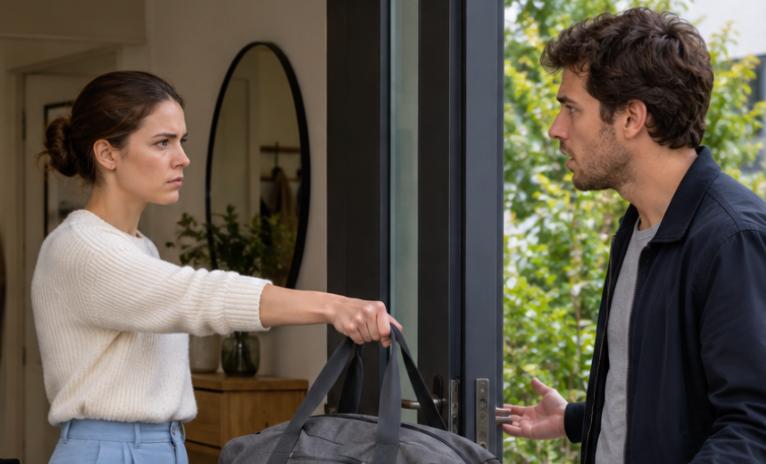
I was giving my son to his father. Not just for the weekend, not for a holiday – for good.
There was no paperwork involved, nothing to sign. There isn’t even a form for giving up your child – something like that just doesn’t exist. I simply packed a bag.
“Olya, are you done in there?” Sergey was standing at the door in his shoes, not bothering to take them off. “My mom’s waiting in the car.”
“Just a minute. The medical card’s in the side pocket. The slippers are in the bag, I labeled them.”
Vanya came out of his room in socks, with his backpack over his shoulder. He’s only six, but he managed to pack and zip everything up himself.
“Mom, what time will you come get me?” he asked.
I knelt down and straightened his collar.
“I won’t be coming, Vanya. You’re going to live with dad now.”
Our neighbor from the fourth floor was standing in the hallway with a bucket in her hand, and she wasn’t planning to leave. Let her stand there.
Sergey picked up the checkered bag and glanced at me. He expected I’d clutch onto our boy, start sobbing, maybe raise my voice in front of his mother. Instead, I just opened the door wider.
It was the fourteenth of May. But it all started back in the fall, with a pair of shoes.
***
In September, Vanya’s shoes stopped fitting. His toes were pinched at the front, but he didn’t say a word; I only noticed in the daycare changing room when he started yanking them off before going outside.
That evening, I waited until my husband finished eating.
“Sergey, we need winter shoes. These are done.”
“He’ll last until spring in those,” he said, without looking up from his plate.
“He can’t even get his feet into them anymore.”
“Well, then he’ll have to fit.” He pushed his plate aside and wiped his mouth. “Kids’ feet grow fast, you can’t keep up with them all.”
I hadn’t held my own salary in six years. Not because he took it – that’s just how it started from our first month of marriage. My card stayed in his wallet right next to his: “It’s easier this way, Olya, otherwise you’ll lose it.” Every Monday, he’d count out the week’s money, put the bills under the daisy magnet on the fridge. By Wednesday, he’d ask where it went, and if I couldn’t remember some pantyhose or something, he’d ask for the receipt.
Once, I bought myself a jacket. It was on sale, gray, the simplest one. He looked at the tag and asked what was wrong with the old one. I told him the sleeve was worn out. He said I could just patch it and that I’m too careless with other people’s money. I wore that jacket for three years, and every time I put it on, I thought about the sleeve.
I worked as a dry cleaner’s clerk on Sadovaya: coats, fur coats, bridal dresses with wine stains on the hem, receipts, and other people’s stories across the counter. Sergey called it “your sitting around.”
A week after the shoes talk, he went on a trip with the guys to a cabin. Three days, overnight. He came back cheerful, brought smoked bream, laid it out right on the newspaper, and told me all about how Vitka flipped his boat right by the shore.
“And the shoes?” I asked when he finished.
“Olya. Don’t start.”
In October, he changed the car tires. The old ones were still fine, but he got four new ones at once and spent half the day in the yard working on them. The guys went out to smoke and gave him compliments.
I never yelled. In six years, not once did I raise my voice at him, and maybe that’s where it all went wrong.
At daycare, they asked us to chip in for New Year’s gifts. I waited until Saturday, until he was in a good mood.
“Sergey, the daycare needs money for gifts, they’re collecting for the whole group.”
“Tell them we won’t. We have enough gifts of our own.” He didn’t take his eyes off the TV.
That year, we didn’t have any gifts of our own at all.
On Thursday, I came home from work and found a long cardboard box on the kitchen table—a fishing rod. He hadn’t put it away in the closet, just left it out in plain sight. I walked past it twice while heating up dinner.
The next morning, I went to see my supervisor.
“Lyuda, put me down for every Saturday. All of them.”
Lyuda looked at me over her glasses and set the intake log aside.
“Olya, Saturdays are when people bring in bags of carpets and down jackets. You’ll be wiped out by evening.”
“Just put me down.”
That evening, I dried my hands and told my husband, speaking to his back:
“I’m taking all the Saturdays. I’ll buy the boots myself. And I won’t ask you for anything else again.”
He smirked, still glued to the screen.
“Fine, then you can pay for daycare, too.”
By late October, with my first Saturday wages, I bought the boots. I got them two sizes too big, so they’d last two winters. Vanya shuffled around in them like they were boats, completely happy.
After November, there wasn’t any more money under the magnet.
***
On December 31st, we went to his mother’s place on Zarechnaya. Anna Vasilevna set the table for eight: the three of us, his sister Masha with her husband and two boys, and herself. Forty years working in the factory, and her table always looked ready for an inspection.
I brought a salad in a container. My mother-in-law opened it, said nothing, and transferred it to her own bowl.
“Olya, who cuts salad like that?”
At midnight, we started giving out presents. For his mother—a phone in a big box wrapped in gift paper. For Masha—a card; she opened it right at the table and gasped:
“Sergey, you really went all out!”
“He’s our generous one,” Anna Vasilevna said, smoothing the tablecloth. “Just like his father.”
Vanya got a remote control car, and immediately crawled under the table with it.
I didn’t get anything. I hadn’t expected to, until Masha asked:
“And for Olya?”
“What for?” Sergey poured himself a drink, set down the bottle. “She’s not a stranger to me. Why would I give her a present?”
Everyone laughed, including me. And right then, over the laughter, my mother-in-law turned to Masha and explained about me like I wasn’t even there:
“It’s pointless giving her anything. Olya is hopeless, she doesn’t care what she wears. Good thing she has Sergey, or you two would be out begging on the street with the boy.”
Vanya crawled out from under the table, clutching his toy car.
“Mom, what does ‘hopeless’ mean?”
I set my cup down on its saucer.
“Anna Vasilevna, I’m not hopeless. I’m inconvenient. There’s a difference.”
It got quiet at the table, except for someone singing on TV. I picked up my son, put his coat on in the hallway, and called a taxi. Sergey followed me out into the building entrance.
“Why are you making a scene? On a holiday?”
“I’m leaving. You stay.”
He stayed. He showed up on the second, around lunchtime, and the first thing he said as he walked in—without even taking off his coat:
“You embarrassed my mother in front of Masha.”
On the third of January, I wrote a request with payroll to have my salary transferred to a different account. I opened my own card that same day on my way home. That evening, I told him:
“Starting January, my salary is going onto my card. I already filed the papers.”
He set down his mug and looked at me like I was a stranger on the bus.
“Alright then. We’ll see what you’re singing by March.”
From that evening on, he started counting out loud. Not his money – but me. How much I cost him, where would I be if it weren’t for him. He’d count every time I came back on Saturday, always using the same words.
On February twelfth, I filed for divorce at the courthouse.
***
Lyuda found me a lawyer: her sister had a house dispute and was happy with the outcome. The office was above a shoe store, on the second floor. Mikhail Yuryevich listened quietly, never interrupting, then asked if I had any documents at all.
“I have receipts. I keep them all in a folder.”
“When was the apartment bought?”
“During the marriage. We finished paying it off.”
“That means half is yours. Do you understand?” He took off his glasses. “And the divorce will go through the court, not the registry office. With a young child, that’s the only way.”
But I didn’t understand. For six years, I’d lived feeling like I was in someone else’s home, there only out of kindness.
Seryozha got the summons a week later and called me that same evening.
“You’re an idiot, Olya. What are you getting yourself into?”
And two weeks after that, I got a paper from the court. He had filed his own petition: he wanted the court to decide that Vanya should live with him. Simply put, he wanted the boy registered with his father, and for me to become the parent who just visits on Saturdays.
“He doesn’t have much of a chance,” said Mikhail Yuryevich on the phone. “But it’ll take six months. And child services will come: they’ll check where the boy sleeps and what’s in the fridge, then write a report for the court.”
Child services came at the end of March, two of them, without warning. I showed them the bed, the desk, a shelf with books, opened the fridge. One wrote things down, the other asked Vanya where he liked it more, and he said with mom, because that’s where his building set was.
Between hearings, Anna Vasilyevna showed up – for the first time alone, without her son, carrying a pie wrapped in a towel. She sat in the kitchen and told me that all men are like that, and what matters is that the boy needs a father, not principles.
“Take the paperwork back, Olya. He’ll cool off.”
“He won’t cool off.”
“Then it’s on your head,” she said at the door. She took the pie back with her.
***
The first hearing was postponed, and the second was set for April seventeenth. Besides us, there were strangers in the room waiting for their cases, and Anna Vasilyevna sat in the front row with a new scarf. Masha also came and sat further away.
Seryozha spoke well. He always spoke well in public.
“She works the counter at the dry cleaner. Her salary is so low it’s laughable. The child wears hand-me-downs, shoes two sizes too big, like a street kid. The boy will be better with me, I support the whole family.”
My mother-in-law nodded from her seat.
I asked to speak for myself. My voice held steady—afterward, even I was surprised.
“I bought those shoes two sizes bigger back in October. With my Saturday earnings. He was at a resort at the time.”
Then I took the folder from Mikhail Yuryevich. Back in March, at my request, he had the court ask the bank for my husband’s account statements for a year and a half. The statements are the documents where you see, line by line, where someone paid with their card. They arrived in April, were added to the case, and by then I knew them by heart.
I read three lines out loud. October twentieth, the holiday camp. November third, a jewelry store, and the gift wasn’t for me. December thirty-first, an electronics store, a phone—and the phone wasn’t for me either.
“In just a year and a half, he spent three hundred twenty-eight thousand on himself and gifts,” I said. “That’s in the paperwork. But when it came to winter boots, there was no money.”
The judge announced a recess. That day, our marriage was dissolved, child support for Vanya was granted, but the statement regarding the boy was set aside, with a separate hearing scheduled for June.
In the hallway, Seryozha caught up with me by the window. My mother-in-law stood just two steps away, not leaving us alone.
“You’ll regret this,” he whispered. “You’ll be left with nothing. No apartment, no son.”
“You should be ashamed,” Anna Vasilievna told me. “You’re disgracing him in front of strangers.”
I stepped out onto the porch. Masha was smoking by her car, and as I walked by, she grabbed my sleeve.
“Olya, wait. I’m not telling you this out of kindness, don’t get the wrong idea.”
“What do you mean?”
“His mother promised to sign over her two-bedroom apartment on Zarechnaya to him. On one condition: Vanka has to grow up with her, not you.”
I stopped. Any other time, I would’ve just nodded and walked on—that’s what I always did. But now, I grabbed the handle of her car and asked:
“When were they planning to do this?”
“In June. After the court decision—she said so herself.”
“She told you that directly? In front of you?”
“She said it at the table, on Easter,” Masha replied, taking a drag and flicking ash onto the pavement. “‘Bring the boy home—we’ll go to the notary.’ And I just sat there quietly.”
“Why are you telling me this?”
“That apartment isn’t a stranger’s place for me either—I have two kids. That’s all.”
On Thursday, Seryozha called and said he’d take Vanya for the May holidays. And that he wouldn’t be bringing him back.
On May fourteenth, they both showed up—without warning, around three o’clock. Vanya was at daycare. My mother-in-law sat on a stool in the kitchen, while Seryozha stayed in the doorway like some stranger who’d been called to look at the pipes.
“Here’s the deal. You write a waiver for your share of the apartment and for child support, and I’ll withdraw my claim about Vanya from court. It’s for your own good, Olya—I’m trying to be reasonable.”
“And if I don’t?”
“If you don’t, we’ll be in court till winter. My statement is already in the case—I’m not taking it back. And for all those months, you’ll go to bed and wake up wondering if the boy will stay with you or with me.” He shook his head, as if he actually felt sorry for me. “So think about what your share is really worth to you.”
He didn’t even realize he said the most important thing out loud: he wanted our son not to raise him, but to use him to control me.
Anna Vasilievna leaned toward the bag by her feet and pulled out a plastic bag. Inside were those very boots; she’d taken them last Sunday when she had Vanya over, and I had just assumed I’d forgotten to hand them back.
“This is what he’s been wearing,” she said, placing them on the stool beside her. “I kept them—we’ll show the judge.”
Dusty, worn down, stained orange from salt. He wore them all winter and dragged them through every puddle this spring.
I left the kitchen, climbed onto a chair, and took a checkered bag from the top shelf.
“What are you doing?” Seryozha called from the hallway.
“Packing up.”
“Who?”
“Vanya.”
I was packing up: shirts, a second pair of pants, the pajamas with motorcycles, throat medicine, and slippers into a bag. My mother-in-law stepped into the doorway and blocked the light.
“Olya, don’t be ridiculous.”
“Take him,” I said without turning around. “For good. Not just for the May holidays, not for the weekend. For good.”
Seryozha laughed, but only with half of his face.
“Don’t make a scene.”
“No scenes. Don’t try to withdraw your application from the court, let it be. I zipped up the bag and straightened up. Only, in June you’ll go to the hearing yourself. You’ll take the work certificate yourself, and let the child services into your home yourself. And I’ll come and tell the judge the truth: that the boy is with you and that I want him back.”
“So are you giving him up or not?”
“I’m handing him over to you. But I’m not signing anything. There’s no document for a mother to give up her son to his father—I asked.”
He was silent.
“And one more condition, Seryozha. You do everything yourself. Not your mom, not Masha, not the neighbor. You wake him up, take him to kindergarten, pick him up at six, help with his sore throat, buy him shoes. In the right size.”
“What are you talking about?”
“And I won’t come to pick him up. If you want to return him, you’ll bring him back yourself.”
My mother-in-law threw up her hands.
“And you call yourself a mother. Giving away your child like a suitcase. I told you, Seryozha—she’s hopeless.”
I turned to her.
“Anna Vasilievna, you wanted your grandson with you. Take him.”
Then Seryozha finally said what I already knew.
“Mom promised she’d sort out the paperwork in June. I’m really doing this for the boy—he’ll have his own room.”
“I know,” I said. “Masha told me. About the notary, and about Easter.”
He looked at his mother. His mother stared out the window. Then it was as it began: the bag in the hallway, the neighbor with a bucket on the landing, and Vanya’s backpack fastened by his own hands.
That evening, I called the lawyer and told him everything. He didn’t interrupt, and then replied in an even tone that actually hurt more than if he had yelled.
“Olga Valentinovna, you haven’t lost your rights, remember that. No mother can officially give her child to the father forever, there’s no such document. If you want, you can come tomorrow and take him back, and he can’t stop you.”
“I know.”
“The real problem is the court hearing in June. The judge will ask where the boy lives. Child services will come and write in their report where he’s living. This is called the established arrangement, and the court pays special attention to it. With your own hands, you gave him the only trump card he didn’t have.”
“I know.”
“I didn’t advise you to do this. Write it down: I did not recommend this.”
“I wrote it down.”
That night, I changed Vanya’s bed to fresh sheets and lay across it myself, fully dressed. There was no point figuring out if I was right or wrong—it was too late. The only thing to count now was days.
For the first three evenings, he called at eight. On the fourth, he didn’t call.
***
I called myself. My mother-in-law picked up the phone.
“He’s with me. Seryozha is working a shift.”
The next week she said something different:
“Let him stay with me for now. Seryozha will figure out his schedule and pick him up.”
He was figuring out his schedule till the end of June.
Every evening at eight, I would call. Vanya would tell me about the pull-up bar in his grandma’s yard and a boy named Kirill, or about how his dad visited on Sunday and brought him chips. I’d listen, say ‘good job,’ and hang up. Then I’d wash my one cup in the kitchen.
There’s something I need to say clearly, or else it just wouldn’t be honest. I could have picked him up any day. Neither his father nor his grandmother would have stopped me, and if they’d tried, I could have brought the police officer with me. There was no document preventing a mother from taking her son. But I didn’t go.
At the end of May, he asked himself. For the first time ever.
“Mom, will you come on Saturday? We could go to the park. Grandma doesn’t go.”
I held the phone with both hands.
“Not this Saturday, Vanya.”
“What about another Saturday?”
“I’ll call you tomorrow at eight. Did you brush your teeth?”
He said he had, and we said goodbye. Afterward, I stood by the window and watched other people’s kids racing their scooters outside. That was the only time I almost got ready to go.
At the start of June, my mother-in-law called first.
“Olya, take him for the weekend. He’s up at six, and I need to rest in the afternoon, but he’s like a little wind-up toy.”
“That’s not what we agreed on, Anna Vasilievna.”
“Not what we agreed on? He’s your son.”
“He is. I’m not just lending him to you. I’m taking him back for good or not at all.”
She hung up. Ten days later, she called again, and didn’t use ‘you’ in the familiar way anymore.
“Olga, at least take him for a week. My whole house is upside down.”
“No.”
Masha texted me late at night: “Are you a mother or what? Your child is with strangers and you’re just being stubborn.” I didn’t reply. Lyuda set a glass of tea in front of me at work and asked directly:
“Olya, what are you doing?”
“I’m not doing anything. I’m waiting.”
“Waiting for what?”
“For it all to be over.”
On June 20th, my mother-in-law showed up herself, without calling, in a taxi. Vanya was standing in the hallway in new sandals, holding a plaid bag with both hands—it came down to his knees.
“Take him,” Anna Vasilievna said.
I brought my son inside the apartment, and he ran to see his own room, as if he’d just come back from camp.
“Where’s Seryozha?”
“Up north. He’s gone away for two months on a job shift. He sent me a text, can you imagine? A text to his own mother.”
She stood in the doorway and didn’t come in. In these five weeks, she really did seem to have shrunk, I swear.
“I took him to kindergarten. He cried the first few days. He was waiting for you.”
I stayed silent.
“You’re apparently not as clueless as I thought,” she finally said. “I expected you to run back in three days. But you endured.”
“I endured.”
“And now I’m not signing the apartment over to him. He hasn’t earned it.” She fixed her scarf. “Don’t think I’m apologizing to you.”
“I don’t.”
She left without saying ‘sorry’ or ‘thank you’. The elevator door slammed shut, and everything went quiet.
I heard water running in the bathroom. Vanya was washing his hands and singing, making up the words as usual. I sat on the rug by the hallway, legs stretched out in front of me. I sat there until the water stopped, and for the first time in six months, the pressure at the back of my head was gone.
And as for how the court case ended, I need to tell it in order—because it didn’t end just on its own.
In June, Seryozha didn’t show up for the hearing. In July, he missed it a second time, and the judge dismissed his claim—that’s the official term when the plaintiff fails to appear twice. After that, he stopped asking anyone about the boy.
Our marriage was dissolved in April, and that’s when child support was ordered. We split the apartment equally in the fall, and he didn’t show up for those proceedings either.
Then, in February of the following year, I filed my own court case. It wasn’t out of spite—Mikhail Yuryevich said it was important to have paperwork, otherwise in two years Seryozha might come back with a new claim. I asked the court to officially set our child’s place of residence with me. Child services visited again, checked out the bed and the fridge, and confirmed everything was in order. Seryozha didn’t come. The judge wrote that Vanya lives with me, and now that paper is in the same folder as all the receipts.
***
Vanya is thirteen now. He’s into swimming, and his schedule is still stuck to the fridge under the same daisy magnet.
I’m a senior intake manager with two locations and three girls working for me. I sold my half of the apartment, added a bit more, and got a one-bedroom on a mortgage. I buy new shoes for my son every year, always the right size.
Seryozha resurfaced after two years. Child support comes now and then, but more often not at all, and the court officers just shrug. He visited for Vanya’s ninth birthday, brought a box of building blocks, and stayed for forty minutes. Afterwards, Vanya asked if his dad would visit again. I told him I didn’t know. He never asked again.
Anna Vasilievna sold her apartment on Zarechnaya and moved in with Masha. She congratulates her grandson twice a year, always sending the same message on messenger. She’s never once said ‘sorry’ to me, and she still tells relatives that I handed the boy over to his father just so I could be free.
In May, Vanya came home from practice and paused in the kitchen doorway.
“Mom. Is it true you gave me away yourself back then?”
He heard it from his cousin, Masha’s eldest.
“It’s true,” I said.
He stood there a moment, nodded, and went off to his room. He never asked a second time. What he’ll make of it in seven years, I have no idea.
Last Saturday, Natasha from the third entrance came over. She sat on a stool, nervously twisting a napkin, and told me her husband was threatening to take Sveta away. He’s got a lawyer, his mom is backing him up, and he’s got all the aces.
“Olya, how did you handle it back then? Maybe I should do the same?”
“Don’t even think about it,” I told her. “Gather your documents. Request his bank statements through court, collect receipts, certificates, everything you can find. Go to a lawyer with a folder, not tears.”
“But you gave your son up yourself.”
“I did. But it’s not because I was some kind of hero, Natasha. I’d just run out of strength. I knew I couldn’t last through six months of court, and he wouldn’t make it even a month. I gambled that he’d break before I did. I gambled with Vanya.” I poured her tea. “And I guessed right. But I could have been wrong.”
I took a risk with my child back then. I happened to be right—but maybe that’s not something you should do with kids?
His sneakers are standing in my hallway. Size 41, perfect fit. I don’t buy shoes for him to grow into anymore.