“You came into our family without a dowry—nothing here belongs to you,” my mother-in-law declared. So I took all my “nothing” away in one truck.
“You came into our family without a dowry—nothing here belongs to you,” Lyudmila Petrovna declared, carefully folding the linen napkin beside her plate—the same napkin I had bought, washed, and ironed.
Andrei methodically demolished the homemade dumplings I had cooked, chewing with such satisfaction that you would think he had personally raised the meat, kneaded the dough, and awarded himself a bonus for the excellent result.
“The apartment belongs to Andryusha,” my mother-in-law proclaimed, majestically sweeping her hand around the spacious kitchen with its Italian cabinetry. “The comfort, the renovation, the appliances—it’s all because my son is the master of this home. He is the pillar of the family. And you, Lenochka, simply managed to attach yourself rather conveniently to a ready-made comfortable life.”
Officially, Andrei and I had never registered our marriage, something Lyudmila Petrovna had considered her personal victory for many years. But after so many years of living together, I had grown accustomed to calling Andrei my husband and her my mother-in-law.
I silently looked at the woman. Lyudmila Petrovna reminded me of a sea lamprey: she latched onto someone else’s prosperity quickly and only let go when there was nothing left to feed on.
The apartment really had been inherited by Andrei from his grandmother. When I moved in twelve years earlier, the only “comfort” there consisted of a sagging sofa, the smell of mothballs, and a bare lightbulb hanging from the ceiling.
All the furniture, appliances, textiles, and even the coffee machine that Lyudmila Petrovna used with such confidence—as though she had inherited it together with her son—had been bought by me.
“Mom, Lena contributes too,” Andrei remarked lazily as he popped another dumpling into his mouth. “She’s always buying new towels, for example.”
“Towels are consumables!” Lyudmila Petrovna said sternly. “And Andryusha is capital!”
My mother-in-law pushed her plate away and continued.
“So, Lenochka, you’ll come with us to the country house on your days off. The roof needs repairing, and you’ll buy the materials. Surely you understand that you’re obligated to invest in the family estate?”
I put down my fork.
“So nothing in this apartment belongs to me, but I’m supposed to pay for the roof on your country house?”
“Don’t twist my words,” Lyudmila Petrovna frowned.
“When money needs to be invested, we’re a family. But when it comes to property, that’s something else.”
Andrei finally looked up from his empty plate.
“Lena, Mom is right. Don’t pick apart every word.”
If you call a husband “golden” for long enough, eventually he starts demanding his own safe and round-the-clock security.
At that moment, I realized that the patience I had stretched thin for so many years had finally run out completely.
My decision to leave formed instantly, becoming a direct response to their own flawless logic.
The next day, I arrived at the furniture showroom of a large chain that I had managed for the past several years and spent a long time staring at a premium display kitchen.
Customers often think furniture is all about beautiful fronts.
But the secret to durability isn’t there at all.
It lies in the hidden hardware—the hinges, drawer slides, soft-close mechanisms, and concealed fasteners that no one sees from the outside.
Put cheap hinges on a solid oak door, and within a year that luxurious heavy door will warp, rip out its fittings, and crash loudly onto your foot.
Our family structure had long resembled exactly that kind of cabinet.
Andrei played the role of the beautiful façade, while for some reason all the hidden hardware was paid for and maintained by me.
“Elena Nikolaevna, you have the expression of someone planning to saw another person apart with a jigsaw,” our warehouse manager, Seryoga, observed.
He was a large man with an anchor tattoo on his forearm and nerves made of steel.
“Seryozha, I need you and four of the guys this Saturday,” I told him. “I’ll pay for everything as a private job. I’ve already booked the vehicle—a large furniture truck going straight to Sochi. We’re going to dismantle some illusions.”
That evening, I called my daughter.
Our Dasha had been living in Sochi for two years. She had married a wonderful man, and they had been inviting me to move closer for a long time, especially after their baby was born.
“Mom, have you finally made up your mind?” my daughter exclaimed happily into the phone. “It’s about time! Your company’s branch here in the city center is expanding. I checked—they’d grab you with both hands. And we already have a room ready for you, with a sea view. Run away from those users!”
By Friday, my plan was completely ready.
I arranged a transfer through work, bought a train ticket to Sochi, and confirmed the time for the furniture truck.
That evening, Andrei sat on the sofa in front of the enormous television I had bought for our anniversary—a television that my husband had regarded as part of his personal greatness from the very first day.
“Lena, Mom called. She says you still haven’t sent the estimate for the country house roof. Don’t drag this out. I still have to supervise the workers. And where’s my dinner?” Andrei complained, patting his stomach irritably.
“At the store, Andryusha. In the frozen-food section,” I replied calmly as I packed my documents into my bag. “And Lyudmila Petrovna can prepare the estimate herself.”
“What kind of way is that to speak to your husband?” he protested, trying to portray a fearsome patriarch.
In his stretched-out house shorts, however, the effect was not particularly convincing.
“Have you completely forgotten who brought you into this home?”
“I remember perfectly well what kind of home I came into,” I replied. “And I remember even better what I brought with me. Go to sleep, pillar of the family. Tomorrow is going to be a difficult day for you.”
On Saturday morning, Andrei left to meet his mother at the railway station. She was returning from visiting some distant relatives.
I had exactly four hours.
At ten in the morning, the doorbell rang.
Seryoga stood outside with four strong men carrying rolls of bubble wrap, packing tape, and electric screwdrivers.
“Well then, Elena Nikolaevna,” Seryoga said, surveying the hallway like a professional. “What are we taking?”
“Everything, Seryozha. Everything that isn’t built in. Leave the fitted kitchen alone, but pack everything else.”
They got to work with such speed that it seemed as though Seryoga and his men had spent their whole lives training specifically to return husbands to their original factory configuration.
During the first hour, we dismantled the oak bedroom set with its orthopedic mattress, the enormous living-room sofa, and the entire Italian dining set.
Then came the household appliances.
We took the refrigerator, washing machine, television, microwave, coffee machine, dishes, rugs, and curtains.
I packed the food into insulated bags and left it for Andrei on the kitchen table. Arguing over ownership of a packet of dumplings as well would have been excessive.
I removed the expensive chandeliers, and Seryoga replaced them with simple bare bulbs in sockets.
The apartment now had exactly as much lighting as the family “capital” required for independent living.
“Nikolaevna, are we taking all the towels too?” Seryoga shouted from the bathroom. “Should we leave one for Andrei?”
“Absolutely not, Seryozha. Lyudmila Petrovna explained it herself: towels are consumables, and Andrei is capital. Capital will manage.”
By one o’clock, all my family “nothing” fit into a single truck.
There was even some room left.
Apparently, I hadn’t been trying very hard at being a penniless bride after all.
The spacious, well-kept apartment had turned into an echoing, empty concrete cave.
In the middle of the living room stood the only piece of furniture that had belonged to Andrei before we met: a wobbly stool covered in peeling green paint.
His old hammer drill lay beside it.
We were carrying out the last bags when a key turned in the lock.
The door opened, and Andrei entered the apartment with Lyudmila Petrovna.
My mother-in-law stepped inside, automatically opened her mouth to criticize me for being too slow about something—and froze.
Her voice disappeared.
Andrei blinked several times and rubbed his eyes as though he had suddenly started hallucinating.
He stared at the bare windows, lonely lightbulbs, and empty corners.
“Lena…” he finally managed, staring at the stool. “Where is… everything? Were we robbed?!”
“Why robbed?” I adjusted my handbag on my shoulder. “I simply cleared the table. Or, more accurately, I cleared it together with the table.”
“What have you done, you lunatic?!” Lyudmila Petrovna finally recovered her voice, instantly reaching the volume usually sufficient for an entire apartment building. “Where did you take our furniture?!”
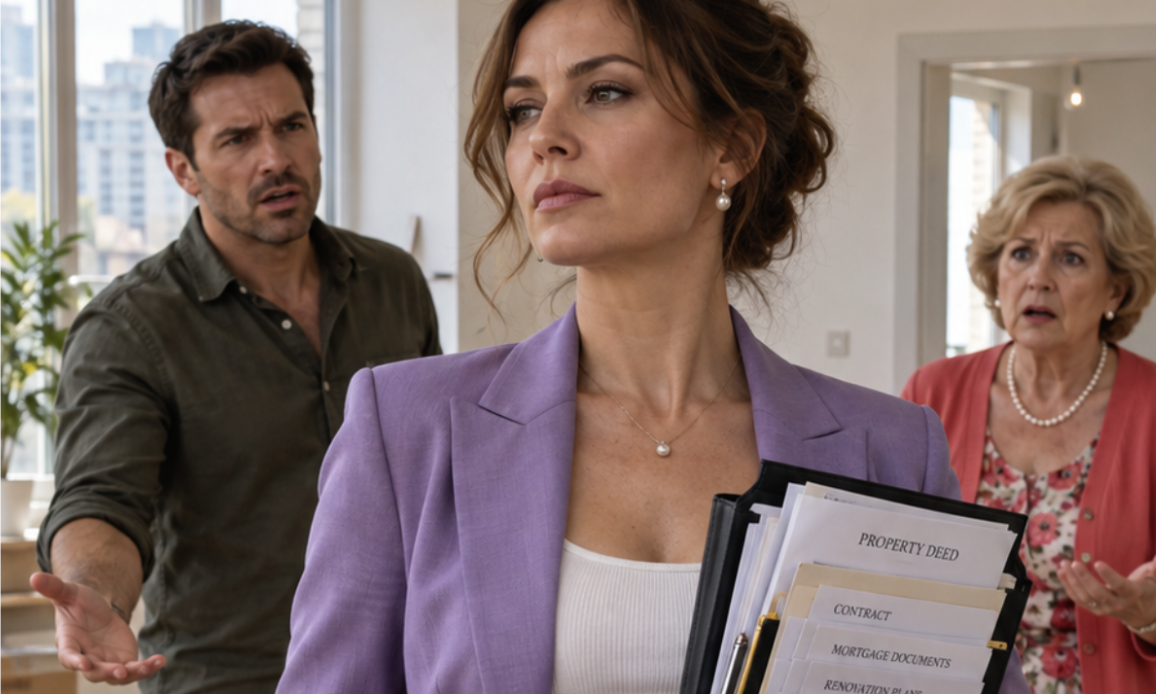
“There is no furniture of yours here, Lyudmila Petrovna,” I replied sweetly, pulling a thick folder from my bag.
“Inside these plastic sleeves are all the receipts and purchase agreements from the past twelve years.
“You’ve spent years telling every relative how wisely you protected Andryusha by preventing him from officially marrying me.
“Well, you were right. We really aren’t legally married.
“And all the things I’ve just taken were purchased by me. The documents are in my name, and the payments came from my account.
“You said it yourself last Sunday: I came here without a dowry, and nothing here belongs to me.
“So I simply took my ‘nothing’ with me.”
“You have no right!” my mother-in-law shrieked. “We’re family!”
Andrei finally came back to life.
He rushed into the bathroom and immediately ran back out, his eyes wild.
“Lena, you took the washing machine! My dirty shirts were inside it!”
It was magnificent.
The man had just lost every creature comfort he had, yet his brain had managed to process only the full scale of the dirty-shirt tragedy.
“Your shirts are in a basin, Andryusha,” I reassured him. “I bought the washing machine. The family capital now has a wonderful opportunity to master hand-washing.”
“How dare you!” my mother-in-law cried, blocking my path. “You are obligated to put everything back! You’re supposed to take care of Andryusha. That is your duty as a woman!”
Sometimes nature may hate a vacuum, but it is still better to leave a place completely empty than to let relatives turn it into their own private all-inclusive resort.
“My obligations to you have been fulfilled in full, Lyudmila Petrovna. Andrei’s apartment is intact and undamaged. Exactly as I received it.
“You can sit down on the stool and start building your family nest.”
Seryoga picked up the final box.
I looked at my mother-in-law.
“Lyudmila Petrovna, please move aside. Everything that belongs to you is staying inside.”
She jerked out of the way, and we stepped onto the landing.
“Who would ever want a woman with a personality like yours?!” she shouted after me.
“Sochi, Andryusha!” I called back from the elevator. “Sochi wants me!”
My job at the new southern office began on Monday, while life near my daughter and grandson felt unexpectedly fresh and light.
We kept the furniture that was useful at the children’s place, and I quickly sold the rest through online listings.
The money became my first substantial contribution toward buying my own small apartment near the sea.
News from my former family life reached me regularly. Mutual acquaintances were delighted to act as a slightly distorted news service.
As it turned out, the great pillar of the family did not last even a week.
For the first two days, Lyudmila Petrovna came to her son’s apartment to “help him get his household running.”
Andrei quickly decided that if his mother had come to help, she could also be put in charge of dinner and his shirts.
My mother-in-law—who sincerely believed that some other woman should be responsible for serving Andryusha—was outraged.
The final straw was the kettle.
Lyudmila Petrovna demanded that her son buy a new one.
Andrei replied that he had no money left because he had spent everything on an inflatable mattress.
After that, his mother called him an ungrateful egotist and announced that she would no longer come over to “help him get his household running.”
In the end, Andrei now survives on instant noodles and complains to the neighbors about the treachery of women.
I stepped out onto the balcony and looked at the sea.
Being a woman without a dowry turned out not to be so bad after all.
Especially when all your “nothing” can calmly drive away from the family capital in the direction of the sea.