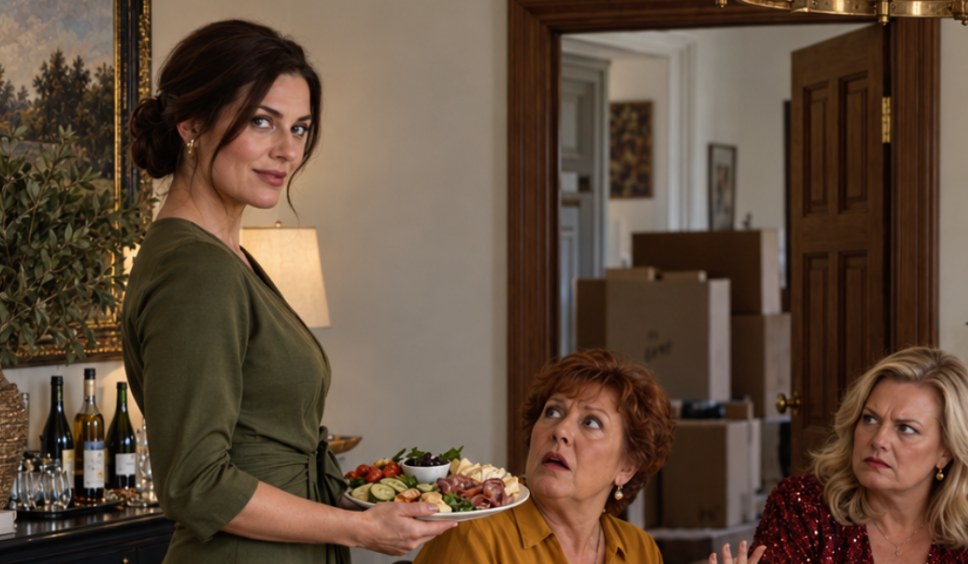
“Young couples benefit from sharing everything,” my mother-in-law lectured us at our housewarming. But I bought the apartment with my mother’s inheritance
Tamara Leonidovna hadn’t even taken off her sandals yet when she swept her hand around the entryway and laughed—loudly, so everyone taking off their shoes by the door could hear.
“Zhenya, don’t take this the wrong way. I’m a straightforward person, a modern mother-in-law, not one of those types. It’s just strange. People usually choose white kitchens nowadays, and yours is… well, bold. Good for you, I suppose.”
Zhenya placed a plate of sliced appetizers on the table.
“Bold,” she said, smiling just as casually. “Thank you, Tamara Leonidovna. I knew you’d appreciate it.”
It was a housewarming party in Ivanovo in July, in a two-room apartment on the fifth floor. The apartment had been bought with Zhenya’s money from the sale of her late mother’s apartment in Kokhma, plus a mortgage taken out in Zhenya’s own name. There were about twelve guests: her husband’s relatives, two of Zhenya’s friends, and the downstairs neighbor, whom they had invited out of politeness.
Her husband, Kostya, was pouring lemonade and making a determined effort to stare into the pitcher.
“You see why I’m saying this,” his mother continued as she settled herself at the end of the table. “I’m an easygoing person. Daughters-in-law are usually afraid of me, but there’s no reason to be. I don’t interfere. I simply notice things. I worked in a museum for forty years, in the exhibition department. Taste is something you either have or you don’t.”
“Taste is valuable,” Zhenya said with a nod as she arranged the glasses.
Someone at the table snorted.
Tamara Leonidovna faltered for half a second, then immediately recovered her previous tone.
“What I mean is, young people are easygoing nowadays, and I’m easygoing too. We’ll get along. Kostik, tell them. I’m easygoing, aren’t I?”
“You are, Mom,” Kostya muttered and went to get some ice.
His mother examined the table. She picked up the salt shaker, turned it around in her fingers, then put it down in a different place, closer to herself.
“The salt was standing over there with its back to the guests. Never mind, I’ll move it. I’m not proud. I’d arrange the plates differently too, but those are little things. Live however you’re used to living.”
Zhenya said nothing.
She moved the salt shaker back to exactly where it had been.
“And why are the forks mismatched?” her mother-in-law continued cheerfully, without sounding openly critical. “Some have patterns, some are plain. I understand—you’re young, you don’t have time to worry about proper sets. At your age I ate with whatever happened to be available too.”
“The patterned ones belonged to my mother,” Zhenya said. “I bought the plain ones later. Everyone can take whichever they prefer.”
“Your mother’s,” Tamara Leonidovna repeated, with a faint note of regret in her voice, as though they were discussing something sacred left behind by the deceased. “Well, that’s different.”
Alla, Kostya’s sister, sat down beside her mother. She was wearing a blouse with metallic threads and had placed her phone face-up so she could watch notifications without completely disconnecting from the family gathering.
She pulled the salad closer, tasted it, and pushed it away.
“Too much mayonnaise,” she said quietly, though loudly enough for half the table to hear. “Mom, I told you. They keep things simple here. Young people’s style.”
“And how do you prefer it, Alla?” Zhenya asked. “Would you like the mayonnaise served separately?”
Alla looked up.
She put down her fork.
Zhenya’s mother had left the apartment in Kokhma entirely to her because Zhenya was her only daughter. They had sold it for 4.2 million rubles. Zhenya added her own savings and took out an eight-year mortgage.
Kostya had contributed exactly zero rubles toward the down payment. He had a car loan for a vehicle he had bought before meeting Zhenya and was still, in his words, “almost finished paying off.”
“And who did the renovation?” the mother-in-law asked conversationally, looking around the walls. “Did you do it yourselves or hire people? Our Allochka hired a designer. A properly educated one. You can immediately see the difference.”
“We chose everything ourselves and hired people to install it,” Zhenya replied. “Rashid laid the tiles. He’s actually here.”
Rashid lived in the same apartment building, on the third floor, and happened to be sitting at the same table for the housewarming.
He finished chewing calmly and nodded.
“She’s a good homeowner. Handled everything herself. The tiles, the floor screed, the doors—Evgenia transferred every payment herself. I gave her all the receipts. Very organized.”
“Well, there you are,” Zhenya said, smiling at her mother-in-law.
Tamara Leonidovna turned slightly pink but laughed.
“I never doubted it. I was simply asking.”
The hot food was served.
Her mother-in-law turned toward the guests—Zhenya’s friends and the neighbor.
“I’ll tell you girls something. I raised Kostik alone. His father left, and I carried everything on my shoulders. And I’m not one of those mothers-in-law who say, ‘Give me back my little boy.’ Quite the opposite. I tell Zhenya, ‘Take him, he’s good with his hands.’ He’s not especially useful around the house, of course, but he has a good heart. And that’s what matters nowadays—not money.”
“Not money,” Zhenya agreed. “Which is why I’m not worried about the apartment.”
“Oh, what’s an apartment?” her mother-in-law said with a dismissive wave. “Property comes and goes. Today you have one apartment, tomorrow you exchange it for another. Young couples actually benefit from starting from zero so that everything belongs to both of them.”
She took a sip of lemonade and looked around at the walls and ceiling.
“By the way, you have two rooms. Kostik should have an office. He’s a man; he needs his own space. And the second room can become a nursery, God willing. Although…”
She glanced at Zhenya, who was already in her thirties.
“You probably shouldn’t wait too much longer. It may already be getting a little late for you.”
Someone at the table coughed.
Zhenya put down her glass.
Not sharply. She simply placed it on the table and paused just long enough for everyone to notice how quiet the room had become.
“A little late,” she said calmly. “I’ll keep that in mind. And an office for Kostya is a good idea. He’ll have somewhere to calculate his car-loan payments.”
Zhenya’s friend by the window snorted into her napkin.
“Oh, I’m only saying it because I care about you,” her mother-in-law hurried to explain. “I worry about both of you.”
Zhenya placed her phone beside her plate.
She didn’t touch it again. She simply set it down.
“Speaking of caring, Tamara Leonidovna, did you ever ask Kostya how much money he put into this apartment?”
“Oh, he must have contributed something,” his mother said dismissively. “A man being in the household is already a contribution.”
“Zero,” Zhenya said calmly. “I’m not saying that as an accusation. I’m just pointing out what number we should use when talking about ‘starting from zero.’”
The table fell silent.
Alla quickly intervened.
“Ugh, how materialistic. Talking about money in front of guests. We don’t like that sort of thing in our family. Mom, I told you—different upbringing.”
“Different,” Zhenya agreed. “In my family, we were taught not to divide up someone else’s property while sitting at their table. But I’ll try to adapt.”
Alla opened her mouth.
Then closed it.
But not for long.
“Maybe your upbringing is different,” she said, finally pushing aside the salad she had barely touched, “but tablecloths should be ironed along the fold, not however you feel like doing it. And wine glasses should be held by the stem with a napkin so they don’t get fingerprints. Small things, of course. But you can tell a lot about a person from the small things.”
“You certainly can,” Zhenya agreed. “Take you, for example, Alla. You’ve spent the entire evening sitting at my table. You’ve eaten two spoonfuls of food, and you criticized both of them. Small things really do tell you a lot.”
Alla flinched.
“I’m simply accustomed to a certain standard…”
“The designer standard,” Zhenya nodded. “I remember. You’ve mentioned it three times.”
Someone at the table could no longer hold back and laughed openly.
Alla grabbed her phone as though something urgent had arrived and buried herself in the screen.
Then Tamara Leonidovna’s phone rang.
She glanced at the caller, waved at the guests to be quiet, but answered directly at the table. Since one hand was occupied with a fork, she accidentally—or carelessly—turned on speakerphone.
“Yes, Lida. We’re at my daughter-in-law’s housewarming… Oh, it’s just an ordinary apartment, nothing special. I told you. Well, at least our Kostik didn’t do too badly. She may be penniless, but she has property. At least he’ll have a roof over his head now, and when they get divorced, at least…”
Tamara Leonidovna abruptly stopped.
Her finger missed the button.
The speakerphone had carried her voice to every single person at the table.
“…at least he won’t end up on the street,” she finished in a whisper before taking the phone off speaker.
The silence became almost tangible.
Zhenya did not raise her voice.
She didn’t even change her tone. She used the same light, casual voice her mother-in-law had been using all evening.
“‘At least the roof over his head will be his. When they get divorced,’” she repeated quietly. “Tamara Leonidovna, did I understand you correctly? Kostya lives in my apartment without having invested a single ruble, and when he gets tired of me, he takes half because we’re married?”
“That’s not what I… I was talking to Lida…” her mother-in-law said, waving her hand. “You misunderstood. It was just a joke.”
“I’m not angry,” Zhenya said evenly. “I’m simply saying out loud what you just said. The apartment was purchased with money from my mother’s apartment in Kokhma. That money was my inheritance. Inheritance received during marriage is personal property. It isn’t divided.”
She paused.
“And the renovation was paid for from my account, with documented transfers. Rashid can confirm it, and I have the receipts. So there really isn’t much to divide. Except perhaps Kostya’s car loan. But I’m not particularly eager to share that.”
“I was only saying it because I care…” Tamara Leonidovna began, and for the first time all evening she couldn’t find her light, cheerful tone.
Her voice came out thin.
Alla tried to rescue her.
“What did she even say that was so terrible? You’re twisting everything! In our family, everything has always…”
“…been shared,” Zhenya finished for her. “I remember. Then let me behave like family too, Alla. You’ve spent the whole evening telling me about my tablecloth, my glasses, and your standards. But this isn’t really about the tablecloth, is it? You’re upset because your sister-in-law owns an apartment while you and your designer are living in a rental. Am I right?”
Alla turned pale.
Without saying a word, she flipped her phone face-down.
The downstairs neighbor—the one they had invited merely out of politeness—suddenly spoke into the silence.
“The tiles really are beautifully laid. I should come by sometime and have a closer look. I’d like the same ones.”
And suddenly the table turned back toward Zhenya.
Someone asked where she had bought the doors.
Someone else reached for the hot food.
Tamara Leonidovna sat alone at the end of someone else’s table and could think of nothing to say.
Kostya returned with the ice.
He looked at his mother, then his sister, then his wife.
He put down the ice.
Instead of sitting beside his mother, he took an empty chair at the far end.
His mother noticed.
She made one final attempt.
She reached for the lemonade pitcher to refill the neighbor’s glass, playing hostess as she had been doing throughout the evening.
“Let me serve you. I’m not too proud…”
“Thank you, I’ll pour it myself,” the neighbor said, pulling the pitcher toward her.
Tamara Leonidovna withdrew her hand.
The guests left around midnight.
Tamara Leonidovna was among the first to go.
In the entryway, where she had begun the evening behaving like the mistress of the house, she now searched for her second sandal without looking at Zhenya.
“Thank you for dinner,” she said quietly.
“You’re welcome. Come again.”
They both knew she wouldn’t.
Three weeks passed.
Then Aunt Lida called—the same Lida from the speakerphone incident.
It turned out that she was a distant relative of Zhenya’s and a very straightforward person.
She explained plainly that Tamara Leonidovna was now telling everyone that she had been “humiliated in front of people at the housewarming,” but fewer and fewer people were willing to listen.
She invited the relatives to her birthday, but only Alla and two former museum colleagues showed up.
Word had spread through Kostya’s extended family that his mother had been hoping to install her son in someone else’s apartment and eventually claim part of it for him. Most of the relatives considered that behavior shameful.
Alla and her designer moved from one rental apartment to another, smaller one.
She called Kostya asking to borrow money.
Kostya refused.
He still had his car loan.
Apparently, before calling him, she had already called half the family. But by then everyone remembered her lectures about tablecloths and “standards,” and somehow nobody could find any money to lend her.
Kostya became quieter.
He stopped visiting his mother.
He stopped visiting his sister.
On weekends, he worked on a loose cabinet hinge in the kitchen—a hinge he himself had loosened.
Once he said to Zhenya:
“Maybe we should invite Mom over and you two could make peace.”
Zhenya replied:
“Invite her. To your apartment.”
Kostya silently went back to tightening the hinge.
The downstairs neighbor really did come by to ask about the tiles.
She wrote down the brand, stayed for tea, and mentioned that people in the building had already given Zhenya’s mother-in-law a nickname.
They called her “the museum guide,” because apparently she couldn’t stand at anyone’s doorstep without conducting a full inspection and giving them a guided tour of everything they had done wrong.
The nickname stuck.
Zhenya took down the picture Kostya had hung on the wall.
It was crooked.
She rehung it herself, using a level.
Then she put the hammer back in the drawer.
And closed it.