My Co-Mother-in-Law Criticized My “Poor” Table for Years but Always Took the Food Home in Containers—Until I Finally Welcomed Her Properly
“Such a poor little table! Respectable people don’t receive guests like this, sweetheart!”
Tamara Ignatievna stopped in the kitchen doorway, looked over the set table, and grimaced as though she had stepped in something unpleasant.
Lyuba, standing by the stove with a ladle in her hand, turned around.
They were in Lyuba’s apartment on a Saturday, celebrating her granddaughter’s birthday. Her co-mother-in-law had arrived first and, as always, without so much as a single bag in her hands.
“Hello, Tamara Ignatievna,” Lyuba said. “Come in. Take off your shoes.”
“I’m already in.”
Tamara Ignatievna marched straight toward the table in her outdoor sandals.
“I see you’re serving salads in these bowls again. Respectable people use glass salad bowls, a separate one for every salad. And what is this? One big communal pot like in a cafeteria.”
She lifted the lid from a saucepan and looked inside.
“Olivier salad with mayonnaise. Of course. We don’t do it like that in our family. We use sour cream. It’s easier on the stomach.”
Lyuba put down the ladle.
She said nothing.
Tamara Ignatievna sat at the head of the table even though no one had invited her to sit there. She smoothed the cardigan with shiny buttons over her knees and adjusted the large brooch at her throat.
Then she picked up a fork and examined it.
“The forks haven’t even been polished. In a respectable home, people scrub their silverware with baking soda before guests arrive. Yours have stains.”
There were already about eight people sitting around the table.
Lyuba’s daughter, Nastya, was sitting at the other end with the birthday girl, four-year-old Miroslava, on her lap. Lyuba’s son-in-law, Kostya, was looking at something on his phone and completely ignoring his mother’s remarks, as though he couldn’t hear them.
Beside Tamara Ignatievna sat her own sister, Galina Ignatievna, who was just as stiff and thin-lipped.
“Yes, yes,” Galina immediately agreed. “That’s not how we do things. Silverware is the first thing a guest notices.”
“The very first,” Tamara Ignatievna echoed.
Lyuba served the main course.
Homemade chicken with potatoes.
She put Tamara Ignatievna’s plate down first. Over the past five years, Lyuba had learned that it was easier to serve her first than listen to another lecture about respecting one’s elders.
“Store-bought chicken again?” Tamara Ignatievna poked the breast with her fork. “Pumped-up broiler chicken. We don’t do that. We buy ours from a farmer. But then again, where would you find a farmer on a librarian’s salary?”
Kostya stood up, muttered, “I’m going to the balcony,” and left.
The balcony door closed behind him.
Lyuba sat down at her usual place on the edge of the table.
She picked up her fork—the very same “unpolished” one.
Five years.
The same thing every single time.
For five years every family gathering had followed the same script: inspection of the table, a lecture on proper manners, and then, on the way out, food containers.
Lyuba had even calculated it once.
After every celebration, Tamara Ignatievna took home roughly fifteen hundred rubles’ worth of food. Lyuba had worked it out from her receipts one evening out of sheer boredom: mayonnaise, chicken, sliced sausage, cake.
Over the course of a year, it added up to a respectable amount.
Meanwhile, her co-mother-in-law had never brought groceries.
Not even a box of chocolates for tea.
And the apartment, incidentally, belonged to Lyuba.
She had inherited a one-room apartment in Kashira from her mother, sold it for 3.2 million rubles, added her own savings accumulated over twenty-two years of working at the library, and taken out a mortgage.
Now she owned a two-bedroom apartment on the outskirts of town, with another eight years of mortgage payments ahead of her.
Tamara Ignatievna knew all of this.
Yet she still kept saying, “Respectable people do it this way,” as though Lyuba were some poor relative living in somebody else’s home.
“Nastenka,” Tamara Ignatievna called loudly across the table. “You should teach your mother how to set a table properly. It’s embarrassing in front of people. One day you’ll visit respectable people and won’t even know which side the knife is supposed to go on.”
Nastya lowered her eyes toward her plate.
“Mom, just put up with it,” she whispered to Lyuba, leaning closer. “For Mira’s sake. For the sake of peace. It’s a celebration.”
“I am putting up with it,” Lyuba replied evenly.
Miroslava dropped her spoon.
Lyuba bent down, picked it up, wiped it, and gave the girl a clean one.
By the time she straightened again, Tamara Ignatievna had already moved on to the next topic.
“And I see the cake is store-bought too.”
She nodded toward the box near the refrigerator.
“From Pyaterochka, I suppose. You didn’t even bother removing the price tag.”
The white price sticker was indeed still visible on the packaging.
Three hundred and twenty rubles.
“We don’t do that,” Galina inserted.
“We certainly don’t,” her sister agreed. “If we’re making something for the grandchildren, we bake it ourselves. With custard cream. But of course, you need to know how to do that.”
Lyuba stood up.
She went to the refrigerator, took out lemonade for the children, and placed it on the table.
She said nothing.
Nastya looked at her gratefully, mistaking her silence for submission.
The celebration lasted about three hours.
Tamara Ignatievna ate heartily, never forgetting to comment between bites.
The potatoes didn’t have enough salt.
She could make lightly salted cucumbers much better herself because she had her mother’s recipe.
The fruit compote was too watery.
The napkins were paper, whereas respectable people used cloth ones.
Galina agreed with everything, perfectly synchronized, like the second half of a single mechanism.
Kostya eventually returned from the balcony, stayed at the table for ten minutes, and left again—this time “to smoke.”
Kostya seemed to spend more time escaping to the balcony than sitting at the table.
When it was finally time for tea, Tamara Ignatievna pushed her cup aside and professionally surveyed the leftovers.
“So, what do we have left here? There’s some chicken. Almost the entire salad is still here. Nastya, give me some containers so the food doesn’t go to waste.”
Lyuba already knew this part by heart.
Containers.
Always containers.
The table that had been “poor” and “improper” all evening suddenly became perfectly respectable once the food was destined for Tamara Ignatievna’s refrigerator.
Nastya hurried to the cupboard and started looking for food containers.
“Put in the Olivier salad too,” Tamara Ignatievna instructed. “And the chicken. Give me all the herring under a fur coat; fatty food isn’t good for children anyway. Leave the cake for my granddaughter, but wrap up that sausage. It’s good sausage, expensive. No point leaving it sitting here.”
Twenty minutes later, Tamara Ignatievna and her sister were leaving.
Each of them carried two tightly packed bags.
At the doorway, Tamara Ignatievna turned around.
“Next time, make the table a little better, Lyuba. It’s embarrassing. Respectable people don’t do things like this.”
The door closed.
Lyuba returned to the sink.
Nastya came up behind her.
“Mom, thank you for not losing your temper. I know it’s difficult. But she’s elderly. That’s just her personality. Let’s just put up with her until her anniversary, and then…”
“We’ll put up with it,” Lyuba said.
“And then we’ll see.”
Tamara Ignatievna’s anniversary was two weeks later.
She was turning sixty-five.
They decided to celebrate at Lyuba’s apartment again.
“Your kitchen is bigger, and my renovation still isn’t finished.”
The fact that Lyuba would also be responsible for setting the table, cooking the food, and washing everything afterward was apparently not even up for discussion.
Lyuba prepared thoroughly.
She went to the market and bought the exact farm-raised chicken Tamara Ignatievna had been talking about for years.
She polished the silverware with baking soda until it gleamed.
She took the glass salad bowls out of the cabinet—one separate bowl for each salad.
She ironed the cloth napkins she had bought especially for the occasion.
She ordered a cake from a pastry shop.
Custard cream.
Exactly the way “respectable people” liked it.
And naturally, there was no price sticker to remove.
But Lyuba prepared something else too.
She printed little cards.
Small, thick cards, like the ones you might see in a restaurant.
She placed one beside every plate.
The guests arrived at three o’clock.
Tamara Ignatievna appeared dressed in her finest clothes, with an even larger brooch and even shinier buttons.
And, naturally, with empty hands.
Galina followed directly behind her, like a shadow.
Tamara Ignatievna approached the table, already prepared to begin her inspection.
She opened her mouth.
Then stopped.
The table was gleaming.
Glass salad bowls.
Polished forks.
Cloth napkins.
A beautifully browned farm-raised chicken in the center.
There was absolutely nothing to criticize.
“Oh,” was all Tamara Ignatievna managed to say.
“Come in, Tamara Ignatievna,” Lyuba said, pulling out a chair for her. “Just the way you like it. Everything according to the rules.”
Her co-mother-in-law sat down.
She picked up a fork.
It gleamed.
She turned it over in her hand.
There was nothing to complain about.
Then her eyes fell on the card beside her plate.
She put on her glasses.
The card read:
“In our home, this is what is considered proper: a guest arrives with bread—and with respect for the hostess.”
Tamara Ignatievna read it twice.
Red blotches appeared on her cheeks.
“What kind of nonsense is this?”
She looked around the table.
There was an identical card beside every plate.
The guests were already reading them.
Someone covered their mouth with a fist to hide a smile.
“Rules,” Lyuba said calmly. “You’re always telling us that respectable people have certain customs. So I wrote down the customs in our home. That way the guests know.”
Galina reached for her own card.
She read it.
Her lips tightened even more.
But she said nothing.
For once, the echo was silent.
The dinner proceeded strangely.
Tamara Ignatievna ate without speaking.
There was nothing to criticize because everything had been done exactly the way she had demanded for the past five years.
Farm-raised chicken.
The right amount of salt.
Cloth napkins.
Every one of her former complaints was now sitting before her on the table, corrected exactly according to her instructions.
And somehow that seemed to make swallowing her food rather difficult.
“You’ve become awfully quiet, Tamara,” remarked Valentina, a neighbor sitting across from her. “The table is certainly impressive today. You should compliment the hostess.”
“It’s an ordinary table,” Tamara Ignatievna said through clenched teeth.
“Ordinary?” Valentina smiled. “You were always saying Lyuba’s table was poor. This looks like a restaurant.”
For once, Kostya never left the table.
He sat, ate, and didn’t even look at his phone.
At one point, he caught his mother-in-law’s eye and gave the slightest nod.
Whether it was approval or an apology, Lyuba couldn’t tell.
Eventually, they reached the tea.
And then came the moment Lyuba had been waiting for.
Out of habit, Tamara Ignatievna pushed her cup aside and opened her mouth.
“Well, bring the containers. Let’s pack up whatever is left…”
Lyuba stood.
She went into the kitchen.
But she didn’t return carrying empty containers.
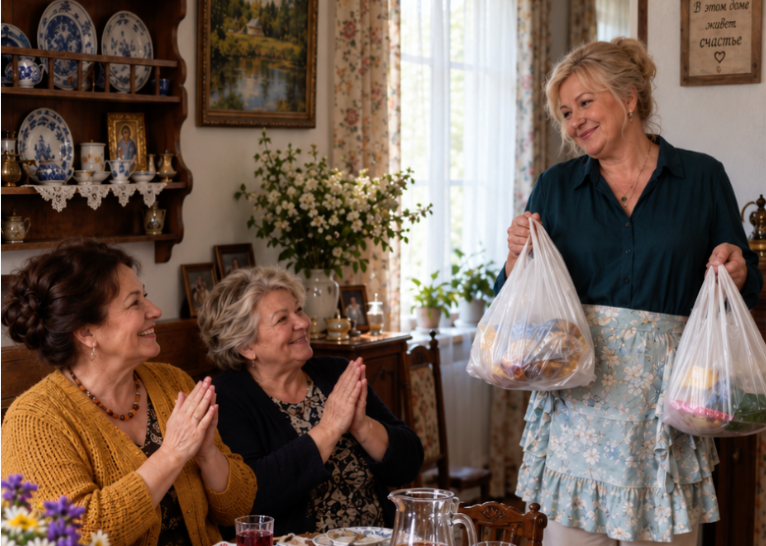
Instead, she was holding two neatly arranged bags.
The containers inside had already been packed with chicken, salad, and sausage.
Each container was closed tightly with a lid.
And each bag had a nylon bow tied around its handles.
Lyuba placed the bags directly in front of her co-mother-in-law.
“We’ve already packed everything for you, Tamara Ignatievna. Just the way you like it.”
She tilted her head slightly.
“No need to stay around the table any longer. It might suddenly start looking poor again.”
Someone at the table snorted.
Valentina coughed into her napkin.
Nastya froze with the teapot in her hand.
Tamara Ignatievna slowly lowered her cup onto its saucer.
Her hand moved awkwardly, and tea spilled over the edge.
A dark stain spread across the cloth napkin.
The very same kind of napkin used “in respectable homes.”
She stared at the bags decorated with bows.
For once, she couldn’t find anything to say.
“I…” Galina began.
But her sister tugged sharply at her sleeve under the table.
The echo went silent again.
Kostya stood up.
He walked over, picked up both bags by their bows, and held them out to his mother.
“Mom, let’s go. I’ll call a taxi,” he said evenly.
It was the only meaningful thing he had said all evening.
Tamara Ignatievna stood.
The red blotches still hadn’t disappeared from her cheeks.
She took the bags.
She didn’t refuse them.
Her hand reached for them automatically, driven by a habit that had become deeply ingrained over the years.
And then she suddenly realized what she had done.
But it was too late.
Everyone at the table had seen it.
At the doorway, she said nothing about proper manners.
She silently put on her shoes and left.
Galina hurried after her.
The door closed.
Nastya put down the teapot.
“Mom,” she said quietly. “I didn’t realize it was really that bad. I’m sorry I kept asking you to put up with it.”
“It happens,” Lyuba replied and began collecting the cups.
Three weeks passed.
Valentina—the same neighbor who had sat opposite Tamara and coughed into her napkin—ran into Lyuba near the entrance to the apartment building and happily shared the latest news.
Apparently, she had been sitting in the same waiting room at the clinic as Tamara’s sister.
It turned out that Galina had fallen out with Tamara.
She was tired of being her sister’s echo.
Tired of agreeing with everything she said.
Tired of going everywhere with her and feeling embarrassed about those food containers.
Now Galina attended celebrations separately.
As for Tamara Ignatievna herself, she hadn’t set foot in Lyuba’s apartment since that evening.
However, according to Valentina, Tamara had recently attended another co-mother-in-law’s birthday carrying a cake.
A custard cake from a pastry shop.
And she had spent the entire evening boasting about it louder than anyone else, almost as if she had baked it herself.
She never mentioned respectable behavior or properly set tables again.
After that evening, Kostya began greeting his mother-in-law with a handshake.
And Nastya stopped asking her mother to “just put up with it.”
As for those food containers with the bows, they eventually came back to Lyuba through Nastya.
Empty.
Clean.
Washed.
Lyuba put them back in the cupboard.
On the bottom shelf.