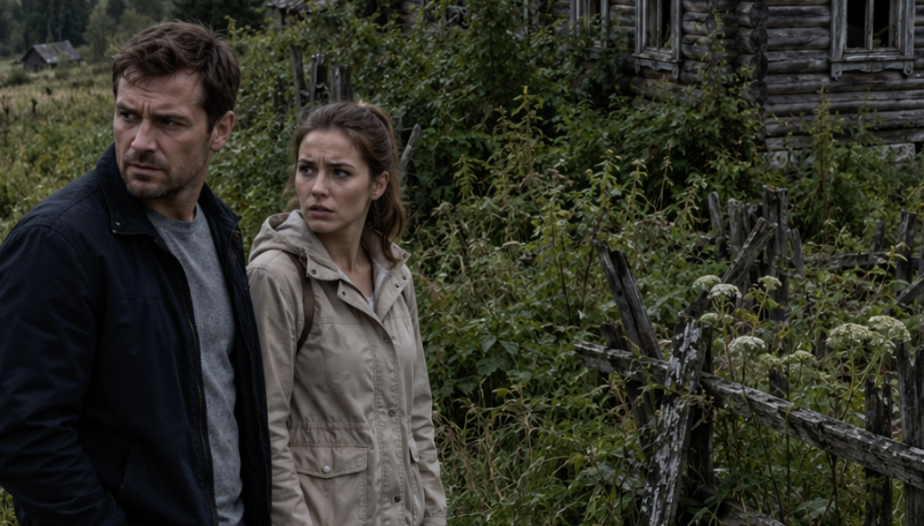
Dima and Alyona stood in front of their new home without saying a word.
For several minutes, neither of them moved.
The house looked worse than it had in the photographs.
Years of rain had darkened the wooden walls. Part of the roof sagged dangerously, several windows were missing, and broken glass still clung to some of the frames. Nettles had swallowed almost the entire yard, rising nearly to their shoulders in places. What remained of the fence consisted of a few crooked posts and rotten boards hidden beneath the weeds.
Alyona slowly turned toward her husband.
“Dima… do you really think we can do this?”
He looked at the collapsing porch, then at the roof.
“Of course we can.”
“The roof is practically falling down.”
“I know.”
“There are no proper windows.”
“I noticed.”
“And the yard looks like nobody has stepped into it for twenty years.”
Dima smiled.
“I told you it wouldn’t be easy.”
Behind the house, however, the world looked completely different.
Wide green meadows stretched toward the horizon. Beyond them flowed a silver river, and behind the river stood an old linden grove. There were no apartment towers, no traffic, no horns, no concrete walls.
Only grass, sky, trees, and silence.
Alyona breathed deeply.
For the first time in years, she felt as though there was enough air.
Only a few months earlier, their lives had been completely different.
Dima worked as a programmer. Alyona was an accountant at a small company. They owned a tiny studio apartment with a mortgage and spent most of their lives between work, traffic jams, supermarkets, and home.
Dima often worked late into the evening. Even after coming home, he answered messages and opened his laptop again.
Alyona was just as exhausted. Her boss seemed to remember urgent reports five minutes before the end of every workday.
They survived on strong coffee and five or six hours of sleep.
Even weekends disappeared into cleaning, groceries, errands, and preparations for Monday.
Then one evening, sitting in their tiny kitchen, they looked at each other and realized something frighteningly simple.
They didn’t want this life anymore.
At first, the idea of leaving the city sounded ridiculous.
Then it became a plan.
They sold their apartment, paid off the mortgage, and found an abandoned village house being sold for almost nothing.
After buying it, they had only a small amount of money left.
And so, at thirty and twenty-eight years old, they arrived in a village where no one understood why two educated city people would willingly choose a collapsing house without reliable water, heating, or even a proper fence.
The villagers watched them suspiciously.
Some were convinced they would last until winter.
Others gave them a month.
Aunt Zina, who lived nearby, came to inspect them on their second day.
Dima was cutting nettles when she stopped beside the ruined fence and placed her hands on her hips.
“You know this house has been empty for twelve years?”
“I know.”
“You’ve seen the stove?”
“Yes.”
“It’s almost fallen apart.”
“We’ll repair it.”
“And the well?”
“We’ll clean it.”
Aunt Zina stared at him.
“You city people think everything is easy.”
“No,” Dima replied calmly. “I think it’s going to be extremely difficult.”
She began describing winter.
Snow deep enough to block the gate.
Electricity disappearing for days.
Temperatures so low that trees cracked in the cold.
Dima listened patiently.
Then he asked something that completely confused her.
“Is the honey good around here?”
“What?”
“The honey. Alyona and I want to keep bees.”
Within an hour, the entire village knew.
The city couple in the abandoned house wanted to become beekeepers.
Most people laughed.
Only Stepan Ivanovich did not.
Stepan Ivanovich was seventy-two and had kept bees for forty years. Everyone in the district knew his honey.
Three days later, he appeared at Dima and Alyona’s house.
“I hear you want bees.”
“We do,” Dima said.
“How much do you know?”
“Not enough.”
At least the answer was honest.
They had been reading everything they could find.
Stepan Ivanovich snorted.
“Books are useful. But books are paper. Bees are alive.”
Then he began questioning them.
What breed?
How would they prepare the hives for winter?
What would they feed the colonies?
To his surprise, Alyona answered several questions correctly.
“My grandfather had bees,” she explained. “I spent my childhood summers helping him.”
The old beekeeper studied her carefully.
Finally, he nodded.
“We’ll see what becomes of you.”
That was all.
Their first year tested them constantly.
They repaired the roof and windows. Dima restored the stove and replaced rotten floorboards. Alyona plastered walls and sealed cracks.
Their savings disappeared alarmingly fast.
Still, by autumn the house was warm, dry, and livable.
They bought three bee colonies.
Dima built the hives himself.
Alyona chose a place behind the house, sheltered from the wind and close to the linden grove.
In August, they harvested their first honey.
Only two large jars.
It was almost nothing.
Yet they placed those jars on the kitchen table and stared at them like treasure.
Alyona tasted a spoonful.
“Oh, Dima…”
“What?”
“I’ve never tasted honey this good.”
He laughed.
“That’s because it’s ours.”
They gave one jar to Aunt Zina.
The second went to Stepan Ivanovich.
The old man opened it, smelled the honey, tasted it slowly, and closed his eyes.
“Linden,” he finally said. “And sweet clover.”
Dima and Alyona waited nervously.
Stepan Ivanovich nodded.
“Good honey.”
Two words.
But to them, they meant everything.
Then winter came.
In February, the temperature dropped brutally.
Dima checked the hives every day.
At first, everything seemed fine.
Then one colony weakened.
Soon another began weakening too.
The humming inside the hives grew quieter.
Bees began dying.
Alyona cried.
Dima spent nights reading, searching, contacting experienced beekeepers, trying desperately to understand what they had done wrong.
Nothing helped.
By the fifth day, they believed they were going to lose two colonies.
Then Stepan Ivanovich appeared.
He walked into the yard wearing a heavy coat and carrying a large sack.
“Where are the hives?”
They took him behind the house.
He listened carefully to each hive.
Then he opened his sack.
Inside were reed mats, burlap, and rope.
“They’re freezing,” he said. “Not enough insulation.”
“What do we do?” Alyona asked.
“We work.”
They worked until evening.
Stepan Ivanovich showed them how to protect the hives without blocking ventilation.
He didn’t lecture.
He demonstrated.
They followed.
When they finally finished, he looked over the apiary.
“Now they have a chance.”
Alyona hesitated.
“Why are you helping us?”
The old man frowned.
“What kind of question is that?”
“We sell honey too. That makes us your competitors.”
Stepan Ivanovich smiled.
“Bees don’t care about competition. They collect honey. They don’t ask who sells the jar.”
Then he became serious.
“And you’re not outsiders anymore.”
Alyona blinked.
“What do you mean?”
“You stayed. You repaired the house. You survived the difficulties. You work the land. You respect the bees.”
He looked at them.
“You’re ours now.”
Then he said something neither of them ever forgot.
“I’m old. My son doesn’t want my apiary. My grandchildren don’t care about bees.”
He paused.
“But you understand them. You feel them.”
Dima looked at him.
“So if we’re not competitors, what are we?”
Stepan Ivanovich answered quietly.
“My successors.”
All three colonies survived the winter.
The following summer, they produced nearly forty kilograms of honey.
At the district fair, every jar sold.
The next year, they added five more colonies.
Stepan Ivanovich personally helped them choose the bees.
Beekeeping gradually stopped being an experiment.
It became their life.
Dima eventually left programming completely.
Alyona started a blog documenting their village life, their mistakes, their victories, and everything Stepan Ivanovich taught them.
People began following her.
Ten thousand followers became customers.
Their honey began traveling far beyond the village.
Local shops started placing orders.
People drove from other towns specifically to buy their linden honey.
And the villagers who had once laughed now came to them for advice.
They were no longer “the city people.”
They belonged.
Then, one morning during their third summer, Stepan Ivanovich arrived and sat quietly on their porch.
Dima brought him tea.
For a long time, the old man stared at the hives.
Finally, he said:
“I’ve decided to sell my apiary.”
Dima stared at him.
“Why?”
“I’m seventy-three. My back hurts. My legs don’t listen anymore.”
“Who are you selling it to?”
Stepan Ivanovich looked at Dima.
Then at Alyona.
“You.”
They were speechless.
“But your apiary is worth a fortune,” Dima protested. “More than twenty colonies, the hives, the equipment…”
“I don’t want your money.”
“We can’t take it for nothing.”
“You’re not.”
Stepan Ivanovich looked toward his bees.
“I spent forty years wondering what would happen when I was gone. My son doesn’t want this life. Neither do my grandchildren. Selling everything to a stranger would feel like burying something that’s still alive.”
His voice softened.
“But now I’m not worried anymore.”
He looked at them.
“You love the bees. Not only because they make money. You love the work itself.”
Dima tried to object again.
The old man raised a hand.
“Enough. Don’t argue.”
Then he made only one request.
“Every year, bring me one jar of your first honey.”
Alyona’s eyes filled with tears.
“Of course.”
“Not for selling,” he continued. “For me. I want to open it, smell it, and know the apiary is still alive.”
Alyona stood and hugged him.
At first, Stepan Ivanovich froze awkwardly.
Then he gently placed a hand on her head.
And suddenly, the old man began to cry.
Quietly.
Tears simply ran along the wrinkles of his face.
A month later, twenty-four of Stepan Ivanovich’s colonies became theirs.
Together with their own, Dima and Alyona now had thirty-two.
It was no longer a hobby.
It was a real apiary.
They hired a local assistant.
They built a proper winter shelter.
They bought better equipment and a larger honey extractor.
Their days began at sunrise and often ended after dark.
They had almost no weekends.
But the exhaustion felt completely different from the exhaustion they had known in the city.
Back then, they had gone to bed tired because another day had disappeared.
Now they went to bed exhausted because they had built something.
And they were happy.
That autumn, they returned from a large regional fair shortly before sunset.
When they drove into the yard, Alyona noticed Stepan Ivanovich sitting on the porch.
Dima took a large jar of honey from the car and placed it in front of him.
“What’s this?” the old man asked.
“Your order.”
“What order?”
“The first honey.”
Stepan Ivanovich slowly picked up the jar.
The golden honey glowed in the evening sunlight.
He opened it.
Smelled it.
“Linden,” he said.
Then he smelled it again.
“And fireweed.”
Dima smiled.
“Exactly.”
The old beekeeper tasted a spoonful.
For several seconds, he said nothing.
Then a wide, almost boyish smile appeared on his face.
“My honey.”
He tasted another spoonful.
“Only somehow it’s better.”
Dima laughed.
“How could it be better?”
“I don’t know. Same bees. Same linden trees. Same place.”
He looked suspiciously at Alyona.
“What did you put in it?”
Alyona kept a perfectly serious face.
“Love.”
For a second, no one spoke.
Then Stepan Ivanovich snorted.
Dima laughed.
Alyona followed.
And finally, Stepan Ivanovich laughed too.
The three of them sat on the porch of the house that had once been abandoned.
Before them stood a jar of fresh golden honey.
Behind the house, bees made their final flights of the evening.
Beyond the apiary stood the darkening linden grove.
Farther away, the river reflected the last light of the setting sun.
Three years earlier, Dima and Alyona had arrived there with almost nothing.
A ruined house.
Three bee colonies.
A little money.
And a vague hope that life could somehow be different.
Now they had a home.
They had an apiary.
They had work they loved.
They had neighbors who had become family.
And they had an old beekeeper who had trusted them with the work of his entire life.
Stepan Ivanovich looked once more at the jar.
“Good honey,” he said.
Alyona smiled.
“So we’re doing everything right?”
The old man nodded.
“You are.”
Then he added:
“Keep going.”
And that was enough.
The golden evening slowly faded over the village.
The bees hummed.
The air smelled of warm wood, summer grass, earth, wax, and honey.
It smelled of life.
And perhaps, Dima thought, that was exactly what happiness smelled like.