“We’ll Move Your Orthopedic Chair to the Director’s Office — a Regular One Is Good Enough for You,” the Facilities Manager Ordered. So I Took My Personal Purchase Home
“Where do you think you’re taking that?!” I said sharply without looking away from the quarterly report on my monitor, although out of the corner of my eye I had already noticed the outrageous scene unfolding beside me.
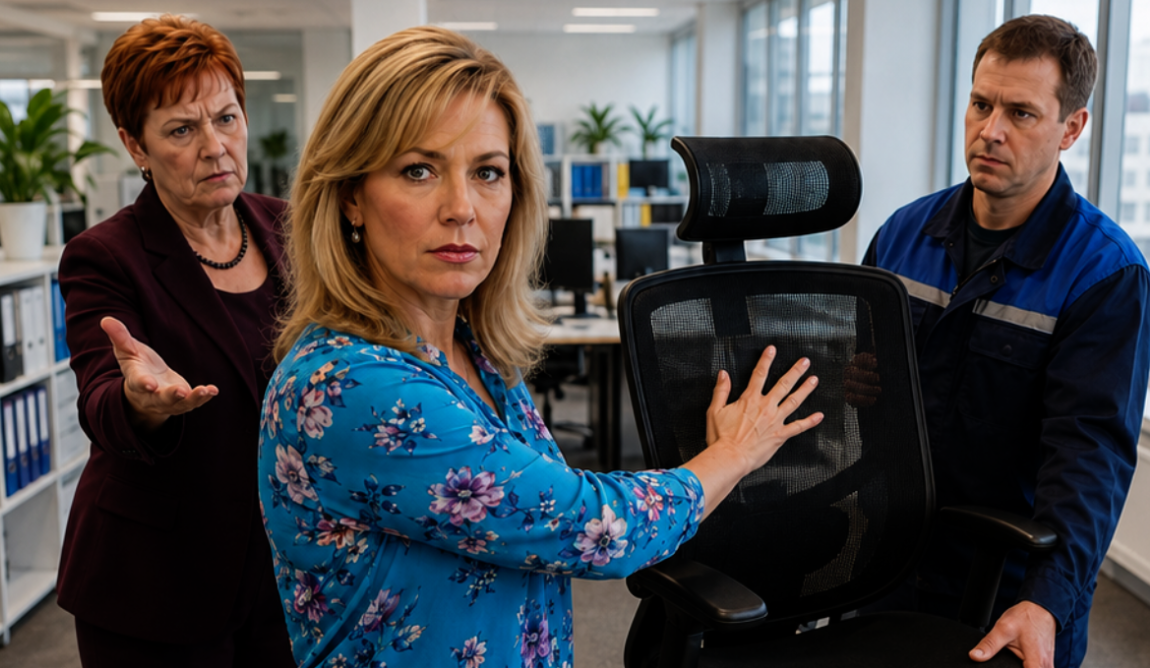
Two workers in blue overalls stained with paint were grunting with effort and shifting from foot to foot as they lifted my orthopedic chair off the worn office linoleum.
“We’re moving your orthopedic chair into the director’s office. A regular one is good enough for you,” announced Lyudmila Arkadyevna, the facilities manager, stepping out from behind their broad backs as though the matter had already been settled. “Look at you, lounging around in comfort. You’re no aristocrat. You can sit like everyone else. Your crown won’t fall off.”
With those words, she contemptuously kicked a standard office chair toward me. It stood on flimsy wheels that spread apart under pressure. The chair gave a miserable squeak, as if already anticipating its imminent demise beneath the weight of everyday accounting work.
I slowly removed my glasses.
I am fifty-two years old. I work as a senior accountant at a small municipal design bureau, and my spine stopped resembling a flexible steel rod willing to bend for the glory of someone else’s business a long time ago.
Three years earlier, when ordinary office furniture had begun making it increasingly difficult for me to survive an entire working day, I bought that chair myself.
With my own honestly earned money.
It had cost an outrageous amount. It had an anatomical backrest, a synchronized reclining mechanism, and adjustable lumbar support. I had carefully set the seat height, back resistance, and armrests to suit me and no longer spent half the day searching for a position in which I could work peacefully on financial reports.
I was still tired by evening—accounting doesn’t perform miracles—but I no longer had to stand up every ten minutes to stretch my aching back.
The chair was not a status symbol or an office decoration. It was my personal work item, purchased specifically because sitting at a desk for eight hours requires proper support.
And now someone was trying to carry this precious possession of mine—precious both to my heart and to my back—into another person’s office without my permission.
“Put it back,” I told the workers calmly, although there was steel in my voice. “One, two, three.”
The movers froze like prairie dogs, staring questioningly at the facilities manager.
“What are you standing there for? Take it to Viktor Pavlovich’s office!” Lyudmila Arkadyevna raised her voice.
She was fifty-five, and she had a peculiar understanding of saving company resources: if someone else could be forced to suffer the inconvenience, then apparently the expense had disappeared.
“Lyudmila Arkadyevna,” I said, standing up from behind my desk and bracing my hands against the tabletop. “You seem to have confused both boundaries and balance-sheet categories. I bought this chair. With my own money. It is not listed among the bureau’s assets. Take your hands off it.”
“Personal property! Listen to her! She has personal property in the office!” the facilities manager exclaimed loudly enough for nearby colleagues to start listening. “Every paper clip in this office is accounted for. The boss comes back from his business trip tomorrow, and he needs a decent chair when he meets with partners. You sit in accounting where nobody even sees you. You’re no lady of the manor. A regular chair is good enough for you. Give this one up.”
Whenever her practical arguments ran out, rudeness took over.
But I had spent too many years balancing debits and credits to confuse a loud voice with the legal right to dispose of someone else’s property.
“My chair isn’t part of the staffing table,” I replied. “Gentlemen, put it back where it was. If anyone tries to remove my personal belongings despite my explicit objection, I will call the police and document what is happening. Let the people responsible decide on the legal classification.”
The workers exchanged glances, carefully lowered the chair back onto the linoleum, and disappeared into the corridor while muttering something about how they were “just following orders” and that we should settle the matter ourselves.
Lyudmila Arkadyevna pressed her lips together and stared at the chair.
Several weeks earlier, she herself had told colleagues that the approved replacement for the director’s chair was “almost ordered.”
But I worked in accounting, and I had seen neither a paid invoice nor documents from a new supplier.
Now, one day before the director’s return, her sudden interest in my chair seemed highly revealing.
I didn’t waste time arguing.
I took out my smartphone, opened an app, and ordered a cargo taxi to my home address.
“What are you doing?” the facilities manager asked suspiciously, narrowing her eyes as she watched me.
“Evacuating private property from a natural-disaster zone,” I replied, sitting back down in my beloved chair. “The vehicle will be here in twenty minutes.”
Lyudmila Arkadyevna abruptly turned around and marched into her office.
My colleagues returned to work, and I continued arranging the cargo taxi.
The disagreement had stopped being public entertainment and had returned to what it had been from the very beginning: an attempt to dispose of my property without my consent.
The funniest part was that Lyudmila Arkadyevna knew perfectly well where the chair had come from.
Three years earlier, before bringing it into the office, I had written an official memo requesting permission to use my personal orthopedic chair at work.
She herself had approved it.
I had kept a copy.
So any sudden story about “unregistered surplus property” would not survive even the most superficial inventory check.
Ten minutes later, Lyudmila Arkadyevna returned carrying an inventory log and a white permanent marker.
From the determined expression on her face, I realized that her administrative creativity had found a new route.
“Get up!” she barked, advancing toward me. “I’m assigning an inventory number to this unidentified object right now! It’s unregistered surplus discovered on company premises. That makes it bureau property! We’ll put it on the balance sheet as discovered assets!”
She bent toward the base of the chair with the marker, but I rolled it away and stood beside it.
Apparently, her idea of an inventory procedure was going to begin not with paperwork, but with decorating my personal property.
“Lyudmila Arkadyevna, a marker does not turn someone’s personal belongings into company assets,” I said. “An asset does not magically appear without a legal basis, primary documentation, and an employer’s decision. Three years ago, you personally approved my memo allowing me to bring my personal chair into the office. I have a copy in my desk. I also have proof of payment and witnesses. If you want to verify something, verify the documents—not the armrest.”
“I never signed anything! You made it all up!” Lyudmila Arkadyevna snapped. “You think you’re the smartest one here with all your numbers? I’m trying to save every penny for this bureau while you’ve turned your workplace into a private furniture showroom. That chair is going into Viktor Pavlovich’s office.”
She reached for the armrest again.
At that exact moment, my phone rang.
“Yes, you’ve arrived?” I said loudly into the phone. “Second floor, turn right down the corridor. Come in.”
The arrival of the cargo-taxi driver made the dispute practically meaningless.
I had already arranged to take my property home.
“We’re taking this,” I told him, patting the back of the chair. “Please be careful. It’s fragile and expensive.”
“I forbid you from removing company property! This is bureau territory!” the facilities manager shrieked, spreading her arms and trying to block the corridor.
The driver looked at her with complete indifference, then looked at me.
I handed him the cash I had already prepared.
“Don’t pay any attention to her,” I said calmly. “The lady has overworked herself doing inventory. Let’s go.”
Without saying a word, the driver simply walked around Lyudmila Arkadyevna as if she were an annoying but harmless obstacle, picked up the chair, and rolled it into the corridor.
The facilities manager watched him leave with a look of helpless fury before turning sharply toward me.
“You’ll regret this, Natasha. The boss is coming back, and I’m going to tell him everything! You can explain why you ignored the facilities manager’s order and removed a chair from the office.”
With that, she marched back into her room.
I pulled the standard office chair she had left for me toward my desk.
The gas lift sank several centimeters the moment I sat down. The hard seat was noticeably lower than I was used to, and the backrest offered almost no lumbar support.
I raised the monitor, moved the keyboard, and tried adjusting the chair, but the gas lift simply did not have enough range.
Within a few minutes, I was changing positions every thirty seconds, desperately trying to find something that resembled a workable posture.
I also had to get up more frequently to retrieve documents myself, although colleagues normally brought some folders over when they passed my desk.
It did not turn the day into a tragedy, but it demonstrated perfectly what someone else’s idea of “administrative savings” actually meant.
The discomfort had not disappeared.
It had simply been transferred from one employee to another.
There was no question about it: my back was not going to appreciate spending an entire working day in that chair.
Working became noticeably more difficult, but at least my orthopedic chair was safely at home and could no longer mysteriously appear in the director’s office.
I had no idea what Lyudmila Arkadyevna intended to do next.
I knew only one thing.
The director was returning the following day, and accounting still had no documents for the supposedly approved replacement of his old chair.
The rest of the day passed with steadily increasing pain in my lower back.
My coworkers occasionally glanced in my direction, but nobody interfered.
I finished the report and went home knowing that the director would inevitably ask the next morning why his approved replacement chair had never arrived.
The following day began in a flurry of activity.
At half past nine, the director, Viktor Pavlovich, entered the office.
He was a stern, businesslike man who disliked it when routine administrative matters turned into full-scale projects.
He gave the open-plan office a brief greeting and went straight into his room.
Barely a minute later, his voice boomed from behind the door.
“Lyudmila Arkadyevna! My office! Now!”
She quickly rose from her seat and hurried toward him.
The door closed behind her, but the soundproofing in our bureau left much to be desired.
“Lyudmila Arkadyevna, where is the new chair?” Viktor Pavlovich demanded. “We wrote off the old one in advance and sent it for disposal under the approved procedure because you confirmed that its replacement would be here by the time I returned. Why is there another temporary chair in my office?”
“Everything was ready!” the facilities manager replied quickly. “There was already an orthopedic chair in the office, but Natalia from accounting caused a scandal and took it home. I tried to explain that we needed it in your office, but she said it belonged to her and refused to give it up.”
I closed the accounting software window and removed my glasses.
Now I understood exactly what version of events Lyudmila Arkadyevna had decided to present to the director.
In her story, my personal chair had somehow transformed into office furniture prepared specifically for him.
A moment later, the intercom on my desk came to life.
“Natalia Nikolayevna, come to my office,” the director said in an icy voice.
I stood, straightened my blouse, and walked to the director’s office.
When I entered, Viktor Pavlovich was standing beside his desk.
Behind it sat the same temporary office chair.
His old chair had indeed been written off and sent for disposal under the approved procedure. A replacement had been authorized in advance, and Lyudmila Arkadyevna had assured everyone that the new chair would arrive before the director returned.
Now the deadline had passed, and there was no replacement.
“Natalia Nikolayevna,” the director began, “Lyudmila Arkadyevna says that yesterday you removed a chair she intended to place in my office. I want to understand who owns this chair and on what basis it was being kept here.”
I looked at the director and then at the facilities manager.
Lyudmila Arkadyevna remained silent, waiting for my answer.
“Viktor Pavlovich, the chair belongs to me. Yesterday Lyudmila Arkadyevna ordered workers to move it into your office without my permission. I stopped them and took my property home.”
“What do you mean, personal property?” the facilities manager interrupted. “That chair has been standing in this office for three years!”
“I purchased it myself three years ago,” I continued. “I bought it with my own money after an ordinary office chair began seriously interfering with my ability to work an entire day. It was my private purchase, not bureau furniture.”
“Proof?” Viktor Pavlovich asked shortly, narrowing his eyes.
“Of course. There is a copy of the official memo in my desk that approved my bringing my personal chair into the office three years ago. Lyudmila Arkadyevna’s approval is on it. If necessary, I can also show proof of payment from the orthopedic furniture store. And my colleagues can confirm that I have been the only person using the chair all this time.”
Viktor Pavlovich turned toward the facilities manager.
“Lyudmila Arkadyevna. Is that true?”
She began leafing through the inventory journal she had brought with her.
“Viktor Pavlovich, I don’t remember any memo. The chair has been here for years, so I assumed we could use it in your office,” she said.
“Fine. We can verify the ownership of my chair separately,” I said. “But now let’s discuss your replacement chair, Viktor Pavlovich. Two weeks ago, accounting received an invoice for the approved model. Lyudmila Arkadyevna asked us not to pay it because, according to her, she had found a cheaper option. Since then, accounting has received neither a new invoice, nor a contract, nor a payment request. In other words, as of today, no replacement purchase has actually been processed.”
The director turned sharply toward the facilities manager.
“You canceled it? Why?”
“I found one cheaper from another supplier,” Lyudmila Arkadyevna replied quickly. “I wanted to save the bureau money.”
“Then show us the documents from the new supplier,” I said. “Accounting has nothing. I checked the incoming invoice register, payment requests, and approved procurement documents yesterday. After the first invoice was canceled, no new application appeared.
“Your old chair was written off under the approved procedure. The replacement was never ordered. And yesterday, my personal chair was already being carried toward your office.
“I’m not going to speculate about exactly what Lyudmila Arkadyevna intended to do next. I am only describing what I can prove through documentation and what I witnessed myself.
“That is more than enough to explain why she suddenly became interested in my chair on the day before your return.”
Viktor Pavlovich sat down on the temporary chair and reviewed the dates I had mentioned once again.
Then he asked for my original memo regarding the orthopedic chair and the documents connected to the failed purchase.
Lyudmila Arkadyevna stopped arguing and began explaining that she had only wanted to save money and had expected to find another replacement quickly.
“Viktor Pavlovich… I only wanted what was best… I wanted to save money…” she muttered while staring at the floor.
“Saving money ends when it causes an approved purchase to collapse and leads you to start disposing of other people’s belongings,” the director said harshly. “My old chair was disposed of only because you confirmed that its replacement was ready. Yesterday, you apparently decided to cover the gap by taking an employee’s personal chair.”
He closed the folder containing the documents.
“Here’s what will happen. First, today you will provide a written explanation concerning the failed procurement and your attempt to dispose of an employee’s personal property. Once the proper procedure has been followed, we will decide whether disciplinary action is appropriate.
“Separately, effective today, I am revoking your authority to move office property at your sole discretion. From now on, such decisions require written approval.”
Lyudmila Arkadyevna wrote down the instruction and tucked the inventory log beneath her arm.
“And one more thing,” the director continued. “Fix the procurement immediately. The organization will pay for the chair, exactly as originally planned. There will be no deductions from the department’s bonuses because of your mistake.
“Any decision regarding your own incentive payment will be made only under the existing bonus policy, not according to my personal mood.
“Now find a legitimate supplier, prepare the paperwork, and bring it to me for approval.”
Lyudmila Arkadyevna quickly left the office and headed back to her desk.
Now she would have to repair the procurement failure herself: find a supplier, prepare the documents, and explain why none of it had been done on time.
Viktor Pavlovich leaned tiredly against the squeaking backrest of his temporary chair, winced again, and looked at me.
“Natalia Nikolayevna, I apologize for this disgraceful situation. And for the facilities manager’s behavior. You may bring your chair back to the office. Nobody will touch it again. I will personally make sure of that.”
I looked at the temporary chair behind his desk and adjusted my glasses.
“Thank you, Viktor Pavlovich. But for now, my chair will remain at home,” I replied. “I’ll bring it back after receiving written confirmation that it is my personal property and is not subject to inventory as bureau property. I like my balances accurate, especially when my back is involved.”
By the end of the day, Lyudmila Arkadyevna had found a supplier, prepared a new request, and submitted the documents for an urgent purchase.
The bureau paid for it.
Several days later, after her written explanation had been reviewed and the formal order had been processed, she received an official reprimand.
A separate directive established that she was no longer permitted to move property without written approval.
The matter of her incentive payment remained subject to the existing bonus regulations—there would be no deductions from her colleagues and no improvised financial punishments.
Once an official memo confirmed that my orthopedic chair remained my personal property and was not part of the bureau’s assets, I brought it back to work.
Lyudmila Arkadyevna never approached it again.
Not with workers.
Not with an inventory marker.
And the director’s new chair arrived through the route it should have taken from the beginning:
through a purchase request, an invoice, and an authorized supplier.
Administrative savings require balance too.
Especially when someone is trying to balance the books at somebody else’s expense.