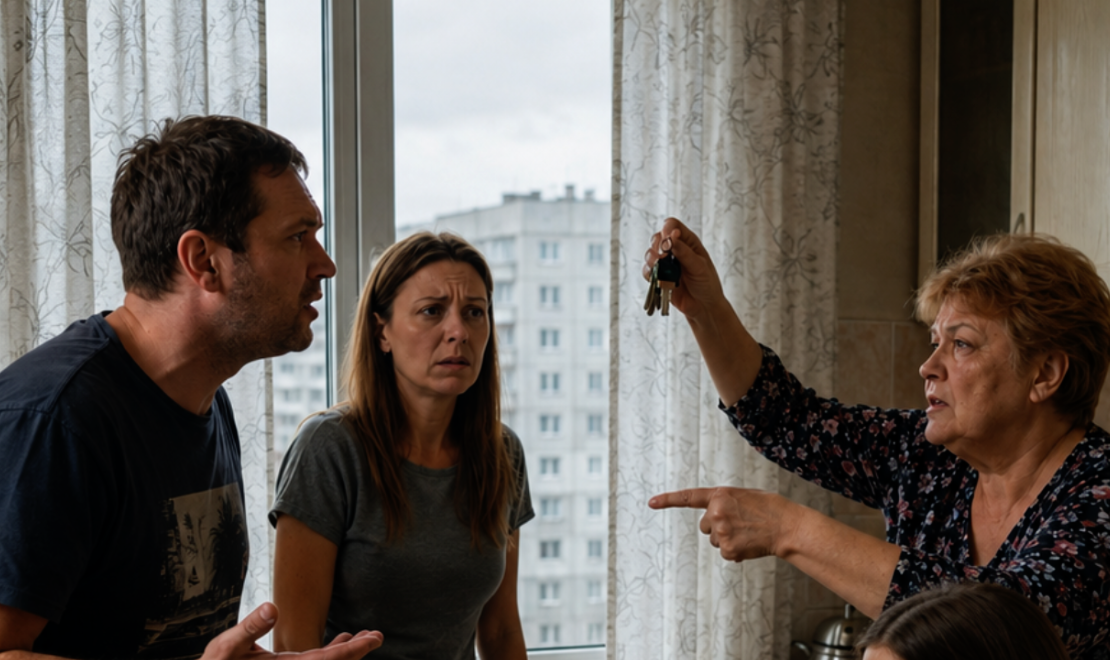
“Olya Will Take the Car — She Needs It More, and You Already Have Everything,” My Mother-in-Law Declared, Brazenly Giving Her Daughter the Car My Husband Had Restored
— We talked it over and decided that Olya will take the car for now, — Galina Pavlovna said, carefully covering the keys lying on the kitchen table with her palm.
The words “we talked it over” hung in the air. Denis and I were sitting across from her in the cramped kitchen, which still smelled of fresh pastries and thyme tea. Sunday evening was growing dark outside. In the courtyard, directly beneath the windows, stood a freshly washed dark-blue Nissan Qashqai, gleaming under the lights—the car my husband had spent the last two months practically bringing back from the dead.
Denis blinked as though he hadn’t understood what she had said. He looked at the keys, then at his mother, then at his younger sister Olya, who was sitting on a stool in the corner, absorbed in her phone and pretending the conversation had nothing to do with her.
— What do you mean, Olya is taking it? — Denis’s voice trembled, but he tried to smile, apparently deciding this had to be some strange joke. — Mom, we had an agreement. I got the car running, rebuilt the suspension, bought new tires. Tomorrow I was planning to go register it in my name, just like you said.
Galina Pavlovna adjusted the collar of her house cardigan, and her face took on that familiar expression of long-suffering stubbornness she always wore whenever an argument arose.
— Denis, sweetheart, why do you need a second car right now? You already have your Ford. It runs, and it gets you to work. But Olya is a young girl. She has to take two buses with a transfer to get to her new office. It’s dark and cold in the evenings, and you never know what kind of people are hanging around at bus stops. As her mother, I can’t sleep peacefully knowing my child is freezing outside. Besides, the car belonged to your father. It should stay in the family and serve whoever needs it most.
The story of the Nissan had begun at the end of summer, about a year and a half after Denis’s father passed away. When the inheritance was being settled, Denis and Olya had both given up their shares in favor of their mother because neither of them needed the car at the time.
The Nissan had sat in a solid garage ever since. Galina Pavlovna didn’t have a driver’s license and had no intention of getting one. Olya was in her final year of university at the time and had no interest in cars. Slowly, the Nissan gathered dust. The battery died, rubber parts dried out, and the vehicle deteriorated from sitting unused.
At the time, Denis and I were living under a strict savings regime. Our small two-bedroom Khrushchev-era apartment had started to feel far too cramped, especially since we were planning to have a child. We were saving for a down payment so we could move into a proper three-bedroom apartment in a newer neighborhood.
Denis had an old Ford Focus that needed occasional attention but reliably took him to his job in technical support at a large logistics company. I worked as head of procurement at a medical center, and nearly my entire salary went into our savings account.
That was when my mother-in-law first brought up the Nissan.
During one of our family lunches, she was the one who suggested Denis take it.
— Why should it rot away in the garage? — she sighed while putting another helping of food on her son’s plate. — Your father wouldn’t have wanted the car to go to waste. Take it, Denis. Fix whatever needs fixing and drive it. Consider it your inheritance. Then sell your Ford, and you’ll have some extra money toward your mortgage.
Denis immediately became enthusiastic.
The Nissan was about ten years old, but it had a good trim package and a completely transparent history. The only problem was that after sitting unused for so long, it required serious investment.
All the fluids needed replacing. The seized brake system had to be rebuilt. Dried-out suspension bushings needed replacement. It required a new battery and a new set of summer tires because the old ones had cracked.
That evening, my husband and I sat in our kitchen with a calculator.
Even by the most conservative estimate, parts and materials would cost around one hundred thousand rubles—and that was assuming Denis did all the labor himself.
— Anya, it makes financial sense, — he told me, sketching numbers on a sheet of paper. — We’ll put in a hundred thousand, maybe one hundred twenty. Then we’ll sell the Ford for around five hundred thousand. We’ll have a decent car and a good amount left to add to our savings. Mom said she’d write a deed of gift or we could simply transfer ownership under a sales contract once the Nissan passed inspection.
I had doubts.
My professional experience told me that any agreement involving money should be put in writing before anyone started investing.
But this was his mother.
She had looked at him with such warmth when she handed over the garage keys that even my own suspicions seemed petty and cynical.
So I agreed to dip into our savings.
For two months, Denis practically lived in the garage.
He went there after work and spent every weekend there. He came home with blackened hands, exhausted and smelling of motor oil and solvent, but completely happy.
I took care of logistics and sourcing.
Thanks to my procurement contacts, I found original parts at good discounts, ordered oils and filters, and searched warehouses for the correct suspension arms.
Every order was paid for with my bank card, which was linked to our joint savings account.
I even created a separate folder on my laptop called “Nissan,” where I stored electronic receipts and invoices.
The final amount, including insurance and a good new set of tires, came to 146,840 rubles.
And then the car was ready.
The day before, Denis had driven it out of the garage, passed its inspection in his own name, and paid for compulsory auto insurance with himself listed as a driver.
That morning, he had taken the Nissan to the car wash. Then we drove to his mother’s place in two cars—he in the Nissan, me following in the Ford.
We wanted to proudly show her what he had accomplished.
And now the keys were lying beneath my mother-in-law’s hand.
— Mom, wait, — Denis said, rubbing his forehead as he tried to find the right words. — What buses are you talking about? Olya doesn’t even have a driver’s license. She only just finished driving school.
— Exactly! — Olya suddenly said cheerfully, looking up from her phone. — I passed the exam on Thursday! I’m picking up my license tomorrow. Mom said a first car should be safe, and Dad’s Nissan is big and sturdy.
— Galina Pavlovna, — I began calmly, trying not to raise my voice. — We invested almost one hundred fifty thousand rubles from our family budget into this car. We bought the parts, the tires, the insurance. Denis spent two months of his life working on it. You were the one who told him he could have the car.
My mother-in-law looked at me, and her expression changed almost imperceptibly.
The gentle maternal smile vanished. Hard, cold lines appeared around her mouth.
— Anya, first of all, this was my husband’s car, and as his legal heir I decide who drives it. Second, Denis repaired the car for the family. He’s a man. He’s good with his hands. It wasn’t exactly a hardship for him. And third…
She paused and looked meaningfully at my neatly manicured nails.
— I don’t remember seeing you in the garage turning any wrenches. You didn’t help at all. You sat at home in the warmth while my son worked himself to exhaustion. So don’t start calculating your “joint money” for me. You’re adults. You both work. Olya is only just starting her life. Family is supposed to help.
I looked at Denis.
He was sitting there pale, his jaw clenched.
In his understanding of the world, his mother had always been fair.
Yes, she spoiled his younger sister. She forgave Olya for skipping classes, taking academic leave, and constantly changing jobs.
But with him, she had always been honest.
Until now.
— So we’re not selling the Ford, — Denis said quietly.
— Why sell it? Keep driving it. It’s a perfectly good car, — my mother-in-law said soothingly. — The Nissan can remain registered to me. I’ll somehow manage the taxes from my pension, don’t worry. Olya will drive carefully.
— Olya will not drive it, — Denis said just as quietly, but firmly.
He stood up from the table.
— Not until she pays back the 146,000 we spent repairing it.
— What?! — Olya jumped up from the stool. — What 146,000?! For what? For some old pieces of metal? Mom, are you hearing this?!
— Denis! — Galina Pavlovna pressed both hands dramatically to her chest. — How can you demand money from your own sister? Are you seriously going to send her a bill? She’s your own flesh and blood!
— My flesh and blood, Mom, are my future children—the ones whose room we were saving that money for. Come on, Anya.
Denis turned around and walked into the hallway.
I silently got up, put on my coat, and followed him.
Behind us, my mother-in-law was lamenting about how money had ruined people and how his father would never have tolerated such behavior.
We drove home in complete silence.
Denis gripped the steering wheel tightly and stared straight ahead the entire way.
I looked out the window at the passing streetlights and didn’t try to start a conversation.
He needed time to process what had happened.
It was one thing to suspect someone was using you.
It was another thing entirely to have the proof thrown directly in your face—with a smile and a justification.
At home, Denis stood under the shower for a long time.
Then he came into the kitchen, where I was drinking tea.
— Anya, forgive me, — he said, sitting across from me and hiding his face in his hands. — I really believed she would give me the car. It never even crossed my mind that she was planning to hand it over to Olya. So basically I prepared a car for my sister using our money.
— I don’t think she planned this from the beginning, — I said, pouring him tea and sliding the mug toward him. — At the end of summer, Olya wasn’t even planning to get a driver’s license, and the garage needed clearing out. Your mother offered you the car because it was convenient.
— But once the car was running, once she saw it clean, sitting on brand-new tires, fully ready to drive… and suddenly Olya has a license. Why buy Olya a car when there’s already one ready to go?
— But what about the money? She knows we’re saving!
— To her, our money is just numbers. Olya is a real daughter who needs transportation to work.
— I’m not letting this go, — Denis said, lifting his head.
There was no anger in his eyes anymore, only deep, heavy exhaustion.
— I’ll take off the new tires and put the old ones back. I’ll pull out the new battery. I’ll put half the old suspension parts back in.
— No, you won’t, Den, — I said gently, covering his hand with mine. — On paper, the car belongs to Galina Pavlovna. If you go there now and start removing parts, Olya will throw a fit and your mother may call the police. Legally, it could be treated as theft or damage to someone else’s property. You know perfectly well they’re capable of doing that. Your mother already reminded us that this is “the inheritance.”
— So what are we supposed to do? Gift them 150,000? It took us six months to save that money!
I opened the laptop sitting on the table and pulled up the “Nissan” folder.
— I’m not giving anyone anything, — I said, opening the summary spreadsheet in Excel. — Look. Everything is here. From the brake pad receipt to the insurance payment. Every item, every date, every amount, every transfer screenshot. Total: 146,840 rubles. Tomorrow I’ll save it as a PDF and send it to the family group chat.
— You think they’ll pay it back? — Denis asked skeptically.
— No. They won’t. Olya will say she doesn’t have that kind of money, and your mother will accuse us of being greedy and petty. But at least we’ll officially document how much we spent and exactly how much we’re asking them to repay.
I paused.
— And from now on, you and I are going to have new rules.
The next day, during my lunch break at work, I sent the file to the family group chat, which included me, Denis, my mother-in-law, and Olya.
I attached a short message:
“Galina Pavlovna, Olya. Since the Nissan is being transferred for Olya’s use, I am sending you the complete breakdown of expenses paid from our family budget for restoring the vehicle. The amount to be reimbursed is 146,840 rubles. Denis’s card number is linked to his phone number.”
The reaction came twenty minutes later.
First, Olya sent me an angry voice message privately.
She screamed that I was a crazy accountant, that she was a student who had only just started working, and that her brother was supposed to help her rather than sending her invoices through his “greedy wife.”
Then my mother-in-law called Denis.
I didn’t hear the entire conversation, but that evening my husband told me that Galina Pavlovna had cried.
She pressured him with guilt, saying he had no heart, that he had betrayed his family over a piece of metal, and that his father would be turning in his grave.
Denis held firm.
He didn’t try to justify himself.
He simply said:
— Mom, when Olya pays us back, then we can talk. Until then, consider me gone from your lives.
The first few weeks were unusually quiet.
Olya drove the Nissan.
Galina Pavlovna added her to the insurance.
Denis continued seeing the traffic fines in his app because he had previously added the Nissan using its registration certificate number.
Within the very first week, Olya received two speeding tickets from traffic cameras.
Denis worried.
I could see that the situation was difficult for him.
He was used to being the good son.
He was used to rushing over whenever his mother called, fixing her faucet, driving her to the country house, helping her with shopping.
On top of that, every month we transferred Galina Pavlovna 10,000 rubles simply to help with utilities and medication—even though she received a decent pension and Olya lived with her and had already started working.
At the beginning of the next month, the date of our regular transfer arrived.
Denis sat with his phone in his hands, staring at the banking app.
— Should I send it? — he asked, looking at me.
— Den, she’s your mother. I can’t forbid you from helping her. Decide for yourself.
He stared at the screen for a long time.
Then he closed the app.
— One hundred forty-six thousand divided by ten, — he said aloud. — That’s almost fifteen months.
He nodded slowly.
— So in a year and three months, we’ll reconsider financial assistance.
It was his decision, and it wasn’t easy for him.
When my mother-in-law didn’t receive the usual transfer on the first of the month, she called three days later.
She didn’t mention the money directly.
Instead, she started from a distance—complaining about prices, her health, and how much Olya was spending on gasoline because the Nissan “drinks fuel like crazy.”
Denis listened calmly.
— Mom, I understand. But we’re under a strict savings regime right now. We’re rebuilding the financial cushion we spent on your car. We don’t have any spare money.
Galina Pavlovna hung up.
The real conclusion to the story came in November, when the first serious snowfall arrived.
On Saturday morning, Denis’s phone rang.
It was Olya.
Her voice was trembling.
— Denis, can you come? — she whined. — I’m at the roundabout near the shopping center. The car won’t stop properly. I hit the curb, something’s scraping, and one of the tires is flat.
Denis put her on speakerphone.
We were sitting at breakfast, and I could clearly hear road noise in the background.
— Did you put winter tires on it? — Denis asked calmly, taking a sip of coffee.
— I was going to change them next week! Mom said I could keep driving on these until the really hard freezes started, — Olya blurted out.
Denis covered his eyes with one hand.
— Olya, I bought summer tires. Dad’s old winter tires were rotten. We threw them away. You were supposed to buy winter tires and install them in October.
— I thought I could still drive on these! — his sister shouted. — Mom said nothing would happen until it got really freezing! Come change my tire. I’m freezing out here!
— Call a tow truck and take the car to the nearest tire shop. Have them check the wheel and suspension while you’re there. You have a salary, don’t you? — Denis replied evenly.
— I don’t have money for that! Mom told me to call you. You’re my brother!
— The brother who “doesn’t help,” according to you. Olya, the car has an owner. That’s Mom. And it has a driver. That’s you. Deal with your own property yourselves. I have my own things to do.
He ended the call.
The phone rang five more times.
Then messages from my mother-in-law began arriving, full of accusations about cruelty and heartlessness.
Denis simply muted the phone and put it on the shelf.
— Are you going? — I asked quietly as I took his empty cup.
— No, — he said, shaking his head. — If I go now, I’ll become their free mechanic again. They’ll never understand until they pay for their own mistakes themselves. A tow truck and suspension repairs after hitting a curb will probably cost her thirty thousand. Maybe then she’ll understand the value of the parts I installed.
He got up, walked to the window, and looked out at the snow-covered courtyard where his old faithful Ford was parked.
— You know, Anya, — he said thoughtfully, — at first I thought you were only making the conflict worse when you started talking about the money and the receipts right there in Mom’s kitchen. I thought you were destroying the family.
He paused.
— But now I understand that the family I imagined we had was already gone. There was just a convenient system where I was expected to serve their interests and never ask questions. You simply said out loud what I didn’t want to admit to myself.
After that, Denis stopped trying to save the Nissan.
Olya eventually called a tow truck, and Galina Pavlovna paid for the repairs by withdrawing money from her savings account.
A month later, Olya managed to overheat the engine because she ignored the warning light on the dashboard. Coolant had leaked out through a burst hose.
When the repair shop told her how much fixing the engine would cost, Olya refused to pay.
Galina Pavlovna announced that she wasn’t taking another ruble out of her savings.
The Nissan remained parked in the courtyard, slowly turning into a snow-covered heap.
Of course, no one ever returned our money.
Galina Pavlovna still tells relatives about the greedy wife her son chose and how that wife turned Denis against his own mother.
We don’t argue with her.
In March, we sold the Ford, added the money we had managed to save during those months, and took out a mortgage on an excellent three-bedroom apartment.
Furnishing our new home turned out to be far more enjoyable than rebuilding someone else’s suspension.
And as for helping relatives financially, we won’t be returning to that subject anytime soon.
The months we counted toward repayment of their debt haven’t expired yet.