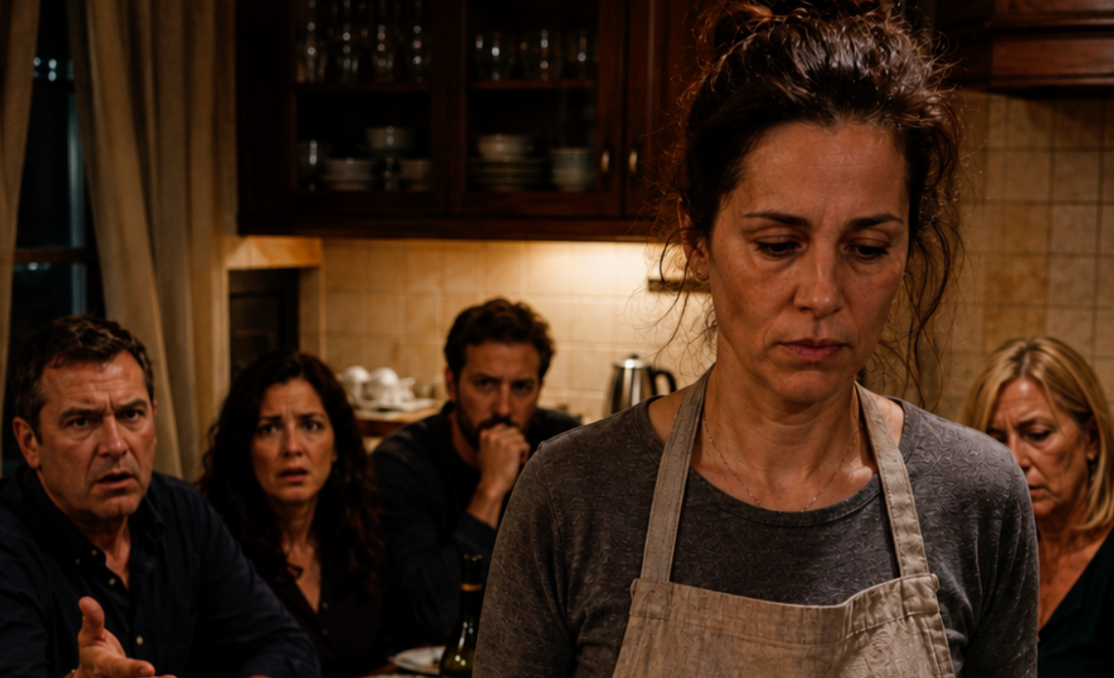
The dill was chopped to a fine, aromatic dust, an old lesson from my mother to ensure the fragile herbs melted seamlessly into the golden broth. For three long hours, the heavy cast-iron pot simmered over a low flame as I meticulously skimmed off the foam, curl by delicate curl. The farm-fresh chicken yielded a rich, shimmering surface, standing in stark contrast to sterile, store-bought alternatives. A second pot boiled potatoes to the absolute threshold of tenderness, while a flawlessly glazed cabbage pie cooled on the oven rack. I had even ironed the heavy, starched tablecloth—a burdensome relic from the rare era when my hyper-critical mother-in-law and I still tolerated each other’s presence.
“Vera, are you almost done in there?” Oleg’s voice echoed sharply. “The guests arrive in an hour.”
“I’ll have everything ready,” I replied quietly.
He didn’t hear me. Over eighteen years of marriage, I had systematically forgotten how to project my voice, gradually shrinking into the wallpaper of our shared existence. Tonight celebrated his highly coveted promotion to department head. The guest list was a daunting assembly: his formidable new boss, Viktor Pavlovich; two sycophantic colleagues; and my mother-in-law, Larisa Stepanovna, who visited our home exclusively to audit my domestic failures.
Eighteen years ago, armed with a university economics degree and bright, audacious ambitions, I couldn’t even bake a simple pie. Time and obligation had steadily whittled away my extraneous dreams, replacing them with a quiet, instinctive precision.
My phone vibrated against the kitchen counter. It was Katya, calling from her university dorm in St. Petersburg. “Mom, are you actually happy for Dad, or are you just perpetually exhausting yourself for him? There’s a profound difference.”
Her words lingered in the humid air. There is a difference. For nearly two decades, I had been his silent, load-bearing scaffolding. Convenient. Familiar. Entirely invisible.
Oleg appeared in the doorway, casually fastening his silver cufflinks. Even at forty-seven, he radiated the specific, relaxed entitlement of a man whose world is effortlessly curated for him by unseen hands. “The napkins aren’t paper, are they? Viktor despises paper napkins.”
“They’re cloth. I know, Oleg.”
“Well, you would know,” he smirked, pivoting on his heel and walking away. I stood absolutely still, absorbing the casual, patronizing jab, skimming it away from my heart just as I skimmed the bitter foam from the broth. At seven o’clock sharp, the apartment swelled with unfamiliar voices. Viktor Pavlovich, an imposing man with an intensely observant gaze, arrived with his wife, Inna, who was practically buckling under heavy gold jewelry. Oleg’s colleagues brought weary-looking wives who dutifully offered kitchen help. As always, I politely declined.
My mother-in-law arrived last. She immediately scanned the mirrored hallway shelves for dust before parading into the living room, loudly proclaiming that Oleg had achieved his towering success entirely with his “own brains.” I leaned heavily against the doorframe. His own brains. I had painstakingly proofread his analytical reports and spoon-fed him the corporate strategies he passed off as his own brilliant epiphanies. But to them, I was merely the obedient, unimaginative housewife.
“You made all this yourself?” Inna marveled at the lavish spread.
“Vera is a housewife,” Oleg interjected smoothly, pouring expensive cognac. “She has nothing else to do, so she cooks.”
I caught Inna’s brief, half-pitying glance. As the evening wore on, Oleg dominated the conversation, flawlessly reciting risk-assessment strategies I had calculated for him late at night. I remained the silent shadow, dutifully slicing the meat pie.
Eventually, I ladled the golden, fragrant broth into porcelain bowls. Viktor Pavlovich tasted it and closed his eyes in genuine delight. “This is truly magnificent. That’s what I call a real homemaker.”
I felt a brief flicker of warmth and was just about to smile.
Then Oleg, flushed with wine and an audience, leaned back in his chair. He deployed the indulgent, patronizing tone one might reserve for a loyal pet. “Oh, come on. What homemaker? My wife is a simpleton—she can’t do anything! Making soup isn’t real work. I spend all day using my complex brain, while she just takes care of the house. Quietly. My sweet little simpleton.”
The table erupted into polite, compliant laughter. My mother-in-law beamed with venomous vindication.
Gripping the heavy ladle, something inside me didn’t explode; it quietly, irrevocably snapped. Like an over-tightened violin string bearing the immense weight of eighteen years. I felt a sudden, terrifyingly pure clarity. I surveyed the strangers I had slaved over, the husband who believed he owned my dignity, and the mother-in-law reveling in my public humiliation. I realized, with cold certainty, that if I continued to be convenient, eventually there would be nothing left of me at all. “Quiet. Like water,” my mother-in-law chimed in, twisting the emotional knife.
I placed the ladle down, slowly wiped my trembling hands on my apron, and gripped the heavy, steaming pot of soup. I carried it away from the table. The room instantly fell into a dead, confused silence. Instead of returning to the stove, I set the pot on a side table, draped my apron neatly beside it, and walked back. Bypassing my invisible spot, I took the vacant chair directly beside Viktor Pavlovich. I sat upright.
“Vera, what are you doing?” Oleg stammered, his confidence faltering.
“Nothing,” I replied, my voice projecting with unfamiliar resonance. “I’ve spent long enough playing the simpleton. It’s time we talked like adults.”
“For eighteen years, Larisa Stepanovna, you have meticulously inspected my cabinets for dust,” I told my mother-in-law, my tone entirely devoid of anger. “Allow me to inspect your fundamental assumptions. Oleg, tell your guests who actually owns this apartment.”
The color drained completely from his face. “Ours. Jointly ours. We’re married.”
“No,” I corrected gently. “My parents legally gifted this apartment exclusively to me before our wedding. Under the law, a personal gift is never considered marital property. It is never divided in a divorce. Oleg has lived here for eighteen years essentially as a guest. He does not own a single square meter.”
Viktor Pavlovich let out a low whistle. Oleg’s horrified silence confirmed every word.
“But this is our home,” Oleg’s voice trembled.
“As long as there is mutual respect, ownership doesn’t matter,” I agreed smoothly. “But today, you called me a simpleton. Twice. And you laughed. So let me share what else this silent simpleton has done.”
I turned my gaze to Inna. “For twelve years, I have handled the accounting for a regional transportation company. Remotely. Closing quarterly accounts, calculating complex taxes, and single-handedly funding our daughter’s university education—while my husband assumed I was merely ‘taking care of the house.’ My labor was invisible to him. Like air. You only truly notice it when it’s gone.”
Oleg stared at me, stripped of his constructed reality. “So what now? Are we getting divorced?” he snapped defensively.
“Divorce isn’t about real estate,” I replied softly. “It’s about the heartbreaking realization that the person sitting next to you is no longer your home. They are just a stranger occupying half of your bed. Tonight, even a pot of soup received more genuine gratitude than I did.”
Larisa Stepanovna loudly pushed her chair back, demanding Oleg leave. For the very first time in his life, Oleg looked at his mother and told her to sit down.
The dynamic of the room had permanently, tectonically shifted. Viktor Pavlovich pulled his soup bowl closer. “I’ve learned more about you tonight, Oleg, than in six months of corporate evaluations. How you treat the person who has quietly carried you for eighteen years tells me absolutely everything I need to know.” He took another bite. “Good soup.”
As the guests finally departed, Inna lingered to apologize for her earlier condescension, revealing her own deep-seated unhappiness. Viktor Pavlovich offered a firm, respectful handshake and his business card, extending a genuine professional lifeline.
When the door clicked shut, Oleg and I were alone amidst the ruins of his triumph. He attempted to clear the dirty plates—a pathetic, unprecedented gesture that I immediately halted.
“You wanted to look impressive at my expense,” I said, crushing exhaustion seeping into my bones. “To feel bigger, you instinctively had to make me smaller.”
“How are you, Vera?” he asked hollowly, asking the question a decade too late.
“I am not well,” I answered truthfully. “I live my life behind thick glass. I’m not leaving, because this is my home. If anyone leaves, it will be you. It is entirely up to you to become someone I actually want to stay with. For the first time, Oleg, it is not up to me.”
I walked back into the kitchen, returning the cooled pot of soup to the stove. The golden fat had settled, but the rich, meticulously crafted broth remained intact underneath. I didn’t need to feed anyone anymore. I could just warm a bowl for myself, alone.
I didn’t know if our marriage would survive the night. But I knew with absolute certainty that he would remember this evening with a profound shudder. Not because of screaming or shattered porcelain, but because I simply chose to stop being quiet water.
And quiet water, eventually, wears away the hardest stone. Slowly. Intentionally. One little curl at a time.