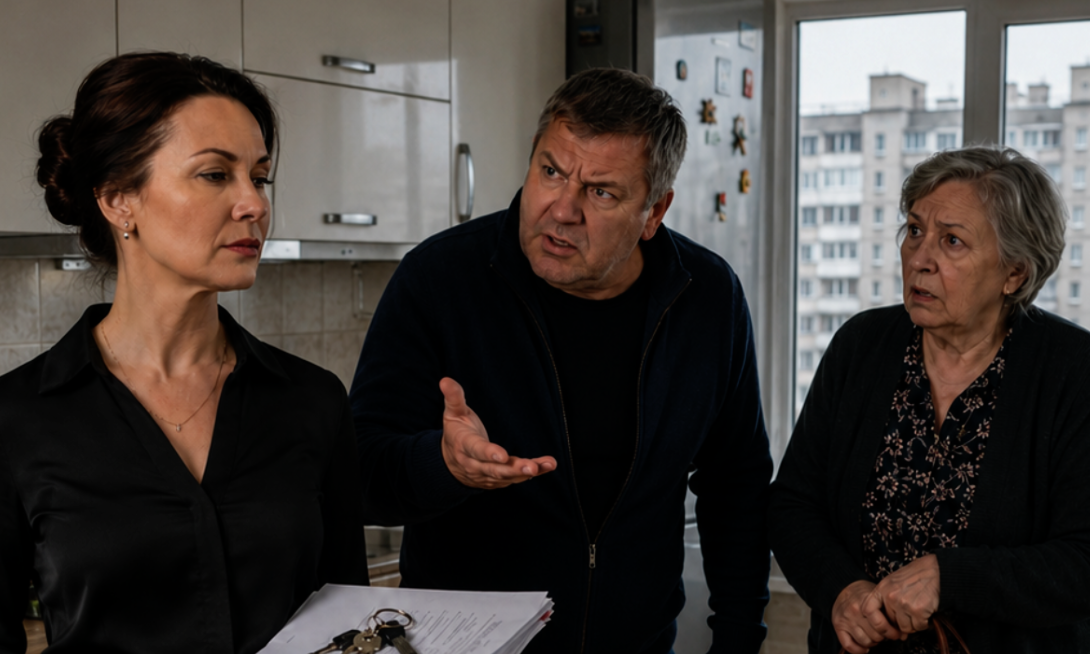
My Husband Forbade Me to Go on Vacation Because His Mother Was Coming. In Response, I Canceled His Registration
“You’re not going on any vacation. We’re having a family gathering!” Igor stood in the bedroom doorway with his hands planted on his hips. His bulky figure almost completely blocked the way into the hall. “Mom and Oksana are already on their way. They’re coming to stay with us for an entire week.”
I carefully folded my linen dress and placed it at the bottom of my dark blue travel bag. The metal zipper pull clinked unusually loudly in the silence that hung between us. My trip to Kemer had been paid for back in April, the day after a substantial six-month bonus had landed in my bank account. Igor knew perfectly well when I was flying. My tickets had been printed and sitting on the nightstand for several days. But now, exactly three hours before the taxi was supposed to take me to Sheremetyevo Airport, he had suddenly decided that my plans meant absolutely nothing.
“But we’re a family!” my husband’s voice became louder and sharper when he realized I wasn’t going to start fussing around and unpacking my things. “Normal wives welcome guests, set the table, and take care of relatives. That’s how everyone lives, but you have to show off with your trips to the seaside. My mother is traveling five hundred kilometers just to see us, and you’re running away from home.”
I looked at him.
Carefully, as though I were seeing this man for the first time.
He genuinely believed that a vacation I had earned honestly and planned for six months could be canceled simply because he used a demanding enough tone.
During our three years of marriage, I had become accustomed to constantly smoothing things over. I gave in over small matters, took responsibility for organizing his everyday life, and kept quiet when his sister Oksana helped herself to my expensive cosmetics without permission whenever she visited.
But this time, I felt none of my usual resentment and no desire to get dragged into another endless kitchen argument.
There was only cold, crystal-clear understanding.
This wasn’t just about the vacation.
It was about territory.
The apartment we lived in had been transferred to me as a gift from my grandmother before Igor and I got married. Igor had never contributed to the renovations. He hadn’t bought any of the furniture, hadn’t paid for the electrical rewiring, and even the utility bills were always left sitting on the kitchen table for me to pay.
Over the course of three years, he had become so accustomed to me taking care of the entire household and paying all the bills that he sincerely began to believe the stamp in our passports had automatically granted him unshakable rights to my property.
That was why he so happily treated the apartment as though it were his own, regularly inviting his relatives to stay “for a week or two,” because whenever they came to Moscow, they supposedly needed somewhere to stay while sightseeing, getting medical examinations, or simply enjoying a change of scenery.
“There’s a to-do list on the refrigerator,” I said evenly, picking up my bag by its leather handles. “It explains exactly what needs to be done before your mother arrives. And you’re paying for it, Igor. My salary went toward my vacation.”
He stared toward the kitchen in confusion.
A yellow sticky note was attached to the refrigerator door.
It contained only three items, written in my neat handwriting.
First: clean the guest bathroom, where Igor had promised to repair the faucet a month ago.
Second: buy enough groceries for three adults for one week.
Third: make up the folding sofa in the living room with the fresh bedding stored in the top drawer of the dresser.
“You don’t understand the first thing about caring for people!” He stepped toward me, trying to loom over me, using his favorite method of physical intimidation. “I work, you know! Who’s supposed to cook for us? Who’s supposed to clean?”
“Your mother is an excellent cook. You’re always saying so yourself.”
I calmly walked around him, brushing my shoulder against the doorframe, and opened the front door.
“Have fun. The bedding is in the closet.”
As my taxi merged onto the Moscow Ring Road, I turned off notifications from Igor.
It was the best decision I had made in the entire past year.
Ten days beside the Mediterranean Sea passed in absolute, uninterrupted peace.
I woke up without an alarm, drank my morning coffee on the balcony while watching the sun rise above the water, and every couple of days I opened my messenger app just to assess the scale of the disaster unfolding back home.
My husband’s messages gradually changed in tone, shifting from righteous anger to cheap manipulation.
On the second day, he wrote:
“Mom is shocked that the refrigerator is practically empty. In my family, wives don’t abandon their husbands alone with relatives. Send me ten thousand. We ordered food delivery, and I’m broke until payday.”
On the fourth day, I received a voice message from an unfamiliar number.
It was Antonina Petrovna.
“Anya, sweetheart, we moved your orchids from the windowsill into the hallway because Oksanochka was getting a draft from the window. And send Igor some money. He spent a lot on our taxi. Hospitality costs money too, you know.”
On the fifth day, my husband appeared again.
“Oksana accidentally burned your silk blouse with the iron. Don’t turn it into a tragedy. Clothes are just pieces of fabric. You’ll be selfish if you start a scandal over this.”
I listened to those recordings accompanied by the sound of waves rolling onto the shore and gradually understood one incredibly simple thing.
My marriage had long ago become a one-way street.
I had become a convenient, multifunctional, completely free add-on to his life.
I was an ATM, a cleaning service, and a hotel administrator for his entire family.
It was there, sitting in a wicker lounge chair beneath the blazing Turkish sun, that I opened my banking app and transferred the remainder of my savings into a restricted savings account.
Then I opened the Gosuslugi government services app.
A year earlier, Igor had complained endlessly that without local registration he couldn’t properly register with a dental clinic.
As the legal owner of the apartment, I had arranged temporary residence registration for him.
A few confident taps on my smartphone screen, and my application requesting the early termination of that registration was submitted to the authorities.
The law allowed a property owner to do this unilaterally.
Igor’s legal basis for being registered at my property officially ceased to exist.
Wednesday, August 5, 2026.
Moscow welcomed me with heavy morning traffic, light rain, and a gloomy gray sky.
Sitting in the back seat of a taxi on my way from Sheremetyevo Airport, I arranged for a locksmith to come to my apartment.
I turned the key in the lock at around ten in the morning.
The door opened reluctantly, as though resisting me.
The first thing that struck me when I stepped inside was the smell.
A heavy, stale mixture of unwashed dishes, Oksana’s cheap sweet perfume, and damp towels that had been tossed into heaps.
Three pairs of unfamiliar sneakers were scattered across the hallway floor, and I nearly tripped over them.
The television was playing in the living room. Some kind of morning talk show was on.
The yellow sticky note containing my list of chores was still attached to the refrigerator with a magnet.
Not a single item had been crossed out.
A monumental pile of dirty dishes filled the sink, covered with dried remains of buckwheat and ketchup.
A sticky ring from spilled jam decorated my expensive oak countertop.
Antonina Petrovna was sitting at the kitchen table wearing my terrycloth robe and leisurely stirring sugar into her cup.
Igor was scrolling through his phone while finishing a sandwich.
When they saw me, neither of them even changed expression.
Nobody asked how my flight had gone.
Nobody offered to help me with my bag.
“Oh, look who finally showed up.” My husband pushed away his empty mug. His voice was thick with undisguised irritation. “We’ve barely survived without you. Do you even understand that you left us without a penny? I spent all my emergency cash buying food for Mom. You could at least have stocked the refrigerator before deciding to run away.”
Antonina Petrovna pursed her lips and sighed loudly, making her disapproval obvious.
“That’s not how things are done in my family, Anya,” my mother-in-law said without looking at me. “You don’t abandon your husband and go off enjoying yourself. Poor Oksana has been surviving on convenience food, and the girl has stomach problems. We thought you would at least bring us an apology.”
I placed my travel bag against the wall.
Slowly, I surveyed the ruined countertop, the pile of garbage beside the overflowing trash bin, my mother-in-law’s relaxed posture, and my husband’s dissatisfied expression.
Not a single muscle inside me twitched.
My emotions had burned out back in Kemer.
“Pack your things. You have exactly one hour.”
My voice was quiet, but so steady and firm that Igor froze with his half-eaten sandwich still in his hand.
“What?”
A sleepy Oksana walked into the kitchen, rubbing her eyes and yawning.
She was wearing my silk lounge shirt, badly stretched across the shoulders, and in one hand she held my limited-edition lipstick, which I had been saving for special occasions.
Completely unconcerned, my sister-in-law began applying it to her lips while standing in the middle of my kitchen.
“Igor, what nonsense is she talking about this early in the morning?”
My husband abruptly rose from his chair.
Its wooden legs scraped unpleasantly across the laminate floor.
“What the hell do you think you’re doing?!” he roared automatically, trying to overpower me with sheer volume, the way he always had before. “This is our home! We’re a family, remember? You’re back now, so start behaving normally instead of pretending you’re some kind of landlady!”
I unzipped the side pocket of my bag and took out a thick leather document holder.
Inside were the original documents proving ownership of the property.
“This apartment belongs to me under a deed of gift,” I said, placing the official property registry extract directly on the table beside the sticky jam stain. “Article 36 of the Family Code of the Russian Federation. Property received by one spouse as a gift is that spouse’s separate property. You don’t own a single share of this apartment, Igor. You never have.”
My mother-in-law stopped stirring her sugar.
The spoon struck the edge of the porcelain cup with a faint clink.
“And as for your temporary registration,” I continued, looking directly into his eyes without raising my voice, “I canceled it three days ago through the government services portal. All three of you are now here without any legal basis.”
My husband’s face rapidly began changing color.
The aggressive redness drained away, replaced by gray, helpless confusion.
But he wasn’t ready to surrender that easily.
Igor took a heavy step toward me, extending his hand as though he intended to snatch the leather document holder from the table and destroy what he apparently considered my only proof.
I didn’t move backward.
Instead, I deliberately pulled out my smartphone, dialed 112, and held my thumb directly above the call button without taking my icy gaze from his face.
“Take one step back,” I said quietly. “One more move, and I report unauthorized entry by outsiders.”
He stopped.
His breathing was heavy.
The hand that had reached toward the documents remained suspended in the air for a moment before dropping helplessly to his side.
He finally understood that I wasn’t bluffing.
I was dealing in facts, and he had no arguments against them.
“The divorce petition has already been prepared on the court portal,” I said, looking at the screen of my phone to check the time. “The locksmith I called while I was still in the taxi will arrive in forty minutes. I’ve already paid for the callout and for a new, more sophisticated locking mechanism. If you and your suitcases aren’t out of here within an hour, I’m calling the police. Article 304 of the Civil Code gives me, as the property owner, the right to demand that people without a legal right to occupy my apartment leave the property. No endless discussions.”
“Anya, have you lost your mind?” Antonina Petrovna pressed a hand dramatically against her chest, attempting to portray sudden illness. “You’re throwing your own mother out onto the street?!”
“You have fifty-five minutes.”
I folded my arms across my chest and leaned against the doorframe.
They began packing in a frenzy of panic and ridiculous anger.
Oksana hissed indignantly under her breath while stuffing her belongings—and my lipstick—into plastic bags.
Antonina Petrovna lamented the ingratitude of modern young people.
Igor tried several times to start a conversation with me.
He approached me, switching his tone from aggressive to pleading, but every time he encountered an impenetrable wall of absolute indifference and silently walked away again.
Toxic manipulation stopped working when there was no one left willing to listen to it.
I was no longer a resource they could exploit.
They left the apartment ten minutes before the locksmith arrived.
Igor silently dragged two heavy suitcases toward the elevator without even looking back.
The heavy door slammed shut behind them, permanently cutting me off from my past.
The locksmith finished everything in half an hour.
He quickly drilled out the old lock cylinder and installed a new, secure mechanism with perforated keys.
By lunchtime, my front door could be opened only with a completely different set of keys.
After the locksmith left and the door closed behind him, I walked through every room and opened all the windows wide.
The cool August draft instantly swept away the smell of someone else’s perfume, lifted the yellow sticky note from the refrigerator, and sent it fluttering to the floor.
I brewed myself fresh coffee in a cezve.
The apartment smelled of rain, fresh air, and real, long-awaited freedom.
And at last, the silence belonged only to me.
What would you have done in the heroine’s place?