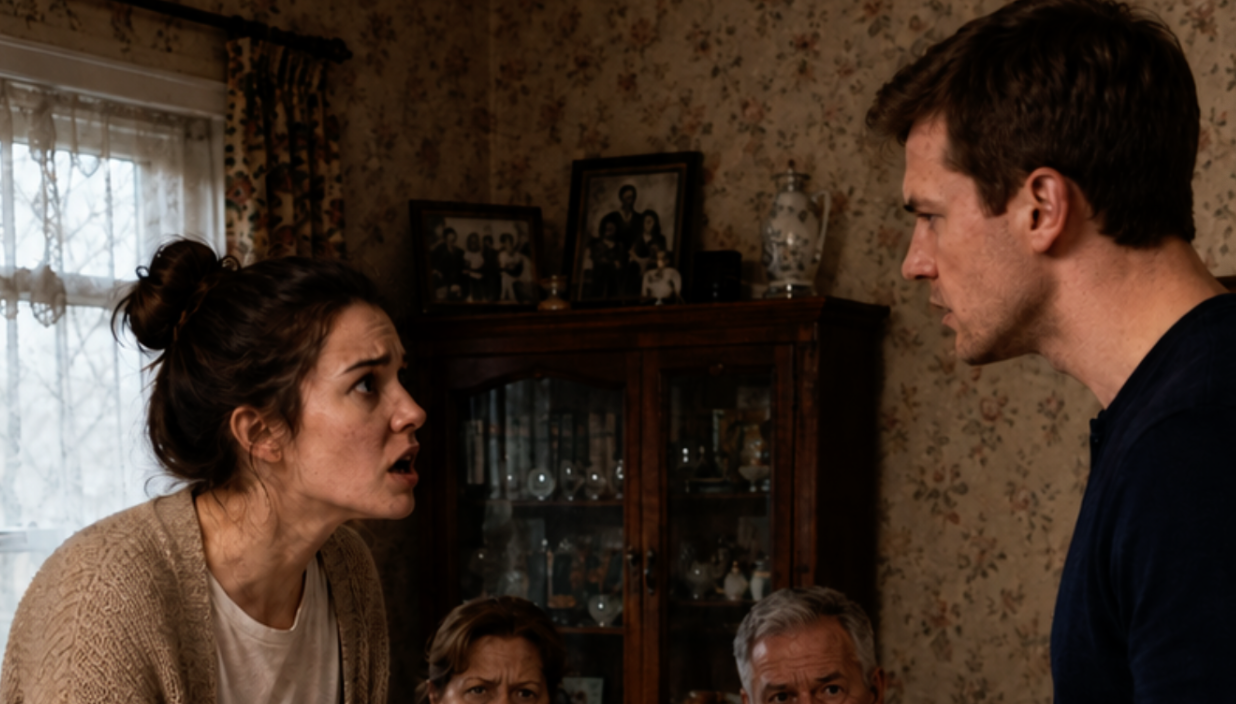
“So our entire family is supposed to contribute money and sell Grandma’s country house to cover your brother’s debts because he lost everything betting? Denis, tell Lenya he’d better find a job! Or sell one of his kidneys! But he won’t get any money from us!”
Veronika’s words, spoken without shouting but with icy precision, hung in the stuffy air of the living room. She had arrived ten minutes earlier after an urgent call from her husband, who had vaguely mumbled something about “family problems.” And now she was sitting here, at the very center of those problems, feeling like an outsider at a trial where, for some reason, they were trying to make her and her future the victims.
There were four other people in the room. Her husband, Denis, was hunched over on the sofa as though he were trying to make himself smaller. His younger brother, Lenya, the cause of this gathering, was studying the faded floral pattern of the old carpet so intently that one might have thought it held the key to all the mysteries of the universe. Opposite them, sitting in massive armchairs like two stone idols, were their parents—Pyotr Ilyich and Galina Vasilyevna. Their faces were unreadable, while their postures expressed a heavy, silent condemnation seemingly directed at the entire world, but most of all at Veronika.
“Veronika, you need to understand the seriousness of the situation,” her father-in-law, Pyotr Ilyich, began in his booming bass voice. He always spoke as though addressing an audience from a podium, even when asking someone to pass the salt at dinner. “Leonid has encountered certain… financial difficulties.” Galina Vasilyevna, his wife, pursed her lips and nodded slowly without taking her heavy gaze off Veronika. There was more accusation in her silence than in her husband’s entire speech. It was as though she were saying, “You should have anticipated this. You are the elder son’s wife. You are part of this family and its problems.”
“Difficulties?” Veronika gave a short, bitter laugh. She turned her gaze toward Denis. “Denis, perhaps you could translate that from your father’s language into normal human language. What kind of ‘difficulties’ require selling the only place where my grandmother was happy?”
Denis flinched but still did not raise his eyes. His fingers nervously picked at the upholstery of the sofa.
“W-well… Lenya owes money. A lot of money. And the people he owes it to… they won’t wait.”
“We have decided,” Pyotr Ilyich interrupted imperiously, not allowing his son to finish, “that selling the country house is the most reasonable and quickest solution. This is a family matter. And we must resolve it together, as a family.”
“As a family,” Veronika repeated silently. Whenever they used those words, they always meant the same thing: she and Denis were expected to sacrifice their interests for the “common good,” which invariably meant satisfying Lenya’s wishes or solving the problems created by him and his parents.
She slowly looked around at everyone gathered there. Lenya, the unfortunate thirty-year-old boy who had gambled everything away. His parents, prepared to auction off the memory of their own mother just to save the reputation of their irresponsible younger son. And Denis… her husband, who sat there in silence after already making the decision for her. She paused, allowing the silence in the room to grow almost unbearably thick. The hum of the old refrigerator in the kitchen suddenly seemed deafening.
“Lenya,” she said directly to her brother-in-law, forcing him to tear his eyes away from the carpet. “Let’s be honest. Is this your first debt, or simply the largest one we know about?”
Lenya jerked, and his face turned red. He muttered something, but his words were impossible to understand.
Veronika did not wait for an answer. She turned toward her husband. Her gaze was direct and hard, like a physical blow.
The color slowly drained from Denis’s face. He stared at her with wide eyes filled with fear. He had not expected such a direct attack. He was accustomed to her being tactful and refusing to air the family’s dirty laundry in public. But it appeared that the family home had already burned to the ground.
“Denis, how many times have you taken money from our household budget to deal with his minor troubles? How many times have I seen charges on our shared card while you told me they were ‘unexpected car expenses’ or that you were ‘helping a friend’? Did you think I didn’t notice anything?”
Veronika’s voice remained steady, but every intonation carried the resentment she had restrained for far too long. Her words pierced the tense silence of the room like icy arrows. Denis flinched, his face turning the color of parchment. He looked at his wife, and his eyes revealed a mixture of panic and doomed guilt. He clearly had not expected such a direct assault. Normally, Veronika was more… delicate. She preferred hints and subtle jabs rather than an open attack. But apparently, the situation now required a different approach.
“I… I didn’t take it,” Denis mumbled, but he immediately stopped when he realized how ridiculous his excuse sounded. “I was… helping him. Brotherly assistance.”
“Brotherly assistance?” Veronika raised one eyebrow ironically. “Denis, brotherly assistance implies that both brothers are in an equal position—or at the very least, that one of them is not living at the other’s expense. But you… you are constantly repairing the damage Lenya causes through his recklessness. And you repair it using our shared money, the money you and I are saving for our future. Do you remember how we saved for the down payment on our mortgage? Do you remember how we denied ourselves little pleasures so that one day we could have a home of our own? Or was that also ‘brotherly assistance’?”
She took a step forward. Her gaze, previously fixed on Denis, now moved to his father, Pyotr Ilyich.
“Pyotr Ilyich, Galina Vasilyevna,” she addressed her husband’s parents, her voice growing even firmer, “can’t you see what is happening? Don’t you understand that Lenya will never change as long as he knows he has a ‘financial safety net’ in the form of his brother? As long as he knows that every mistake he makes will immediately be written off as your ‘family responsibility’?” Galina Vasilyevna, who had been watching silently until then, finally spoke. Her tone was syrupy, but steel could be heard beneath it.
“Veronika, don’t speak like that. We are a family. And families are supposed to support one another. Especially their children. We cannot simply abandon Lenya when he is in trouble. He is our son.”
“He is your son, a thirty-year-old man who lives at his brother’s expense and, essentially, at yours,” Veronika retorted without backing down. “And I, excuse me, am Denis’s wife. I am also part of this family. And I do not want our family—my family—to remain permanently indebted because of your problems. You call it ‘support.’ What I see is encouragement. You aren’t supporting him. You’re enabling him.”
“You don’t understand,” Denis said quietly, finally raising his eyes. “You don’t know how difficult things were for Lenya. He… he was desperate.”
“Desperation is when someone recognizes that they have made a mistake and starts looking for a way out,” Veronika replied coldly. “When someone keeps doing the same thing again and again, expecting somebody else to fix everything for them, that isn’t desperation. It’s manipulation. And all of you—the entire family—are enabling it.” She looked at Lenya again. He appeared not even to be listening, his gaze still fixed on the floor.
“Lenya,” she said, her voice becoming sharper, “you know perfectly well how this is going to end. Those people aren’t simply going to ask you politely to return their money. You know who they are. Do you think they will wait for you to find a job? Or for Denis to sell the country house? You are playing with fire, Lenya, and dragging all of us into it.”
Lenya finally raised his eyes toward her. There was fear in them, but no remorse. It seemed that he was frightened only of the consequences and had not understood his guilt.
“I… I’ll find a way out,” he whispered.
“What way out?” Veronika exploded. “Another bet? Another loan? Or will Denis once again hand over the last of his money to you? Enough! I will not allow this to continue!” She walked over to Denis and took his hand. His hand was cold and trembling.
“Denis, do you love me?” she asked. Her voice softened, yet became even more penetrating. “Do you want to build your life with me? Your own life, not the one your parents and brother are forcing upon you?”
Denis nodded, unable to speak.
“Then listen to me carefully.” She straightened again, and determination filled her gaze. “Nobody is selling the country house. It is our memory and our history. Tomorrow, Lenya is coming with me to the employment center. He is going to work, and he is going to repay the money. And you, Denis… you are giving me every bank card. Every single one. And all access to the online banking accounts. From today onward, I will manage our budget. The first item in that budget will be the repayment of every ruble you secretly gave to Lenya. We will account for every last coin. When you have returned everything down to the final coin, then we can talk about trust. Until then… until then, you will live according to my rules. This is not a request, Denis. It is my condition. And if you do not accept it… I don’t know whether I can live with a man who allows himself to be deceived like this.”
Veronika released Denis’s hand. There was no longer any doubt in her eyes. There was only cold determination. She cast one final glance at her husband’s parents, who sat with their mouths open in shock at her audacity, and at Lenya, who had lowered his eyes to the floor once again, as though trying to disappear into it. “And now,” she said to everyone, “I have nothing more to do here. When you decide that being a family means sharing not only problems but also responsibility, then we can talk. Until then…”
She headed toward the door, leaving behind confusion, anger, and a growing sense that this family council had become the starting point of a new, unknown, and most likely extremely difficult reality for all of them.
“You have no right!” Pyotr Ilyich’s normally steady and authoritative voice trembled with indignation. He jumped out of his chair and loomed threateningly over Veronika like a storm cloud. “Who are you to dictate terms to us? This is our house, our son, and our country house! You are merely Denis’s wife, and your place is to remain silent and do as your elders tell you!”
Galina Vasilyevna took up the attack and rose as well, her eyes flashing with rage.
“That’s right! Do you think you’re smarter than everyone else? Do you think you’re the only one who knows how people should live? We raised our children and put them on their feet, and now you’ve arrived and want to destroy everything! You’re simply jealous of Lenya. You’re jealous because he has problems while you’re so perfectly righteous!”
Veronika remained motionless. She looked at them, at their sudden fury and desperate attempt to regain control, and felt only cold calmness. Her determination, hardened by years of compromises and concessions, had now become an impenetrable wall.
“I’m not jealous,” she answered calmly. Her voice was quiet, yet it seemed to penetrate the deepest parts of their minds. “I simply do not want my life and my husband’s life to become hostages to your irresponsible decisions. You keep saying ‘our son.’ Yes, he is your son. But he is already an adult. His problems are his problems. If he is incapable of solving them, then he must learn. But instead of giving him that opportunity, you are prepared to drown the last thing remaining from your family in the swamp of his gambling.”
She turned toward Denis, who was still sitting as though paralyzed.
“Denis, did you hear them? They are ready to sell the country house. Your grandmother’s country house—the place she loved, where she spent the best days of every summer. And for what? To pay Lenya’s debts. Are you willing to do that? Are you willing to sell our past and our inheritance because of yet another one of his mistakes?”
Denis raised his head. There was pain and confusion in his eyes, but not the same fear as before. A new strength appeared in his gaze, as though Veronika’s words had awakened something buried beneath years of paternal control and guilt.
“I… I don’t know, Veronika,” he whispered, his voice filled with doubt. “It’s… it’s complicated.”
“Complicated?” Veronika laughed bitterly. “Complicated is when you have no roof over your head. Complicated is when you are starving. This is simply an unwillingness to admit that your ‘golden boy’ is rotten to the core. It isn’t complicated, Denis. It is a choice—a choice between what is right and what is easy.”
She walked over to him and placed her hand on his shoulder.
“You said yourself that you love me. You said that you wanted to build our life together. Well, our life begins with honesty and responsibility. If you want to be with me, you must be prepared for that. And those two…” She nodded toward his parents. “They must understand for themselves that the time of their manipulation is over.”
Pyotr Ilyich took a step forward, his face twisted with fury.
“You! You’re blackmailing us! You’re threatening us!”
“I’m not threatening you,” Veronika answered calmly. “I’m setting a condition—a condition that will finally allow all of us to become adults. Lenya will find a job. You, Denis, will give me control over all our finances. And we will repay the debts, but not by sacrificing our dream and our country house. It is the last thing we have left of our family, and I will not let you trample it into the ground.”
She looked at Lenya, who was still sitting there, curled into himself.
“Lenya, did you hear me? Your brother is prepared to give up our shared future. I’m giving you a chance. One chance. Either you accept it and start working, or… you will be left alone with your debts and your problems. Nobody will save you anymore.”
Silence hung in the air. But it was a different silence now—not oppressive, but tense and foretelling a storm. Pyotr Ilyich and Galina Vasilyevna stared at Veronika with undisguised contempt, but fear also flickered in their eyes. They were afraid of losing control, afraid of realizing that their authority over their sons had ended.
Denis, meanwhile, looked at his wife with genuine respect for the first time in years. He no longer saw her as merely his wife, but as a strong and determined woman prepared to fight for their future.
“So you’re saying,” Veronika said to Denis, “that you’re ready? Ready to live differently? Ready for us to build our own happiness instead of waiting for other people to destroy it?”
Denis slowly nodded.
“Yes, Veronika. I’m ready.”
“Then”—Veronika turned her gaze toward his parents—“you heard him. Denis has accepted my condition. From this moment onward, all financial matters in our family will go through me. And Lenya… Lenya will find a job. Otherwise…”
She did not finish the sentence. But the gaze she directed at Lenya contained all the severity and ruthlessness of what was coming. She no longer intended to participate in their family games. She had come to establish her own rules. And it appeared that she had succeeded.
“Did you hear that, Denis?” Pyotr Ilyich clenched his fists, his face turning purple with rage. “Did you hear what she’s saying to you? What she’s saying to us? This is no longer a simple argument, Veronika. This is a slap in the face to our entire family! You’re destroying us! Do you want Lenya to die? Do you want him to fall into the hands of people even worse than those demanding payment from him now? Is that how you care about him?”
Galina Vasilyevna added fuel to the fire by sobbing, although there was not a trace of sincerity in her sobs. It was the well-rehearsed role of a victim, intended to make Denis feel guilty and force him to reconsider his decision.
“Denis, sweetheart,” she said, addressing him in a trembling voice. “Think about this. How can you do such a thing? How can you abandon your brother in a single moment? Your own flesh and blood? We are a family! We must stay together through sorrow and joy! But you… you chose her. You chose her instead of us.”
Lenya finally tore his gaze away from the carpet. His face was pale, and his lips were trembling. He looked at Denis, fear and pleading flickering in his eyes.
“Denis… don’t…” he whispered, his voice barely audible. “I… I’ll handle it. I’ll repay everything. Just… not like this. Not the way she says.”
Veronika looked at them and at this spectacle of shared despair and mutual accusations. She could see Denis wavering and how difficult the choice was for him. But she could also see that he had already made it. He simply was not yet ready to say it aloud.
“Not the way I say?” Veronika repeated calmly. Her voice remained even, but steel could be heard in it. “And what do you suggest, Pyotr Ilyich? Selling the country house? The last thing remaining from Grandmother? So that Lenya can continue gambling? So that he can continue living without taking responsibility for his actions? And how will that help you ‘handle it,’ Lenya? Are you going to keep pretending everything is fine until the people you owe find you? Do you think they will wait for Denis to sell the country house and then continue earning money to support you?”
She turned her gaze toward Denis.
“Denis, you said you were ready. You said you were ready to live differently. Living differently means accepting responsibility for our own actions. Lenya must find a way out himself. Without selling the country house. Without us rescuing him financially. He must understand what real consequences are. Otherwise, he will never change.”
“But what is he supposed to do?” Galina Vasilyevna exploded. “They’ll kill him!”
“That is his problem,” Veronika snapped. “His choice and his responsibility. You raised him. You brought him up. If you failed to teach him to take responsibility for his words and actions, that is your fault, not mine. I am not going to spend my entire life being his nanny. And I will not sacrifice our future because of his mistakes.”
“You’re a monster!” Pyotr Ilyich shouted. “You simply want to destroy all of us! You hate us!”
“I don’t hate you,” Veronika replied. Her voice trembled, but she held back her tears. “I simply do not want you to destroy us. I want us to be a family—a real family where there is trust, responsibility, and support. But support is not the same as covering up someone’s mistakes. It means helping someone through a difficult time, not solving every problem for them.”
She walked over to Denis and took his hand.
“Denis, I’m ready. I’m ready to fight for our future. But I cannot do it alone. Are you with me?”
Denis looked at his parents, his brother, and Veronika. A painful struggle could be seen in his eyes. He loved his parents and felt sorry for his brother, but Veronika… Veronika was his wife and his future. And he knew she was right.
“Yes, Veronika,” he said, his voice firmer than it had ever been. “I’m with you.”
At that moment, a deafening sound rang through the room. As though he had lost his mind, Pyotr Ilyich grabbed a heavy porcelain figurine from the shelf—a gift from Grandmother that she had loved dearly—and hurled it against the wall. The figurine shattered, sending fragments flying across the entire room.
“Get out!” he growled, his face distorted with fury. “Get out of my house! I never want to see either of you again!”
Galina Vasilyevna burst into tears and rushed toward her husband, trying to calm him, but he pushed her away. Lenya, frightened and pathetic, looked from his parents to his brother and then to Veronika, clearly unable to understand what was happening.
Without saying a word, Veronika took Denis by the hand and led him toward the exit. They walked past the shattered figurine, past his father shouting curses, and past his mother weeping over her “destroyed” family home. They passed the brother who had never managed to find the strength to accept responsibility. Standing on the threshold, Veronika turned around. She watched as the exhausted father collapsed onto the sofa, as the mother bent over him, and as Lenya remained sitting among the broken fragments, looking small and lost.
“That was the last thing,” she said quietly, more to herself than to anyone else. “That was the last thing you could take away from us.”
They left.
They left behind the shouting, the accusations, and the shattered fragments of their former unity. They left to begin building their own future, free from the ghosts of the past and the burden of another person’s irresponsibility.
They left, and in the silence that hung behind them, there was no longer any room for family councils or compromises. There was only emptiness—an emptiness that might one day, although not today, force all of them to reconsider what a real family truly was…