He Left His Wife—the Best Milkmaid in the District—for a City Beauty Because He Was Ashamed of Her Calloused Hands
Zinaida got up at four in the morning. Always. She never needed an alarm clock—her body knew when it was time.
She dressed in the dark so she wouldn’t wake her husband and children, drank cold water from a dipper, and stepped outside. She walked through the entire village—past sleeping houses, dark windows, and dog kennels whose occupants wouldn’t come out at such an early hour. She walked quickly, steadily, following the familiar route. She knew the road by heart—two kilometers to the farm. Snow, mud, slush—it made no difference.
They were already waiting for her at the farm. Forty-seven cows. She knew every one of them by name, by temperament, by the way each one turned its head or glanced sideways. Zinka, the first-time mother. Old Zorka. Romashka, the most affectionate. And Buynaya—the restless one who was always trying to kick over the milk pail.
Zinaida was the best milkmaid in the district. Her photograph had hung on the honor board for three years in a row. Her milk yields were so impressive that officials came from the regional center to record them, measure them, and marvel at them. Zinaida would merely shrug.
“What’s so surprising about it? You have to love the cow. That’s the entire secret.”
Her hands were like two shovels. Broad palms, short fingers, and ingrained dirt that no amount of soap could wash away. Her skin was rough, covered in cracks, calluses, and scars from accidental cuts. Those hands could do anything: milk forty-seven cows during the morning shift, carry buckets of water, chop firewood, knead dough, bandage a wound, or rock a child to sleep.
And her husband was ashamed of those hands.
Alexei worked for the district administration. He sat in a warm office, shuffled papers around, and drank tea with cookies. The salary wasn’t particularly good, but the job was considered “clean,” and he was proud of that.
He dressed like a city man: a suit, a tie, and polished shoes. He shaved every day. He smelled of cologne rather than manure, unlike his wife.
At first, he loved Zinaida. Or he thought he did.
She possessed a special kind of northern beauty—tall and stately, with light-brown hair and gray eyes that seemed to reflect the sky. When they first married, he used to tell her:
“You’re my queen. But why do you need that farm? You could work in a shop or an office. I could arrange it.”
“And what about the cows?” Zinaida would laugh. “They can’t manage without me. They wait for me.”
“Oh, come on. They’re only cows. Ten people would be willing to take your place.”
But Zinaida didn’t leave. She couldn’t.
She loved the smell of fresh milk, the warmth of a cow’s flank, the steady sound of milk streaming into the pail, and the first rays of sunlight appearing in the farm windows as the morning milking came to an end.
It was her life. Her true self. Her truth.
Meanwhile, Alexei became increasingly distant.
He stayed late in the district town more and more often. He constantly blamed meetings, reports, or urgent work. He came home late, remained silent, and ate without appetite.
One day, Zinaida placed her hand on his shoulder—an ordinary, affectionate gesture from a wife.
He flinched.
He pulled away, looked at her palm, and grimaced.
“Zina, what kind of hands are those? They look like a man’s. You could at least put some cream on them.”
She quickly withdrew her hand.
She didn’t say anything, but something snapped inside her chest—something thin and delicate, like a thread pulled too sharply.
Her name was Marina.
She worked as an accountant in the same administration office as Alexei. She had come from the city—young and carefully groomed, with manicured nails and smooth hair. She smelled of perfume rather than manure. Her hands were white and soft, with slender fingers—the sort of fingers suited to holding a cup of coffee or sorting through documents, but not to milking cows.
Alexei left Zinaida for her shortly before New Year’s.
He packed his suitcase carefully and unhurriedly. He folded his suits, ties, and shoes. He didn’t look back even once.
“Forgive me, Zina. I can’t live like this anymore. You’re a good woman, but… none of this is for me. These cows, the manure, your hands… I want something different. Do you understand?”
Zinaida sat at the kitchen table.
She remained silent, staring down at the tabletop.
“What about the children?”
“The children are already grown. They’ll manage.”
“And what about me?”
“You’re strong. You’ll cope.”
With those words, Alexei walked out. The door closed behind him.
Zinaida sat there for a long time, listening as the sound of his footsteps faded along the frozen road.
She didn’t cry. She didn’t scream. She didn’t smash any dishes.
She simply stood up, took her milk pail, and went to the evening milking.
Because the cows were waiting.
Cows didn’t betray you.
Naturally, the entire village knew what had happened.
The women at the farm whispered among themselves, cast sideways glances at Zinaida, and pitied her. Some condemned Alexei, while others blamed Zinaida instead.
“She should have taken better care of herself. A man needs beauty.”
“How are you holding up, Zinaida Petrovna?” asked Nyurka, one of the other milkmaids. “Do you need help with anything?”
“What could happen to me?” Zinaida answered calmly. “The cows still need milking, and I’m still here to milk them. Life goes on.”
And it truly did.
She got up at four. She walked to the farm. She milked the cows, fed them, and cleaned their stalls. Then she returned to her house—empty, cold, and without Alexei—and continued living.
She did begin putting cream on her hands.
She bought the cheapest children’s cream she could find at the pharmacy. She rubbed it into her palms at night, pulled a pair of old mittens over them, and went to sleep.
Her hands felt better. The cracks began to heal.
But her soul did not.
A year passed surprisingly quickly, filled with labor, responsibilities, and an endless succession of milkings and feedings.
Zinaida lost weight, and her face grew thinner, but she continued to stand straight. At the district milkmaids’ competition, she took first place again. She received a certificate and a prize of ten thousand rubles.
She bought new boots for her children and saved the rest for repairs to the roof.
She tried not to think about Alexei.
She wasn’t very successful.
Sometimes she woke during the night and reached toward the place where he used to sleep, only to find cold emptiness. Then she would lie awake for hours, staring at the ceiling.
Only fragments of gossip reached her.
She heard that Alexei and Marina were living in a rented apartment in the district town. That Alexei walked around importantly in his suit and tie, smelling of cologne. That Marina bossed him around—first demanding a new car, then a vacation abroad. That he was struggling, borrowing money, and desperately trying to live up to her expectations.
Then the rumors stopped.
Silence followed.
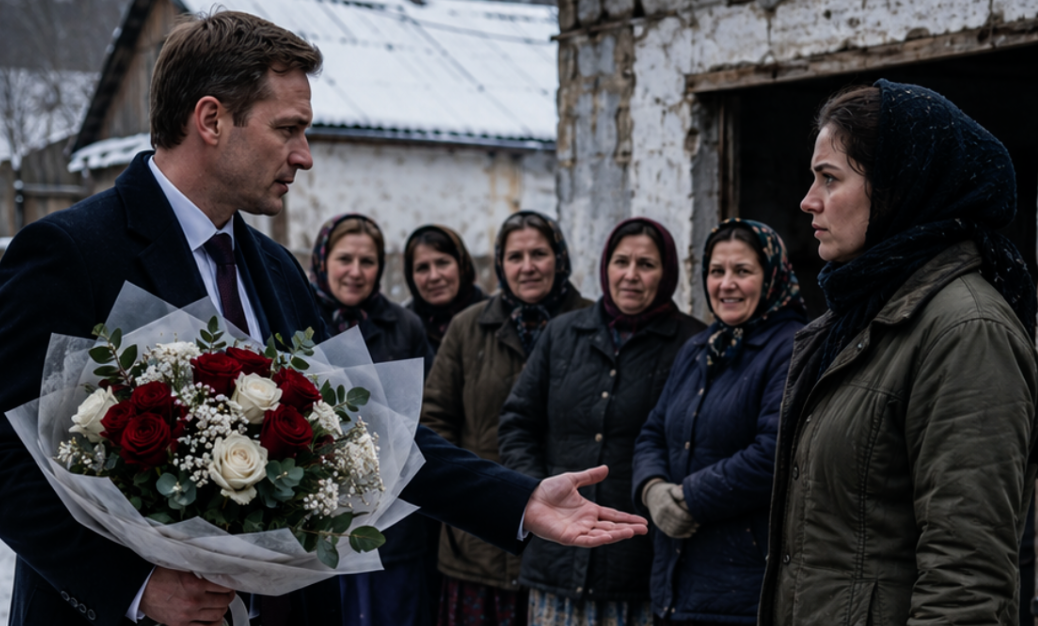
He appeared at the end of February, on a bright, freezing day when the sky above the village was high and blue, like something from a child’s drawing.
Zinaida had just finished the morning milking. She stepped out of the cowshed, her cheeks flushed, her apron splattered, and her eyes tired but satisfied.
Then she froze.
Alexei was standing by the farm gates.
He had lost weight. His face was gaunt. His suit was wrinkled, and his tie hung crookedly.
In one hand, he held a bouquet of absurdly bright flowers, obviously purchased from a kiosk in the district town. In the other, he carried a box of chocolates.
He looked at her and gave an uncertain, guilty smile.
“Zina… Hello.”
She said nothing.
The other milkmaids began coming out of the cowshed. When they saw Alexei, they stopped and exchanged glances.
“I came to… talk,” Alexei said. “May I?”
Zinaida looked at him—at his wrinkled suit, the bouquet, and his guilty face—and felt something happening inside her.
It wasn’t joy.
It wasn’t resentment.
It was something else.
“Speak,” she said evenly.
“In front of everyone?”
“What is there to be embarrassed about? We separated in front of everyone—the entire village knows. You can say this in front of everyone too.”
Alexei hesitated. He looked at the milkmaids. They remained where they were, watching him without any intention of leaving.
Finally, he sighed.
“Marina left me. She found someone else. Some businessman from the city. She told me, ‘You’re not good enough, Lyosha. Your salary is pathetic. You live in a rented apartment. You have no prospects.’ Then she left.”
He fell silent.
Then he stepped forward and held out the flowers to Zinaida.
“Forgive me, Zina. I was a fool. I didn’t understand how fortunate I was. You’re genuine. You’re loyal. You’re…” He faltered. “I want to come back to you. If you’ll have me.”
Silence hung in the air.
The milkmaids stood motionless. Even the cows inside the cowshed seemed to have fallen quiet.
Zinaida looked at her husband.
She looked at the flowers, his wrinkled tie, and his guilty eyes.
Then, suddenly, she laughed.
It wasn’t a cruel laugh. It wasn’t bitter.
It sounded almost surprised—as though she had finally seen something she had never noticed before.
“You know, Lyosha,” she said, her voice sounding clear and pure, like milk streaming into a pail, “I think I’ve forgiven you. I forgave you a long time ago. Anger is like milk in hot weather—it turns sour quickly. And if you hold on to it too long, it spoils completely and becomes useless to everyone.”
“Then you’ll take me back?” He stepped closer.
“No.”
“Why?!”
“Because I learned how to live without you, Lyosha.”
She removed her mittens and showed him her palms.
“Do you see them? They’re the same hands. Worn out and calloused. I put cream on them, but it doesn’t help much. I’m not ashamed of them anymore. And do you know something? I’m proud of them.
“These hands take care of forty-seven cows. These hands raised our children. These hands built our home. And what can your hands do, Lyosha? Shuffle papers? Tie a necktie?”
He lowered his head.
“You left a year ago,” she continued, “because you were ashamed of me. But I was never ashamed of you. I loved you exactly as you were—in your suit and tie, smelling of cologne.
“But you didn’t love me. You merely tolerated me.
“And now that someone has abandoned you, you suddenly remember that I’m ‘genuine’ and ‘loyal’? It’s too late, Lyosha. That train has already left.”
“Zina…”
“Don’t.” She raised her hand. “Don’t humiliate yourself. And don’t humiliate me. Go with God.”
Alexei remained where he was.
The flowers trembled in his hand. He dropped the box of chocolates, and they scattered across the frozen ground.
“Where am I supposed to go now?” he asked quietly.
“I don’t know,” Zinaida replied. “That’s something you’ll have to decide for yourself. You’re a man, aren’t you? Then act like one. I have to go. My break is almost over.”
She turned around and walked back toward the cowshed—toward her cows, her work, and her life.
Straight-backed.
Strong.
Her head held high.
The milkmaids stepped aside to let her pass. They watched her go with respect, admiration, and a kind of female solidarity that could never be expressed in words.
Alexei remained standing by the gates—with his bouquet, his scattered chocolates, and his ruined life.
The entire village saw him there.
Everyone had their own thoughts, but no one said a word.
Words were unnecessary.
Everything had already been said, done, and lived through.
That evening, Zinaida finished the milking as usual. She delivered the milk, washed the pail, put on her coat, and left the farm.
There was no one by the gates anymore.
Only crushed chocolates darkened the frozen ground, and a solitary flower lay nearby—a red rose broken in half.
Zinaida bent down and picked up the rose.
She looked at it and sighed.
“Oh, Lyosha,” she said quietly. “You foolish man. I loved you. I truly loved you.”
Then she walked home, carrying the broken flower in her hand.
She didn’t know why.
Perhaps she simply wanted something to remember it by.
Something to remind her that everything eventually passes—love, resentment, and even the longest winter.
Spring still comes.
Cows still give birth to calves.
And life continues.
With a man or without one, life continues.
Because a woman who gets up at four every morning possesses a strength that cannot be broken by any Alexei, any Marina, or any grief.