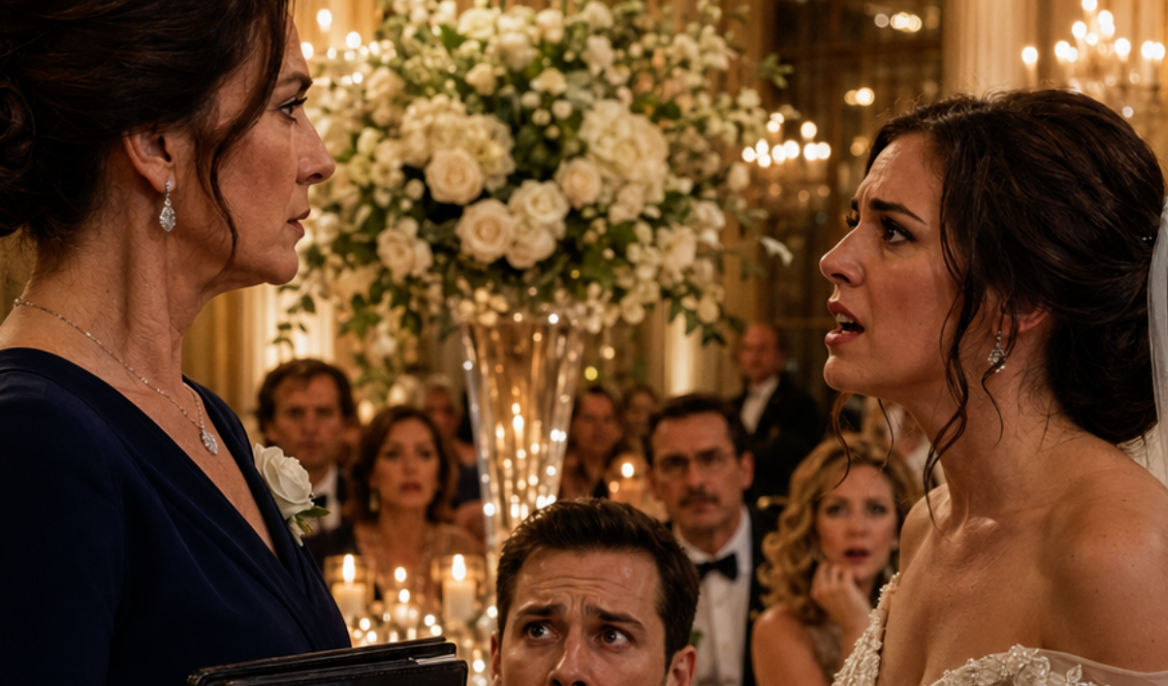
“Did you really decide that I was going to pay for your wedding?” I asked my future daughter-in-law, and her smile disappeared instantly.
Vika’s smile faltered for only a second, but that was enough for me.
She was sitting across from me at a long table in the restaurant hall, where she herself had invited me to “discuss the final little details.” She wore a cream-colored blazer, her hair was pulled into a sleek ponytail, her nails were pale pink, and her face showed not a single unnecessary emotion. It was the same beautiful, confident mask that made it easy to take someone else’s money and act as though that was perfectly normal.
Beside her, Inga Romanova was leafing through the menu with the expression of a woman choosing not appetizers, but the scale of her own triumph. Denis sat slightly to the side in a white shirt, looking confused and far too quiet. On the table, between the glasses and the folder containing the banquet contract, lay the bill. The same bill Vika had just gently pushed toward me with two fingers.
“Larisa Pavlovna, everything has already been calculated,” she said with a smirk. “We just need to pay the deposit today so we don’t lose the date.”
I looked first at the number at the bottom and then at her.
“Did you really decide that I was going to pay for your wedding?”
Her smile vanished.
It did not drop suddenly. It simply tightened, as though her face had forgotten how to maintain its politeness. Inga slowly lowered the menu. Denis looked up and, apparently, only then realized that we were no longer going to be discussing the color of the tablecloths.
Beyond the restaurant’s panoramic windows, the damp Samara spring glowed faintly. The trees in the park were swelling with buds, the asphalt was dark after the recent rain, cars stood near the entrance, and women in high heels posed beside the photo backdrop. Inside, the air smelled of expensive coffee, polished wood, and white peonies arranged in vases.
Everything was beautiful, smooth, and wedding-perfect.
And that only made me angrier.
For several weeks, a very simple idea had been hiding behind all that beauty: I had long ago been added to their budget not as the groom’s mother, but as their personal cash register.
“But weren’t you planning to?” Vika quickly regained control of herself and even smiled again. Only now the corners of her lips were rigid. “We discussed this.”
“No,” I replied. “We discussed that I would help. Those are two different things.”
Inga was the first to lean forward.
“Helping means paying, Larisa. Young couples have a difficult time these days. They need a respectable start in life. Or have you suddenly changed your mind about loving your son?”
That was exactly why I had always disliked women like her.
They could even wrap money in words about love. As though a mother who did not want to carry someone else’s celebration on her shoulders immediately became a bad mother. Greedy. Boring. Incapable of being happy for her children.
I placed my palms on the edge of the table so no one would notice that my fingers were trembling.
“My love for my son is not measured by someone else’s banquet.”
“Someone else’s?” Inga scoffed. “This is your Denis’s wedding.”
“His wedding and his fiancée’s. It is not my anniversary or my personal performance.”
Denis let out a heavy breath.
“Mom, let’s not be harsh.”
I turned toward him.
“No, Denis. I am not the one being harsh now. The harshness began the moment you decided my help was unlimited.”
I think it was at that exact moment that I truly saw how frightened he was.
Not frightened of me. Frightened of the scene.
Men like my son are almost always less afraid of being used than they are of the truth being spoken aloud and making everyone uncomfortable.
And yet, only a month and a half earlier, I had been happy.
Denis had come to the bakery one evening and, smiling awkwardly, said:
“Mom, I’m getting married.”
I was holding a baking tray filled with still-warm sweet cheese buns. The kitchen smelled of butter, vanilla, dough, and apple jam. Sonya was dusting pastries with powdered sugar near the window.
I set the tray on the table and actually laughed with happiness.
“Really?”
“Really,” he said with a nod.
His face looked so youthful and bright at that moment that I no longer saw a grown man with a factory access card in his pocket. I saw little Denis, who had once hidden a kitten inside the bread box when he was ten years old.
I hugged him right there, surrounded by flour and baking trays.
“So, are you going to introduce us?”
He introduced me to Vika three days later.
She entered the bakery as though she were stepping into a beautiful scene that already belonged to her. She was tall and slender, dressed in a light-colored coat, with neatly styled hair and eyelashes that seemed never to have experienced rain or wind. She smiled broadly, looked directly into my eyes, and spoke quickly and sweetly.
“Larisa Pavlovna, I’ve heard so much about your pies,” she cooed. “Denis says you have golden hands.”
I am always suspicious when young women find the perfect words too quickly. But at the time, I told myself not to be ridiculous. Perhaps she was simply polite. Perhaps she was in love. Perhaps she genuinely wanted me to like her.
Her mother was Inga Romanova, an administrator at a fitness club. We met a week later at a small café near the embankment.
Inga sat across from me, ordered mineral water, and within ten minutes did what women like her do best: she outlined everyone’s responsibilities as though life itself had assigned them.
“She’s my only daughter,” she said with a smile. “Naturally, I want everything to be beautiful. You understand.”
I nodded.
“I understand. I raised my son alone too. I’ll help however I can.”
I should have been more precise immediately.
Instead of saying, “I’ll help however I can,” I should have said, “This is the exact amount I am prepared to contribute.”
I should not have made a general, warm, gentle promise that could later be stretched in any direction. But I was happy for Denis, and once again I decided to be nice.
That word was what eventually caused all my problems.
People find it very convenient to interpret kind women as free resources.
At first, everything still seemed reasonable.
I suggested a small family wedding. Something warm and intimate. A good restaurant, a wedding cake made by me as a gift, flowers, a dress, and a photographer. Nothing pretentious, but full of heart.
Denis agreed immediately.
“Mom, that would be perfect.”
Vika smiled, placed her hand over his, and nodded too.
“Of course. We don’t need anything extravagant.”
A week later, it became clear that her idea of “nothing extravagant” somehow cost the same as two months’ worth of supplies for my bakery.
First, a different restaurant appeared in the group chat.
Then they wanted a professional host “with a respected name.”
Then a photographer who “captured natural moments instead of taking the same pictures as everyone else.”
Then came decorations with peonies and candles.
Then an outdoor ceremony.
Then Vika decided against the dresses we had looked at in the beginning and chose one from a boutique where the fitting-room curtains were heavier than my winter coats.
“Larisa Pavlovna, you only get married once,” Vika would say with a smile. “I want photographs that I won’t be embarrassed to show people later.”
Photographs.
It is astonishing how many women are prepared to bankrupt the living for the sake of beautiful pictures in which everyone will eventually be wearing the same smile.
I remained silent.
Not because I failed to notice what was happening. I noticed everything.
But Denis looked so happy beside her and was so afraid of the slightest crack appearing in their wedding plans that I kept postponing the conversation.
I thought they would come to their senses soon.
Or that I would calmly explain the numbers to them.
Or that the situation would somehow resolve itself.
For a long time, I had one dangerous habit: believing that people would notice a boundary if I showed it to them silently.
They did not notice.
The first time I truly felt sick was at the bridal salon.
I did not go there by choice. Vika called me that morning, cheerful as always.
“Larisa Pavlovna, could you stop by? I want you to see the dress. It’s supposed to be such a touching moment…”
The continuation is just below in the first comment.
“Did You Really Decide I’d Pay for Your Wedding?” I Asked My Future Daughter-in-Law—and Her Smile Vanished
Vika’s smile faltered for only a second, but that was enough for me.
She was sitting across from me at a long table in the restaurant hall—the restaurant where she herself had invited me to “discuss the final little details.” She wore a cream-colored jacket, her hair pulled into a sleek ponytail, her nails painted pale pink, and her face showed not a single unnecessary emotion. It was that beautiful, confident mask that made it easy to take someone else’s money while pretending that was simply how things were supposed to be.
Beside her, Inga Romanova was leafing through the menu with the air of a woman choosing not appetizers, but the scale of her triumph. Denis sat slightly to the side in a white shirt, looking confused and far too quiet. On the table, between the glasses and a folder containing the banquet contract, lay the bill—the one Vika had just pushed toward me almost affectionately with two fingers.
“Larisa Pavlovna, everything has already been calculated,” she said with a little smile. “All that’s left is to confirm the reservation today, before someone else takes the date.”
I looked first at the figure at the bottom of the page, then at her.
“Did you really decide that I would pay for your wedding?”
Her smile vanished.
It did not disappear abruptly. It simply tightened, as though her face had forgotten how to maintain its pleasant expression. Inga slowly lowered the menu. Denis raised his eyes and seemed to realize only then that we were no longer going to be discussing the color of the tablecloths.
Beyond the restaurant’s panoramic windows, the damp Samara spring glowed beneath a gray sky. Budding trees stood in the park, the asphalt was dark after the recent rain, cars were parked near the entrance, and women in high heels posed beside the photography area. Inside, the air smelled of expensive coffee, polished wood, and white peonies arranged in vases.
Everything was beautiful, smooth, and perfectly bridal.
And that only made me angrier.
Because behind all that beauty, a very simple idea had been hiding for several weeks: I had long since been entered into their budget not as the groom’s mother, but as their personal ATM.
“Weren’t you planning to pay?” Vika quickly regained her composure and even smiled again, although the corners of her mouth were now stiff. “We discussed this.”
“No,” I replied. “We discussed the fact that I would help. Those are two different things.”
Inga was the first to lean forward.
“Helping means paying, Larisa. Young couples have a difficult time these days. They need a proper start in life. Or have you suddenly stopped loving your son?”
That was exactly why I had always disliked women like her. They even knew how to wrap money in words about love. As though a mother who did not want to carry someone else’s celebration on her shoulders automatically became a bad person—greedy, dull, and incapable of being happy for her children.
I placed my palms on the edge of the table so no one would notice my fingers trembling.
“My love for my son is not measured by somebody else’s banquet.”
“Somebody else’s?” Inga snorted. “This is your Denis’s wedding.”
“His and his fiancée’s. It isn’t my anniversary or my personal recital.”
Denis exhaled heavily.
“Mom, let’s not be so harsh.”
I turned toward him.
“No, Denis. The harshness didn’t begin now. It began the moment you decided that my help came without a limit.”
That was probably the moment when I truly saw how frightened he was.
He was not frightened of me. He was frightened of the scene.
Men like my son are almost always more afraid of the truth being spoken aloud and making everyone uncomfortable than they are of being used.
And only a month and a half earlier, I had been delighted.
Denis had come to the bakery one evening and said with an embarrassed smile:
“Mom, I’m getting married.”
I was holding a baking tray covered with still-warm sweet cheese buns. The kitchen smelled of butter, vanilla, dough, and apple jam. Sonya was standing near the window, dusting pastries with powdered sugar.
I put the tray down on the table and actually laughed with happiness.
“Really?”
“Really,” he said with a nod.
At that moment his face looked so boyish and bright that I did not see an adult man with a factory ID card in his pocket. I saw little Denis, the ten-year-old who had once hidden a kitten in the bread box.
I hugged him right there among the flour and baking trays.
“So, when are you going to introduce us?”
He brought Vika to meet me three days later.
She entered the bakery as though she were stepping into a beautifully arranged scene that already belonged to her. She was tall and slender, wearing a light-colored coat, with perfectly styled hair and eyelashes that appeared never to have encountered rain or wind. She smiled broadly, looked directly into my eyes, and spoke quickly and sweetly.
“Larisa Pavlovna, I’ve heard so much about your pies,” she cooed. “Denis says you have golden hands.”
I always become cautious when young women find exactly the right words too quickly. But that day I scolded myself for thinking that way.
What was wrong with me?
Perhaps she was simply polite. Perhaps she was in love. Perhaps she genuinely wanted me to like her.
Her mother was Inga Romanova, the manager of a fitness club. We met her a week later at a small café near the embankment. Inga sat across from me, ordered mineral water, and within ten minutes did what women like her did best—she outlined everyone’s responsibilities as though life itself had dictated them.
“She’s my only daughter,” she said with a smile. “Naturally, I want everything to be beautiful. You understand.”
I nodded.
“I do. I raised my son alone as well. I’ll help however I can.”
I should have been more precise from the beginning.
Instead of saying, “I’ll help however I can,” I should have named an exact amount.
I should not have made a general, warm, gentle promise that could later be stretched in any direction. But I was happy for Denis, and once again I decided to be nice.
That was the word that eventually betrayed me.
Nice women are very conveniently interpreted as free of charge.
At first, everything still appeared reasonable.
I suggested a small family wedding. Something warm and intimate: a good restaurant, a wedding cake made by me as a gift, flowers, a dress, and a photographer. Nothing extravagant, but full of heart.
Denis agreed immediately.
“Mom, that would be perfect.”
Vika smiled, placed her hand over his, and nodded as well.
“Of course. We don’t need anything pretentious.”
A week later, it became clear that her definition of “nothing pretentious” somehow cost as much as two months’ worth of supplies for my bakery.
First, a different restaurant appeared in the group chat. Then they needed a host “with a recognized name.” Next came a photographer who “captured real life, unlike everyone else.” Then there were decorations with peonies and candles, an outdoor ceremony, and a dress that was no longer from one of the shops we had originally visited, but from a boutique where the changing-room curtains were heavier than my winter coats.
“Larisa Pavlovna, it only happens once in a lifetime,” Vika would say with a smile. “We want photographs we won’t be embarrassed to show people afterward.”
Photographs.
It was astonishing how many women were prepared to bankrupt the living for the sake of beautiful pictures in which everyone would later wear the same smile.
I remained silent.
Not because I failed to notice what was happening. I noticed everything.
But Denis looked so happy beside her and seemed so afraid of the slightest crack appearing in their wedding plans that I kept postponing the conversation. I thought they might eventually come to their senses. Or perhaps I would calmly guide them toward the actual figures. Or the situation would somehow resolve itself.
For a long time, I had one dangerous habit: believing that people would notice a boundary if I silently showed it to them.
They did not.
The first time I truly felt sick was at the bridal boutique.
I had not gone there by choice. Vika called me that morning, as cheerful as always.
“Larisa Pavlovna, could you stop by? I want you to see the dress. It’s supposed to be a touching moment.”
I arrived carrying a box of éclairs for the boutique employees. Old-fashioned, perhaps, but I was accustomed to never visiting people empty-handed.
The shop smelled of perfume, steam from the garment steamer, and new satin. Young women in black dresses moved around almost silently. White gowns stood on mannequins like clouds that did not know their own prices.
I was asked to wait because Vika was in the fitting room.
I stood near a mirror and heard her voice from behind the curtain.
Not immediately.
First, there was laughter.
Then came a sentence that felt like a bucket of icy water being poured over me.
“Relax,” Vika giggled to one of her friends. “The groom’s mother is a convenient ATM. She’s still pretending to be modest, but Denis will wear her down. And if everything goes well, maybe we’ll even get her to sell the bakery. That money would be very useful for a down payment.”
Someone snickered.
“Doesn’t she understand what’s happening?”
“She’s one of those people who loves being nice. They’re the easiest ones to handle. You just have to talk about how much she loves her son and make sure she doesn’t feel excluded.”
I stood there holding the box of éclairs and staring at my reflection in the tall mirror.
My face was calm.
Too calm.
That was the first time I had a thought that would return to me more than once: I was no longer angry.
It was worse than anger.
I did not go in immediately. I did not create a scene in the boutique or throw the box across the room. I simply left the éclairs on the counter, told the receptionist that an urgent matter had come up, and walked outside.
A fine rain was falling. It was a cold, spiteful spring rain driven by the wind.
I stood beneath the awning and watched cars drive through the puddles. Suddenly, I understood something very clearly.
I no longer wanted to be nice.
I wanted to be honest.
At least with myself.
Even after that, however, I continued to hesitate.
Because there was Denis—my son. There was his happy face, his confused tenderness toward that young woman, and his lifelong desire to reconcile everyone.
I knew far too well how men like him clung to love, even when that love had already begun selling them according to a price list.
“Mom,” he said one evening when I finally began speaking carefully about the expenses. “You can see that Vika is nervous. It’s important to her that everything be beautiful. Don’t talk to me about money right now. Tell me how you feel. Are you supporting us or not?”
I looked at him and realized how completely he had been blinded by a convenient lie.
Not by cruelty, but by convenience.
He liked believing that the restaurants, bouquets, expensive fabrics, and lists of contractors were expressions of love rather than attempts to discover how deeply they could reach into my wallet.
“I support you,” I answered. “But that doesn’t mean I’m obligated to pay for someone else’s appetite.”
He became offended, almost like a child.
“You don’t like Vika.”
“I don’t know her well enough to love or dislike her. But I can already see how useful I am to her.”
He stood up from the table.
“You’re complicating everything.”
“No, Denis. I’m finally beginning to look at everything directly.”
Inga called me herself the next day.
“Larisa,” she said in a smooth, almost affectionate voice. “The girls are upset. You shouldn’t pressure everyone with figures like this. You want Denis to feel supported, don’t you?”
“Support is not the same thing as unlimited payment,” I replied.
“There’s no need to be rude. We’re practically family.”
I nearly laughed.
People rarely decide that you are family as quickly as when they urgently need access to your bank card.
Oleg Martynov finally opened my eyes completely.
He was the manager of the restaurant Vika had chosen instead of my original suggestion. Oleg had been ordering buns, brunch pastries, and miniature corporate desserts from my bakery for years.
We were not friends, but we had reached that calm, adult level of familiarity at which people could speak without excessive politeness.
I visited him on business because I wanted to find out whether I could at least make the cake myself and save money that way. He led me into a small office behind the main hall, where the air smelled of paper, coffee, and lemon-scented furniture cleaner.
“Larisa,” he said slowly while looking through several sheets of paper. “I don’t like interfering in other people’s affairs, but something here seems strange.”
He turned the contract toward me.
Inga Romanova was listed as the client.
The list of services was enormous and inflated, containing additional items nobody had ever mentioned to me: extra lighting, a second photographer, a bartending performance, and a content-creation area.
At first, I did not even understand what a “content-creation area” was.
At the bottom, someone had added a handwritten note:
“Payment to be made by Larisa Klimova during an in-person meeting. Guaranteed by the groom’s party.”
I looked up at Oleg.
“Who wrote this?”
“Not me,” he replied dryly. “Our event coordinator wrote it after meeting with the bride and her mother. I recognized your surname and decided to show it to you.”
I sat across from him, feeling something very cold and steady slowly rising inside me.
“So they listed me as the person responsible for payment without my permission?”
Oleg shrugged.
“According to the documents, yes. As for real life, I don’t know. But they behaved as though the question had already been settled.”
I returned to the bakery late and said nothing.
Sonya was wiping down the display case. When she saw my face, she did not even try to make a joke.
“Did something happen?” she asked quietly.
At first, I waved the question away.
Then, without even noticing how it happened, I told her everything: what I had heard at the boutique, the remark about the “convenient ATM,” the contract, and my son’s refusal to see what was happening.
Sonya listened, slowly turning redder with outrage over someone else’s shameless behavior than some people would have turned over their own.
“Larisa Pavlovna,” she breathed. “May I show you something?”
She took out her phone, scrolled through it, and handed it to me.
Vika had a private profile that, as it turned out, was private only to people she did not find useful. On it was a screenshot from a conversation with a friend.
White letters appeared against a pink background:
“Getting your dream wedding paid for by the groom’s mother is a talent, not luck.”
There was also an emoji of a raised glass.
I looked at the words and felt no shock.
Only exhaustion.
It was such deep exhaustion that it made me want not to scream, but to wash my hands—slowly and thoroughly, all the way up to my elbows.
“I’m sorry,” Sonya murmured. “I wasn’t trying to spy. She posted it herself.”
“It’s all right,” I answered. “You showed me at exactly the right time.”
After that, I had no more doubts.
That evening, I sat at the kitchen table, took out the squared notebook I usually used for recording orders, and began writing down figures.
Not their expenses.
My boundaries.
How much I had originally been prepared to give my son. How much I had already mentally surrendered. How much they had added without consulting me. And what exactly angered me most about the entire situation.
It was not the amount.
It was not the restaurant.
It was not the dress.
It was the fact that they had removed me from the position of a human being and placed me in a column labeled “Will pay.”
I hardly slept that night.
Neither did Denis.
He sat in the kitchen, scrolling through his phone, sighing, and attempting to start conversations. But I no longer had the energy for his small peacekeeping maneuvers.
“Mom,” he whispered near dawn. “Just don’t destroy everything.”
I looked at him for a long time.
“I’m not destroying anything, Denis. I’m simply refusing to pay for something in which I have already been excluded as a person.”
He wanted to object but could not find the words.
And now we were sitting in the restaurant.
Vika was still trying to maintain her composure.
“Larisa Pavlovna, you’re behaving very strangely. You promised to help us.”
“To help,” I said with a nod. “Not to become your bank.”
Inga leaned toward me.
“This is humiliating.”
“What was humiliating was hearing your daughter call me a convenient ATM.”
Vika turned pale so quickly that even her makeup could not hide it.
“You were eavesdropping?”
“No. You were speaking too loudly.”
Denis abruptly turned toward his fiancée.
“What?”
Vika attempted to laugh.
“Oh, for heaven’s sake. People say all kinds of stupid things when they’re talking to their friends.”
I took the printed contract out of my bag and placed it beside the bill.
“Was this also something stupid you said to your friends? Inga is listed as the client, but for some reason I’m supposed to pay.”
Oleg, who had been standing a short distance away near the bar, pretended to examine the glasses. But I could see that he was hearing every word.
Inga became as pale as her daughter.
“Larisa, it was merely a technical detail. We thought it would be more convenient for you.”
“More convenient?” I actually smiled. “Are you seriously saying that, or are you testing how patient I am?”
Denis picked up the contract, turned the pages, and read the handwritten note.
His face became so empty that for a moment I felt sorry for him, like a child who had reached into a beautiful box only to find someone’s old rags inside.
“Vika,” he managed to say. “Did you know about this?”
Her face flushed.
“What difference does it make who is listed as the client? The groom’s family pays anyway. Mom said from the beginning that this was customary among people like you.”
“Among people like us?” I asked quietly.
Inga pressed her lips together.
“Among normal people.”
Even Oleg looked away at that.
I took out my phone and showed Denis the social media story.
He read it silently.
For a very long time.
Then he raised his eyes toward Vika as though he were truly seeing her for the first time.
“‘Paid for by the groom’s mother.’ Was that a joke too?”
She jerked one shoulder irritably.
“Whose side are you on?”
“My own,” he answered unexpectedly, his voice quiet. “For the first time, apparently.”
I had not expected that from him.
It seemed that he had not expected it from himself either.
Vika stood up.
“Wonderful. Your mother has won.”
“No,” I interrupted. “Nobody has won. I simply stopped being your payment system.”
Inga sharply pushed the bill toward me.
“So, are you paying or not?”
I looked at the paper and then at her.
“No.”
“Not at all?” For the first time, genuine confusion appeared in her voice without being concealed by anything.
“Not at all,” I replied. “I will not finance a celebration in which I have been deprived of respect and retained only as a line in the budget.”
Vika gave an angry, almost ugly smile.
“Did you think the groom’s mother was supposed to be the most important person at the wedding?”
“No. I thought people weren’t supposed to turn other human beings into wallets.”
Denis remained seated, staring at the table.
Then he exhaled slowly.
“Mom, if you hadn’t discovered all of this, would you really have paid?”
I thought about it honestly before answering.
“Yes. And that is what makes me feel most ashamed now.”
He closed his eyes.
Perhaps something broke inside him at that moment as well.
Not his love.
His illusion that a beautiful bride must always be accompanied by an equally beautiful truth.
Vika was no longer pretending.
“Fine,” she said through clenched teeth. “Have your pathetic, penniless family party without us.”
“Without me,” Denis corrected her quietly.
She froze.
“What?”
“I’m not leaving with you now,” he said, finally looking directly into her face. “I need to understand whether I was ever actually part of this story, or whether there was only your budget.”
“You’re leaving me because of money?”
I shook my head.
“No, Vika. It’s because you kept talking about love while calculating everything as though I were a client.”
She grabbed her handbag. Inga jumped up after her, and the chair scraped unpleasantly against the floor.
“Let’s go,” Inga snapped at her daughter. “People here don’t understand us.”
When they left, the restaurant suddenly seemed strangely spacious.
Not because there were fewer people in the room.
It was because the sticky, smiling certainty that I could be forced to submit without resisting had disappeared.
Oleg did not approach the table immediately. When he finally did, he placed a glass of water in front of me.
“Should I cancel the reservation?” he asked.
I looked at Denis.
He sat with his head lowered, twisting a napkin between his fingers as though that small piece of paper were the only thing keeping him together.
“I don’t know,” he said. “Right now, I don’t know anything at all.”
That was perhaps the most adult answer I had heard from him in several months.
I picked up the glass, took a sip, and only then felt my throat trembling.
“Cancel the reservation,” I told Oleg. “And I won’t be making the cake under any circumstances. Not for a story like this.”
He nodded.
Denis and I drove home in silence.
Samara floated beyond the car windows in the damp evening light. Restaurant signs flickered. People walked along the sidewalks carrying bags and bouquets. Somewhere in somebody else’s life, perhaps someone was truly preparing for a wedding without a war.
I stared through the window and thought about only one thing.
Would I really have paid for all of it if I had not overheard the conversation in the boutique and seen the documents?
Yes.
And that knowledge hurt more than anything else.
When we reached the apartment building, Denis did not get out of the car immediately.
“Mom,” he said without looking at me. “I’m sorry.”
I remained silent.
“I thought she was simply nervous. Her mother too. I thought these were normal pre-wedding demands.”
“No, Denis,” I answered quietly. “You simply wanted very badly not to notice that you were being used. That isn’t the same thing.”
He nodded.
Then he suddenly asked:
“Do you think I’m just like them now?”
I looked at his hands—large, adult, and nervous. I looked at his profile, which suddenly seemed older. I saw the boy I had once taught to say thank you and never take someone else’s property without permission.
And I saw the man who had almost allowed his fiancée to turn his own mother into a convenient wallet.
“No,” I answered. “But you stood beside them and remained silent. Silence in situations like this also carries a very high price.”
He covered his face with his hands.
The wedding did not happen that day.
It did not happen the following week either.
Vika wrote to Denis several times. At first, her messages were angry. Then they became wounded and resentful. Finally, she adopted a tone suggesting that Denis should apologize for failing to pay for her dream on time.
Inga called me once.
I did not answer.
There was nothing left for us to discuss.
Denis took some time off work. He came to the bakery in the mornings, silently carried sacks of flour, delivered orders, and helped Sonya arrange the display case. It was as though he were trying to regain some simple, human movement that could not be sold as part of a banquet package.
I did not force him into conversations.
He needed to reach his own conclusions.
It always takes men longer.
One evening, as we were closing the cash register, Sonya cautiously asked:
“Larisa Pavlovna, do you regret it?”
I looked at the tray of sweet cheese buns that had not been sold, the yellow light inside the display case, and the empty street beyond the window.
“Regret what exactly?”
“Well…refusing to pay.”
I smiled.
“I don’t regret refusing. I regret spending so much time believing that love had to be proven through payment.”
Sonya nodded as though that realization were more important than all the wedding dresses in the city.
Two weeks later, Denis sat down with me in the kitchen.
He did not come to ask for anything or to justify himself.
He simply sat down, rubbed his face with both hands, and said:
“I keep remembering the way she said it. That you were a convenient ATM. What hurts most is knowing that I probably would have pressured you myself. Not because I wanted to hurt you, but because I was afraid of losing her.”
I poured him some tea.
“I know.”
“That’s very bad, isn’t it?”
“It’s a very adult moment, Denis—when a person suddenly sees not only someone else’s cruelty, but also his own weakness beside it.”
He remained silent for a long time.
“I’m not going to marry her.”
I nodded.
Not triumphantly.
Wearily.
“That is your decision.”
“Are you angry?”
“No,” I replied. “I simply refuse to keep paying for other people’s lessons.”
He gave a weak smile that made him look almost like a boy again.
“That’s harsh.”
“It’s overdue.”
The next morning, I arrived at the bakery earlier than usual. I put the kettle on, opened the window, and allowed the damp Samara morning to enter.
Outside, the air smelled of rain and fresh bread from the neighboring kiosk. Sonya was kneading dough, flour covering her arms up to the elbows. Denis was carrying boxes of cottage cheese inside from the car.
Life had not become easier or sweeter.
It had simply become more honest.
And within that honesty, there was suddenly so much room to breathe.