“I’m Oleg’s New Wife. I Already Have the Keys to the Apartment,” the Stranger Smirked
The doorbell rang just as Tamara was taking a pot of borscht off the stove. It was sharp, impatient, and long. The kind of ring people used when something urgent had happened—or when they simply were not accustomed to waiting.
She lowered the heat, wiped her hands on her apron embroidered with sunflowers, and went to answer the door.
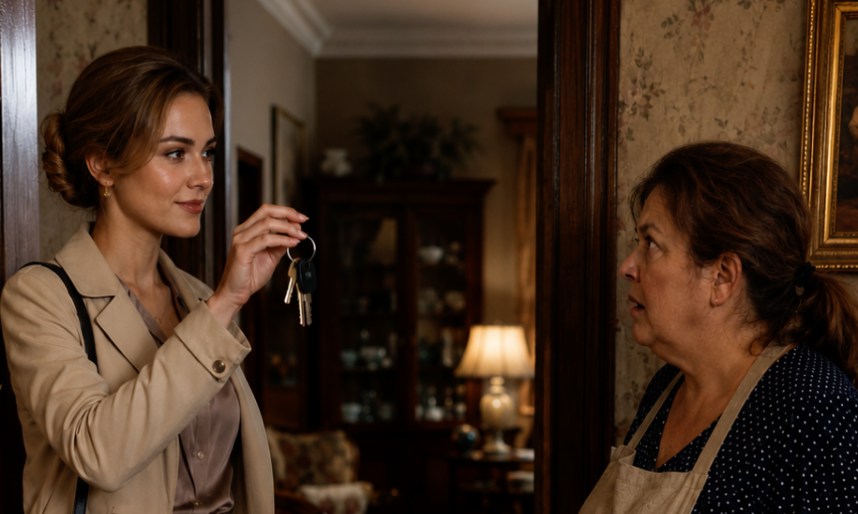
A young woman in a beige coat stood outside. Bright lipstick, carefully styled hair, and a glossy leather handbag resting in the crook of her arm. Tamara had never even stopped to admire bags like that in shop windows.
“Are you Tamara Ivanovna?”
The visitor’s voice was confident, almost cheerful, as though she had arrived for a celebration.
Tamara nodded while holding the door. The smell of borscht and dill drifted in from the kitchen. On the windowsill in the living room, a cactus had been slowly turning yellow. Tamara had forgotten to water it for nearly three years, yet somehow it remained alive.
An ordinary Tuesday. An ordinary December evening.
“My name is Kristina. I’m your son Oleg’s new wife.”
The stranger smiled and pulled a bunch of keys from her handbag. She spun them around one finger the way a magician might twirl a coin.
“Oleg gave me the keys to the apartment. We’ve decided that we’re going to live here. We’ve found a nice room for you in Podolsk. It’s quiet there, the air is fresh, and there’s a clinic right across the street.”
Tamara stared at the keys.
Attached to them was a familiar keychain shaped like an orange cat. She had bought it for Oleg’s twentieth birthday fifteen years earlier, in a little souvenir shop on the Arbat.
Oleg had laughed and said:
“Mom, I’m not a girl.”
But he had attached it to his keys anyway. And he had carried it all these years.
The world did not turn upside down. It simply became very quiet. Even the cuckoo clock seemed to stop ticking.
“Are you joking?” Tamara heard herself ask.
Her voice sounded distant, dull, and unfamiliar.
Kristina stepped across the threshold without waiting to be invited. Her heels clicked against the old parquet floor. She looked around, her gaze sliding over the wallpaper with faded flowers, the photograph of little Oleg hanging on the wall, and the crack in the ceiling that Tamara had hidden for years beneath a paper lampshade.
“I’m not joking, Tamara Ivanovna. Oleg said you would understand. You want your son to be happy, don’t you?”
Tamara closed the front door. The lock clicked, as though that might somehow help. Her hands were trembling slightly, but she clasped them together and straightened her back.
“Oleg told you this? Personally?”
Kristina had already entered the living room. She sat down on the sofa and crossed one leg over the other, looking around with the expression of someone examining merchandise at a market.
“Of course. We discussed everything yesterday. It’s a two-bedroom apartment, which will be just right for Oleg and me. You have far too much space here for one person. At your age, having one room should be more than enough, you know.”
At your age.
Tamara was fifty-eight. Not seventy. Not ninety.
She had worked until the previous year, going to her shift at the district library every morning. Thirty-two years without missing a single day. She had carried boxes of books up to the second floor herself whenever the elevator broke.
And this apartment had not cost her merely “too much space.”
It had cost her half her life.
Tamara took out her phone and called Oleg.
A long series of rings. One, two, five.
He rejected the call.
She called again. This time he answered.
“Hi, Mom. I’m at work. I can’t talk.”
“Oleg, there’s a woman here. She says she’s your wife. She has the keys to my apartment. Explain to me what is going on.”
Silence.
Three seconds. Five. Seven.
Tamara counted them in her head.
“Mom, I’ll call you later. Don’t worry. Everything’s fine.”
Then the line went dead.
He had hung up.
Her son had ended the call while a strange woman sat on her sofa and discussed moving her into a room in Podolsk.
Kristina watched her calmly. There was not the slightest sign of embarrassment on her face. Only the satisfied smile of someone accustomed to getting whatever she wanted.
Why had he not explained?
Why had he hung up?
Perhaps he was ashamed. Or perhaps he was simply weak.
Tamara had suspected that for a long time, but she had never wanted to admit it to herself.
She lowered herself onto the chair in the hallway.
The apartment had been allocated to her through work. Or rather, it had not simply been handed to her. She had spent eleven years on a waiting list.
Eleven years in a communal apartment on Sretenka, with a leaking ceiling and a neighbor named Vera Stepanovna, who turned the television up to full volume every evening and boiled fish.
The smell of cod and soap operas still appeared in Tamara’s dreams sometimes.
Oleg had been four when they finally received the housing order.
He had run through the empty rooms shouting with joy, his voice echoing off the bare walls. There had been no furniture, no curtains, not even a light bulb in the bathroom.
And still, it had felt like a celebration.
Then came privatization. Lines at the housing office, documents, certificates, photocopies.
Everything had been registered in Tamara’s name.
She was the sole owner.
Oleg had grown up without a father. His father had left when the boy was two.
He packed a suitcase one Saturday morning and said:
“I’m going on a business trip. I’ll be back in a month.”
The suitcase had seemed suspiciously large for a month-long trip, but Tamara had not paid attention at the time.
Two months later, a letter arrived from his lawyer.
Tamara had never complained. Not once.
She worked at the library from eight in the morning and tutored Russian in the evenings. She taught other people’s children to write correctly, then came home and checked her own son’s school notebooks.
She saved money.
For his university education. For his first suit for a job interview. For his wedding.
His first wedding, to Lena.
That marriage lasted three years and ended quietly.
And now there was a second wife.
A wife Tamara had never even heard about.
Meanwhile, Kristina got up from the sofa and began inspecting the apartment.
She looked into the bedroom, ran one finger across the windowsill, and examined the dust on her fingertip. She shook her head. Then she opened the wardrobe and touched the shelves, as though deciding where she would hang her dresses.
“Of course, we’ll have to renovate. This wallpaper is awful. Oleg promised stretch ceilings, and the kitchen needs to be replaced completely. These cabinets of yours should have been thrown away years ago.”
Tamara remained silent.
Something unfamiliar was rising inside her.
It was not hurt and it was not anger.
It was something cold and clear, like well water in winter.
Tamara stood up from the chair.
“Kristina, you said Oleg gave you the keys. Is that true?”
“Of course. Why?”
“Oleg cannot dispose of someone else’s apartment. This is my home. I am the sole owner, according to both the documents and the law.”
Kristina laughed.
It was a short, condescending laugh, the way people laughed at a child who had said something foolish.
“Tamara Ivanovna, we’re all adults here. Oleg is your son. Your only heir. He decided it was time for us to live properly, like normal people. And you’ll be more comfortable in Podolsk. There’s a park there, by the way, and a store only five minutes away.”
A clinic. A park. A store.
As though Tamara were already supposed to retire quietly with a newspaper and a bottle of kefir.
“I’m not going anywhere,” she said.
Then she remembered that the borscht on the stove had probably gone cold.
Good borscht, made with young beets and beef. Three hours at the stove.
For some reason, that upset her more than anything else.
Kristina took out her phone and called Oleg.
This time he answered immediately.
“Olezhik, your mother is being stubborn. You did explain everything to her, didn’t you? Please talk to her, like we agreed.”
She switched on the speaker.
Oleg’s voice filled the hallway. Quiet and guilty.
Tamara recognized that tone. He had used it as a child whenever he broke something and hoped not to get caught.
“Mom… Come on, Mom. I wanted to tell you. I just didn’t know how to begin. Kristina and I registered our marriage a month ago. She’s pregnant, Mom. We need somewhere to live. You know how much rent costs. You’re alone in a two-bedroom apartment, while we don’t even have a corner for ourselves and the baby.”
Pregnant.
The word hung in the air like the smell of borscht that refused to disappear.
Tamara was going to have a grandchild.
A grandson or a granddaughter.
Her first grandchild.
She felt as though she had been waiting for this her entire life.
She leaned against the wall.
The photograph of Oleg on his first day of school stared at her from its frame. A gap-toothed smile, an enormous schoolbag, and a white shirt with a chocolate stain on the collar.
That boy had believed his mother could do anything.
The man on the phone was asking his mother to leave her own home for the sake of a woman Tamara was seeing for the first time in her life.
“Mom, it’s temporary. Just for a couple of years. Then we’ll earn enough money and buy a place of our own. I promise.”
Temporary.
Just for a couple of years.
Tamara had heard words like that before. Exactly those words.
Her former husband had said:
“It won’t be long, Tamarochka. I’ll be back soon.”
He never returned.
But he did send a lawyer.
Something inside her stretched tight and snapped.
There was no pain.
“All right,” she said quietly.
Kristina smiled triumphantly.
Oleg sighed on the other end of the line, and there was so much relief in that sigh that Tamara felt sick.
“Thank you, Mom. You’re the best. I’ll come over this weekend and help you pack.”
Pack.
Fifty-eight years of life placed into cardboard boxes and taken to a stranger’s rented room.
Tamara ended the call.
Kristina was already photographing the apartment with her phone. She took pictures of the walls, the corners, and the windows. She crouched down to photograph the baseboards.
Probably for an interior designer.
Tamara went into the kitchen and closed the door behind her.
She poured water into a cup with a chipped handle that she had been using for nearly ten years. She drank slowly, one sip at a time.
Her hands stopped trembling.
She looked at the refrigerator.
Underneath a magnet from Crimea, brought home three years earlier from her only vacation in a very long time, there was a business card.
White card stock. Strict lettering.
“Nadezhda Pavlovna Surkova, Attorney, Housing Law.”
She was a neighbor from the third entrance. She had given Tamara the card two years earlier, when Tamara had been preparing her will.
“If you ever need anything, call me. Any time. Even in the middle of the night. I have insomnia anyway.”
Tamara removed the card from the refrigerator.
She called her neighbor from the third entrance, who worked as a lawyer at some firm, and explained the situation.
Kristina was rustling around in the next room and paying no attention to her.
“Tamara Ivanovna, do not sign anything. Nothing at all. Not even if your son asks you to,” the neighbor replied.
Tamara thanked her and ended the call.
She stood for a moment, looking down at her sunflower apron.
Then she removed it, hung it carefully on its hook, and walked out of the kitchen.
Kristina was standing in the bedroom photographing the wardrobe.
“Kristina.”
She turned around, phone in hand.
“I’ve changed my mind.”
“What?”
“I’m not going anywhere. This is my apartment. By law, according to the documents, and according to basic decency. My son is not registered here and has no rights to this property. You certainly don’t either. Give me the keys and leave. Please.”
The smile slid off Kristina’s face like fresh plaster falling from an old wall.
Her eyes became sharp.
“Are you serious? Oleg will be furious!”
“My son will be furious because his mother refused to give her home to a stranger?”
Tamara tilted her head slightly. Her voice was steady.
“That is his problem, not mine. And if you don’t leave, I will call the district police officer.”
She held out her hand.
An open palm. A calm gaze.
“The keys.”
Kristina tightened her grip around the key ring.
One second. Two. Three.
Then she threw the keys onto the hallway table, grabbed her handbag, and headed for the door.
“Oleg will never forgive you! You’ll be left alone! Completely alone, do you hear me?”
“Tell him I’m waiting for him to come over for borscht. Without intermediaries,” Tamara said after her.
The front door slammed.
Kristina’s heels clicked down the stairs and faded into silence.
The apartment became quiet.
Only the cuckoo clock continued ticking as though nothing had happened.
Tamara walked over to the hallway table and picked up the keys.
She stroked the orange cat keychain with one finger.
She remembered the little shop on the Arbat and twenty-year-old Oleg laughing:
“Mom, I’m not a girl.”
Yet he had carried it all the same.
She placed the keys in a drawer and locked it.
From now on, the spare set would remain at home.
She did not cry.
She was not angry.
Inside, she felt empty and clean, like a room after a thorough cleaning—when everything unnecessary had been thrown away and suddenly there was more air.
Oleg called an hour later.
“Mom, Kristina told me everything. Why did you treat her like that? She’s upset. She shouldn’t be stressed in her condition.”
“Oleg, I’m glad you got married. I truly am. And I’m happy there’s going to be a grandchild. But this is my home. I spent thirty years earning it. Eleven of those years were spent waiting in line for it. I will not give it to anyone. Not even you.”
“Mom, we have nowhere to live! You understand that, don’t you?”
“You’re thirty-five. You’re a grown man. Rent an apartment. Take out a mortgage. Find a second job. When I was your age, I lived in a communal apartment with a leaking ceiling, worked two jobs, and supported you on a librarian’s salary. I managed. And I never took anything away from anyone.”
He was silent for a long time.
Tamara could hear him breathing on the other end of the line.
“You’ve changed, Mom.”
“No, Oleg. I simply stopped being afraid of upsetting you. Those are two different things.”
Another pause.
Then he said quietly:
“All right. I’ll think about it.”
“Think. And when you’re ready, come over. We’ll talk. Without Kristina and without accusations. Just you and me.”
He ended the call without saying goodbye.
It hurt.
But it was bearable.
Tamara had endured far worse.
She walked over to the window.
Darkness was falling outside. The courtyard lamps glowed yellow, and wet snow settled evenly along the ledges. The yard was empty except for someone’s dog running in circles around the children’s slide.
Tamara washed a plate and placed it on the shelf.
The cuckoo clock struck eight.
Everything was where it belonged.
The photograph on the wall. The flowered wallpaper. The crack in the ceiling beneath the paper lampshade.
And Tamara herself.
She was still where she belonged too.
In the morning, she would call a locksmith.
It was time to change the locks.