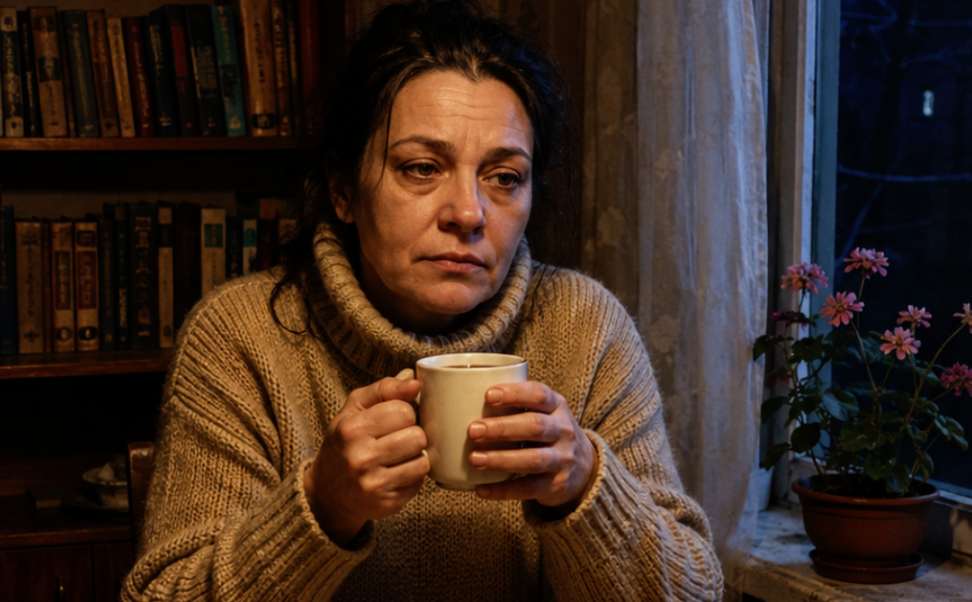
“Sign the apartment over to your sister — she’s pregnant, and you’ll survive,” my father ruled at the family council. I had clawed my way to that apartment with my teeth.
“Ol, you understand, don’t you? Katya is pregnant. She and her husband have nowhere to live. And you’re alone, you’re strong, you’ll manage. Sign the apartment over to her.”
My father said it calmly. As if he were asking me to pass the salt.
Everyone was sitting at the table: my mother, my father, my sister Katya, her husband Dima. And me. With a slice of Napoleon cake on my plate that I never managed to finish.
I put down my fork.
“Dad. Did I understand you correctly? You’re suggesting that I give my apartment to my sister?”
“Not ‘give.’ ‘Sign it over.’ That’s different.”
“Dad, that is exactly the same thing. It just sounds softer.”
Katya stroked her still completely invisible belly — she was eight weeks along, I knew that — and said in a thin little voice:
“Olechka, it’s not forever. Later, when we get back on our feet, we’ll pay you back. Some amount.”
“Some amount.” Let’s remember that too.
Mom stared at the table. Silent. That was her trademark — staying silent whenever Father made decisions for everyone.
“All right,” I said. “Then let me speak too. Since this is a family council.”
And I began to speak. Calmly. Quietly. Without shouting.
My name is Olga. I am thirty-five. My sister Katya is twenty-eight.
There are seven years between us and two completely different lives.
When I was eleven, Katya was born. And from that moment on, I stopped being a child. I became “the older sister” — which in our family meant “free babysitter, dishwasher, and donor of everything imaginable.”
Katya got everything. New clothes — I wore her dresses after her. Which, by the way, is a separate story, because she was younger, but from the age of eleven we wore the same size — she was always plump, and I was thin. Toys — I got whatever she broke. Parental attention — I got whatever was left after Katya. Meaning nothing.
At seventeen, I got into university. On a state-funded place. By myself. Without tutors — because tutors in our family were only for Katya. “Katya has poor health, she gets tired.” And I apparently didn’t get tired. I was made of iron.
After university, I got a job. At twenty-two, I left home and rented a room in a communal apartment near Dynamo. Cockroaches, an alcoholic plumber neighbor, a shared bathroom with a line every morning. But it was mine. Away from my father, who every evening seasoned dinner with the words, “Katya is such a clever girl, unlike you.”
At twenty-five, I took out a mortgage. A one-room apartment in Butovo. Forty-two square meters. The down payment was mine — I had saved it over three years. The payments were mine, always. I ate buckwheat with eggs for dinner five years in a row just to keep up with the mortgage. I didn’t go on vacation. I didn’t buy myself a new jacket — I kept wearing an old one with a patch on the elbow. I didn’t go to the dentist on time — I lost two teeth, and now I have implants there, which I also paid for myself, on credit.
Ten years of mortgage payments. Ten. Years.
I paid it off last September. At thirty-four. Two months ahead of schedule.
I called my mother that day. And I cried. I said:
“Mom, I paid off the mortgage. That’s it. The apartment is mine.”
My mother replied:
“Well done, daughter. And Katya is getting married. We’re having the wedding in the fall. Will you help with money?”
I helped. Two hundred thousand for the wedding. Mom chose Katya’s dress — one hundred and fifty thousand. With a train.
I never had a wedding. I didn’t have a husband. I still don’t. Forty-two square meters, a cat named Bonya, and a job in the IT department of a large bank. A good salary. A calm life. And finally, my own place.
I lived peacefully in my apartment for one year. One. Year.
And then came this “family council.”
“Dad,” I said, “let me remind you of one thing. When I took out the mortgage, what did you say? Do you remember?”
“I don’t remember,” Father snapped.
“But I remember. You said, ‘Olka, you’re a fool. Why do you need an apartment in Butovo? It’s the edge of the world. You’d be better off helping the family. We’re hiring tutors for Katya, preparing her for the exams.’ That is what you said. Word for word.”
Father was silent.
“And when, six months after taking out the mortgage, I asked to borrow thirty thousand for Grandma’s medicine, you said, ‘We don’t have it, Katya is in her final year of school, we have expenses.’ And I paid for our grandmother’s treatment myself. From the same salary I was using to pay the mortgage. Do you remember?”
“Ol, why are you bringing up old things now…”
“I’m bringing them up because now you’re asking me for my apartment. And it matters to me that you remember how you spoke to me while this apartment was still a dream, not an asset.”
Katya fidgeted.
“Ol, why are you saying all this… It’s not my fault I was born the younger one…”
“Katya, it is not your fault that you were born the younger one. That’s true. But it is your fault that at twenty-eight, you still haven’t learned how to work.”
“I have a higher education!”
“You have a design diploma that our parents paid for, and you haven’t worked a single day in that field. You spent three years sitting on Mom’s neck while you were ‘searching for yourself.’ Then you worked half-time in a showroom for six months. Then you got bored. Then you met Dima. Now you’re pregnant, which is wonderful, but it does not instantly turn you into a person to whom I owe forty-two square meters in Butovo.”
Dima, my sister’s husband, puffed himself up.
“Olga, you’d better watch your mouth.”
“Dima, you’d better keep quiet altogether. You’ve been with my sister for a year and a half. You work as a courier. You rent a one-room apartment with Mom’s money. You are not the one to lecture me about my property.”
“And why do you decide it’s yours? Did you buy it all by yourself or what?”
I laughed. Not cruelly. Tiredly.
“Dima, are you serious right now? Yes, by myself. One hundred percent by myself. Do you want me to show you the property registry extract? Do you want bank statements for ten years of payments? All from my account. Every single kopeck.”
Father stood up.
“Olga. I’m trying to speak to you nicely. Katya is your only sister. She is having a hard time now. She is pregnant, and she and Dima have no housing. You have housing. Share.”
“Share, Dad, means sharing a pie. Sharing money. Even sharing a room, if I wanted to let them stay for a month or two. But ‘signing over an apartment’ is not sharing. It is giving it away. Forever. It means that at thirty-five, I start over from scratch. I go back to a communal apartment. With cockroaches and an alcoholic plumber. And that is what you are suggesting? Seriously?”
“You’re strong. You’ll manage. You have a good salary.”
“Dad.” I leaned forward. “And Katya? Will Katya not manage? She has a husband. He has arms, legs, a head. Let him work. Let him save. Let him take out a mortgage. Why am I supposed to hand over square meters for them?”
“They’re going to have a child.”
“I might have a child someday too. Where am I supposed to bring that child? To a rented room? ‘Sorry, baby, Mom gave her apartment to Aunt Katya because she got pregnant first’?”
Mom raised her eyes.
“Olechka, but you’re alone. You have no husband, no children…”
And that was when — yes, that was when I exploded. Quietly. I don’t know how to scream. But inside, I exploded.
“Mom.” My voice trembled. “You just said that because I don’t have a husband or children, I must give away what is mine. So is my life worth less? Because I’m alone? Mom, for twenty years you told Katya that the main thing was to get married and have a baby, while you told me that the main thing was to ‘help the family.’ And here is the result. She is twenty-eight, expecting a child, and has nothing. I am thirty-five, I have everything on my own, but I’m supposed to give it away. Because I’ll ‘manage.’ Mom, that is some kind of wild logic. Do you even hear yourself?”
Mom started crying.
“Olechka, I just…”
“Not ‘Olechka.’ Not now. Right now, the answer is no.”
Father slammed his fist on the table. Mom’s mug jumped.
“Olga! I am your father! I raised you!”
“Dad.” I looked at him calmly. “You raised me until I was seventeen. After that, I raised myself. And I bought the apartment myself. And I rented the communal room myself. And I got my implants myself. And I treated Grandma myself. If now, at sixty-two, you want to start commanding my property — it’s too late, Dad. You lost that right. Somewhere around 2010.”
“Then you are nobody to us!” he shouted. “If you don’t want to help your sister, you are no daughter of ours!”
The room went quiet.
I stood up. Took my bag. Took my jacket from the hanger. Walked to the door.
“Dad. I haven’t been your daughter for twenty years already — not in the sense you understand it. To you, I was always ‘not Katya.’ So you haven’t said anything new. Goodbye.”
And I left.
I left my parents’ house. And went to my apartment. In Butovo. Forty-two square meters. Mine.
I didn’t cry in the elevator. I cried later on the metro. Quietly, turned toward the window. Across from me sat a man with a dog, and the dog looked at me with sympathy. Better than any mother, honestly.
At home, Bonya greeted me. A ginger cat with one torn ear — I had picked her up from the street three years earlier, in the rain, under a bridge. She jumped onto my knees and purred as if she wanted to say, “It’s okay. We’re home. This is ours.”
I hugged her and sat on the hallway floor for a long time. In my jacket. In my boots.
Then I got up. Went to the kitchen. Put the kettle on.
And I realized: I was not guilty. Not at all. I owed no one anything. I had clawed my way to that apartment with my teeth. I hadn’t received it, won it, or inherited it. I had earned it. Every square meter.
Which meant it was mine. And there would be no “signing it over.”
For a month, nobody bothered me. Then the calls began.
Mom cried into the phone: “Olechka, your father didn’t mean it, come over, let’s make peace.” I answered calmly: “Mom, I’m not angry. But I won’t come home. And I won’t sign over the apartment. Those are two separate decisions, and both are final.”
My aunt — my mother’s sister, the family’s main gossip — said, “Olga, you have no conscience. Katya is going to have a baby!” I replied, “Aunt Larisa, I have a cat. Also a living creature. By the way, she also wants to live in her own apartment, not on the street.”
I hung up. Bonya meowed approvingly.
Katya called me herself two months later. Not to apologize. To say:
“Olka, you’re selfish. Because of you, I live in a rental. I will never forgive you for this.”
I thought for a second and answered:
“Katya, agreed. Don’t forgive me. Just don’t pick up the phone when I call. And I won’t be calling. So everything works out perfectly.”
And I hung up.
A year and a half passed.
Katya gave birth. A girl. They named her Alisa. I found out through social media — no one told me. I sent Mom five thousand with the note “For Alisa’s gift from Auntie.” Not out of resentment, not to show off. Simply because the child was not to blame for anything. Mom accepted the transfer. She did not write thank you.
Dima, as I heard from the same Aunt Larisa — she calls on major holidays, manages to get through — left Katya eight months after the birth. He couldn’t handle “the pressure.” Now Katya lives with our parents. With Alisa. On Father’s pension and Mom’s side jobs. They no longer have money to rent.
Would the forty-two square meters in Butovo that I refused to give away have solved that situation? Possibly. But not for long. Because a person who has not learned to support herself at twenty-eight will not learn at thirty-eight either. Even if you sign three apartments over to her.
My father and I still do not speak. With my mother, we talk once every two or three months by phone. Dry. About the weather, about health. Without warmth.
I am not suffering. I thought I would be — but no. It turns out you can live without a family that sees you as “an ATM with a heart.” You can. You just have to decide once to say no. And not spend the rest of your life making up for it.
Last Sunday I went to an exhibition at the Tretyakov Gallery. Alone. I walked around, looked at paintings, drank coffee in the café on the second floor. Nearby sat a couple — a man and a woman about my age, also with coffee. He was telling her something, and she was laughing. I thought: maybe someday I’ll have that too. Or maybe I won’t. That is not the most important thing.
The most important thing is that I return to my own home. My own. Where Bonya is waiting for me, along with a clean kitchen and a round lamp with warm light above the table.
And “one’s own” is not four walls and not forty-two square meters. “One’s own” is the right to say no when someone wants to tear a piece out of you.
P.S. Aunt Larisa called before New Year’s. She said Katya “understood everything,” “had changed,” and “wanted to make peace.” “And by the way, she’s struggling with money. Maybe you could help her, at least five thousand?”
I answered: “Aunt Larisa, I’m struggling too. My ginger Bonya demands premium-class food, and I’m barely managing.”
She didn’t understand the sarcasm. She got offended. She hung up.
And I poured myself some tea. And for the first time in thirty-five years, I felt that I owed absolutely nothing to anyone.