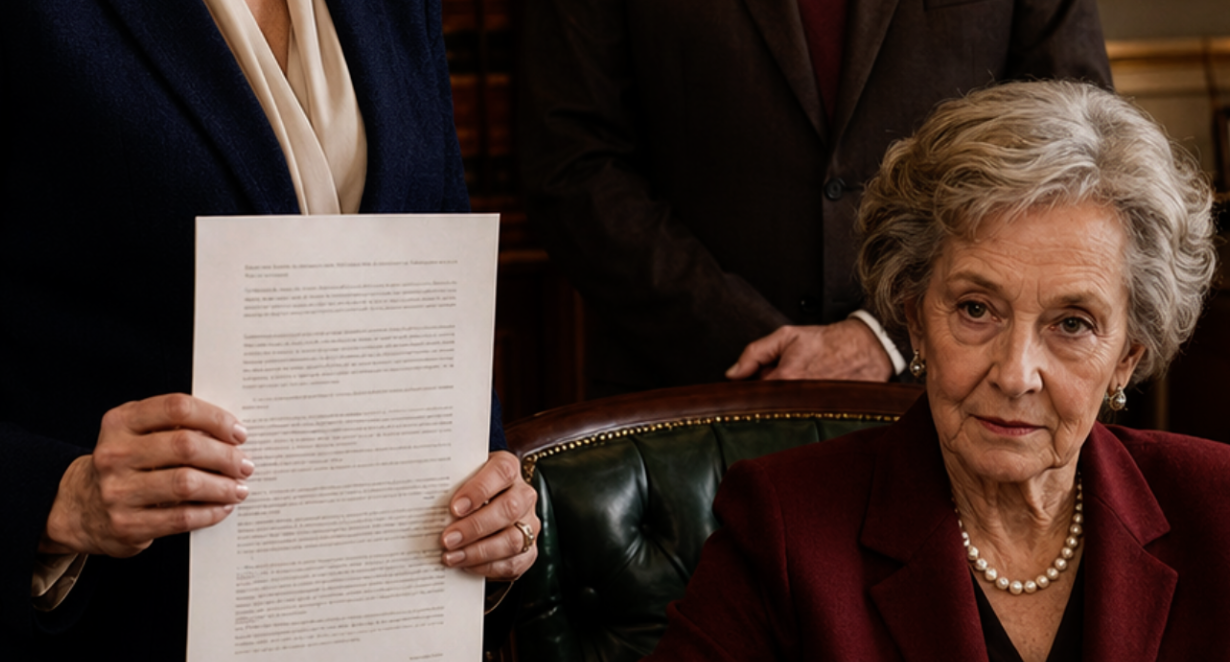
“I Have My Own Apartment, the One My Grandmother Left Me!” the Daughter-in-Law Said to the Mother-in-Law Who Demanded the Inheritance
The notary cleared his throat and adjusted his glasses, preparing to read the document aloud, while Larisa Petrovna was already smiling that triumphant smile that always made Marina’s head begin to ache.
Three years. Three long years Marina had endured this woman, who had somehow managed to turn their family life into a branch of her own personal empire. Today, everything was supposed to be settled. Marina’s grandmother had left her an apartment in the city center — a spacious three-room apartment with high ceilings and a view of the park. The documents were ready; all that remained was to officially accept the inheritance.
But her mother-in-law came with them. Of course she did.
She sat in the notary’s office chair like a queen on a throne, holding her son Pavel by the arm. Pavel looked as if he had been brought there by force. Marina sat on the other side of the table, clutching the folder of documents in her hands. Her fingers trembled slightly, but not from fear. From anticipation.
“Now then,” the notary began, unfolding the will, “citizen Elizaveta Andreevna Somova bequeaths her apartment at 14 Sadovaya Street, apartment 42, to her granddaughter, Marina Alexandrovna…”
“Excuse me,” Larisa Petrovna interrupted in her honeyed voice, the one that always sent chills down Marina’s spine. “But Marina is married now. She is part of our family now. And in a family, everything should be shared, shouldn’t it?”
The notary raised his eyebrows but continued reading. Marina felt the familiar mixture of anger and despair boiling inside her. She knew where this was going. Her mother-in-law never said anything without a reason.
After all the papers were signed, they went outside. The February sun dazzled their eyes as it reflected off the snow. Larisa Petrovna immediately took Marina by the arm, pretending to be a caring mother.
“Marinochka, dear,” she chirped, “what luck! Now we have a wonderful apartment to rent out. Can you imagine what kind of income it will bring? Pasha was just thinking about buying a new car.”
Marina stopped so abruptly that her mother-in-law nearly stumbled.
“This is my apartment. My grandmother left it to me.”
“Of course, of course,” Larisa Petrovna nodded, though her eyes remained cold. “But you understand that Pasha is the head of the family. He should manage the family property. That’s the proper way.”
Marina looked at her husband. Pavel stood with his face buried in his phone, pretending not to hear the conversation. His typical position — an ostrich hiding its head in the sand at the first sign of conflict.
“Pasha,” she called. “What do you think?”
He looked up, and Marina saw the familiar panic in his eyes. The panic of a man forced to choose between his mother and his wife. As always, the choice was predictable.
“Mom is right,” he mumbled. “Everything in a family is shared.”
Something broke inside Marina’s chest. Not because of his words — she had expected them. But because of how easily he said them. Without a shadow of doubt, without even trying to defend her right to her inheritance. A mama’s boy to the bone.
“Well, wonderful!” Larisa Petrovna rejoiced. “Tomorrow we’ll find good tenants. I know an agency…”
“No.”
The word escaped Marina quietly, but firmly. Her mother-in-law stopped mid-sentence.
“What do you mean, ‘no’?” Steel appeared in her voice.
“The apartment will not be rented out. I’m going to live in it.”
Larisa Petrovna laughed. But her laughter sounded like breaking glass.
“Live there? Alone? You want to abandon your husband?”
“I want to live in normal conditions. Not in the walk-through room of your apartment, where you come into our bedroom without knocking at seven in the morning to straighten the curtains.”
Her mother-in-law’s face turned crimson. She was not used to resistance. In three years, Marina had never opposed her so openly.
“Pasha!” she barked. “Do you hear what your wife is saying?”
Pavel shrank back, but he looked at Marina reproachfully.
“Marina, don’t talk to Mom like that. She cares about us.”
“Cares?” Marina felt the last string of patience snap inside her. “She controls our every step! She checks our purchases, reads our messages, decides what we eat for dinner! That isn’t care — it’s tyranny!”
“How dare you!” Larisa Petrovna shrieked. “I gave my whole life to my son! I raised him alone, without a husband! And I won’t allow some upstart…”
“Upstart?” Marina stepped toward her, and her mother-in-law involuntarily stepped back. “I have endured your humiliations for three years. For three years I’ve listened to you tell me what a bad housewife I am, what a bad wife I am, how wonderful Pasha’s ex-girlfriend was. For three years you have tried to turn me into your servant. Enough!”
She turned to Pavel. He stood pale and confused, not knowing whose side to take. His mother was pulling him by one sleeve, his wife was looking at him from the other side. And he, as always, chose the path of least resistance.
“Marina, apologize to Mom. You’re wrong.”
Those five words were the final straw. Marina nodded — but not to him. To herself. The decision had been made.
“Fine. I apologize,” she said calmly. Too calmly. “I apologize for wasting three years of my life trying to build a family with a man who never managed to become a man.”
She turned and walked away. Behind her, her mother-in-law’s indignant screech rang out, Pavel shouted something, but Marina did not turn around. She walked toward the metro, and in her head there was an unexpectedly clear plan.
That evening, she came to their — no, not their anymore, but her mother-in-law’s — apartment with a suitcase. Pavel was sitting in the kitchen, surrounded by plates of food that his mother had carefully served for him. Larisa Petrovna sat opposite him, stroking his hand.
“…she’ll come to her senses, son. Where else can she go? She’ll be lost without you.”
Marina walked past them into the bedroom without saying a word. She methodically packed her things into the suitcase until her mother-in-law’s sugary voice sounded behind her:
“Marinochka, stop acting foolish. Come have dinner. I made your favorite stuffed cabbage rolls.”
“My favorite stuffed cabbage rolls were made by my grandmother. I ate yours out of politeness.”
She snapped the suitcase shut and turned to them. Pavel looked at her with the offended expression of a child whose toy was being taken away.
“Are you really leaving?”
“Yes.”
“But… where will you go?” Larisa Petrovna’s voice carried poorly concealed gloating. “You don’t have money for a rented apartment.”
“I have my own apartment. Remember? The very one you wanted to rent out this morning.”
Her mother-in-law pressed her lips together.
“It needs repairs! There’s no furniture!”
“A mattress on the floor is better than a golden cage under your supervision.”
She took the suitcase and headed toward the exit. At the door, Pavel caught up with her.
“Marina, wait. Let’s talk. Without Mom.”
She looked at him, and pity pricked her chest. He was not a bad person. He was simply… nothing. An empty space between two women, a prize in their war.
“What is there to talk about, Pasha? About the fact that not once in three years did you take my side? About the fact that your mother checks our bank accounts? About the fact that she forbade us from having children until we saved a million?”
“She’s just worried…”
“No. She simply doesn’t want to share you with anyone. And you indulge her.”
Larisa Petrovna appeared behind Pavel. Her face was twisted with anger.
“Go!” she hissed. “And don’t even think about coming back! We’ll live perfectly well without you!”
Marina smirked.
“I know. You always lived perfectly well as a pair. I was the unnecessary third.”
She stepped out onto the landing and heard the door slam behind her. Then came muffled voices. Her mother-in-law was explaining something to her son, and he was obediently agreeing as usual.
Her grandmother’s apartment greeted her with silence and the smell of old things. Marina walked through the rooms, opening the windows and letting in fresh air. Yes, it really did need repairs. The wallpaper was peeling, the parquet floor creaked, and the kitchen tap was dripping. But it was her apartment. Her space. Her freedom.
She took out her phone and saw twenty missed calls from Pavel. And not a single message. He could not even write to her without his mother’s permission.
The first night on the floor, on an old mattress, was unexpectedly peaceful. No one burst in that morning with complaints. No one discussed her shortcomings behind the wall. No one told her how to brew tea properly.
The next day, she took a day off and got to work on the apartment. She called a plumber to fix the tap and arranged with a crew to do cosmetic repairs. She had money — she had been secretly saving it from her salary, away from her mother-in-law. Saving for an escape, without even realizing it.
By evening, Pavel came. Alone, which was surprising. He stood in the doorway looking guilty, holding a bouquet of chrysanthemums — flowers she disliked, but the only ones his mother approved of.
“May I come in?”
Marina stepped aside and let him enter. He looked around, wrinkling his nose.
“It’s so… unsettled here.”
“But it’s mine.”
They sat in the kitchen, where the only furniture was two old chairs and a wobbly table. Pavel turned his phone over in his hands, clearly waiting for a call.
“Mom said she’s ready to forgive you,” he finally forced out. “If you apologize and admit that the apartment is family property.”
Marina laughed. Sincerely, from the heart.
“Your mother is generous. She’s ready to forgive me for not giving her my inheritance.”
“Marina, why are you acting like a child? Everything in a family is shared!”
“In a normal family, yes. But we don’t have a family, Pasha. We have a branch of your mother’s house. Where she decides everything — from the color of our socks to the time we go to bed.”
“She cares…”
“She controls! Don’t you see the difference?”
At that moment, Pavel’s phone rang. Of course, it was his mother. He answered automatically, like Pavlov’s dog responding to a bell.
“Yes, Mom. I’m at her place. No, she doesn’t agree. Yes, I talked to her… Fine, I’ll come now.”
He stood up without looking at Marina.
“Mom is waiting with dinner.”
“Of course she is. She will always wait for you with dinner. And breakfast. And advice on how to live. Go, Pasha. Your leash has tightened.”
He was offended, but said nothing. He simply left, leaving the chrysanthemums on the table. Marina threw them in the trash.
A week passed. The renovation was in full swing. Marina bought furniture, chose curtains, and arranged her own little nest. Everyone at work noticed the changes — she began to smile, joke, and even looked younger.
Then Larisa Petrovna came. Without warning, as always.
Marina opened the door and saw her mother-in-law in her best coat, holding a folder of documents.
“We need to talk,” she announced, entering the apartment without an invitation.
She looked around, clicking her tongue judgmentally.
“Tasteless. I would have chosen different wallpaper.”
“Good thing you weren’t the one choosing.”
Larisa Petrovna sat down on the new sofa without waiting to be invited.
“Marina, stop being stubborn. Pasha is suffering. He has lost weight and eats poorly.”
“Maybe he should learn to cook for himself?”
“Don’t be smart!” her mother-in-law snapped, then immediately pulled herself together. “I came with a business proposal. Here are the divorce papers. You’ll sign them, arrange everything quickly and quietly. In return, I won’t demand division of property.”
Marina laughed.
“What property division? The apartment was left to me by will before the divorce and belongs to me personally.”
“But Pasha invested his efforts into it!”
“What efforts? He had never even been here until yesterday!”
Larisa Petrovna pursed her lips.
“Moral efforts. Worrying. That is also a contribution.”
“Are you serious?”
“Absolutely. A lawyer I know said we have a chance of suing for half.”
Marina stood up and went to the window. Children were playing in the courtyard, their mothers sitting on benches. Normal families. Normal relationships.
“You know what, Larisa Petrovna? Go to court. Spend money on lawyers. Prove Pasha’s moral contribution. Meanwhile, I’ll live here and enjoy every day without you.”
Her mother-in-law jumped up, her face turning dark red.
“You’ll regret this! You’ll come crawling back on your knees! Without us, you are nobody!”
“Without you, I am a free person. And that, you know, is worth a great deal.”
She opened the door, making it very clear that the audience was over. Larisa Petrovna stormed out of the apartment, her heels clacking loudly.
“Pasha will never forgive you!”
“Pasha will do whatever his mother tells him. As always.”
The door slammed shut.
A month passed. Marina had fully settled into her apartment. Work was going well, and she made new friends — the very people her mother-in-law had once forbidden her to communicate with. Life began to sparkle with new colors.
Pavel came twice more. The first time, begging her to return. The second time, with threats from his mother’s lawyer. Both times, he left with nothing.
Then Marina ran into him by chance. At a shopping mall, in the home appliance department. He was choosing a kettle, and beside him stood Larisa Petrovna, explaining to the sales assistant exactly what kind of kettle her son needed.
“It must have an automatic shut-off! He’s absent-minded, he might forget to turn it off!”
Pavel stood there with his usual obedient-lamb expression, while the sales assistant — a young woman of about twenty — looked at him with poorly hidden mockery.
Marina walked past, but Larisa Petrovna noticed her.
“Oh, look, Pasha! Your ex! Alone, just as expected!
”
Marina stopped, turned around, and smiled.
“Not alone. Free. Those are different things.”
“Free from what? From family? From love?”
“From the need to ask my mother-in-law for permission to buy a kettle.”
The sales assistant snorted, trying to hide her laughter. Pavel blushed. Larisa Petrovna straightened like a tightened string.
“Pasha doesn’t need permission! I’m simply helping him choose!”
“Of course. Just as you helped him choose a wife. And a job. And friends. And, in general, his entire life.”
She looked at Pavel. He seemed even more tired and faded than he had a month earlier.
“You know, Pasha, I used to think you betrayed me. But now I understand — you betrayed yourself. You could have become a man, a husband, a father. Instead, you became an eternal little boy beside his mother. And that is your choice.”
She turned and walked away without looking back. Behind her, her mother-in-law’s indignant voice rang out:
“You see how ungrateful she is! Good thing we got rid of her!”
“Yes, Mom,” Pavel answered automatically.
And Marina walked through the shopping center smiling. Because ahead of her waited her apartment. Her life. Her freedom.
Without her mother-in-law.
And it was wonderful.
Six months later, she received the divorce papers. Pavel did not try to sue for the apartment — either his conscience had awakened, or a lawyer had explained that the idea was hopeless.
And a year after that, she met Andrei. A grown, independent man who chose his own kettles and did not call his mother ten times a day. He had a mother too, but she lived in another city and sent jam once a year, without interfering in her son’s life.
When Andrei proposed, the first thing Marina asked was:
“Your mother won’t live with us, will she?”
He laughed.
“Are you kidding? She values her independence more than anything in the world. She says she raised me not so she could spend the rest of her life running after me.”
Marina exhaled. It seemed life was giving her a second chance. A chance at a real family. Without a tyrannical mother-in-law and a henpecked husband.
The wedding was modest. Andrei’s mother came for a couple of days, gave them a dinner set, and went back home, saying:
“Live your own life, children. And I’ll live mine.”
The perfect mother-in-law, Marina thought.
And somewhere on the other side of the city, Larisa Petrovna was making dinner for her son, telling him about a new neighbor — a pleasant girl who, unlike some people, knew how to appreciate family values.
Pavel nodded while chewing cutlets. He was forty-two years old, and he still lived with his mother.
And both of them were satisfied with that.