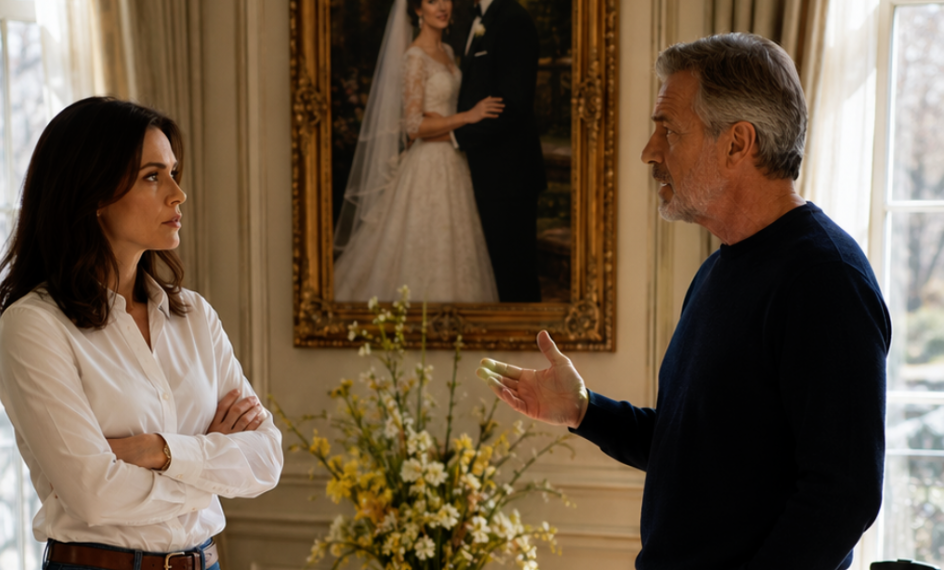
“You’ve got that sour face again. Maybe you should see a gastroenterologist?” Maria smirked without even turning around. She was chopping onions for a salad, but her hand trembled, and the knife struck the wooden board with a dull thud.
“Did you even hear what I said?” Alexey stepped closer and placed his palms on the table. They looked just as limp as his attempts to appear decisive.
“What is it this time?” Maria wiped her hands on a towel and turned around. “Don’t tell me your mommy needs another ‘small amount.’”
“Well, yes. Small. Fifteen thousand. She…”
“Does she not have enough for her nails? Or does she urgently need to go to Sochi to ‘recover from stress’?” Maria folded her arms across her chest. There was no malice in her voice. Only exhaustion. The kind that clings to the body like the smell of old oil on a kitchen curtain.
“She has a loan! She… she can’t pay it!” Alexey flared up like a candle in the wind.
“She took it out. Let her pay it herself. I am not her ATM, and you are not her nanny. And if you’re comfortable being stuck between two women, congratulations, you’ve got a new job: between the hammer and the rolling pin.”
“You don’t understand. She’s my mother. She…”
“And what am I? Just a convenient ATM with a good credit history?” Maria stepped closer. “I’ve been working two jobs since January, remember? I’m saving for a car. For my dream. Not so your mother can wander around shopping malls with a new handbag.”
Alexey sat down at the table and pressed his palms to his face.
“You’re cruel, Masha. She’s sixty.”
“Mm-hmm. And she behaves like a sixteen-year-old whose daddy will buy her everything. And by the way, ‘she’s sixty’ is not a reason to order sushi every evening and then cry that ‘the interest is piling up again.’”
“Well, she’s had a hard life…”
“Alexey, you are a grown backside with a passport. You are married. You live in an apartment you haven’t invested a single kopeck into. And you’re sitting in the kitchen telling me your mother is a ‘poor thing,’ so what does that make me? A witch with a cash register?”
He stood up sharply.
“There we go again. Again. Maybe you should look at yourself. Everything with you is ‘must’ and ‘schedule.’ Even sex is on Tuesdays.”
“Mm-hmm, and even then only if your mother doesn’t call with an ‘important question.’ Last time she sent you a link to a vacuum cleaner.”
“Because her old one broke!” he shouted.
Maria suddenly laughed. Not from joy, but from helplessness.
“Tell me honestly. Did you marry me, or her?”
He said nothing.
Silence had long ago become the universal answer in their family.
Maria turned back to the stove. The kettle had been boiling for a while. Steam swirled under the ceiling, like all their arguments — unbearably hot and so thick it was hard to breathe.
“I won’t give her money, Lyosha. Not fifteen thousand, not five. Zero. Everything I’m saving is for a car. I’m tired of riding the minibus after a night shift and listening to someone cough into my ear.”
“That’s selfishness.” Alexey’s voice had grown quieter.
“No. That’s maturity. Selfishness is when a grown woman takes out loans for cosmetics, knowing her son will ask his wife to pay off the debts.”
He stood in the middle of the kitchen like a man who had lost something very important. Only the loss was not an object. The loss was in his face. In his eyes.
“And what if I give her the money anyway?” His voice was quiet. It was as if he were asking, “Would you leave me then?”
“Then you’ll pack your things and go to her. You don’t even have to call. Just leave.”
He did not answer. He only pressed his lips together as if he wanted to say something, but changed his mind. Or realized it would only make things worse.
That evening, he slept on the sofa in the living room. She slept in the bedroom. Between them there was not a door. Between them there was an abyss. Made of resentment, debts, and women’s dreams that had never been given a chance.
For the first time in six years of marriage, she did not set an alarm for the night. Let tomorrow begin without a plan, at least once.
Alexey lay quietly on the sofa, staring at the ceiling. His phone blinked on the nightstand. A message from “Mommy”:
“How’s Mashka? Has she died from spite yet?”
He did not answer. But his fingers twitched.
Because for the first time in six years, he understood what the real debt was.
And whom he owed it to.
Saturday began with Alexey trying to cook porridge.
In the end, he cooked something Maria would have called “a sticky mass for plastering walls.” She did not come out of the bedroom. She simply lay there, looking at the ceiling, as if waiting for a hint to appear on it: “how to live with a man who fears his own mother more than the tax office.”
Alexey lingered by the door like a guilty schoolboy.
“Maria…” he called uncertainly, opening the door slightly. “I made… breakfast. Do you want some?”
“If you poured your arguments into it, then no,” she answered calmly, without turning around.
He sighed and sat on the edge of the bed. Morning crept into the room, so gray it seemed as though the sky had gone into debt again.
“Listen. You do understand… Mom is in trouble. Things are really bad for her.”
“Things are ‘really bad’ for her every time I get a dream,” Maria turned and sat up on the bed, resting her elbows on her knees. “Have you noticed? The moment I start planning something, Elena Petrovna suddenly has a tooth problem, or a bank problem, or depression, and all of it happens with such timing that I’m starting to think she receives my bank messages.”
“You’re exaggerating,” Alexey grimaced.
“Exaggerating?” Maria stood up, adjusting her T-shirt. “Let’s remember, then. Two years ago, I was saving for courses — she got sick. Six months ago, I wanted to register as self-employed — her refrigerator burned out. And now I want to buy a car, and what happens? Once again, she’s the poor, unfortunate victim of capitalism. With a debt that, for some reason, her son is supposed to pay. Which means me.”
“It’s not that simple,” he muttered. “She really has no one except us.”
“She has no one because she burned everyone in her emotional crematorium,” Maria walked over to the window. “Her friends ran away because it’s impossible to listen to stories about her golden son without sedatives. Her relatives disappeared because, God forgive me, she used to drag even other people’s raspberry bushes from the dacha — ‘for cuttings.’ And you still believe she is poor and unfortunate.”
“You just don’t understand!” Alexey burst out. “She raised me alone! Alone, do you understand? Without help! Without a man! She worked herself to the bone!”
“And now she thinks she is entitled to lifelong compensation,” Maria came closer, and her voice hardened. “And who am I? An extra account in her bank?”
“You’re wrong,” he exhaled.
“No, Lyosha. You’re wrong. You’re not a husband. You’re a courier. You deliver money and excuses. I don’t want to live like this. I should not have to live as the second woman in the house. The woman in your life should be one. But you have two. Only one is in the bedroom, and the other is on the phone.”
“Are you giving me an ultimatum?”
“I’m putting a period at the end of this, Lyosha. I’m not against helping. But when your mother acts as though her problems are more important than ours, and you participate in that, I am not a wife. I am an extra.”
Alexey sat there, staring at the floor. He was not angry. He was… weak. That was how he had grown up. His mother had decided everything for him. Then Maria did. He simply drifted. And now he was sinking.
“I… I’ll talk to her,” he finally forced out.
“It’s too late,” Maria spread her hands. “I already said I won’t give a single kopeck. And you know, if after all this you send her money, everything will become clear to me.”
He nodded. Heavily. As if someone had hung a sack of sins around his neck. Then he stood up and went into the hallway. Put on his shoes.
“I’ll go to her. Talk. Maybe… somehow explain.”
Maria did not answer. She only watched him zip up his jacket. Slowly, clumsily. Like a man who had understood for the first time that he would no longer be able to sit on two chairs.
Alexey arrived at his mother’s place closer to noon. A Khrushchev-era apartment block. Second floor. The smell of cats and boiled onions reached him while he was still on the stairwell.
“Oh, so you finally showed up,” Elena Petrovna greeted him in a colorful housecoat, curlers on her head, lipstick on her lips. Red. Like her certainty that she was right.
“Mom, we need to talk,” he began immediately, without taking off his coat.
“What, did Mashka scream at you again… oh, sorry, ‘Maria’? Well, of course. So refined. For your information, I never spoke rudely to her. She’s the one humiliating you.”
“Mom. Enough. I can’t keep begging my wife for money because you’re always in debt.”
“And who is this wife of yours? Is she your savior? I couldn’t care less. She’d even take your socks from you if she could!”
“Mom. I’m serious.”
“And I’m not? I gave you my life, for your information! And now you crawl before that… that whining snake?!”
He looked at her as if she were a stranger. She cursed, shouted, threatened — as always. But now he heard only an echo in her voice. Empty, irritated, powerless.
“I won’t give you money.” He said it quietly, but firmly. “And I won’t ask Masha either.”
His mother fell silent.
For a moment.
Then she slapped him across the face. Not hard. But not playfully either.
“You’re pathetic. Henpecked,” she hissed.
Alexey silently turned around.
And for the first time in his life, he did not look back.
He came home after dark. Maria was sitting at the table with a cup of tea.
He took off his jacket and came closer.
“I didn’t give her money,” he said simply.
“And she kicked you out?” Maria asked without emotion.
“Yes.”
“Well then,” she stood up. “Welcome to adult life.”
He looked at her as if for the first time.
As if all this time she had been standing at the far end of the room, in the shadows. And now she had stepped into the light.
“I want to change everything,” he said.
“Then start with yourself, Lyosha. Not with your mother’s debts.”
And she went to the bedroom.
He remained in the kitchen.
Alone with the silence.
This time, it was not cruel.
Just honest.
Sunday. Maria woke up early. The house smelled of coffee and fresh bread — Lyosha was trying. Trying quietly, carefully, as though afraid to scare away the fragile truce they had signed yesterday without words.
He placed a cup in front of her.
“With sugar. The way you like it.”
She looked at him. He seemed somehow unfamiliar. Not the one with whom she had shared household chores, shopping, and endless conversations about the exchange rate. This man now stood before her with the eyes of someone who had stepped out of his mother’s shadow for the first time.
“I’ll go see Igor today,” he said. “I want to ask if he can help with Mom’s loan. At least with advice. I won’t give her money. But I need to understand how she can get out of this.”
“Why?” Maria set the cup down. “She is an adult. She made the mess — let her clean it up. That is adult life.”
“Well, I can’t abandon her completely…”
“I can.” She stood up. “Because I am not thirteen, and I don’t have to earn anyone’s approval, especially a woman’s. Not your mother’s, not the downstairs neighbor’s, not even yours.”
He said nothing.
Maria stepped closer.
“I am so tired of being third in your life. You are your mother’s. You always were your mother’s. Even on our honeymoon you called her three times a day.”
“I understand…” he whispered.
“No, Lyosha. You don’t understand. You’re afraid. More than you love. And I will no longer stay beside a man who is afraid.”
He sat down, resting his hands on his knees. His shoulders sagged.
“I don’t want to lose you.”
“And I don’t want to lose myself.” Maria took her jacket from the hanger. “I’m moving out.”
“Where?”
“To my own place.”
He did not ask unnecessary questions. And that was a first. No resentment, no accusations. He simply nodded. He understood.
A week later, Maria rented a one-room apartment near the metro. It had no renovation, but it had windows facing the courtyard and freedom. During the first few days, she drank tea from a disposable cup and slept on a mattress. But she felt better than she had in the last two years.
Lyosha wrote to her. Calmly. Without hysterics.
“I’m working with a psychologist. I want to understand myself. I don’t know what will happen. But I want to be better.”
She did not answer right away. She thought.
Elena Petrovna wrote too. A whole essay about how Mashka had destroyed her son, stripped him of his masculinity, and how this whole generation was selfish anyway. At the end there was a postscript:
“Live however you want. But don’t think I’ll forget.”
Maria smiled.
And did not answer.
Because she owed nothing.
Two months later, she went to a store to buy light bulbs. At the entrance stood Alexey. Flowers in his hands. Not roses. Simple wildflowers wrapped in paper.
“Hi,” he said. “I just… wanted to say thank you.”
“For what?” she asked, surprised.
“For choosing yourself. Because if you hadn’t, I would have stayed a mama’s boy forever. And now…”
He fell silent.
“And now who are you?” she asked, squinting in the sun.
“Now I’m learning to be a man. Without my mother. Without rescuers. Just… on my own.”
“Well then, good luck to you, Lyosha.” She nodded toward the flowers. “Only don’t give them to me. Give them to yourself. For courage.”
And she walked on. Light bulbs, receipt, bag.
And inside — light.
Without his mother’s debts, without someone else’s hysterics.
Only her.
The very woman who once could not get enough air.
Now — she breathes.