I found a sick night cleaner mopping the floors in my own company and tried to help him before I knew who he was. Then he saw a photo of my mother on my desk, and one question dragged thirty years of silence into the room.
I never thought that the man mopping my company’s marble floor was the same man who left my mother pregnant on graduation night.
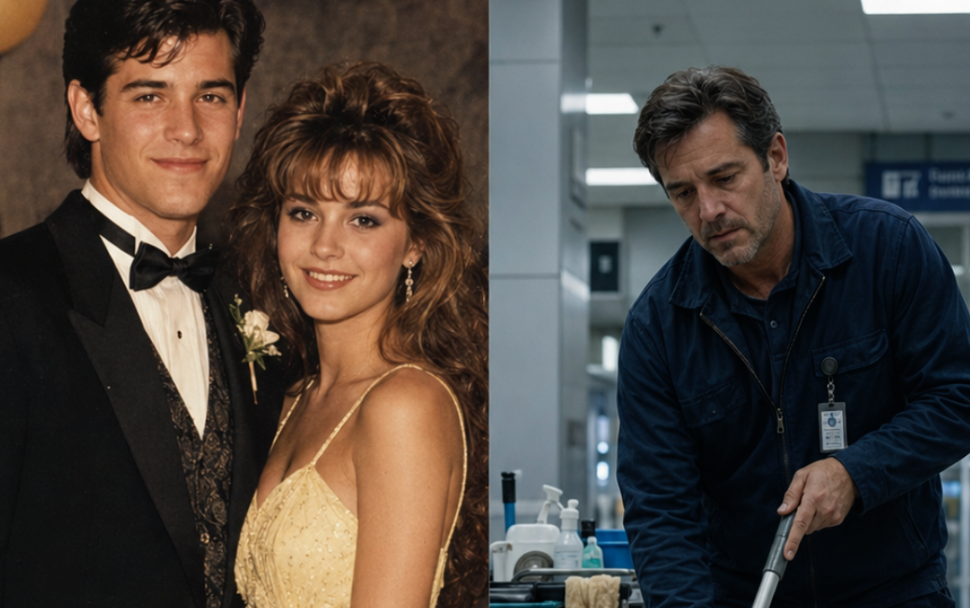
I didn’t recognize him because the old photo my mother kept in her Bible showed Raymond young and smiling, one hand on her waist, his lips pressed against her cheek while she wore a blue graduation gown.
Now, the man in front of me had taped-up boots, shaking hands, and a cough that sounded like it belonged in a hospital room.
He looked up from beside the executive elevators and flinched when he saw me.
“Sorry, sir,” he said, grabbing the mop handle. “I’ll have this clean before the morning crew comes in.”
He didn’t know me. There was not even a flicker of recognition.
“What are you doing up here at this hour?” I asked.
“Scuff marks, sir. They only let us clean this floor after everyone important leaves.”
I looked at his split shoes. “You’re sick, aren’t you?”
“I’ll have this clean before the morning crew comes in.”
He gave a dry little laugh. “I’m working.”
“That wasn’t what I asked.”
“No, sir,” he said, wiping sweat from his forehead with his sleeve. “But it’s the only answer I can afford.”
I stepped closer. “Do you need a doctor?”
“Doctors are for people with insurance, sir.”
My jaw tightened. “Your job doesn’t provide it?”
“I’m contract night staff, sir. We get hours, but not benefits.”
Then he tried to stand too fast. His knee buckled, and the bucket tipped.
Dirty water ran across the marble and soaked the edge of my shoes.
The cleaner dropped the mop and shrank back like I’d raised my hand instead of my voice.
“Please,” he said. “I’ll pay for the cleaning. Just don’t tell my supervisor. Sir, please.”
I looked down at the water, then at him.
“Just don’t tell my supervisor.”
But he was shaking so hard that the mop handle tapped against the floor.
“I said leave it,” I told him.
He bent for the mop again, coughing into his sleeve before his fingers reached the handle.
He hesitated. “Just Raymond.”
“Do you work for us directly?”
“No, sir. I’m a cleaning contractor.”
“Do they know you’re this sick?”
He gave a small, tired smile. “They know I show up. That counts.”
I pulled out my phone. “Who supervises the night crew?”
His eyes widened. “Please don’t call him.”
“I’m not calling your supervisor,” I said. “I’m calling someone who can answer for this. My assistant.”
I left him by the spill and walked into my office.
Marisol answered on the fourth ring, her voice thick with sleep. “Anthony? It’s after midnight.”
“Please don’t call him.”
“I need the night cleaning crew’s files and the vendor contract,” I said. “Start with a man named Raymond.”
I looked through the glass at Raymond, who was still coughing beside the dirty water.
“Yes,” I said. “Something happened. And by morning, I want to know how many people in this building are being treated like they don’t count.”
When I hung up, I turned toward the framed photo on my desk.
Mom smiled back at me from my first birthday, helping me blow out a single blue candle on a cupcake.
She must have been exhausted, barely making ends meet, and alone.
But in that photo, she looked like she had everything she needed.
That was why I built my logistics company.
At 6:30 a.m. the next morning, I called Raymond into my office.
He arrived breathless, holding a worn cap in both hands.
“Sir, please,” he said. “If this is about the spill, I can pay for the shoes. Maybe not all at once, but I can pay.”
“This isn’t about my shoes.”
She must have been exhausted.
His shoulders stayed tight. “Then am I losing the shift?”
Raymond glanced around the office before he sat. “I’ve cleaned outside this room plenty of times, but I’ve never been in it.”
I slid a folder across my desk. “Your contractor doesn’t offer benefits,” I said. “So I changed what I could change by sunrise. Every night cleaner assigned to this building gets emergency doctor visits and paid sick days while legal reviews how fast we can exit the vendor contract.”
I slid a folder across my desk.
Raymond stared at the folder.
“Every one. You just made me look.”
He blinked hard. “Why would you do that?”
“Because no one should mop floors while sick and scared of being fired for it. And because my name is on the doors they walk through.”
Raymond looked down at his cap. “I don’t know what to say.”
“Why would you do that?”
The framed photo on my desk was from my first birthday.
Raymond leaned forward slowly.
“That woman,” he said. “Where did you get that picture?”
I frowned. “That’s my mom.”
The cap slipped from his hands.
“No,” he whispered. “No, that’s not possible.”
“How do you know my mother?”
Raymond pressed one hand to his chest.
“How do you know my mother?”
“She had the baby,” he said to himself.
I pulled the graduation photo from my drawer.
Then I placed it on the desk.
]
\
Raymond stared at the younger version of himself kissing Mom beside the football field.
I looked from the photo to his face.
And finally, I understood.
“You’re Raymond,” I said.
His eyes filled. “I was.”
“You kissed my mother on a football field while she was pregnant, and then you vanished?”
His shoulders folded. “Yes.”
“Good. We’re starting with the truth.”
He nodded. “I was nineteen, broke, and scared. I left. I failed her. I failed you before I ever held you.”
“Three months later,” he said, “I went back to the laundromat where she’d been staying. I knocked upstairs. Nobody answered. I waited behind the building until dark.”
“Mom was working double shifts while I slept in a laundry basket beside the dryers. An old woman watched me.”
“Good. We’re starting with the truth.”
His mouth trembled. “I didn’t know. I panicked and went to my mother. She told me Mom had lost the baby. She said she moved away and never wanted to see me again.”
“The deadbeat father becomes the wounded one.”
“No,” Raymond said, wiping his face. “I’m still the man who should’ve knocked on every door until I found her. I believed the lie because it let me stop being scared. That’s on me.”
“I panicked and went to my mother.”
“So why work here?” I asked.
He looked down at his taped shoes. “I had nowhere else to go. I saw a job advertisement, and I applied.”
At the door, he turned. “Is Claudette alive?”
“Don’t look so relieved,” I said. “You still have to face her.”
That evening, I drove to my mother’s house.
She opened the door with a dish towel over one shoulder.
“You only stand like that when your heart’s in your mouth. Come in, baby. I just made dinner.”
I hated what I was about to do.
I handed my mother the graduation photo.
Her fingers tightened around the edge. “I didn’t know you had this, Anthony.”
I hated what I was about to do.
The kitchen went quiet except for the old clock over the stove.
“Raymond? You found Raymond?” she whispered.
“He works in my building, Mom. He’s a cleaner.”
Mom sat down slowly, like her knees had given up.
She looked at the photo again. “Well, that’s inconvenient, baby.”
“He works in my building, Mom.”
I almost laughed, but my throat hurt too much.
“He says he came back three months later.”
Her eyes sharpened. “No, he didn’t.”
“He says he went to the laundromat. Nobody answered. Then he went to Lorraine.”
Mom’s face changed before I finished.
“What did that woman tell him?”
“That you lost the baby. That you moved away and wanted nothing to do with him.”
“What did that woman tell him?”
Mom stood so fast that the chair scraped the floor.
“That’s what he told me.”
For a second, I saw every year of her life stack behind her eyes. The long shifts. The late rent. The birthday cupcakes with one candle because one was all she could afford.
Then she picked up her coat.
“Where are we going?” I asked.
“To ask an old woman why she buried my child while I was still raising him. I know where she is.”
Lorraine lived in an assisted living facility across town.
She was smaller than I expected. Silver hair. Pink cardigan. A cross at her throat. She smiled at me first.
Then Mom stepped around my shoulder, and her smile vanished.
Mom held up the photo. “You remember me, then?”
Lorraine looked toward the nurse’s station. “This isn’t a good time.”
“It never was,” Mom said. “Did Raymond come to you looking for me?”
Lorraine’s mouth pressed thin. “That was thirty years ago.”
I stepped forward. “Answer her.”
Lorraine looked at me then, really looked.
“Did you tell Raymond my baby died?”
Lorraine lifted her chin. “He was nineteen. He had no money, no plan, and no sense.”
“That wasn’t the question.”
“Fine,” Lorraine snapped. “Yes. I told him.”
Lorraine kept going, like she had waited thirty years to defend herself. “I protected my son. You were living above a laundromat. Pregnant. Poor. That baby would have swallowed his whole life.”
Mom opened her eyes. “That baby is standing right here.”
Lorraine looked at me, then away.
“That baby is standing right here.”
“You didn’t protect him,” I said. “You gave him a lie he was weak enough to accept.”
Her face flushed. “You don’t understand what mothers do for their children.”
Mom stepped closer. “I know exactly what mothers do. They work sick. They skip dinner. They help a little boy blow out a blue candle and pretend one cupcake is a party.”
The nurse behind the desk looked down.
Mom placed the photo on Lorraine’s table.
“You didn’t save Raymond’s future,” she said. “You stole my son’s father and called it love.”
“You don’t understand what mothers do for their children.”
When we left, Mom walked ahead of me to the car.
“No,” she said. “But I’m glad I heard it while she still had a mouth to say it.”
Raymond was waiting in my office when we got back.
He stood the second he saw her.
Mom stopped in the doorway. “Don’t say my name like you kept it safe.”
He nodded once. “I deserve that.”
She sat across from him. I stayed near the wall.
Raymond folded his hands together. “I came back. I should have come sooner. And when my mother lied, I should have fought harder.”
“Yes,” Mom said. “You should have.”
“I believed her because it let me stop being afraid.”
Mom’s eyes shone, but she didn’t cry. “Do you know what fear cost me? I pawned my graduation dress when Anthony had a fever. I took him to work because I couldn’t afford a sitter. He asked me in second grade why other fathers came to school breakfasts and his didn’t.”
Raymond covered his mouth.
“No,” Mom said. “Look at me.”
“Do you know what fear cost me?”
“You didn’t just miss my life,” she said. “You missed his.”
Raymond nodded, tears slipping down his face. “I’m sorry.”
“I’m not asking you to forgive me.”
A silence passed between them.
Then Mom said, “But if you want to apologize properly, start by listening.”
“I’m not asking you to forgive me.”
Raymond whispered, “I’m listening.”
I looked at the medical folder still on my desk.
“Your first doctor visit is tomorrow,” I told him. “So is Mr. Alvarez’s from the loading dock, and Denise’s from the east wing. This isn’t charity, Raymond. It’s policy now.”
Raymond nodded slowly. “I understand.”
“And after that,” I said, “you keep showing up. Not as my father. As a man willing to earn the truth.”
Mom stood and touched my arm.
Thirty years earlier, Raymond left her with a promise to call tomorrow.
That day, I didn’t give him forgiveness.
I gave him tomorrow and made him earn the rest.
I didn’t give him forgiveness.