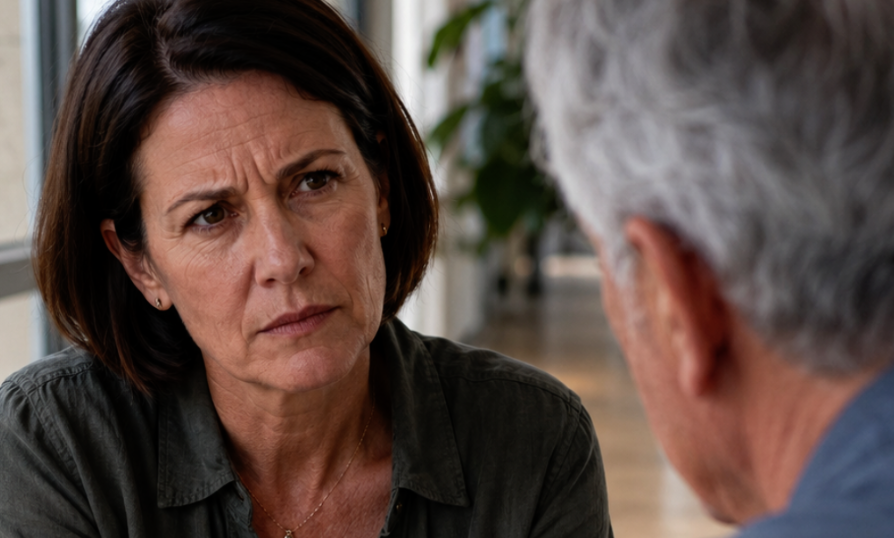
“Anya Is Having My Baby. I’m Leaving. I’ll Take the Car and the Apartment,” Her Husband Announced — But He Never Expected His Wife’s Reaction
Inessa Viktorovna Klimova’s life had always followed an unwritten schedule. Up at five-thirty in the morning, while the house was still asleep. A quick shower, taming her unruly hair, almost silent movements in the kitchen — frying, steaming, chopping. By seven o’clock, a hot breakfast was already on the table. Her husband, Vitaly Andreevich, was always the first to receive a plate filled to the brim. Their son, Kostya, was the second most important man in the house. Only afterward, if there was still time before the men left, could Inessa allow herself to sit down and swallow something.
Twenty years — from bell to bell. No amnesty, no early release. Not that she considered her life a prison. Not at all. Rather, a service. Many saw her as a saint. Others as spineless. Inessa herself simply knew that she was fulfilling her main purpose: taking care of her family.
“Inessochka, you’re a miracle, not a woman,” her mother-in-law, Klavdia Stepanovna, often told her when she came to visit and inspected the spotless apartment with a critical eye. “My Vitalik really was lucky with you.”
At such moments, Inessa would only smile restrainedly with the corners of her lips. She knew that in her mother-in-law’s eyes, something entirely different could be read: How has this simpleton managed to keep my son for so many years?
Compliments from her mother-in-law were rare handouts, given with obvious reluctance. Klavdia Stepanovna, a woman with an iron character and a sharp tongue, saw her daughter-in-law first and foremost as a rival. A rival who, twenty years ago, had taken her beloved son out from under her wing — and then had given birth to a grandson, pulling even more of Vitalik’s attention onto herself.
“Come on, Mom,” Vitaly would usually defend his wife, patting Inessa on the shoulder. “She’s gold, not a wife. I was right to decide she didn’t need to work. What would be the point? I earn well enough, and she keeps the family hearth.”
At that moment, Inessa usually felt not like a person, but like a function. Convenient, useful — but still a function. Still, she never complained. When, twenty years earlier, Vitaly, then a promising lawyer at a large company, declared that his wife should not “ruin her nerves at work,” Inessa accepted it as a given. Especially since Kostya was born a year later, and her responsibilities tripled.
Then the years began to stretch on — gray, identical, like twins. Home-store-home. Laundry-cooking-cleaning. School, activities, tutors for Kostya. Everything for others, nothing for herself. Her university degree in economics had long been gathering dust in a desk drawer. And what kind of economist was she now anyway? Twenty years without practice.
“I need to talk to you,” Vitaly’s voice sounded unusually sharp that evening.
It was Tuesday — the most ordinary Tuesday, no different from all the other Tuesdays of the past twenty years.
Inessa was hanging her husband’s ironed shirts on hangers, sorted by color, exactly as he liked. Blue with blue, white with white.
“Of course, I’ll just hang this one,” she replied, carefully smoothing a nonexistent wrinkle on the collar of his favorite pale blue shirt.
“Leave those rags and sit down already.”
Something in his tone made her freeze. Mechanically, she placed the shirt on the bed and sat beside it, folding her hands on her knees like an obedient schoolgirl.
Vitaly stood by the window with his back to her, staring somewhere into the distance, as if trying to make out something important in the thickening twilight of the Moscow evening.
“I’m leaving you,” he said in such an everyday tone, as though he were announcing tomorrow’s weather forecast.
Inessa blinked. Once. Then again. She thought she must have misheard.
“Sorry, what?”
“I’m leaving you,” he repeated, finally turning around.
His face, which she had studied down to the last wrinkle over twenty years, suddenly seemed to belong to a complete stranger.
“Anya is having my child.”
Inessa felt something snap in her chest and plunge downward, like an elevator with a severed cable.
“Which Anya?” she asked, although she already knew the answer.
“Your sister. Who else?”
Anya. Her second cousin. Fragile, ringing with laughter, always cheerful Anya, who was ten years younger than Inessa. Anya had come from Novosibirsk five years earlier to conquer the capital. Of course, Inessa had taken her in, helped her find work, supported her however she could. Then Anya got on her feet, rented an apartment nearby, and became a frequent guest in their home. Cheerful, carefree, with eyes sparkling with love of life — the complete opposite of tired Inessa, forever preoccupied with domestic concerns.
“But how…” Inessa began, then stopped herself.
A stupid question. She understood perfectly well how.
“It just happened,” Vitaly shrugged, as though they were talking about an accidentally broken cup. “I love her, Inessa. And I want to be with her and our future child.”
Inessa felt nausea rise in her throat.
“And what about Kostya? What about me? What about our twenty years?”
“Kostya is grown. He’s not five years old. You… you’ll manage. You’re strong,” he said with sudden tenderness, which made her feel even sicker. “And twenty years… well, things happen. People change. Feelings fade.”
“And when are you leaving?” she asked in a hoarse voice, desperately clinging to details so she would not think about the main thing.
“Today. I’ll stay in a hotel for a couple of days while you move out. I’ve already packed,” he nodded toward the suitcase standing behind the bedroom door.
Only now did Inessa notice it.
“And what about…” She gestured around the room, meaning their apartment, their furniture, their jointly acquired property.
Vitaly sighed, as though speaking to a foolish child.
“Iness, let’s be honest. I bought the apartment with my money. The car too. All this time I supported the family while you took care of the home. Legally, of course, you’re entitled to part of the property, but…” He paused. “I’m counting on your reasonableness. Besides, I’m leaving you some savings — enough for the first while, until you find work.”
Inessa felt something inside her crack. She raised her eyes to her husband — still formally her husband — and saw in his gaze not regret, not guilt, but only impatience. He wanted to finish this unpleasant conversation as quickly as possible and leave. Leave for Anya, for a new life.
“You’ve thought everything through,” she said quietly.
“Yes. I spoke with a lawyer. I understand that what I’m doing isn’t very pretty, but I want to be honest. I’ll take the car and the apartment. That’s fair.”
“Fair,” Inessa echoed. “And all those years I spent on you, on Kostya, on creating comfort — how does that fit into your understanding of fairness?”
Vitaly grimaced.
“Come on, don’t dramatize. You always wanted to be a housewife yourself. I offered you work several times, and you refused.”
“Because you came with those offers when Kostya was three, then five, then eight! And later it was already too late — who needs an economist with no work experience?”
“In any case, it was your decision,” Vitaly cut her off. “I provided you with everything you needed. More than enough, even.”
Inessa was silent. Images of her life flashed before her eyes — endless chores, childhood illnesses when she did not sleep at night, parent-teacher meetings, standing at the stove, endless washing and ironing, the constant care to ensure that her men had everything perfect.
And this was her gratitude.
You’ll manage.
“Does Kostya know?” she suddenly asked.
Vitaly hesitated.
“Yes, I spoke with him. He… understands.”
“Understands what? That his father is abandoning his mother for a young mistress who is also a relative?”
“Don’t exaggerate. Kostya is an adult. And, by the way…” Vitaly looked away. “He decided he’ll stay with me for now.”
That blow was devastating. Inessa felt her legs weaken, and she sank back onto the bed, from which she had apparently risen without noticing.
“He chose you,” she whispered.
“He didn’t choose anyone. It’s just more logical this way. It’s easier for him to be with me right now — I’m closer to his university. And besides, a man understands a man better.”
“More logical,” Inessa repeated, feeling something dark and hot begin to boil inside her. “And when did you all discuss this behind my back? When did you work out this… logic?”
Vitaly did not answer, and that silence said more than any words could have.
“Who else knew?” Inessa asked, raising her eyes to him. “My mother? Your parents?”
A shadow crossed his face, and she understood.
Everyone.
Everyone had known. Their entire little world had been aware of the betrayal, and only she had remained in blissful ignorance.
“How long has this been going on?” she asked another question, although an inner voice screamed: Don’t ask! Don’t hurt yourself more!
“A little over a year,” Vitaly said reluctantly.
A year.
A YEAR.
An entire year of intrigues, whispering, discussions behind her back. All those family dinners when Anya sat opposite her and smiled her radiant smile. All those holidays when they gathered together and raised glasses “to family.” Inessa suddenly remembered how, a couple of months earlier, Anya had burst into tears at the table and run out of the room — and Inessa, the fool, had run after her, comforted her, hugged her, asked what had happened.
“I need to go,” Vitaly said, glancing at his watch again.
“Yes,” Inessa nodded. “Go.”
He grabbed his suitcase and headed for the door. At the threshold he turned, as if wanting to say something, then changed his mind and left silently. The lock clicked, and silence settled over the apartment — so dense it seemed one could touch it with one’s hands.
Inessa sat motionless, staring at one spot. Inside there was emptiness — a huge, ringing emptiness where her husband’s words echoed:
Anya is having my child. I’m leaving. I’ll take the car and the apartment.
The phone rang. Inessa automatically glanced at the screen — her mother. Most likely, she already knew and was calling to express sympathy. Or to scold her — saying she had failed to keep her husband. Inessa rejected the call. A minute later the phone rang again — this time her older sister Marina. Inessa turned the phone off.
She did not know how long she sat there in a stupor. Maybe an hour, maybe three. The doorbell rang. Larisa, her best friend since university, was standing on the threshold.
“I know everything,” she said without preamble. “Vitaly called Kostya, Kostya called his girlfriend Veronika, and she called me. I decided you needed support.”
Inessa silently stepped aside, letting her friend into the apartment. Larisa came in, kicked off her shoes, and without removing her coat went straight to the kitchen. She opened the fridge, took out a bottle of white wine that Inessa had been saving for special occasions, found a corkscrew, opened it, and poured two glasses.
“Drink,” she commanded, handing one to Inessa.
“I don’t want to,” Inessa shook her head.
“I said drink!” metallic notes rang in Larisa’s voice. “It’s medicine.”
Inessa obediently took the glass and sipped. Then again. And again. The wine spread through her body with pleasant warmth, dulling the sharp pain of betrayal.
“I’m taking you with me,” Larisa announced after finishing her own glass. “You’ll stay at my place until you decide what to do next.”
“But what about…” Inessa looked around the kitchen.
“No buts. Pack only the essentials. You’re not coming back to this apartment.”
“Why?”
“Because everything here will remind you of betrayal. Every corner, every object. No, that won’t do. We’re leaving.”
Inessa looked at her friend for a long moment. Maybe Larisa was right. Staying within these walls would be like living on ashes. She slowly nodded and went to pack her things.
Kostya called the next day. Inessa did not want to answer, but Larisa insisted.
“Mom,” her son’s voice sounded uncertain. “How are you?”
“Fine,” Inessa answered dryly. “And you?”
“I… I wanted to explain. I didn’t betray you, it’s just…”
“You just decided to stay with your father. I understand.”
“Mom, understand, it’s easier for me this way. I’m in my third year, I have classes, friends, and from Dad’s apartment to the university it’s a fifteen-minute walk.”
“Of course,” Inessa nodded, although her son could not see the gesture. “I understand everything. Convenience above all.”
“Mom, don’t start,” irritation entered Kostya’s voice. “It’s not forever. I’ll visit you. It’s just more logical right now.”
Again that word — logical. How much he resembled his father, even using the same expressions.
“Fine, Kostya. Live as you wish.”
“Mom, why are you so cold? It’s not my fault that things turned out this way with Dad and her.”
Inessa felt that hot, dark wave rise inside her again.
“And what, in your opinion, is my fault?” she asked quietly. “That I devoted twenty years to the family? That I trusted my husband instead of spying on him? That I took Anya in when she came to Moscow?”
“Nobody blames you!” Kostya exclaimed. “That’s just how life turned out. You yourself used to say marriages don’t always last forever.”
“I did,” Inessa agreed. “But I meant that people can separate if feelings fade. Not like this, Kostya. Not behind someone’s back, not with betrayal, not with lies.”
“Mom, you need to calm down. You’re emotional right now. Later you’ll understand…”
“No, Kostya,” Inessa interrupted him. “I already understand everything. About your father and about you. Listen, I have to go. Take care.”
She pressed “end call” without waiting for an answer. Larisa, who was sitting nearby and had heard the whole conversation, shook her head.
“He’s a boy. He doesn’t understand yet.”
“He’s an adult man, Lar. He’s not ten. And he made a choice.”
Inessa spoke calmly, but inside everything clenched from pain. Her son, her only son, her own flesh and blood, whom she had carried, given birth to, fed, raised — had chosen his father. Chosen “logic” and “convenience.”
Well, so be it.
That night, Inessa did not sleep. For the first time in many years, she had no duties, no plans for tomorrow, no urgent worries. Only emptiness and ringing silence in her head.
The next day, her mother called. Inessa hesitated, but answered anyway.
“Daughter, how are you?” her mother’s voice oozed false concern.
“Wonderful, Mom,” Inessa replied evenly. “Just wonderful.”
“Inessochka, I understand it’s hard for you right now, but…”
“Mom,” Inessa interrupted her. “Tell me honestly: how long did you know about Vitaly and Anya?”
Silence hung on the line.
“Inessa, why so suddenly…”
“How long, Mom?”
Her mother sighed.
“About three months. But I didn’t want to tell you! I thought it wasn’t serious, you know how men are. Vitalik would have his fun and come back.”
“And when it became clear that it was serious, you also decided not to tell me?”
“Inessa, why are you acting like a child?” irritation appeared in her mother’s voice. “Do you think it was pleasant for me to know? I’m on your side! But remember yourself — you let yourself go completely, always in a robe, always with a rag in your hand. Men love with their eyes. And Anya is young, beautiful…”
“Thank you, Mom,” Inessa interrupted coldly. “You’ve helped me a lot.”
“Why are you angry? I’m telling the truth! Right now you need to get yourself together, find a job, maybe even a new man. Life isn’t over…”
“Thanks for the advice,” Inessa said in the same icy tone. “I have to go.”
“Inessa, don’t be foolish! Call me back when you cool down!”
But Inessa had already ended the call. Larisa, sitting nearby with a cup of tea, sighed.
“Your mother has always been… peculiar.”
“You’re too kind with your definitions,” Inessa smirked.
The phone rang again. This time — her mother-in-law.
“Don’t answer,” Larisa advised. “You won’t hear anything good.”
But Inessa answered anyway. Klavdia Stepanovna’s voice sounded strict, like a teacher calling in the parents of a troublesome student.
“Well? Did you finally drive your man away?” she began without preamble. “I always knew you were no match for my Vitalik. Too simple, too… ordinary. He was howling from boredom with you!”
“Hello, Klavdia Stepanovna,” Inessa answered calmly. “I’m happy to hear from you too.”
“Oh, drop the ceremony!” her mother-in-law snorted. “Let’s speak honestly. Anya is exactly who my son needs. Bright, cheerful, alive. He blossomed with her!”
“In how many months did he blossom? Twelve?”
“What?”
“Nothing. I’m just asking how long you knew about their affair.”
Klavdia Stepanovna chuckled.
“What was there to know? At Kostya’s birthday, if you remember, I saw the girl and immediately understood — there she is, the one. Exactly what my Vitalik needs.”
Inessa froze.
So it was her mother-in-law who had arranged it? Deliberately?
“You… brought them together?”
“Well, I helped a little. They would have found each other anyway. I merely sped up the process. Vitalik was unhappy with you. I could see it.”
“Unhappy for twenty years?” genuine amazement sounded in Inessa’s voice.
“Yes! You suffocated him with your care, your correctness! Turned him into a slipper-wearing house husband!”
Inessa could not hold back and burst out laughing — bitterly, brokenly.
“Klavdia Stepanovna, you are magnificent. Simply magnificent. Tell Vitaly that I’m filing for divorce. And let him prepare the documents for the apartment and the car — I won’t stand in the way.”
“That’s a clever girl,” her mother-in-law softened unexpectedly. “I knew you were a reasonable woman.”
“Oh yes,” Inessa nodded. “Now I’m very reasonable. Goodbye, Klavdia Stepanovna.”
She ended the call and turned to Larisa.
“You know what?” she said suddenly, her voice firm. “We need to leave.”
“Where?” Larisa was surprised.
“Anywhere. Away from here. At least for a couple of weeks. I need time to think, recover. And here they’ll find me and peck me to death.”
Larisa looked at her friend for a few seconds, then nodded decisively.
“I have an idea. Let’s go to Pyatigorsk, to a sanatorium. It’s off-season there now, the vouchers aren’t expensive. Mountains, air, thermal springs — just what you need for healing.”
“Thermal springs don’t heal betrayal,” Inessa smiled bitterly.
“No, but they help restore strength. And you’ll need strength to start a new life.”
Inessa was silent.
A new life. At forty-three, without work, without a home, without a family.
Well, that sounded like a challenge.
“Fine,” she finally said. “Let’s go to your Pyatigorsk. It can’t get any worse…”
They left two days later. Inessa gave a lawyer power of attorney to handle the divorce proceedings. She did not want to see Vitaly, his lawyers, or hear formal words about “irreconcilable differences.” What differences? Everything was perfectly clear. Her husband of twenty years had decided that a young mistress and a child from her mattered more than the wife who had devoted the best years of her life to him.
The sanatorium greeted them with coolness and silence. October in Pyatigorsk was the time of rains and fog, when the tourists had already left and the locals were preparing for winter. The perfect time to heal wounds.
“You know,” Larisa said on the very first evening, pouring thick red wine into glasses, “sometimes it’s useful to lose everything in order to understand who you really are.”
“Philosophizing?” Inessa smirked, accepting the glass. “It’s easy to reason when it isn’t your life that has shattered into pieces.”
“Mine shattered five years ago, in case you forgot,” Larisa replied calmly. “When Igor left me for his secretary, leaving me with a mortgage and two children.”
Inessa guiltily lowered her eyes. Indeed, Larisa had her own experience of betrayal.
“Sorry. I got buried in my own grief and forgot I’m not the only one.”
“Come on,” Larisa waved it off. “That’s not the point. I just want to say this isn’t the end. It hurts, damnably hurts. But it isn’t fatal.”
Inessa sipped her wine, feeling the tart liquid burn her throat.
“You know what’s worst?” she asked, looking out the window at the rain-wet mountains. “Not Vitaly’s betrayal, no. I’m not even surprised. He was always a weakling hiding behind the mask of a strong man. And not Anya — after all, she was never truly close to me. The worst thing is that everyone around me knew. Everyone! And they were silent. As if I didn’t deserve the truth.”
Her voice trembled, but she held herself together. There were no tears left. They had run out somewhere halfway to Pyatigorsk, in the train compartment, when Inessa, looking into the darkness outside the window, suddenly realized she was not crying for her husband, but for herself. For twenty years lived with a person who could so easily discard her.
“People don’t like being the bearers of bad news,” Larisa said thoughtfully. “They prefer to pretend everything is normal, even when everything is collapsing. That’s human nature.”
“And what about honesty? Decency? Basic respect?”
“That’s too much to ask of most people,” Larisa shrugged. “Believe me, I know. When I found out about Igor and his secretary, it turned out the whole office had known for half a year. Including my best friend Svetka, who worked in the next department.”
“And how did you cope?”
“I didn’t,” Larisa answered honestly. “I simply accepted it as a given. People are weak, cowardly, and selfish. Almost all of them. And if you expect nobility from them, prepare for disappointment.”
Inessa shook her head.
“What a bleak picture of the world.”
“A realistic one,” Larisa corrected her. “But you know what’s good? Sometimes, very rarely, there are people who still do the right thing. Who tell the truth, even when it hurts. Who stay close, even when it’s inconvenient. And those moments are worth living for.”
She raised her glass, and Inessa hesitantly clinked hers against it.
The days at the sanatorium flowed slowly and monotonously. In the morning — treatments: massage, mud baths, mineral water. During the day — walks through the surrounding area, if the weather allowed. In the evening — conversations over wine in a small room overlooking the mountains.
Sometimes they cried together — drunken tears to old songs and memories of times when everything had seemed right and understandable. Sometimes they went into the forest and screamed — loudly, desperately, pouring their accumulated pain into the emptiness. At such moments, Inessa felt as if her scream could be heard even in Moscow — where her former husband and his new family were now building their happiness on the ruins of her life.
One evening, two weeks after their arrival, Larisa suddenly said:
“You’re free, Inessa. For the first time in twenty years, truly free.”
“What do you mean?” Inessa raised her eyes from the book she had been unsuccessfully trying to read for the last hour.
“I mean exactly what I said. You are no longer a wife, no longer the mother of an adult son who doesn’t need you. No longer the keeper of the family hearth. You are simply a woman who can do whatever she wants.”
“And what can I do?” Inessa smiled bitterly. “At forty-three, without work, without housing, without prospects?”
“Everything,” Larisa replied simply. “Study. Travel. Work. Love. Live for yourself, not for others. You are a beautiful, intelligent woman. You have a higher education. Yes, it won’t be easy to find work in your field, but you can retrain. Or leave. Or simply start from scratch.”
Inessa shook her head.
“You say it as if it’s simple.”
“No, not simple. Terribly difficult. Frightening to the point your knees shake. But possible. And you have the strength, Inessa. I’ve known you for thirty years and I’ve never seen you give up.”
“Back then there was someone to fight for,” Inessa said quietly.
“And now — for yourself. Isn’t it about time?”
That evening, Inessa could not fall asleep for a long time. She stared at the ceiling and thought about her friend’s words.
Free.
The word sounded simultaneously like a sentence and a promise. Like a burden and like wings behind her back. She had lived so many years for others — her husband, her son, her parents. But for herself? What had she done for herself all these years?
In the morning, she woke with a strange feeling of lightness. As if something inside her had broken — not her heart, no, rather the chains she herself had put on many years ago.
“I want to cut my hair,” she announced to Larisa at breakfast.
Larisa raised an eyebrow.
“Just like that?”
“Yes. And dye it. Red.”
Larisa smirked.
“The classic post-breakup stage — changing your hairstyle. Well, I’m in. Let’s go into town and find a decent hairdresser.”
Three hours later, Inessa was looking in the mirror at an unfamiliar woman with short reddish hair and surprised eyes.
“So?” the stylist asked, fixing the last strand.
“Unusual,” Inessa answered honestly. “But I like it.”
“It suits you,” Larisa confirmed. “A completely different look. You look younger.”
On the way back to the sanatorium, Inessa suddenly said:
“I’m not going back to Moscow.”
“What do you mean?” Larisa was surprised.
“Exactly that. I’ll get the divorce, take my share of the money, and leave. Somewhere nobody knows me. Somewhere I won’t have to see sympathetic looks from acquaintances every day. Or worse, run into Vitaly with Anya and their child.”
Larisa looked at her friend carefully.
“Are you serious?”
“Absolutely.”
“And where will you go?”
Inessa shrugged.
“I don’t know. Maybe Kaliningrad. Or Sochi. Or another country altogether. But definitely not back to Moscow.”
“And what about me?” Larisa asked quietly. “We’ve been friends for so many years…”
Inessa took her hand.
“You’ll be the only one I tell where I am. And you’ll be able to visit. Or I’ll visit you. But living somewhere where every stone reminds me of the past… no, I can’t do that.”
They returned to Moscow a month later. During that time, Inessa’s lawyer had managed to prepare all the divorce documents. Vitaly, strangely enough, did not object to the division of property — apparently out of guilt, or simply wanting to finish the formalities as quickly as possible. Inessa was entitled to compensation — not enormous, but enough to rent modest housing and live for a year or year and a half while she looked for work.
The court hearing was quick and emotionless. Inessa sat opposite Vitaly and looked at the man with whom she had lived for two decades as if she were seeing him for the first time. A stranger, a completely strange man.
When the judge announced that their marriage was dissolved, Inessa felt nothing but relief. As if a heavy burden had been lifted from her shoulders, one she had carried far too long.
After court, Vitaly tried to approach her.
“Inessa, I wanted to say…”
“Don’t,” she raised her hand, stopping him. “Just don’t. Everything has already been said.”
“I didn’t want it to turn out this way.”
“It doesn’t matter what you wanted or didn’t want. What matters is what you did,” Inessa said calmly, without anger. Anger required strength, and she had no strength left for this man. “Goodbye, Vitaly. I hope you’ll be happier with Anya.”
She turned and walked away without looking back. Behind her, she heard his voice:
“And what about Kostya?”
Inessa stopped.
“What about Kostya? He’s an adult. He lives with you. He’ll figure it out.”
“He misses you.”
She smiled without turning around.
“He knows where to find me. If he wants to.”
With those words, she left the courthouse. Outside stood golden autumn — the very kind she had always loved. Sunlight, a cool wind, yellow leaves underfoot. Once, on a day just like this, she and Vitaly had met. Today, they had officially become strangers. The circle had closed.
Larisa was waiting for her in the car.
“Well?” she asked when Inessa sat beside her.
“Free,” Inessa answered.
And for the first time in a long while, she smiled for real.
Inessa lived with her friend for another three months. During that time, she considered every option — from Crimea to the Far East. She went to several job interviews, but everywhere the answer was the same: “You have no work experience.” As if twenty years of running a household was not work.
Kostya called only once — on her birthday. The conversation was short and strained. He complained about his studies, talked about his new girlfriend, but said not a word about his father and Anya. And Inessa did not ask. She was no longer interested.
In February, she received a letter — a real paper letter in an envelope. It was from Aunt Vera, her mother’s sister, who had gone to a monastery thirty years earlier. They had never been especially close; they had seen each other a couple of times in childhood, then exchanged rare holiday cards. In the letter, her aunt expressed condolences about the divorce — apparently her mother had still contacted her — and invited Inessa to visit the women’s monastery near Tver.
It is quiet here, she wrote. Here, one can think. And here, no one will judge you because your life did not go according to plan.
Inessa looked at the letter for a long time. Then she took out her phone and found the monastery online. Small, but ancient, founded back in the sixteenth century. Beautiful old buildings among forests and lakes. Silence, peace, rhythm.
“I’m going to Aunt Vera,” she told Larisa that evening. “To the monastery.”
“Why?” Larisa was surprised.
“I don’t know. Maybe there I’ll find answers.”
“To what questions?”
Inessa thought.
“To the main one: who am I now that I have stopped being a wife, a mother, and the mistress of a home?”
Larisa frowned.
“Are you sure a monastery is the right place for such searches?”
“I’m not sure of anything,” Inessa answered honestly. “But I want to try.”
She left a week later. Aunt Vera met her at the station — a small, thin old woman in black robes, with a sharp, unexpectedly young gaze.
“Hello, Inessa,” she said, embracing her niece. “I’m glad you came.”
She smelled of incense, herbs, and something elusively warm, homelike. Unexpectedly, Inessa burst into tears, burying her face in her aunt’s shoulder. The old woman stroked her head without saying a word, letting her cry.
The monastery turned out to be exactly as it had been in the photographs — ancient, peaceful, as if frozen in time. Her aunt settled Inessa in a small cell for pilgrims. Modest, but clean and cozy.
“You may stay as long as you need,” she said. “No one will rush you. Pray if you wish. Help the sisters if you have the strength. Just live and breathe. It is easy to breathe here.”
And Inessa stayed. First for a week, then for a month. She became drawn into the unhurried rhythm of monastic life — rising at dawn, prayers, work in the refectory or garden, prayers again, sleep at sunset. Simple food, simple conversations, simple joys.
One evening, while she and Aunt Vera sat in her cell drinking tea, Inessa asked:
“Auntie, have you ever regretted coming here? Giving up worldly life?”
Aunt Vera smiled.
“I did not give it up, child. I chose. Those are different things.”
“And you don’t miss what might have been? A family, children, a career?”
“Sometimes,” her aunt answered honestly. “But in return I received something more valuable. Peace. Understanding of myself and my place in the world. And most importantly — freedom from other people’s expectations. Here, I answer only to God and to myself.”
Inessa fell silent.
Freedom from expectations.
Wasn’t that what she had dreamed of all those years? Wasn’t it about doing, at least once in her life, what she wanted — not what others expected from her?
In the spring, she made a decision. Not the easiest one, not the most obvious. But it was hers.
“I’m staying,” she told Aunt Vera. “I want to become a novice.”
Her aunt looked at her carefully.
“Are you sure? This is a serious step.”
“I’m sure,” Inessa nodded. “For the first time in many years, I know exactly what I want.”
Aunt Vera was silent, studying her face.
“You’re not afraid of being judged? Your mother, your friends…”
“They have been living their own lives for a long time. And I am beginning mine. A new one.”
Larisa flew in three days after Inessa’s call. She burst into the monastery like a hurricane, ignoring the surprised looks of the nuns.
“Have you lost your mind?” she asked without preamble, finding her friend in the garden. “A monastery? Seriously?”
Inessa smiled — calmly, serenely.
“I’m glad to see you, Lara.”
“Don’t try to distract me!” Larisa nervously paced back and forth along the narrow garden path. “This is madness! You’re giving up everything — your future, possible relationships, a normal life!”
“And what is a normal life, Lar?” Inessa asked quietly. “One where I again live according to other people’s expectations? Search for work I don’t like? Try to arrange a personal life at forty-three when the scars of betrayal in my heart haven’t even healed yet?”
“But this is… escape! You’re just hiding from reality!”
Inessa shook her head.
“No. I’m finally facing it. And I understand what I need. I found peace here, Lara. For the first time in many years.”
Larisa sank onto the bench beside her.
“So you plan to spend the rest of your life here?”
“I don’t know,” Inessa answered honestly. “Maybe a year. Maybe two. Maybe my whole life. But right now — yes, I want to be here. I want to heal my soul. And I want to understand who I really am when there is no one beside me for whom I must pretend.”
They spoke for a long time that evening. Larisa cried, threatened, pleaded. Inessa remained unshakable. Eventually her friend gave up.
“Fine,” she said, wiping her tears. “It’s your choice. I don’t understand it, but I respect it. Just promise you won’t disappear. That you’ll write, call…”
“I promise,” Inessa smiled.
In June, she received a letter from her son. Short, formal. Kostya wrote that he was doing well, that he had moved out from his father’s and was renting a room with friends, that Anya had given birth to a girl, and Vitaly now spent all his time with his new family. At the end, there was: Mom, I miss you. May I come visit?
Inessa looked at those lines for a long time. Then she wrote back:
Come. I’ll be waiting.
He arrived a week later — more grown-up, a little lost. They walked through the monastery garden, and Inessa listened to his stories about life, studies, plans for the future. About how he had quarreled with his father because of Anya. About how he missed maternal warmth.
“Why did you leave, Mom?” he finally asked.
“Because I needed to find myself,” she answered simply.
“And did you?”
Inessa smiled.
“I did.”
Before leaving, Kostya hugged her — tightly, childishly.
“Will you ever come back?”
“I don’t know,” she answered honestly. “But you can always come here. It’s a good place to think.”
A year later, the abbess suggested that Inessa take monastic vows. Inessa hesitated — it was a serious, final step. But over that year she had truly found what she had been searching for all her life: her real self. Not a function, not an attachment to a husband and son, but a whole person with her own thoughts, feelings, and aspirations.
“I agree,” she said after a week of reflection.
Aunt Vera embraced her.
“You have walked a difficult path, but you did not break.”
Larisa and Kostya came to the ceremony. Her mother did not come — offended that her daughter was “burying herself alive.” Inessa was not upset. She had long since forgiven everyone who had betrayed her. And she had forgiven herself too — for the years of blindness and self-denial.
As she stood before the altar in a long black robe, preparing to accept a new name and a new life, her entire past flashed before her eyes in bright fragments, like slow-motion film.
The wedding.
The birth of her son.
Endless housework.
That evening when Vitaly said:
Anya is having my child. I’m leaving.
Once, those words had destroyed her world. Now they seemed distant, almost unreal, as though they had happened to someone else. To that former Inessa, who dissolved herself in others and forgot about herself.
Thank you, she mentally said to her former husband.
Without his betrayal, she would never have found her path. She would never have understood that happiness is not when someone needs you, but when you are at peace with yourself.
Anya is having my child. I’m leaving. I’ll take the car and the apartment, Vitaly’s words echoed in her mind.
And Inessa smiled, accepting her new life.
A life where, at last, she belonged only to herself.