At Her Son’s Wedding, the Maid Was Humiliated — Until the Bride’s Father Spoke the Truth…
She never imagined the first words she’d hear at her only son’s wedding would make her feel invisible. Certainly not after everything it had taken to get there.
Linda Brown paused outside the glass doors of the Royal Garden Hotel, fingers tightening around a small, weathered purse. She’d mended her faded cream dress the night before, working the needle by lamplight until the seams lay flat and hopeful. Years of scrubbing other people’s floors and stirring other people’s soups had toughened her hands, but today she’d rubbed lotion into the knuckles until they looked almost soft. Today wasn’t about hardship. Today was Daniel’s day.
Daniel—her Daniel—who had studied by the glow of library lights after shifts at the grocery store, who’d graduated as an engineer because she had pressed every spare dollar, every aching hour, into the future he deserved. Seeing him now in a crisp suit beside his luminous bride, Amelia Miller, felt like a receipt from the universe: paid in full.
But the promise of the day thinned the moment she stepped into the ballroom.
Everything gleamed. Crystal chandeliers scattered warm light across gold-trimmed walls; a quartet lilted through something elegant and old; waiters in white gloves drifted like swans, balancing glasses of champagne that caught and held the light. Guests floated past in silks and satin, labels she’d only ever seen on coat tags while dusting other people’s closets. Linda pressed her invitation card between her palms and took a cautious step forward.
A woman with a clipboard intercepted her—polite smile, puzzled eyes. “Excuse me, ma’am… are you with the cleaning staff?”
Heat rushed to Linda’s cheeks. “No,” she said softly, steadying her voice. “I’m the groom’s mother.”
The smile faltered. The woman blinked, then pointed toward a table pushed up against the catering station. “Of course. You can sit over there—it’s… quieter.”
Quieter. Out of the way. Linda nodded and walked where she was told, spine straight, breaths measured. She set her purse in her lap and folded her hands over it, the way she had in church all those years when she’d prayed for exactly this moment. Across the room, Daniel caught sight of her. He lifted a hand—just a small, excited wave—but in the next breath a cluster of relatives in expensive suits, a photographer, and a woman with a makeup brush swept him back into their orbit.
From the corner, Linda watched the choreography of celebration unfold. She smiled when the string quartet shifted to a bright melody. She dabbed the corner of her eye when the emcee announced the newlyweds. She told herself she would have her moment with her son soon, when the photographs were finished and the toasts were done, when someone—anyone—remembered to bring her closer.
Near the head of the room, a placard in looping calligraphy announced FAMILY OF THE GROOM. Several chairs remained empty, dressed in white covers and tied with satin bows. Linda studied the sign for a long moment. Family. The word pulsed in her ribs like a heartbeat. She had earned that word with a lifetime.
She rose carefully, smoothing the skirt of her dress. If she walked slowly, no one would startle. If she kept her eyes forward, no one would see the tremor in her hands. She moved along the edge of the room, past clusters of perfume and murmured laughter, past a tall floral arrangement that smelled like summer rain.
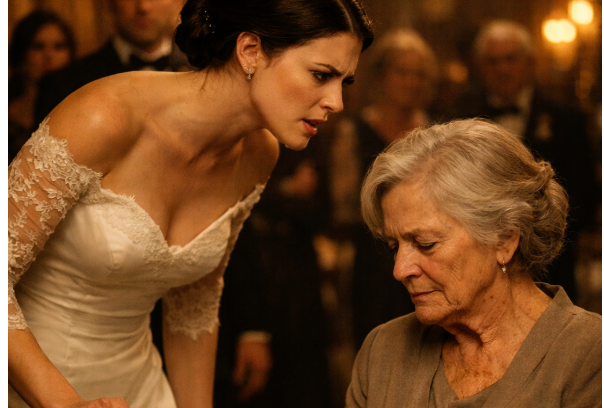
Whispers skimmed the air as she approached. Someone’s brows knit. Someone else pretended not to stare. At the front, Amelia turned from the photographer, smile lacquered and bright. The smile thinned when she saw Linda nearing the empty chair beside Daniel.
“Ma’am,” Amelia said, pleasantly tight, chin lifting a fraction. “That table is reserved for family.”
Linda’s own smile was gentle, stitched together with years of patience. “I am family, dear. I’m Daniel’s mother.”
For a beat the room seemed to inhale. The emcee’s microphone crackled faintly; a waiter paused mid-pour. Linda reached for the back of the chair, fingertips brushing the bow.
Before she could settle her weight, Amelia’s hand flashed forward and yanked the chair away.
It happened fast—the sudden emptiness where support ought to be, the lurch of her body, the useless clutch of air as her balance slipped. Linda tumbled, landing hard on polished marble. Her purse burst open, coins clattering and spinning in glittering circles, tissues fluttering like small white flags. The quartet faltered. A champagne glass chimed against a plate. And then silence, clean and stunned.
Daniel’s fork stopped halfway to his mouth. Around him, faces tipped and stiffened, expressions freezing in place like mannequins in a storefront. For a breath, the entire ballroom watched an older woman on the floor gather what little she owned.
Linda blinked hard. Tears rose, hot and humiliating, blurring the chandelier light into smears of gold. She reached for a coin that had rolled under her heel, for the purse that suddenly seemed too small to hide behind. She could feel the weight of a dozen gazes pressing down—pity from some, discomfort from others, satisfaction from a few who liked their hierarchies unruffled.
She swallowed, the movement tight and painful. “It’s all right,” she whispered to no one in particular, to everyone at once. “I’m all right.”
The words barely left her lips when a voice—deep, resonant, unarguable—rose from the doorway and cut through the hush.
“Stop.”
Heads snapped toward the sound as if tugged by a wire. In the archway, framed by the glow of the hall beyond, stood a tall man in a dark suit that did not ask for attention so much as command it. His tie was simple, his cuff links discreet, but there was something about the way he occupied the space—rooted, immovable—that silenced even the clink of cutlery.
His gaze traveled over the scene: the tilted chair, the scattered coins, Linda kneeling on the marble with her hands shaking, Amelia standing too straight beside the sign that declared FAMILY. The man’s jaw tightened, just once.
“Enough,” he said, stepping forward. The band stilled completely. Even the air seemed to hold itself carefully, waiting.
He did not look at the guests. He looked at Linda. “Please, Mrs. Brown,” he said, voice gentler now, “allow me.”
And then, very slowly, he turned to the bride.
Continued in the comments.
When the housemaid arrived at her only son’s wedding, she never imagined she would be treated as if she didn’t count—least of all by the bride.
Linda Brown stood just outside the glass doors of the Royal Garden Hotel, smoothing the skirt of the best dress she owned: a cream-colored gown she had mended by hand the night before, the stitches tiny and neat. Her purse was small, the clasp a little loose; inside were a folded tissue, a few coins, and the invitation with her son’s name printed in gold. She had spent years cleaning other people’s kitchens, ironing shirts that were not hers, cooking meals she could not afford to taste. But today wasn’t about any of that. Today, Daniel—her Daniel—was getting married.
He had always been her pride. A clever boy who grew into a focused, determined man, who studied engineering while she took extra shifts so he wouldn’t have to choose between books and dinner. Every late night on her knees scrubbing tile, every early morning catching the first bus, all of it had funneled quietly toward this moment: her son in a suit, tall and steady, standing beside the woman he loved. Seeing him with the bride, Amelia Miller—beautiful, poised—felt like the world had finally met her halfway.
The ballroom swallowed her whole. Crystal lights glittered overhead; music fluttered softly above expensive laughter. Guests floated through the room in tailored tuxedos and designer gowns, their perfume and cologne a layered cloud. Waiters in white gloves carried trays of champagne and tiny jeweled pastries. Linda stepped in, clutching the invitation as if it were a passport.
A woman with a headset and a practiced smile slid into her path. “Excuse me, ma’am. Are you with… housekeeping?”
Heat climbed Linda’s neck. “No,” she said, keeping her voice gentle. “I’m the groom’s mother.”
The coordinator’s expression flickered—surprise, then apology that never fully landed. She gestured toward a table tucked beside the catering doors. “You can sit right over there. It’s… quieter.”
Linda thanked her and walked to the table. The seat wobbled slightly. The closest conversation belonged to a pair of waiters debating the best route to refill the wine. From across the room, Daniel caught sight of her and lifted his hand in a quick, helpless wave before the photographer swept him away. Linda set her purse on her lap and folded her hands over it. She would wait. It was a big day. People were busy.
When dinner was announced, a gleaming placard appeared on the long front table: FAMILY OF THE GROOM. Five chairs sat empty, including the one next to Daniel. Linda hesitated. Then she rose, invitation trembling between her fingers, and made her way down the aisle of round tables and curious eyes.
Whispers trailed after her like a veil. When she reached the head table, Amelia saw her and the bride’s smile stiffened. “Ma’am,” Amelia said, the word clipped and sugar-coated, “that table is reserved for family.”
Linda’s answering smile was small but unfaltering. “I am family, dear. I’m Daniel’s mother.”
She reached for the chair beside her son. In a fast, graceless motion, Amelia yanked it back.
The world tilted. Linda pitched forward and hit the marble floor hard, the sound echoing under the chandeliers. Her purse burst open—the coins scattered, the tissue skated away, the invitation splayed like a white flag. Conversations died mid-sentence. A silver fork clinked back to a plate and then there was nothing but the soft hush of shock.
Daniel half rose, frozen, his napkin still gripped in his fist. A few guests gasped; others stared at their hands, their plates, anywhere but the woman on the floor. Linda blinked up, cheeks burning, eyes shining with tears she willed not to fall.
From the doorway came a voice that cut across the silence—low, resonant, unmistakably certain. “Linda Brown?”
Heads turned. In the archway stood Robert Miller, the bride’s father. His face had gone quite pale; his eyes looked as if they were seeing a ghost.
He took a step, then another. “My God,” he breathed. “It’s you.”
Amelia’s brow knit. “Dad? What—”
Robert didn’t look at her. He went straight to Linda, kneeling to gather the spilled things with hands that suddenly seemed unsteady. He helped her up, his grip careful, reverent. “Linda Brown,” he said, voice roughening, “you saved my life twenty-five years ago.”
The ballroom erupted into a soft roar of questions. Someone dropped a flute of champagne. The bandleader lowered his baton.
Amelia stared. “Dad, what are you talking about?”
Robert swallowed, his gaze never leaving Linda’s face. “Texas. A long night. A wrecked car in a ditch.” He exhaled, and the memory seemed to flow out with his breath. “I was trapped, bleeding, and everyone passed by. You didn’t. You dragged me out, drove me to the hospital, sat beside me until I woke up. You paid for my medication when I had nothing but trouble to offer.” His voice broke, and he steadied it. “If not for you, I wouldn’t be alive. And you—” he turned slightly, his words aimed at Amelia without truly looking at her—“you wouldn’t be standing here.”
Color drained from Amelia’s cheeks.
Linda’s lips parted. “I… I didn’t realize it was you, Mr. Miller,” she whispered. “I’m just glad you made it.”
Robert’s expression changed—gratitude collapsing into a quiet, stern fury. He turned, finally, to his daughter. “And this is how you repay the world? You humiliate the woman who saved your father and raised your husband alone?”
“Dad, I didn’t know,” Amelia said, tears springing fast. “I thought she was—”
“Just a maid?” His voice sharpened. “That’s the center of it, isn’t it? You looked at her dress and not at her soul.”
No one moved. A cough somewhere in the back sounded indecently loud. The photographers lowered their cameras, suddenly conscious of their own presence.
Daniel had already slid to the floor, gathering his mother’s coins, her tissue, her pride. He pressed the invitation back into her hand and held it there a beat longer than necessary. When he stood, his face was calm in the way that follows the final decision. “Sir,” he said to Robert, “my mother is extraordinary.”
Robert’s eyes softened. “You have every reason to be proud.”
Amelia was crying now, but Daniel didn’t look at her. His attention was tethered to the small tremor in Linda’s hand, the tiny scuff at the toe of her shoe, the sheen at the corner of her eyes that she refused to let fall.
Robert faced the room and his voice steadied again, taking on the weight of a man used to being heard. “If wealth teaches cruelty,” he said, “it’s not worth keeping. Amelia, from this moment, you are cut off from my company and my estate. I won’t bless a marriage that treats decency as disposable.”
“Dad—please,” Amelia choked, reaching for him. “I made a mistake. I—”
He turned away. “Learn humility. Then come find me.”
A stillness fell that felt like judgment. Daniel unclasped the ring from his finger and set it on the linen beside the empty chair. “Mr. Miller,” he said, voice even, “even if you had said nothing, this wedding couldn’t go on.”
Amelia’s sob caught on the polished air. “Daniel, don’t do this. We’re—this is our wedding.”
“Marriage is respect before it is anything else,” he said. “If you cannot honor the woman who gave up everything so I could stand here, you will never honor me.”
He closed his fingers around his mother’s hand. The crowd parted without instruction, white and black fabrics swishing like surf. Mother and son walked toward the doors—she in a mended dress, he in a sharp suit—and every step seemed to loosen something that had been tight for years.
At the threshold, Robert caught up and lowered his voice. “Ms. Brown, I owe you a debt I can’t repay. Please—allow me to help you now.”
Linda’s smile was soft and steady, the kind born of long roads. “You already have, sir,” she said. “You reminded my son what matters, and he chose it. That is more than enough.”
They stepped into the cold evening. The hotel’s glitter dimmed behind them; the city’s ordinary lights blinked on, honest and unadorned. For the first time in years, Linda felt light—as if every small humiliation, every aching night shift, every swallowed insult had been set down on the ballroom floor and left there.
Daniel squeezed her hand. “Let’s go home, Mom.”
They walked away from chandeliers and murmurs, from broken pride and unspilled champagne. And somewhere between the revolving doors and the sidewalk, Linda understood the shape of it at last: she had never been poor in anything that mattered. She had raised a son rich in courage—and that wealth would never run out.