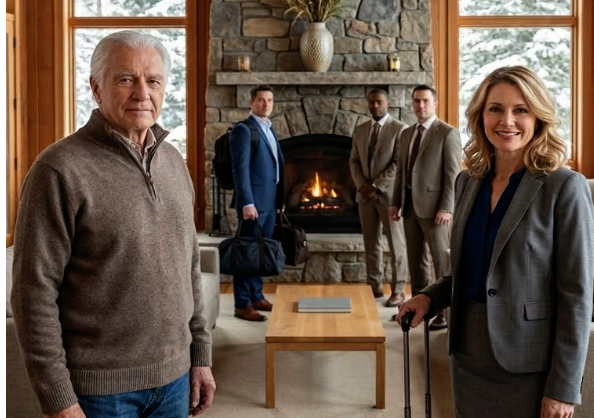
My name is Harold Winston, and at 68, I have learned that peace is the most expensive commodity a man can own. I live in a mountain cabin in Aspen, Colorado—a structure of cedar and stone that smells of pine needles and old paper. For thirty-two years, my life was defined by the rhythmic clang of stainless steel and the frantic energy of a dinner rush. I didn’t inherit my success; I forged it in the heat of a kitchen. I started as a line cook in a Denver diner, a kid who knew the weight of a heavy dish rack and the sting of a grease burn.
Eventually, I built “Winston’s Grill.” It grew from a single storefront into a chain of four high-end restaurants known for their uncompromising quality. Three years ago, I exited the industry, selling the chain for $3.8 million. It wasn’t just a financial transaction; it was the culmination of a life’s work. I moved to Aspen to fly fish the Roaring Fork River and curate a collection of 19th-century cookbooks—artifacts of a time when food was about soul, not just calories. I thought I had earned my silence.
However, wealth has a way of acting as a beacon for the desperate. My son, Trenton, is forty-one. He’s a mid-level manager at an IT firm in Aurora, earning a respectable $78,000. In another life, he was the boy who sat on a flour sack in my first kitchen, watching me with wide, adoring eyes. But that boy vanished seven years ago when he married Deborah Kelly.
Deborah is thirty-eight and views the world through the lens of an unpaid invoice. A former real estate agent, she retired the moment she secured Trenton, deciding that “managing the Winston name” was her full-time vocation. Her real job, as I eventually discovered, was spending capital they hadn’t earned and looking down on anyone who worked for a living—myself included. Our relationship hadn’t just cooled; it had fossilized into a state of mutual, polite resentment, punctuated by years of silence. The peace shattered on a Tuesday at 2:00 PM. I wasn’t expecting guests. In Aspen, people usually call ahead, but the figures on my porch didn’t believe in protocol. Through the frosted glass, I saw the silhouette of Deborah, draped in what looked like three months of Trenton’s salary in faux fur.
“We heard you scooped up that fancy cabin in Aspen! We’re moving in to bury the hatchet,” Deborah barked the moment I opened the door. She didn’t wait for an invitation. She shoved two massive hardshell suitcases over my threshold, the wheels screaming against my hand-scraped oak floors.
Trenton trailed behind her, laden with three more bags, his eyes fixed firmly on his shoes. He looked like a man who had long ago surrendered his internal compass. “Dad,” he muttered, a greeting that carried no warmth, only a sense of obligation.
“Deborah. Trenton. This is… unexpected,” I said, keeping my voice as flat and professional as a maître d’ dealing with an unruly patron.
“Isn’t it wonderful?” Deborah’s eyes were already darting around the great room, mentally appraising the height of the ceilings and the quality of the stonework. “Family reunited at last. I told Trenton, ‘Family is everything.’ We can’t let these silly grudges keep us apart.”
I knew that look. It was the “predatory appraisal” look. She wasn’t seeing a home; she was seeing a $2.3 million asset that she believed was being “wasted” on a man she considered a relic. I smiled—a genuine, sharp smile. I let them barge in because I already knew their secret. Four months ago, an old friend from the country club, Dr. Mitchell, had tipped me off. A woman claiming to be my daughter-in-law had been asking him about “guardianship procedures” and “cognitive decline.” Then, a year ago, I accidentally overheard a pocket-dialed conversation. I heard Deborah’s sharp voice asking when “the old man” would finally stop being a burden and leave them the money. I heard Trenton—my son—reply, “Soon, probably. He’s not getting any younger.”
That was the moment I stopped being a father and started being a strategist. I realized that my son wasn’t just losing his way; he was being coached into a crime.
For the first three days of their “reunion,” I played the part of the eccentric, aging father. I watched Deborah photograph my bank statements when she thought I was napping. I watched her “redecorate” by criticizing the local artisan curtains I had spent thousands on.
“These look so… rustic, Harold. We need to modernize. I know a designer in Denver who could really transform this place,” she said, her fingers tracing the fabric as if she already owned the deed.
I didn’t argue. Instead, I drove to Denver under the guise of “getting fresh mountain air” and met with Marcus Reynolds, an attorney specializing in elder law. I also retained Carla Summers, a private investigator and former detective with a gaze like a laser.
“In Colorado,” Marcus explained, “we are a one-party consent state for recording. And at-risk adult laws are strict. If they are planning to declare you incompetent to seize your assets, they are walking into a felony.”
I told him I wanted a full defense, but more than that, I wanted the truth. I wanted to see how far they were willing to go. On the fourth morning, I called a “family meeting” in the great room. Deborah and Trenton arrived with expectant, greedy smiles, likely thinking I was about to discuss an early inheritance or a change to my will.
They found me standing by the fireplace, but I wasn’t alone. Marcus Reynolds was there, briefcase open. Beside him sat Nathan Price, a notary, and Carla Summers, who looked at Deborah with the cold detachment of a hunter.
“Before we begin,” I said, “I’d like to introduce my team.”
The blood drained from Deborah’s face so quickly she looked like a marble statue. Trenton’s mouth hung open. Carla stepped forward and laid a manila folder on the coffee table.
“Three weeks ago,” Carla began, “Deborah Winston visited Dr. Patricia Hullbrook, a psychiatrist specializing in geriatric health. She was asking for the specific paperwork required to initiate a dementia evaluation against her will.”
“That’s a lie!” Deborah shrieked. “That’s an invasion of privacy!”
“Actually,” Marcus interjected, “photographing someone in a public medical plaza is perfectly legal. And we have your search history from this house’s IP address. ‘How to have a parent declared incompetent.’ ‘Colorado guardianship laws.’ It’s all here, Deborah.”
Trenton looked like he was going to be sick. “Dad, we were just worried. You live up here alone… we thought you were getting confused.”
“Confused?” I asked, my voice dropping to a low, dangerous register. “I built an empire while you were still figuring out how to tie your shoes, Trenton. I am many things, but ‘confused’ is not one of them. Attempting to seize control of a sound mind’s finances is exploitation. In this state, that’s a class 5 felony.”
Deborah recovered her venom. “You haven’t filed anything, Harold. You’re spying on us. We’re family—we have a right to be here. If you try to kick us out, we’ll tell the court you’re paranoid. Hiring PIs to follow your own kids? That sounds like dementia to me.”
She walked out, chin high, pulling a reluctant Trenton behind her. She thought she was winning because she knew the law made it difficult to evict “guests.” She didn’t realize I wasn’t just using the law; I was using the house. The next few weeks were a masterclass in psychological discomfort. Since I couldn’t legally throw them out without a court order that would take months, I decided to make the cabin a fortress of inconvenience.
I cancelled the internet and cable. “Budget cuts,” I told Deborah as she hovered in the kitchen, desperate to check her social media. “I’m on a fixed income now. I have to prioritize.”
I stopped buying groceries for the house. I kept a small, locked refrigerator in my study with my name on every item. When Trenton asked about dinner, I simply pointed him toward the stove. “You’re forty-one, son. I’m sure you can find the knobs.”
Mysteriously, the appliances began to fail. The oven would run 100 degrees hot, then refuse to turn on at all. The garbage disposal developed a horrific grinding noise. The dishwasher leaked just enough to be annoying. And then, there was the roof. I hired a crew to start “emergency repairs” at 7:00 AM every morning. For two weeks, the sound of pneumatic nail guns and heavy boots echoed through the cabin, making sleep a distant memory for my guests.
While they withered under the noise and the cold, Carla was digging deeper. She found that Deborah had “physician-shopped,” visiting four different doctors to try and get a diagnosis for me. But more importantly, she found a skeleton in Deborah’s closet from six years ago.
Deborah had been a real estate agent for a woman named Eleanor Vance, an 80-year-old widow. Deborah had tried to convince Eleanor her house was structurally unsound to force a sale at $150,000 below market value to one of Deborah’s “associates.” The company had fired her, but settled quietly to avoid a scandal.
“It’s a pattern,” Marcus said. “She’s a predator. And she’s desperate.”
Carla’s final discovery was the most damning. Deborah had been meeting a man named Randall Morgan—a “disreputable” attorney—at a local cafe. They were planning a new escalation. Three days later, I received a court summons. Randall Morgan had filed a petition to freeze my assets. His evidence? A will, allegedly signed by me three years ago, leaving my entire estate to Trenton and Deborah and appointing them as executors with immediate power of attorney.
It was a bold, desperate move. If the court froze my accounts, I wouldn’t be able to pay Marcus or Carla. I would be trapped.
“There’s just one problem,” I told Marcus. “I never signed that document. I don’t even have a will that looks like that.”
We hired Dr. Patricia Webb, a forensic document examiner. She compared the signature on the “will” to twelve verified samples of my handwriting. Her report was a surgical strike: the signature was a clumsy forgery, failing in pen pressure, baseline alignment, and letter formation.
“This isn’t just a civil dispute anymore,” Marcus said, his eyes gleaming. “This is a criminal act of fraud upon the court.”
The hearing took place in a courtroom that felt like a tomb. Randall Morgan stood up, polished and arrogant, presenting the “will” as proof of my “original intentions” before my “decline.”
Then Marcus stood up. He didn’t raise his voice. He simply handed the judge Dr. Webb’s report.
“Your Honor, the document Mr. Morgan has submitted is a forgery. My client never signed it. Furthermore, we have evidence of Mrs. Winston’s history of attempting to defraud the elderly, and her current financial state—$47,000 in debt and an active eviction notice on her Aurora apartment.”
The silence in the room was absolute. Randall Morgan looked at Deborah, then at the judge, and did what all rats do: he jumped ship.
“Your Honor, my client provided me with this document. I acted in good faith based on her representations,” he stammered.
Deborah stood up, her face a mask of fury. “That’s not true! You said you could make it work!”
The judge’s gavel hit the desk like a gunshot. “Enough. I am referring this matter to the Pitkin County Sheriff for criminal investigation. Forgery of a legal instrument and fraud upon the court are serious offenses.” Deborah fled. She took her car and headed for her sister’s house in Las Vegas, but Carla had been tracking her phone. She was arrested by Nevada State Police at a gas station and extradited back to Colorado.
Trenton stayed behind. That night, he came to my kitchen, looking like a man who had finally woken up from a nightmare.
“I’m a coward, Dad,” he said, tears streaming down his face. “I knew it was wrong. I just… I didn’t know how to stop her. She told me we were drowning, that you didn’t need the money anyway.”
“Knowing something is wrong and doing it anyway isn’t just weakness, Trenton,” I said. “It’s a choice. You chose to betray the man who taught you how to walk.”
“I know. I’ll do whatever it takes. I’ll testify. I’ll tell them everything.”
And he did. Trenton’s cooperation with the prosecutor was the final nail in Deborah’s legal coffin. She was sentenced to four years of probation, heavy restitution, and a permanent restraining order. Randall Morgan lost his law license.
As for my estate, I made one final change. I established the “Winston Young Restaurateurs Fund.” Ninety percent of my wealth will go to helping young chefs start their own businesses. The remaining ten percent is in a trust for Trenton—but he can only touch it after five years of stable employment and a completed course in financial literacy.
Trenton moved back to Aurora. He didn’t ask for a handout. He got a job at a neighborhood grill, washing dishes and working the line. He started exactly where I did.
Now, I sit on my porch in Aspen. The air is cold, the mountains are silent, and the Roaring Fork River continues its eternal rush. I have my cookbooks, my peace, and my dignity. I learned that you don’t protect a legacy by hoarding it; you protect it by fighting for the truth.
Life is quiet again. And it is finally, truly, mine.