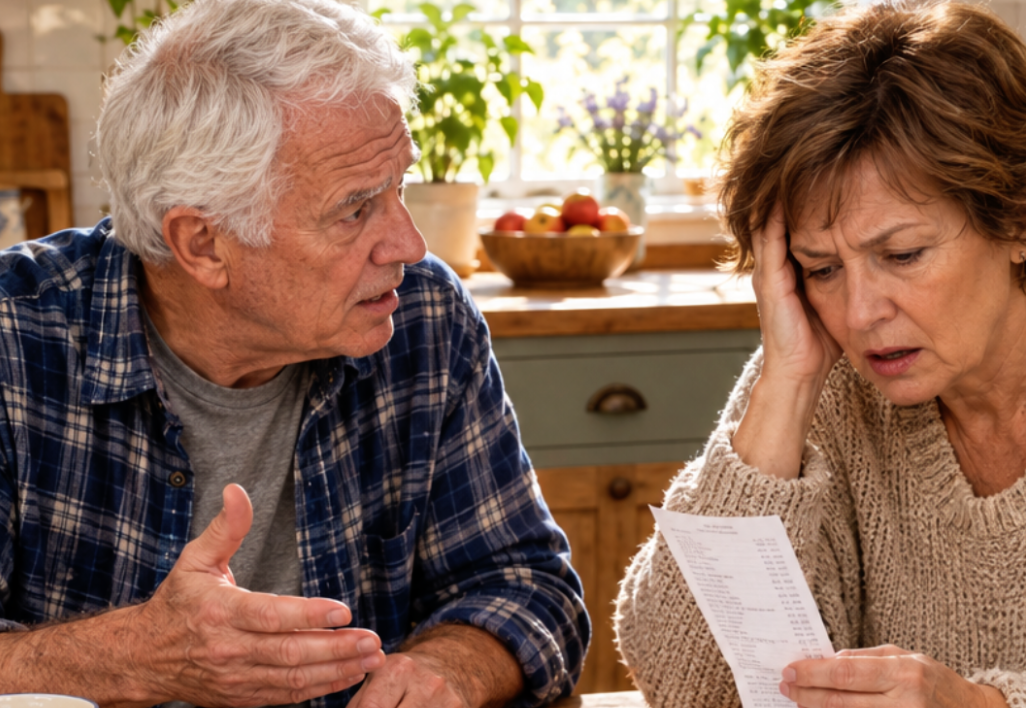
“Give me back my pension, I’ll decide for myself who to help!” Dad suddenly said quietly, and the room fell silent.
Lena was holding a ladle. A drop of sauce landed on the tablecloth, but my sister didn’t even notice.
“Dad, we’re just talking about it,” she said.
“You’ve already talked it over. Without me.”
I glanced at my nephew. Dima was hunched over his plate. Just a minute ago he had been telling us how expensive his car repairs would be, and Lena had promised to transfer thirty thousand on Friday.
“I thought you had it,” I said to my sister.
She put the ladle back in the bowl.
“We’ll find it. Dad always helps Dima out.”
Dad pushed the breadbox away.
“Not this time.”
Dima looked up.
“Grandpa, I didn’t ask you.”
“I know. Your mom promised you.”
We sat in Dad’s kitchen. Nothing festive: we all came after work, Lena brought cutlets, I brought a salad. Dima had just stopped by to pick up his winter wipers from the storage room and stayed for dinner.
Dinners like this used to end with tea and talk about the country house. Now everyone stared at the table as if Dad had just shattered a teacup in the middle of it.
“Give me back my card,” he added.
Lena turned pale.
I knew Dad’s bank card was with my sister. Two years ago, when he was having trouble seeing and getting ready for eye surgery, he’d asked her to pay his bills and buy groceries. Later, his vision improved, but the arrangement stayed the same.
I lived on the other side of the city and visited less often. Lena was closer, stopped by after work, and always knew what laundry detergent Dad was running low on. It felt right not to interfere with everything she did every day.
Dad never complained either. Whenever I checked if he needed anything, he always said, “Everything’s fine.” On my birthday, he gave me an envelope with money. The handwriting on the envelope was Lena’s.
“We’ll talk after dinner,” my sister suggested.
“I’m asking now.”
“Give me back my pension, I’ll decide for myself who to help!” Dad suddenly said quietly, and the room fell silent.
“My wallet’s in the hallway. I’m not running away.”
She tried to smile. Dad didn’t smile back.
I put down my fork. Up to this moment, I’d wanted to smooth things over—Lena was tired, Dad could be sharp, and Dima was just here by chance. But Dad sat so straight that my usual “let’s all calm down” got stuck in my throat.
He was calm already. Speaking almost in a whisper.
“Maybe we should figure out what happened first?” I asked.
“Nothing happened,” Lena replied quickly. “Dad’s upset. I didn’t give him money for the workshop today.”
“Why not?”
“Because it’s the end of the month. Bills, groceries. I told him: next week.”
Dad looked over at my nephew.
“And where are you getting thirty thousand for the car?”
My sister adjusted the breadbox.
“That’s different. Dima can’t get to work without the car.”
“I’ll get there,” he muttered. “By bus. Just takes longer.”
Lena shot him an angry look. My nephew lowered his eyes again.
For the first time, I noticed a wooden boat on the windowsill. It was small, about the length of a hand. The hull was smoothly polished, and a thin stick stood where the mast should be.
“Did you make that?” I asked Dad.
He nodded.
“In the workshop?”
“There. I go on weekends.”
I didn’t know anything about the workshop. I’d only heard that sometimes he met with the neighbor. I thought they played chess or watched soccer.
“Four thousand eight hundred for three months,” Dad explained. “That covers the space, tools, and someone there to help. The materials are extra, but not much.”
“How long have you been going?”
“Since winter. At first I was just watching. Then they gave me some scraps and I tried it out.”
Lena pressed her lips together.
“But can’t you do it at home? You’ve got a whole cabinet full of tools here.”
Dad didn’t answer right away. He took a piece of bread from the box, turned it over in his hands, and put it back.
“I could do it at home. But I want to do it there.”
“How many people go there?”
“Six of us. People come and go at different times. One of them, I used to work with at the factory.”
“See,” my sister glanced at me, “they’ve got their own conversations. And then it starts: one wants to borrow something, another needs help.”
“Lena, nobody there has ever asked me for money.”
“Yet.”
Dad fell silent. I realized he’d heard this argument before, probably many times.
“Have you ever gone there with any of us?” I asked.
“No.”
“Did you want to show us?”
He glanced over at the boat.
“I sent Dima a photo. He gave me a thumbs up. You’re always busy, Lenka thinks I’d be better off at home.”
I felt like grabbing my phone right then to check for any unread messages. But that felt like just one more thing moving away from him. So I stayed sitting.
“I’d like to see it,” I said.
“Come by. I just want to sort the payment out on my own first.”
Lena eyed me seriously.
“I don’t mind. But we can’t do everything at once. We need to count things up.”
“Have you counted my money too?” Dad asked.
“Dad, please, don’t start.”
He got up from the table. Slowly walked into the other room and came back with a small notebook.
“I did my own counting, too.”
My sister leaned back in her chair, frustrated.
“Ira, do you see this? I run around every day, and now I have to report in as well.”
I felt ashamed. Not just in front of her, but Dad as well. I would come with a salad bowl and think that was the end of my responsibility.
“I do see how much you do,” I answered. “But Dad is asking for his own card.”
“You too, now?”
Dad opened the notebook to a page filled with large numbers. He named his pension, and his expenses for the apartment, medicine, and food. Not down to the last penny—a range was listed next to food.
“This is what I need. The rest, I want to decide for myself.”
“But what if something happens?” Lena cut in. “Where’s the backup?”
“I’ve got a backup. You know that.”
“That needs to be protected too.”
I knew about Dad’s savings. A small amount in a separate account. He’d kept it since he was working. We never touched it.
Suddenly my sister turned to Dima.
“Can you give us a moment?”
My nephew set his fork down.
“I can. I just don’t want it to be because of the car…”
“Dima.”
He got up and left for the other room. The door stayed a little open. Lena watched him go, then looked back at Dad.
“Why in front of the kid?”
“He’s twenty. And I wasn’t arguing.”
“Now he thinks I’m taking something away from you.”
Dad ran his finger along the edge of the notebook.
“What would you call it, if I ask for my own money and you’re the one who decides if I can have it?”
My sister pressed her lips together. I could tell she was about to cry, and I felt that old urge to take her side immediately. Lena really did haul in groceries, take Dad to the doctor, organize the bills.
But not a single grocery bag explained why the boat on the windowsill had to wait for my sister’s permission.
“Lena, how much is in the account right now?” I asked.
— I don’t remember.
— Can you check?
She grabbed her phone, unlocked it, and turned the screen toward Dad. He put on his glasses. I didn’t peek over his shoulder.
— Here, — he said. — It’s enough.
— Until Friday, — my sister corrected.
— I never promised Dima anything for his thirtieth.
She put her phone on the table a bit too sharply.
— Fine. So, I’m the one to blame.
I was already tired of that word before she could even finish saying it.
— I’m not asking you to pay for the car. I’m asking why you already promised in Dad’s name.
— Because he always helped before.
— Did you ask today?
Lena looked at Dad.
— I was going to. After dinner.
— So, you promised first, then planned to ask, — he clarified.
The TV suddenly got loud in the next room. Dima turned it up, maybe so he wouldn’t hear us — or so we’d think he didn’t.
I stood up, closed the door, and came back to the table.
— Dad, do you want to pay for everything yourself?
— I do. If I can’t manage, I’ll ask. My hands work just fine.
— That’s not what I…
— I know, Ira.
His voice softened. It only made me feel worse.
— You know, you don’t have to ask Lena for everything I need. You can just ask me.
I nodded. Dad didn’t say more. He turned and looked at my sister.
— Where’s the card?
Lena slowly got up, headed to the hallway, and came back with her wallet. She pulled out the card, but set it down next to her.
— Fine. Then do everything without me.
— What do you mean? — I asked.
— The bills, the shopping, everything. Since I’m doing it wrong.
Dad was quiet for a long time. I could tell her words struck a nerve. He was used to the help, to groceries magically showing up, bills just disappearing off the table.
My sister saw it, too. She didn’t move the card an inch.
I wanted to just say: “I’ll handle it all.” But that would be making the decision for Dad again. Only this time it would be me, from across the city.
— Dad, what do YOU want? — I asked.
He looked at me and sighed deeply.
— Let her give it back, first.
My sister kept holding onto the edge of the card.
— Dad, it’s not like I’m being difficult on purpose. Yesterday you forgot the oil. You went to the store for oil and came back with just bread. Then I had to go again.
Dad tiredly rubbed his cheek.
— I forgot. But you forget bread sometimes, too.
— I’m not talking about bread. I’m talking about how it’s always on me.
I glanced at my sister. For the first time that evening, she was talking about what really bothered her, not just about being unappreciated.
— Let me take care of the heavy groceries, — I offered. — Once a week, with Dad. It’s easy for me since I have a car.
Dad raised his hand.
— Hold on, don’t start dividing things up just yet. I’ll write a list. If it’s too much, I’ll ask Irina for help. If it’s just a little, I’ll go myself. You don’t need to go to the store for me every single day.
— And the bills? — Lena pressed.
— I’ll figure it out. Show me once where you keep track of everything. If you don’t want to, I’ll ask Irina.
My sister looked at me. I nodded.
— I’ll show you, — she said quietly. — The electricity is separate.
— I know.
He didn’t try to snatch the wallet from her. He just sat there, waiting for her to let go on her own.
Lena slowly slid the card over. Dad took it, turned it in his fingers, then slipped it into his shirt pocket.
— I’ll go to the bank tomorrow myself, — Dad added. — I want everything to come straight to me. Those messages, how much is left, and all that.
Lena nodded, staring at the table.
My sister didn’t storm out, and Dad didn’t gloat. The card was simply gone from her side of the table and now in his.
Lena wiped a drop of sauce from the tablecloth with her finger.
— Now I have to explain things to Dima.
— You promised, — answered Dad.
She stood up and went to the other room. I stayed with him in the kitchen, listening to their muffled voices.
— Want some tea? — he asked.
— I do. Dad, why didn’t you tell me before?
He poured water into the kettle and put it on the stove.
— I did. I told Lena. At first, just small things. Money for fishing, for supplies. She always waited, then gave it. And I waited, like a kid.
— You could have told me.
— You always ask, ‘Did Lena buy it?’ And I say, yes, she did.
I lowered my eyes. That was my usual phrase. It was a convenient way to check if everything was okay without having to change my own plans.
Dad took out two cups. I took one from him and set it on the table.
— How about I go to the store with you on Sunday? If you need something heavy.
— Saturday would be better. I have the workshop on Sunday.
— Saturday it is.
— Just in the morning. I want to spend some time with the boat in the afternoon.
For the first time in a long while, we were talking about his plans, not just about what was convenient for me to stop by.
Dima came out of the room, walked over to his grandpa, and stopped.
— I’ll figure out the repairs myself. I’ll do it bit by bit. Don’t worry about it.
— I’m not worrying.
— Mom just wanted to help.
— I know.
My nephew looked at the boat.
— Is this yours? Cool.
He picked it up, but Dad quickly reached out his hand.
— Careful. The mast isn’t secured yet.
Dima put it back. He wasn’t offended.
Lena came out, fully dressed, holding an empty container.
— Dad, can you put the cutlets in the fridge?
— I will.
She kissed him on the cheek—quickly, awkwardly, barely leaning in. She nodded at me and left with her son.
I helped wash the dishes, but didn’t linger as long as usual. Dad walked me to the door, reminded me about Saturday, and went back to his room to work on the boat.
My sister called the next day.
— So now you’re the good one. You came, made me feel guilty, and left.
I knew this conversation was coming.
— I didn’t mean to make you feel guilty.
— But you did. Now Dima won’t take money from me. Said he wants to do things himself.
— Maybe let him try?
— He just started working.
Lena sighed. I could hear her sorting something on the table—probably receipts she always kept in a separate pile.
— Do you think I was keeping anything for myself?
— I don’t think that.
— Everything was for Dad. For groceries. For his grandson. You got gifts from him too…
— I know. But you made the decisions.
My sister paused.
— Should I not visit him at all now?
— You should. He’s waiting for you. Just ask him what he needs.
— That’s easy for you to say.
— No, it’s not. I got used to you handling everything too. On Saturday I’m going shopping with him.
She gave a short laugh.
— You’ll see.
We went shopping on Saturday. Dad walked to the car with his list. I helped carry the heavy stuff, but at the store, he did his own choosing. He picked a different bread than Lena usually bought and chose smaller apples.
— They’re cheaper,— I noted automatically.
— They taste better. The nice-looking ones aren’t, they’re like cotton.
I didn’t argue.
At the register, he took out his card. For a second, he hesitated and turned it the wrong way, but the cashier calmly pointed it out. Dad paid and put the receipt in his pocket.
Before, I would’ve rushed to do it for him—so I wouldn’t hold up the line. Now, I just packed up the groceries.
At home he invited me to stay for tea, but I was in a hurry. At the door, I ran into Lena. She was carrying a small bag.
We both stopped.
“I’m just here for a minute,” my sister said in advance.
Dad came out into the hallway.
“What did you bring?”
“Nothing. Just picking up my sweater. And wanted to ask about tomorrow. When will you be at the workshop?”
“At eleven.”
“Want a ride? It’s on my way.”
He thought for a moment.
“Yeah, give me a ride.”
I left them together. I walked slowly down the stairs—this time, I didn’t want to hear Lena giving orders, but to hear them actually agreeing on something. But behind the door, it was already quiet.
On Sunday, Dad sent me a photo of the boat. It now had a sail—white with a thin blue stripe. At the bottom it said: “Now it’s drying.”
I called him in the evening.
“Did you pay for the workshop?”
“I did.”
“Did everything work out?”
“It did. Lena drove me. Then she stopped by to see where we’re working.”
He paused, and I heard a faint tapping—he was probably moving something on the table.
“I’m going to give Dima five thousand,” Dad added.
I almost asked why again, but held myself back.
“You decided?”
“Yes. I won’t agree to thirty. But I can give him five. As a gift. Not a loan.”
“Okay, Dad.”
“I’ll call him myself.”
I said goodbye and hung up. A minute later, Dad’s message to Dima popped up in the family chat: “Come over tonight. Let’s have dinner.”