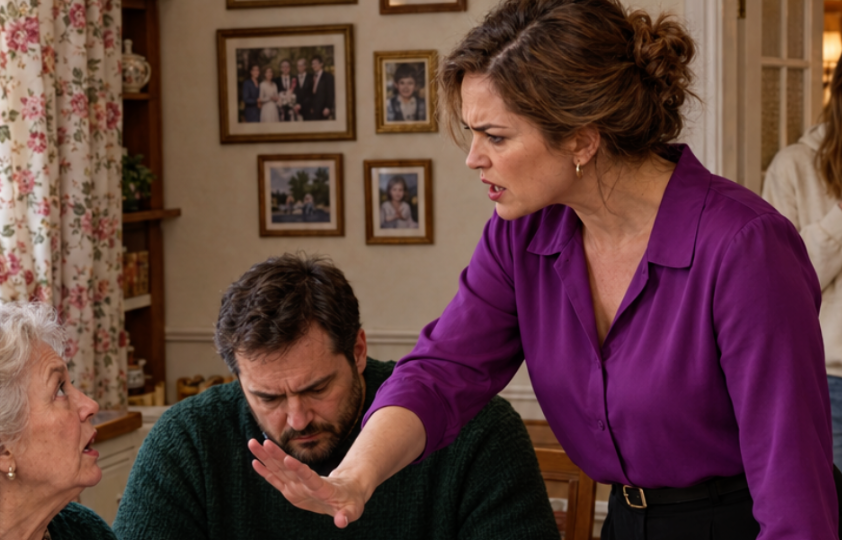
“A million and a half?” Natalia Sergeevna slammed her cup down so hard that tea splashed onto the tablecloth. “Since when did our family ever have that kind of money? And you didn’t tell me?”
“I only found out three days ago,” Olga said, wiping the table with a napkin. “Uncle Grisha left it to me. A notary from Kineshma called.”
“Three days!” her mother-in-law threw up her hands. “You kept silent for three days! And here we are, counting every penny. I had to borrow money from the neighbor to get Anya ready for school, while you have a million and a half stashed under your mattress!”
“It’s not under the mattress. And it’s not mine. Not yet. I don’t actually inherit for another five months.”
The family was having dinner around the round table in the two-room apartment on Korabelnaya, the one Natalia Sergeevna got from the factory back in Soviet times. Four of them lived there: Natalia Sergeevna, her son Dmitry, his wife Olga, and their daughter Anya, who just turned thirteen. Olga worked as a nurse at a clinic on Svoboda. Dmitry drove for the bread factory. Their salaries added up, but disappeared just as quickly: an unexpected dental bill for Anya, winter coats, Natalia Sergeevna’s blood pressure medicine.
Uncle Grisha was Olga’s mother’s brother. He lived in Kineshma, in a wooden house on Zarechnaya Street. He worked forty years at the textile factory, then spent retirement raising chickens and selling seedlings at the market. Olga would visit him twice a year—at Easter and for his birthday in August—bringing medicines, warm socks, and photos of Anya. Uncle Grisha was the only person in her life who never asked why she was still living with her mother-in-law.
“Alright,” Natalia Sergeevna sat up straight, “listen here. A million and a half isn’t just your money—it’s the family’s money. Anya is growing up, she needs a tutor, English lessons, then comes college. Dima wanted a truck so he could do side work. He can’t manage without his own vehicle. And you and I are sharing this apartment, have you forgotten, because we can’t afford to rent. Don’t you think it would be fair to put some of that inheritance toward something for all of us?”
“Uncle Grisha left it to me,” Olga said. “Only my name is in the will.”
“He left it to you!” her mother-in-law scoffed. “Now listen to her—such a lady! You’ve been married to my son for eight years. By law, everything you have is half his. And he’s my son, so I’m part of this too.”
“An inheritance is personal property,” Olga said, trying to sound calm. “It’s not shared. I’ve checked with a lawyer.”
“A lawyer! She’s checked!” Natalia Sergeevna turned to her son, who had been quietly scrolling news on his phone this whole time. “Dima! Do you hear what your wife is saying? She’s already gone to lawyers—against you and me, by the way.”
Dmitry looked up. He had a kind face, gentle features, and a habit of nodding first, then thinking later.
“Olga, but why didn’t you tell us for three days? You know how upset Mom gets. You should have come to us right away, we could have talked it out.”
“Talked it out?” Olga looked at her husband. “With whom? You?”
“Well, with me. With Mom. We’re a family.”
“Exactly,” echoed Natalya Sergeyevna. “Family. Everything’s shared in a family. That’s how I’ve always lived. You get your paycheck—you put it in the communal pot. Everyone gives what they can. Otherwise it’s not a family, just a shared apartment.”
Olga stood up and began to gather the plates. Her hands trembled a little, but she didn’t rush.
“Natalya Sergeyevna,” she said, standing at the sink without turning around, “I’ve lived in your apartment for eight years. Eight years I’ve given you twenty thousand a month—‘for the household.’ You say it’s all for the communal pot. But I haven’t noticed Dima giving you a single extra kopeck. And have you noticed that my salary is forty-two, while his is thirty-eight? So the pot is shared, but the contribution is just mine?”
“Oh, so that’s how you’re going to talk to me now!” Natalya Sergeyevna shoved her chair back with a crash. “And who let you into this apartment? Who gave you a place to live? You came here from a dormitory, got married in just a sweater! I took you in like my own! And now, when you’ve got some money, suddenly your nose is in the air! ‘You have no right,’ ‘it’s not your money’! Well, for your information, my son absolutely has a right to that money!”
“Mom,” Dmitri stood up. “Mom, that’s enough. Please don’t yell. Anechka can hear you from her room.”
Anechka was indeed standing in the doorway, headphones around her neck, staring at the adults with wide eyes.
“Grandma, why are you shouting?” she asked quietly.
“Go to your room, Anya!” Natalya Sergeyevna waved her hand dismissively. “This doesn’t concern you. The adults are talking.”
The girl didn’t move. Olga walked over and hugged her around the shoulders.
“Anechka, please go to my room. I’ll be there in a minute.”
“You just don’t get it,” hissed Natalya Sergeyevna after her. “You don’t understand anything! I pulled you out of the gutter, made a person out of you, and you—you’re a snake. A snake! I always told Dima: don’t marry someone from out of town. Outsiders are always out for themselves. And just look at what happened!”
Dmitry stood in the middle of the kitchen, looking lost.
“Mom, come on, really now. Olga, please come back. Let’s talk calmly.”
“Calmly?” Olga stopped in the hallway. “Fine. Calmly. Natalya Sergeyevna, you want me to give part of my inheritance to your son—and to you? And what will you give me in return? A share of this apartment?”
“What?!” her mother-in-law gasped. “A share? In my apartment?! I worked my whole life for it! I privatized it myself back when privatization was possible! Why should you have any claim at all?!”
“Exactly,” said Olga. “I have no claim. The apartment is yours. And the inheritance is mine. It’s simple logic.”
Natalya Sergeyevna opened her mouth, then closed it again. Then she slowly sank into her chair.
“So that’s really how it is,” she said quietly, almost in a whisper. “So you just… don’t think we matter at all. The whole family. Dima. Anechka. Me. We’re nobody to you. Just an empty space.”
“Natalya Sergeyevna, I never said that.”
“What did you say then? You said—it’s mine. Only mine. And the eight years we fed you, gave you drink, watched Anechka while you worked shifts—that doesn’t matter? That doesn’t count for anything?”
“Mom,” Dmitri sat down beside his mother and put his hand on her shoulder. “Mom, please. Don’t.”
“No, let her speak!” Mother-in-law looked up at Olga from below, tears in her eyes—whether real or not, Olga still couldn’t tell. “Let her say what she thinks about the family she joined. About a mother who welcomed her. About the son who loves her. Speak!”
Olga glanced at her husband. He wasn’t looking at her or his mother. He stared down at the table.
“I’m going to Anya,” she said.
In the room Olga and Dmitry had shared for eight years—fourteen square meters, a wardrobe, sofa bed, and a table by the window—Anya was sitting on the windowsill, swinging her legs.
“Mom,” she said. “Does grandma really think you’re bad?”
“Grandma thinks she’s right. That’s not the same thing.”
“And Uncle Grisha? Did he really leave you a lot of money?”
“He did.”
“Are we going to move now?” The hope in her voice was careful. “To our own apartment?”
Olga sat down next to her. She hugged her daughter’s shoulders. Outside, the streetlights glowed above Korabelnaya, and the wind chased the first leaves across the pavement.
“I don’t know, Anya. Honestly—I don’t know.”
She went to bed late that evening. Dmitry came in an hour later, quietly changed his clothes, and lay down on his side of the bed.
“Olga,” he said in the darkness.
“Mmm.”
“Do you really want to move out?”
“I really want our own apartment. Don’t you?”
He was silent for a long time.
“I don’t know,” he finally said. “I’ve lived here all my life. Everything here is familiar.”
“Familiar doesn’t always mean good.”
“Maybe. But mom isn’t mean. She’s just scared. She’s been alone her whole life. Dad left when I was three, you know that. She raised my sister and me by herself. Then my sister moved to Kazan, and mom stayed here with us. She’s terrified of being abandoned.”
Olga turned toward her husband.
“Dima. She’s afraid of being abandoned. But I’m afraid I’ll keep giving up half my salary to her until I retire. That Anya will never get her own place. That you and I will never live our own lives, just because your mother is scared we’ll leave her. Don’t you see how that’s not normal?”
“Normal, not normal,” he mumbled. “Everybody lives like this.”
“Not everybody.”
She turned to face the wall. Her chest tightened, just like after a long shift.
In the morning, Natalia Sergeyevna was pointedly polite. She poured Olga some tea and set some cookies on a plate.
“Olechka,” she said, “I lost my temper yesterday. Forgive me, I’m just an old woman. My nerves. I really do wish you well. You have to understand: one and a half million is a lot of money. You need to spend it wisely. You know how it is—someone gets a pile of money and wastes it on nonsense.”
“I don’t plan on wasting it.”
“That’s exactly what I mean! Let’s do this: you inherit the money, and we decide together what to do with it. For example, a tutor for Anya. A car for Dmitry. You should buy yourself a fur coat. For me—something for treatment. Isn’t that fair? A little something for everyone.”
Olga looked at her mother-in-law over the rim of her cup.
“Natalia Sergeyevna. How much will you personally contribute from your pension toward Anya’s tutor?”
“Me?” Natalia Sergeyevna was taken aback. “Well… I help in other ways. I buy groceries. I watch Anya.”
“And I pay for utilities, internet, Anya’s music school. And twenty thousand a month to you ‘for housekeeping.’ Out of forty-two. Do the math and see what’s left.”
“Alright,” said my mother-in-law, setting down her cup. “Here we go again. More counting, more lists. You keep treating me like your accountant. But I’m not—I’m your mother.”
“You’re my mother-in-law,” Olga replied. “And I’m not your real daughter. That hit me yesterday. You know what? It goes both ways. You’re not my real mother either.”
She stood up and grabbed her bag.
“I’m heading to my shift. We’ll talk tonight.”
The shift at the clinic dragged on and on. Patients kept coming: coughs, high blood pressure, papers, vaccines. Olga gave injections, filled out charts, listened to complaints, all while her mind wandered. That evening, when she finally left the clinic, Dmitry was waiting for her in the parking lot, leaning against his old Solaris—the very one that was supposed to turn into a delivery van.
“Olga, get in. We need to talk.”
She got in.
“Mom called my sister tonight,” Dmitry said, not looking at her. “Lenka. In Kazan. She cried about us wanting to abandon her. Said you’re taking her money. Lenka said she’s coming here.”
“When?”
“Saturday. With her husband.”
“Great.”
“Olga, don’t be like that. Lenka’s alright. She’s just standing up for Mom.”
“Dima, your sister hasn’t set foot here in ten years. Not for Anya’s birthday, not for New Year’s. And now all of a sudden she cares so much?”
“Well… Mom asked her to come. She said she needs support. Said you’re putting pressure on her.”
Olga fell silent. Outside the car, the stoplight shone red, and people crossed—a mix of those heading home from work and those off to the shops.
“Dima. Do you love me?”
“Well… of course I do.”
“Then answer me honestly. If I told you: give me half your monthly salary or I’ll leave you. Would you give it to me?”
“That’s different. You’re my wife. Mom’s my mom.”
“Exactly. I’m your wife. And she’s your mom. When I say I’m struggling, you stay silent. But if your mom says she’s struggling, you rush to help her. Think there’s a difference?”
Dmitry gripped the steering wheel tightly.
“Olga, please don’t make me choose. Between my mother and my wife. That’s just cruel.”
“And living with a mother-in-law who insults you every day isn’t cruel? You know what, Dima? I’m done. I’ve put myself last for eight years. For you. For Anya. For your mother. Enough. This inheritance is my chance. And I’m not giving it up. Not to you, not to your mom, and not to your suddenly concerned sister. Got it?”
He stayed silent.
“Got it,” she said for him. “Drive me home.”
There was a surprise waiting for them at home. In the hallway stood two big suitcases. A strange voice drifted from the kitchen.
“Lena’s here,” Dmitry said quietly.
Lena, Dmitry’s older sister, was a tall blonde with a hard mouth and sharp eyes. She walked into the hallway in a silk robe, as if she already lived there.
“Oh look who finally showed up!” she said. “Well hello, our golden one. The heiress.”
“Hello, Lena. Long time no see.”
“Well, I guess we’ll be seeing each other a lot more now.” Lena crossed her arms. “Mom told me everything. Honestly, I was shocked. A million and a half! And yet here you sit, in a two-room flat, acting like nothing’s going on with these honest people.”
“Lena,” said Dmitry, “let’s not start a fight right at the door.”
“Why didn’t you just say it at the door?” Lena raised her voice. “She’s living here for free, eating our food, and now wants to quietly take everything from us. Olga, do you realize you just can’t act like this?”
“Like what?” Olga calmly took off her coat. “What am I doing wrong?”
“Like this!” Lena waved her hand. “In a family, everything is shared! Aren’t we a family? Mom took you in when you were a nobody—a waitress at a café! And now you’re a nurse. And why? Because Mom convinced you! Because she told you to study! And now you’re turning your back on her!”
“Lena, I enrolled in medical college myself. I graduated on my own. And I’m working myself.”
“Oh, yourself!” Lena rolled her eyes. “So this is how you talk now! Don’t try to persuade me, I’m a simple person. I’m here now. And I’m not leaving until we sort this out. We’ll show you what a real family is.”
Olga looked at Dmitry. He was standing by the wall, looking like he’d rather be anywhere else—like on the moon.
“Dima,” she said. “Did you know they were coming with suitcases?”
“Well… Lenka said just for a couple of days.”
“A couple of days,” Olga repeated. “With suitcases. For a couple of days.”
“So what?” Lena smirked. “We’re not in any rush. My husband and I are on vacation. We’ll relax at Mom’s—and keep an eye on you, because who knows what you might do. Maybe tomorrow you’ll squander our entire fortune on some freeloading guy!”
“Lena!” Dmitry raised his voice. “That’s enough!”
Olga went to the room. Anechka was sitting on the bed with her textbook.
“Mom,” she whispered, “Aunt Lena said if you don’t give them the money, we’ll all lose our apartment. Is that true?”
“No,” Olga said. “That isn’t true. And you know what? I promise you—we’ll find our own place to live. And no one will ever kick us out of it. Ever.”
On Saturday, they held a family meeting. Natalia Sergeevna took the head spot—in her chair by the TV. Lena and her husband Andrey, a quiet man with a big belly, were on the couch. Dmitry stood by the window. Olga sat on a chair by the bookcase. Anechka was sent to the neighbor’s.
“So here’s the deal,” Natalia Sergeevna started. “We’re here to settle things nicely. Olya, we don’t blame you. We understand—money is always complicated. But try to see it this way: we’re one family. We need to decide everything together. So here’s my suggestion: you accept the inheritance, and then we split it equally. Me, Lena, Dima, you, and little Anechka. Everyone gets three hundred thousand. Sounds good, right?”
“Family is wonderful,” said Olga. “But why are you dividing my inheritance and not your own apartment?”
“What does the apartment have to do with it!” Lena threw up her hands. “That’s Mom’s! She earned it at the factory. But the inheritance—that’s a whole different thing. You just got lucky! So you have to share.”
“Why?”
“Because!” Lena was shouting now. “Because we’re family! Because Mom fed you! Because, for your information, we pulled you out of the mud! And the moment there’s money, suddenly it’s ‘not yours!’ Who do you think you are without us? Where would you be? Nowhere!”
“Lena,” Dmitry said. “Seriously.”
— And you be quiet! — Lena turned to her brother. — You’re making us look bad! Your wife completely controls you and you just sit there in silence! Some man you are! You should stand up to her and say: give us the money! Right now! It’s ours!
— Lena, calm down, — Andrei said. Everyone turned to look at him. He rarely spoke.
— Oh, you too! — Lena waved at her husband. — Everyone’s against me! All of you! I’m the only one who cares about justice!
Olga stood up.
— Natalya Sergeevna. Lena. Andrei. Dima. — She spoke evenly, but her voice trembled with anger. — I’ve listened to all of you. Carefully. Here’s what I have to say. First, Uncle Grisha left this money to me. Not the family. Not Dima. Me. Because I visited him. Because I helped him. Because he loved me. Second, I’m not planning to give any of it to anyone. Not to you, not Lena, not Dima. It’s my money. I’ll buy an apartment for myself and Anechka. Third, Natalya Sergeevna, I am grateful that you took me in. But it wasn’t for free. For eight years I paid you twenty thousand a month. That’s a hundred and ninety-two thousand a year. Over eight years — that’s over one and a half million. I’ve paid you back everything you ever spent on me. And then some.
— What?! — Natalya Sergeevna jumped up. — One and a half million?! What are you talking about?!
— One and a half million, — Olga repeated. — That’s exactly the amount you now want to take from me. I paid you for eight years. Now I just want to reclaim what’s mine. At least my sense of justice.
— How dare you! — Natalya Sergeevna gasped. — I’ll… I’ll… I’ll throw you out!
— Go ahead, — Olga said. — But first explain to me: why should I give my money to people who have only humiliated me? For eight years I heard I wasn’t really family, I was an outsider, just after money. For eight years I was told Dima could do better. For eight years I lived feeling like a nobody. And now I finally have a chance to start over. Do you really think I’ll give it up to you? For what? For treating me like nothing? No. I’m not giving it up. Not now, not ever. And if Dima wants to stay with me — he will stay. If not — then let him go. But the money is mine. End of discussion.
The room fell silent.
Lena opened her mouth but said nothing. Andrei looked at Natalya Sergeevna. Dmitry looked at Olga. Natalya Sergeevna stared at her son.
— Dima, — she said. — Tell her. Tell her she’s wrong.
Dmitry stayed silent.
— Dima!
He slowly raised his head. Looked at his mother. At his sister. At his wife.
— Mom, — he said. — Olya is right.
Natalya Sergeevna slumped down in her chair. Lena gasped:
— Dima! Are you out of your mind?!
— No, — Dmitry replied. — I think this is the first time in eight years that things are finally clear in my mind. Mom, Olya is right. She’s been paying you all this time. I haven’t. She worked two jobs. I didn’t. She wanted her own place, but you always nagged her about it. And now that she finally has the money, you want to take it away from her. That’s not fair. And I’m not going to be part of it anymore. If Olya decides to leave, I’ll go with her. And if you want to keep us, then apologize. And give her back everything she paid you. At least some of it.
“Dima!” Natalia Sergeevna clutched her heart. “You’re killing me! You’re sending me to an early grave!”
“Mom,” Dmitry said, “you’re not going to die. You’re strong—stronger than all of us. You’re just used to everyone around you owing you something. But I don’t owe you anymore. I helped because I love you. But helping doesn’t mean giving up everything. And I won’t do it anymore.”
Lena jumped to her feet.
“Fine then!” she shouted. “Live however you want! Just remember, Mom will never forgive you for this! And neither will I! You’re not my brother and sister anymore! You’re nothing to me!” She grabbed Andrey’s hand. “Let’s go! We’re leaving! I’m done with this madhouse!”
“Lena,” Andrey said, “wait.”
“What?! You’re against me too?!”
“I just want you to calm down,” Andrey said. “And think about it.”
“Think for yourself!” Lena stormed off to her room and slammed the door.
Natalia Sergeevna sat in her armchair, and her face looked like she’d just been struck. Olga watched her and didn’t feel pity or triumph—just exhaustion.
“Natalia Sergeevna,” Olga said, “I’m not going anywhere until I buy my apartment. I need time. You decide: if you want us to live together peacefully, let’s try. If not, I’ll move out. But the money is mine, and I’m not giving it to anyone. Is that clear?”
Her mother-in-law didn’t reply. She just turned toward the window.
A week later, Olga found an apartment—a one-room place in a new building on Burnakovskaya. Forty-two square meters, fifth floor, windows facing the Volga. The price: three million two hundred thousand. She was short two hundred thousand. Olga borrowed it from a colleague, Irina Vasilievna, who had worked at the clinic for thirty years and always said Olga needed to move out from her mother-in-law’s. Irina Vasilievna lent her the money without a receipt.
“Pay me back when you can,” she said. “Most important is that you leave. I know these so-called ‘families.’ My mother-in-law nagged me all my life too. And then she died. And you know what? I still don’t feel sorry for her.”
Olga signed the paperwork at the end of November. She got the apartment keys on Friday, right before Mother’s Day. Dmitry came home from work, and she told him:
“That’s it. I bought it. I have the keys. We’re moving on Saturday.”
He nodded silently.
Natalia Sergeevna found out that evening. She walked into Olga’s room without knocking, her hand pressed to her heart.
“So, you bought an apartment,” she said. “And you didn’t even tell me.”
“I’m telling you now.”
“So I’ll be left alone here. In this apartment. With my pension. With my medicines. Like a stray dog.” Her voice trembled. “Olya. You have to understand—I’m not your enemy. I’m just… I’m just scared. I’ve been scared my whole life. Scared I’d be abandoned. That I’d end up alone. That I wouldn’t cope. And now… you’re going to leave. And Dima will leave. And Anechka. And I’ll be here. Completely alone.”
Olga looked at her mother-in-law and saw, for the first time, what she’d missed before: an old woman in a faded robe, hands trembling, eyes red. And for the first time in eight years, she felt sorry for her.
Natalya Sergeevna, I’m not abandoning you. I’m just moving out. That’s different. You can still visit us. Come over on Sundays. But we’ll live separately. This isn’t cruelty—it’s normal. Grown children live on their own. You didn’t want Dima living with you until he was forty, did you?
“I did,” Natalya Sergeevna replied. “I wanted him to always be close by. I wanted everyone to stay together. I didn’t want anyone to leave.”
“That’s not how it works,” Olga said. “That’s not how it should be, Natalya Sergeevna. People shouldn’t live together just because someone is afraid to be alone. People should live together because they enjoy being with each other. Did you enjoy living with us?”
Her mother-in-law stayed silent for a long time.
“I don’t know,” she finally said. “I never really thought about it. I just… I just lived the way I was used to. The way I was taught. Back in my day, that was normal. Everyone lived together. Everything was shared. I didn’t know it could be any other way.”
“Now you do.”
Natalya Sergeevna went off to her room. That night, Olga heard her walking around and talking to herself.
The move was planned for Saturday. On Friday evening, Lena arrived—no suitcases, just herself. She stood in the doorway, and she didn’t look confrontational at all.
“I’m here to talk,” she said. “Is that okay?”
They sat down in the kitchen. Lena nervously turned her cup in her hands for some time.
“I’ve been thinking,” Lena said. “About what I said—the stuff about ‘dirt’ and ‘nobody.’ I went too far. Sorry.”
Olga raised an eyebrow.
“Are you serious?”
“Well, why not? I wasn’t always like this,” Lena shrugged. “I grew up in this apartment. With mom, who made all the decisions. I got used to her calling all the shots. Then I moved to Kazan, got married, and you know what? Andrey—he’s not Dimka. He told me straight away: ‘Lena, we live on our own, our money is separate.’ At first I was hurt. But then I realized—it’s great. No one tells you what to do. No one counts your pennies. And when mom visits, she’s just a guest, and she behaves herself. She knows: this is our place.”
“Then why did you come here and start bossing me around?”
“Because mom was crying on the phone. I panicked. Thought you were really kicking her out. And then I just lost it. I’m just like mom—shout first, think later.”
Olga smirked.
“Yeah, that’s obvious.”
“Listen, I’m not going to ask for money. I get it now, you’re right. It’s your inheritance. Your apartment. Your life. But I have a request. Don’t abandon mom. She’s complicated. She’s been alone her whole life. She doesn’t know any different. She’s not mean. She’s just… a bit clueless. Not in terms of intelligence, but emotionally. She doesn’t understand that you can love without controlling. That’s how she was taught. Let’s try to be better. I’ll visit, you’ll visit, Dima will visit, we’ll bring Anechka. And mom will get used to it eventually. Okay?”
Olga looked at Lena. Suddenly, she realized Lena was being truly sincere.
“Okay,” she said.
They moved on Saturday. The apartment was empty, with white walls and the smell of fresh plaster. Dmitry walked from room to room, smiling.
“Ol, look. The kitchen. A real kitchen. Nine whole meters.”
“I see.”
“And what’s this? A balcony? A real balcony?”
“A real one.”
“Olya, I’ll take care of everything here. The shelves, the wardrobes—I’ll handle it all myself. Everything will be done.”
Anechka chose her room—it was small, but had a gorgeous view of the Volga. She sat on the floor, spreading out her textbooks.
“Mom, is this really my room?”
“It really is.”
“And nobody will come in without knocking?”
“Nobody will.”
“And grandma won’t say I’m playing music too loudly?”
“She won’t.”
Anechka looked out the window. November outside was gray, wet, with the occasional bit of snow. But from the fifth floor, she could see the Volga—wide and dark.
“Mom,” she said, “thank you.”
Olga sat down beside her.
“For what?”
“For not giving away the money.” Anechka looked at her mom seriously. “I heard what grandma said. And Aunt Lena. They wanted you to give it, but you didn’t. And now we have our own apartment. Our own. For real.”
Olga hugged her daughter.
“Anechka, remember this: nobody ever has the right to tell you what to do with your money. Not your husband, not your mother-in-law, not even me. You decide. And if someone says, ‘you have to share because we’re family’—that’s not family, that’s manipulation. Got it?”
“Got it,” Anechka replied. “Will grandma come for New Year’s?”
“She will. We’ll invite her and she’ll come. And she’ll probably grumble that it’s cold and that we hung the shelves wrong. But she’ll come. Because she’s family. It’s just that now we live separately, and that’s how it should be.”
A week later, Olga went to Kineshma. To the cemetery, to Uncle Grisha. She brought him a bottle of kvass—he always loved it—and some black bread. She stood at his grave and told him about the apartment, about the Volga, about Anechka. About not giving away the money. And how she didn’t regret it.
“Thank you, Uncle Grisha,” she said. “You didn’t even know you helped me. But you did.”
The wind swept dry leaves across the cemetery. Somewhere a crow was cawing. Olga lingered a bit longer, then headed to the bus.
She got a surprise when she got home. Natalia Sergeevna was standing in the hallway, holding a bag.
“I’m not staying the night,” she said quickly. “I just… well, just visiting. For tea. Is that okay?”
Olga stepped aside to let her in.
“Come in. The cups are in the cupboard, I’ll show you.”
Natalia Sergeevna walked into the kitchen. She looked around, touched the new kitchen furniture, and glanced out the window.
“It’s a good apartment,” she said quietly. “Bright. You can see the Volga.”
“Yes.”
“Where’s Anechka?”
“She’s doing her homework. Let her know you’re here—she’ll be happy to see you.”
Natalia Sergeevna stood for a moment more, then went to her granddaughter’s room. A moment later, Anechka’s voice drifted out:
“Grandma! You’re here! Look at my room!”
Olga smiled, poured tea, and set out a dish of cookies on the table. Outside, streetlights lit the Volga, and somewhere across the river, someone was setting off a late-night firework.
Dmitry came home from work. He saw his mother and sat down beside her.
“Well, Mom?” he asked. “Do you like it here with us?”
Natalia Sergeevna was silent for a moment.
“It’s beautiful,” she said. “But the shelves are hanging crooked.”
“I put those up,” Dmitry said. “I haven’t finished yet.”
“That’s what I’m saying: not finished. You should’ve used a level. Do you even have a level?”
“I do, Mom.”
“Then check them. The shelves are all wonky.”
She still sounded a bit grumpy, but her voice had lost the bitterness it once held. Now there was mostly tiredness, a hint of envy, and maybe—just maybe—a touch of respect.
Olga sat down at the table. Dmitry poured tea for everyone. Anechka brought her report card, proudly showing off her top grade in Russian. Natalia Sergeyevna put on her glasses and solemnly signed it at the bottom—right where parents are supposed to sign.
Then she set the report card aside and said:
“So, here’s what I’ve been thinking. Next year, I’ll sell that little studio of mine in Meshchersky. I get twenty-five thousand a month for it. I’ll buy something closer to here, so I can pick Anechka up from school. If you don’t mind.”
Olga looked at her husband. Dmitry looked at her. Anechka looked at both of them.
“We don’t mind,” Olga said. “Just not right across the street from us, okay? Two streets over.”
Natalia Sergeyevna nodded and stayed silent for a moment.
“Thank you,” she said quietly. “For the tea. For inviting me.”
Olga nodded back. And she wondered if maybe, this was what uncle Grisha meant by ‘a home of your own.’ Not just a certain number of square meters. But your own space, where no one has the right to control you. Where you can drink tea with whomever you want. And where your children grow up knowing they’re not just an extension of someone else’s will.
Late at night, after Natalia Sergeyevna had left and Anechka was already asleep, Olga stepped out on the balcony. The Volga was dark and still. Stars hung overhead.
Dmitry joined her on the balcony and put his arm around her shoulders.
“Olya. Thank you.”
“For what?”
“For not giving up. I would’ve given up. I would’ve given everything away. To Mom, to Lena, to whoever. But you didn’t. And you know what? For the first time in years, I really feel like I have my own home. Not Mom’s. Not a rented one. Ours.”
Olga turned to him.
“Dima. Remember this. I didn’t hold onto the money because I’m greedy. I did it because I respect myself. And you. And Anechka. If I’d given it away, we never would have broken free. Never.”
“I know,” he said. “I know that now.”
They stood on the balcony, gazing at the Volga. Winter lay ahead. The first snow. New Year’s. And a life they would build themselves. Without outside advice. Without pressure. Without anyone saying ‘you don’t have the right.’ Because having a right isn’t something you’re given. It’s something you claim—and you hold onto it, tight.
Olga thought about uncle Grisha. About his old house in Kineshma. About the chickens and the seedlings. About how, as a child, he used to say to her: “Katyusha”—even though she was Olya, he always mixed up the names—”the most important thing is, don’t let anyone pressure you. Your will is worth more than their advice.”
Uncle Grisha was gone, but he’d left her more than just money. He left her the knowledge that she deserves better. And she finally made use of that knowledge.
Outside, snow was falling—the first of the year. White, pure, it blanketed the asphalt and roofs, and the wide, dark Volga as the river carried its waters far, far over the horizon.
Olga returned to the room. Anechka was asleep, calm and peaceful. Olga adjusted the blanket and kissed her daughter on the crown of her head.
“Our own roof,” she whispered. “Now we have our own roof.”
And it was true.