On Monday, I walked past Dasha’s desk and didn’t respond to her ‘good morning.’ It’s surprising how easy it was. Just last Friday we were laughing together over a photo of a badly sewn pillowcase, but now I stared straight ahead as if no one was in the hallway.
Dasha didn’t say anything else. I hung up my coat, pulled out my glasses, and spent several minutes unable to find the right line in the order log.
It all happened because of my upcoming birthday. On Friday, I was turning sixty.
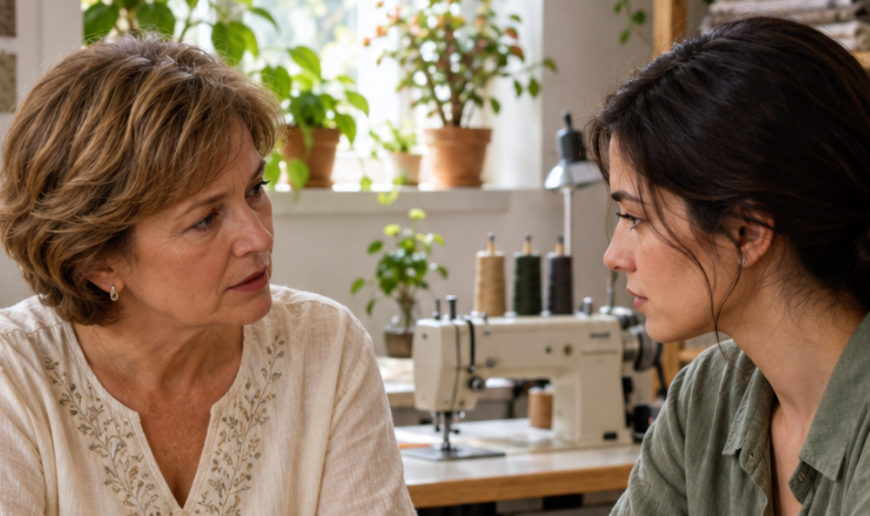
A mature woman in a light blouse is having a serious conversation with a young colleague in a green sweater at a table in a textile workshop. On the table are stacks of fabric and a closed folder.
Our workshop sewed curtains, bedspreads, slipcovers, and bedding. I was the one taking and tracking orders, checking that everything was recorded, calling customers. I’d worked here for twelve years. There weren’t many of us, so we all knew a lot about each other: who had a son starting university, whose mother was ill, who took their husband fishing on weekends and complained that the car smelled afterwards.
We usually celebrated birthdays around a big table in the break room. The birthday person brought a treat for tea, and everyone would chip in for a gift. It wasn’t always something huge. But for a milestone birthday, we tried to pick out something special. I’d bought, picked up, wrapped, and signed cards for others many times before, for those who didn’t have the time.
This time Lena was organizing everything. She was forty-five and loved making sure that congratulating someone looked beautiful. A week before the celebration, she asked me not to bring too much food to work: we’d have a little get-together at lunch, and then in the evening I’d probably be with my family. I agreed. It was nice to know she was planning ahead.
I found out about Dasha by accident. On Friday, just before leaving, I came back for my umbrella. Dasha and Lena were talking in the break room. The door was slightly open, and I just happened to walk by.
“I’m not chipping in,” Dasha said. “Sorry I didn’t say so right away.”
“Not at all?”
“No.”
I stopped, though I probably should have kept walking. Lena asked if things were difficult for her right now. Dasha replied:
“I don’t want to talk about money. Just leave me out of it this time.”
It took me a few seconds to realize exactly what she was refusing to contribute to. It shouldn’t have been a big deal: a younger coworker wasn’t taking part in one group gift. But there I was, standing in the hallway holding my umbrella, feeling like she’d publicly announced she didn’t even want to sit next to me.
Dasha was twenty-nine. She’d joined us four months ago and handled prepping orders for pickup and was learning how to cut simple pieces. I’d shown her how we kept our records, explained who to call when the numbers didn’t match, sometimes helped her fix mistakes, sometimes corrected her. I thought we got along just fine.
Turns out, as soon as it came down to me, she just said: leave me out of it.
I went home angry. I kept thinking about all the times I’d put off buying something for myself so I could contribute to group gifts—for someone’s big birthday, for a wedding, for a farewell. I never asked why it should be me. I just chipped in, because we worked together and that’s the way things were done.
I told my husband over dinner:
— Can you believe it, she didn’t even want to chip in for the 60th birthday.
Sergey was sixty-two. At first, he thought I was talking about something else and asked who I had invited. I explained it was about the gift.
— Did she ask you for money? he asked.
— What does that have to do with it? Everyone’s pitching in, she’s the only one who doesn’t want to.
Sergey just shrugged. He didn’t say I was right, but he didn’t say I was wrong to be upset either. That got to me too. He finished eating, took his dishes to the sink, and I kept explaining that it wasn’t about the amount.
— I get it, he answered. — You’re hurt.
That was the end of the conversation. He wasn’t about to say anything against Dasha, but I really wanted that kind of support.
On Saturday, I picked out my outfit for Friday. I took out a light blouse and matched it with earrings. Then I put them away—why get so dressed up for just an hour in the backroom? Later, I took them out again. I still wanted to celebrate, but at the same time, it felt humiliating to want that after hearing her refusal.
On Sunday, I made the grocery list for the house. Friday evening our son and his wife were coming over, my sister, and two of our friends. Sergey asked me to bake that apple pie. I said that for a 60th birthday, maybe I should make something fancier.
— You love it, my husband reminded me.
I crossed out the store-bought cake from my list and wrote down apples instead. But I still kept thinking about Dasha.
Monday, I didn’t say hello. Then I didn’t ask how her weekend was, even though I usually do. At lunch, I went for tea earlier, while she was still busy. Nothing obvious anyone could call me out for. Anything obvious, I wisely kept to myself.
Toward the end of the day, Dasha came over with a question about an order. I answered briefly, from across the desk, without offering her a seat.
— Nina Petrovna, did I do something wrong? she asked.
I could have answered directly. Or admitted I overheard a personal conversation. Instead, I said:
— Don’t you have any idea yourself?
She looked at me, then at the piece of paper in her hand.
— About this order?
I felt irritated: she was even pretending not to know. I nodded at the note and told her everything she needed was written there. Dasha left. A few minutes later, I called her back and explained the confusing note: I was the one who had introduced that shorthand, so it was silly to expect a newcomer to figure it out.
But we still didn’t talk about the real issue.
That evening, Lena asked if I had any wishes for the gift. I told her I didn’t want anything. She was caught off guard.
— Nina, we’re going to celebrate you either way.
— Go ahead and celebrate. Just don’t force anyone to join in.
Lena set her mug down on the table.
— So, you heard about it, huh?
I nodded.
She didn’t pretend nothing had happened. She said she wouldn’t pressure Dasha anymore. The collection would only be from those who wanted to participate.
— Is she really completely broke? I asked, even though I knew how it sounded.
— I don’t know.
— She could at least explain.
— I thought the same thing at first, Lena admitted. Then I realized: I wouldn’t want to have to talk about my money problems at home either.
I glanced at her. Last year, she chipped in for a group gift and then, for several days, brought her lunch in a small container: just plain porridge, nothing else. I even suggested she add some veggies. Lena had replied that she liked it this way.
I didn’t know if she had been going through hard times back then. Now I realized I have no right to try to guess her struggles after the fact, just so I could let her opt out.
A few years ago, we collected money for the wedding of a coworker who had already left our workshop. She was a nice woman—I had nothing against her. But back then, Sergey and I couldn’t even afford what we had planned out for ourselves. I took my winter boots to get repaired, hoping to make do, and at home we still had to pay for Sergey’s new glasses.
I could’ve just said I wasn’t going to participate. No one came around with a hand out at my desk. But in conversation, it already sounded like, ‘we’ll all congratulate her.’ And I felt like if I said no, I’d erase all the good things between me and that woman.
So I gave the money. I also signed the card myself—everyone said my handwriting was neater. The newlyweds later sent us a picture and thanked us. Everything looked beautiful. I never told anyone about my boots. Sergey found out only after the soles got soaked through.
There was another time when I actually had the money, but I just didn’t want to be part of yet another office collection. The person we were getting a gift for was barely an acquaintance. It felt awkward to object, so I agreed again.
But what I remember now isn’t the gifts—I remember how irritated I was at home. My husband would ask, ‘Who made you do it?’ And I’d reply that he didn’t understand anything. And he really didn’t—because I always agreed out loud. Sometimes, I even felt happy that we all got along so well.
‘So, what are we picking out?’ I asked.
Lena explained. They wanted to get a nice kitchen appliance—the one I had once mentioned. I pictured it on the table, everyone smiling, and me instantly calculating how much we still needed and who chipped in extra.
‘Let’s skip it,’ I said. ‘I haven’t even decided on one yet. Just get something smaller. Or just flowers.’
‘Is this because of Dasha now?’
I stayed silent.
‘Partly because of her. But also because I don’t want my value measured by the price of a gift box.’
It sounded more reasonable than I felt. That didn’t make it untrue. I really didn’t want to. I just didn’t know how to do it any other way yet.
At home, Sergey asked what kind of pie we were baking after all. I said apple, and told him about the conversation with Lena. He remembered when, at his old job, they collected money for someone’s celebration every month. Once he forgot to transfer the money, and later heard a joke that everything had gotten more expensive for him.
‘You never told me that,’ I said in surprise.
‘What was there to tell? I paid up later.’
‘Did it bother you?’ I asked.
He looked up at me.
‘Would you have liked it?’
I remembered my own ‘you have no idea’ and buried myself in the grocery list.
The next day, Dasha arrived before me. She was sorting through bags and checking notes. I greeted her. She replied without looking up.
I hung up my jacket, sat down. It took me about five minutes to work up the courage, then I walked over to her desk.
‘Dasha, I need to apologize to you.’
She stopped rearranging the bags.
I told her I’d overheard the talk about the collection. I felt offended and started acting like she’d wronged me somehow. At the end, I almost added that jubilees only come once a year—but I stopped myself.
“It’s not because of you,” Dasha replied.
I waited for her to explain. Maybe it was a big purchase, a debt, or relatives. Then I could finally understand, forgive, and feel like a good person.
She didn’t say anything else.
So I had to say:
“You don’t have to explain. I shouldn’t have spoken to you like that.”
Dasha nodded. She said she didn’t understand why I was angry, and she started shuffling through her orders, worried she might have mixed something up, and I hadn’t told her.
I started to feel ashamed. Up to that point, I’d only thought about how I looked in her eyes. Now I saw something different: a young woman walking around the workshop, searching for a mistake I couldn’t name—because there wasn’t one.
I apologized again and went back to my desk. Dasha didn’t rush to hug me; we weren’t close friends anyway. Getting through work together after four months seemed like a respectable enough goal.
On Thursday, she found an inconsistency in my notes: I’d written the number of sets, but next to it I’d put a note from another order. She just pointed it out calmly, with no hint of smugness.
“This doesn’t seem right,” she said.
I checked, fixed it, and thanked her. I didn’t mention how many years of experience I have, or that I was just tired before the holiday. It was my mistake, and Dasha did exactly what both of us were supposed to do there.
On Thursday night, I baked a small pie for the workshop. I wrapped it up and set it by my bag. At home, I planned to make a bigger one after work—Sergey promised to get the rest of dinner ready for when I got back. I asked if he was already tired of apples. He said he was ready to test them right away. We cut two small pieces, saving the rest for the morning. The pie would still be good for the celebration. I hid the little gap with a napkin, and Sergey laughed: once again, everything had to be perfect with me.
On Friday, I put on a light blouse and earrings. At home, Sergey was the first to wish me happy birthday, gave me a small bouquet, hugged me. We cut apples for the evening pie together, and I almost ran late for work because I wanted to finish my tea with him in peace.
At the workshop, I was greeted with flowers and a smaller present: a book about garden flowers that Lena and I had once looked at in a store. She’d asked ahead of time if that’s the one I wanted. I did. Those who chipped in for the group gift signed the card. I read their wishes and opened the book.
Dasha came up to me separately, said some warm, simple words. She wished me more days for myself, not just for customer orders.
“Thank you,” I replied.
There was no extra envelope, no explanation, no promise to make up for it later. I didn’t wait for her to change her mind about the money. I just thanked her for the kind words, and for the first time that week, I managed to actually hear her congratulations—without calculating anything in my head.
At lunch, we sat around the table, enjoying the pie I brought and sipping tea. Lena reminisced about how, during my first month on the job, I mixed up two identical packages but managed to find both before it was too late. I laughed. Dasha asked if that sort of thing had happened to me often. I answered that, oh yes, it definitely had.
After lunch, we got back to work. The day didn’t turn into an endless celebration—and honestly, I was a bit relieved. By the end of the day, I was looking forward to seeing my family and wanted to save some energy for them.
Lena helped me clear the table. I thanked her personally, not just for the gift. After all, she had spent time asking around, making choices, and remembered the book. Finally, I asked if it had been too much trouble for her.
“A little bit,” she admitted. “Good thing you told me in time—I almost ordered the appliance already.”
Together, we folded up the tablecloth. Lena took it back to her place, and I took care of the remaining cups.
At home, my son gave me a kiss on the cheek, and my sister immediately asked for the pie recipe. Sergey put on music we’ve loved for years. I sat at the table, watching everyone who had come for me. I had no idea how much each person had spent, who had consulted with whom, or what the present might have been if someone else had chipped in.
On Monday, the book was in my bag—I planned to flip through it during lunch. Dasha came in, greeted me, and asked if we had a good celebration.
“It was great,” I said. “How was your weekend?”
She told me she finally got some sleep and managed to finish her TV series. I asked if it was interesting. Then the first customer came in, and we both got back to work.