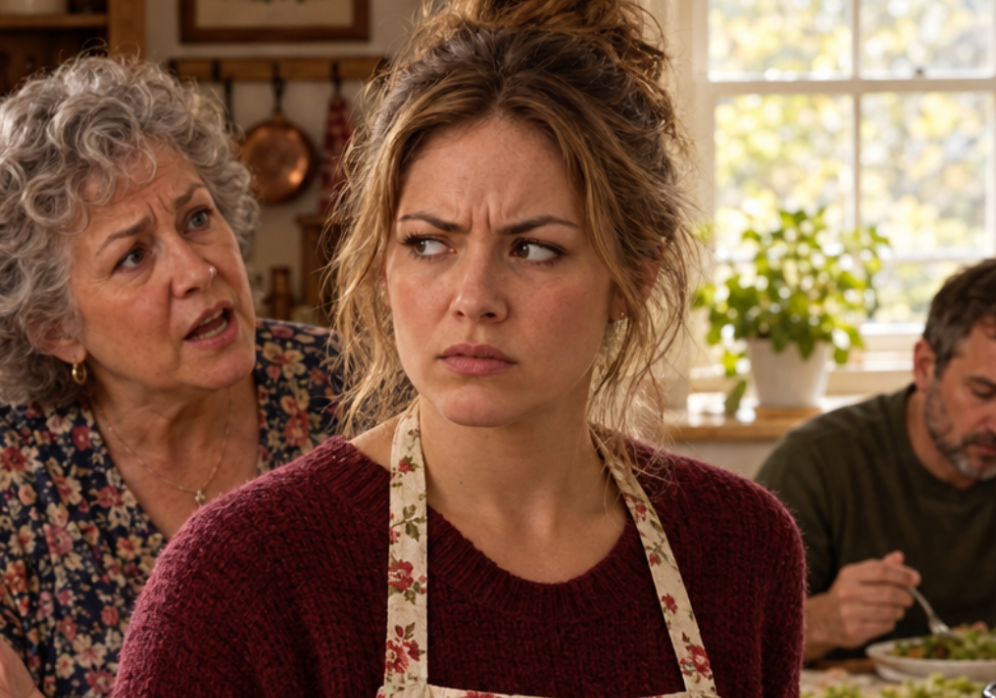
“Olga, did you at least look at the list? I gave you the sheet. Everything is written there.”
Galina Sergeevna spoke slowly and deliberately, as if explaining something painfully obvious to someone who just refused to get it.
“It’s written in black and white: meat aspic from three kinds of meat. Three, Olga. Not one, not two. Three.”
“I read everything, Galina Sergeevna. I just wanted to talk about that part. There’s a week left until the party, and I think…”
“You think.”
Mother-in-law paused briefly. In her voice, those words sounded almost accusatory.
“But I know exactly what should be on the table. Meat aspic from three kinds of meat, cabbage kulebyaka, mushroom pies, pike-perch in aspic, puff pastry with canned fish, winter salad, crab stick salad, stuffed eggs, pancakes with sour cream, goose with apples, potato zrazy, cottage cheese pudding, honey cake and a ‘Fairy Tale’ cake. No less. That’s the most modest menu. Forty guests invited.”
Olga stood by the window with the phone to her ear. Outside, heavy, soggy November snowflakes drifted down, feeling as out of place as this conversation.
“I understand you, Galina Sergeevna. Can I call you back a little later?”
“Just don’t put it off. There’s hardly any time left until Saturday.”
The phone landed on the kitchen table. Olga sat motionless for several moments, staring at it.
Beside it, under the salt shaker, was the checkered list. Her mother-in-law’s bold handwriting filled almost the whole page. Olga pulled it out and skimmed it again. Fourteen dishes. Next to each was a note: “homemade”, “no store-bought”, “make it even tastier than before.”
Back then, it was a family dinner for Larisa and Andrey’s fifth wedding anniversary. Olga had started cooking three days before the celebration. She barely slept. By the second day, her legs were heavy and her hands rough from endless water, dishes, and chopping boards.
Andrey would come home from work, grab food straight from the pot and move to the TV. Once, he asked if she needed any help.
Olga answered that she could manage.
He simply agreed and left the kitchen—no irritation, no argument. He just left her alone.
At the party, Galina Sergeevna tasted the aspic, called Olga over and quietly remarked, “You put in more salt than necessary.”
And that was it. No praise, no “thank you.”
The guests devoured the food, asked for more pies, raved about the fillings. Galina Sergeevna listened and explained with dignity, “That’s our family tradition.”
She didn’t say Olga’s name even once the entire evening.
Now Olga was sitting in the kitchen on Sadovaya Street, where she and Andrey had lived for nineteen years. She understood all too well now what her mother-in-law meant by family traditions.
According to tradition, the daughter-in-law spent hours at the stove. She cleaned the floors and did the dishes. And she was supposed to be happy to get a seat at the table.
The phone buzzed in her hand. Larisa was calling.
“Olya, did you already talk to Mom? She said you were acting strange.”
“I spoke as usual. I’m just tired today.”
“Exactly. And the celebration is close, you need to start shopping for groceries. I can go with you Wednesday and help carry the bags.”
Larisa paused.
“Actually, I have a nail appointment Wednesday. How about Thursday?”
“I’ll manage the shopping on my own.”
“As you like. Just remember, Mom asked for ‘Bogatyr’ apples for the goose. She doesn’t like any other kind. They need to be tangy, you know.”
“I know.”
“And make the aspic clear. Last time the broth was a little cloudy.”
Olga closed her eyes. Clear aspic from three types of meat. Special apples for the goose. A couple of cakes. Forty guests.
“Okay, Larisa. I understand.”
The phone went into her pocket. Olga stood up. It was time to make dinner.
Andrey would be back at seven. He’d come home hungry and, if there was no food ready, would silently look at his wife for a long time. Then, in his usual tone, ask:
“Did you not cook anything today?”
There was no outright displeasure in his voice—just the calm surprise of someone who finds their bus missing at the usual stop.
Olga opened the fridge, took out a chicken, a couple of carrots, and an onion. The pot went on the stove. Her hands worked automatically—nineteen years had taught her every motion by heart.
She and Andrey had met when she was twenty-six. He joked a lot, laughed loudly, and told funny stories with ease. Every get-together sparked to life with him around.
The first time she met Galina Sergeevna, her future mother-in-law looked Olga over and approvingly said, “I can see right away, Olya, you’re a sensible girl.”
Olga thought that was a compliment. Only much later did she realize that, for her mother-in-law, a sensible woman is one who keeps quiet and agrees.
They married when Olga was twenty-eight. The first year was okay. Then Denis was born. He grew up and moved to another city for school.
All that remained of her old life now was the familiar apartment, the endless kitchen, and a checkered sheet full of someone else’s demands.
The broth was boiling. Olga turned the heat down and went to the living room. She wanted to call her mother—not for any big talk, just to hear her voice.
But the phone rang first.
Her mom’s number flashed on the screen.
“Olenka.”
Her mother spoke softly. The sound of her voice made Olga’s insides clench with worry.
“Can you come over today?”
“What happened?”
“Dad isn’t well. We called the doctors. We’re at the hospital.”
Olga was already pulling on her coat when she remembered the pot on the stove. She went back, turned off the burner, and texted Andrey: “Dad’s been taken to the hospital. I’m going to be with Mom. Food is on the stove.”
Grabbing her bag, Olga rushed out.
Outside, the air was damp and dark. She got in the car and drove, watching blurry streaks of light through the window.
Viktor Petrovich. Her father. Seventy-three years old and hardly ever ill. He never complained, always said, “I’ll keep teaching you all how to live.”
Olga always believed him. Now, more than ever, she hoped he was right.
The hospital smelled sharply clean. Endless white corridors stretched before her.
Her mother waited by the window in the admissions hall. Small, lost, coat buttoned up tight. She clutched her purse to her chest with both hands.
“Mom…”
Her mother turned. No tears, but one look at her face was enough to make Olga’s throat tighten.
“His blood pressure shot way up. The doctors are worried there was a problem with blood flow to his brain. He fell in the hallway. I came out of the kitchen and found him on the floor.”
“Where is he now?”
“They’re running tests. The doctor said to wait.”
They sat on rigid chairs. Mom didn’t let go of Olga’s hand—a small, cool hand.
Olga hadn’t visited in almost three weeks. Every time, something came up—shopping, laundry, cleaning, cooking, discussions with Galina Sergeevna about the menu.
About an hour and a half later, a young doctor appeared. He looked exhausted.
“We managed to stabilize his main vital signs. But there may be a disruption in his brain’s blood supply. We need further tests and constant monitoring. He’ll stay with us for the next week.”
“Will he recover?” her mother asked softly.
“Too early to promise anything. We’ll watch closely.”
Olga took her mother home, made some tea, and sat with her. Soon, she drifted off to sleep right there in the armchair.
Olga ended up in the kitchen, surrounded by silence. There, it felt special—warm and soft, like an old wool blanket.
Her mother’s geraniums bloomed on the windowsill, blooming reliably every year with little fuss. A faded photo hanging on the wall showed seven-year-old Olya holding her father’s hand, staring out of frame. He looked only at his daughter.
Olga got home long after midnight.
Andrey was still awake, phone in hand. When she came in, he put it down.
“What did the doctors say?”
“It’s serious. There are signs of impaired blood flow to his brain.”
“That’s no joke.”
He paused.
“Did you eat anything?”
“No.”
“I warmed up the chicken. It’s in the pot, help yourself.”
Olga ate by the sink. She didn’t bother with the tablecloth or plates. Then she went to bed but lay awake for a long time.
Her father’s face hovered in her mind. She remembered her mother’s delicate fingers and the familiar scent of home.
In the morning, Galina Sergeevna called.
“Olga, Andrey told me you left yesterday. Your father was unwell. But you realize there are only six days left before my birthday party?”
“Galina Sergeevna, my father is in the hospital.”
“I heard. The hospital is close by. You’re healthy. When will you get started with the food?”
Suddenly, everything in Olga slowed down and became clear. Like a rushing river stopping and becoming still and transparent.
“I can’t say yet.”
“What do you mean you can’t?”
The same old surprise crept into her mother-in-law’s voice. She always reacted that way when Olga didn’t follow the expected script.
“I’m turning seventy. That only happens once. Don’t you understand?”
“I do. But I only have one father.”
There was silence on the line.
“I think you’ll manage,” Galina Sergeevna finally said. “You don’t have to be at the hospital all the time. Visit, check on him, and then take care of your own responsibilities.”
Olga didn’t argue. She politely ended the call.
Andrey sat at the kitchen table with a mug of coffee. Seeing his wife, he looked up.
“Did Mom call?”
“Yes.”
“What did she want?”
“To ask when I’ll start preparing the food.”
He took a sip and nodded.
“Look, Olya, it’s a big milestone for her. You understand. Forty guests. It’s too late to cancel.”
“I’m not suggesting canceling.”
“Then what’s the issue? You’ll have time for everything. Of course, visit your dad—no question. But you can cook in your free time.”
Olga looked at her husband carefully. His eyes were already on his phone. He frowned slightly, but not because of anything she’d said—just whatever he was reading.
“Andrey, imagine if it had been your mom in the hospital.”
He looked at her instantly.
“What does that have to do with this?”
“Nothing. I’m just curious.”
“It’s not the same.”
“How not?”
“She’s my mother.”
He said it with such certainty he seemed to think that explained everything.
Olga got up and went to her father.
The hospital room had four beds. Olga found her father lying still, eyes closed. Her heart clenched again. The nurse assured her that Viktor Petrovich was just sleeping.
Olga sat beside him, taking in his familiar face. The wrinkles were deeper, his chin shadowed in gray stubble. His big, knobby hands rested gently on top of the blanket.
When she was a child, those hands carved wooden birds for her. Once, he’d caught her just in time when she fell off her bike.
Viktor Petrovich opened his eyes. He recognized her and smiled faintly—like he wasn’t sure she was really there.
“You made it after all.”
See the rest of the story in the first comment.
“Olga, did you even look at the list? I gave you the sheet. Everything is clearly written there.”
Galina Sergeyevna spoke slowly and clearly, as if she were explaining the simplest thing to someone who refused to understand.
“It’s written in black and white: meat aspic from three types of meat. Exactly three. Not two, not one. Three kinds, Olga.”
“Galina Sergeyevna, I’ve read it all. I just wanted to discuss that point. There’s a week left before the celebration, and I think…”
“You think so.”
Her mother-in-law fell silent for a moment. The phrase sounded almost accusatory coming from her lips.
“But I know for sure what needs to be on the table. Meat aspic from three types of meat, cabbage kulebyaka, mushroom pies, pike perch in aspic, puff appetizer with canned fish, winter salad, salad with crab sticks, stuffed eggs, crepes with sour cream, goose with apples, potato zrazy, cottage cheese pudding, honey cake, and the ‘Skazka’ cake. Not a dish less. This is as modest as it gets. We have forty guests invited.”
Olga stood by the window with the phone pressed to her ear. Outside, heavy, wet November snowflakes drifted down lazily. The snow felt heavy and unnecessary, just like this conversation.
“I’ve heard you, Galina Sergeyevna. May I call you back a bit later?”
“Just don’t put it off. There’s almost no time left until Saturday.”
Olga set the phone down on the kitchen table. For a few moments, she sat perfectly still, staring at it.
Nearby, under the salt shaker, a checkered sheet of paper lay stark white. Her mother-in-law’s large handwriting took up nearly the whole page. Olga pulled out the paper and quickly skimmed the lines again. Fourteen dishes in total. Beside each dish was a note: ‘homemade only’, ‘no store-bought’, ‘make it better than last time.’
Last time was a family evening to celebrate Larisa’s fifth wedding anniversary—Andrey’s sister. Back then, Olga started preparing the feast three days in advance. She barely slept. By the end of the second day, her legs were heavy, and the skin on her fingers had become rough from endless water, dishes, and cutting boards.
During those days, Andrey would come home from work, grab food straight from the pot, and move to the TV. Once, he asked if she needed any help.
Olga replied that she could handle it herself.
Her husband calmly agreed and left the kitchen. No irritation, no argument. He simply left her alone.
At the holiday table, Galina Sergeyevna tasted the aspic, called Olga over, and quietly remarked:
“The salt is stronger than it should be.”
That was all. No praise, no customary thank you.
The guests ate with pleasure, asked for more pies, and praised the fillings. Galina Sergeyevna listened and explained with dignity:
“That’s how things are done in our family.”
Fourteen Dishes Against the Father
Olga’s name was not mentioned by her mother-in-law even once the whole evening.
Now Olga sat in the kitchen of their apartment on Sadovaya Street, where she and Andrey had spent nineteen years together. In that moment, she understood clearly what her mother-in-law meant by family traditions.
By tradition, the daughter-in-law spends hours at the stove. By tradition, she scrubs the floors and does the dishes. By tradition, she’s supposed to be happy just to have a seat at the table.
The phone buzzed in her hand. It was Larisa calling.
“Olya, have you already spoken with Mom? She said you were acting strange.”
— I was speaking the same as always. I just don’t have much energy today.
— Exactly. And the celebration is right around the corner—it’s time to get groceries. I can go with you on Wednesday and help carry the bags.
Larisa fell quiet for a moment.
— Actually, no, I have a nail appointment on Wednesday. Let’s go on Thursday?
— I can handle the shopping on my own.
— As you wish. But Mom asked to buy Bogatyr apples for the goose. She doesn’t like any other kind. It needs a good tartness, you know what I mean.
— I get it.
— And make the aspic light. Last time the broth turned out a bit cloudy.
Olga closed her eyes for a moment. A light aspic from three kinds of meat. Special apples for the goose. A couple of cakes. Forty guests invited.
— Okay, Larisa. I understand.
She put her phone in her pocket and stood up. It was time to get dinner started.
Andrey would be back by seven. He’d come home hungry and, if he didn’t see any food, would look at his wife for a long time. Then, as always, he’d ask:
— You didn’t cook anything today?
It wouldn’t even sound annoyed. Just the calm surprise of someone who gets to a bus stop and finds their usual bus isn’t there.
Olga flung open the fridge, pulled out a chicken, a couple of carrots, and an onion. She put a pot on the stove. Her hands moved without her thinking—nineteen years had taught her every motion.
She had met Andrey when she was twenty-six. He joked a lot, laughed loudly, and told funny stories with ease. With him around, any group came alive.
At their first meeting, Galina Sergeevna looked over her future daughter-in-law carefully and said approvingly:
— I can tell right away, Olya, you’re a sensible girl.
Back then, Olga took it as a compliment. Much later, she realized that to her mother-in-law, being ‘sensible’ meant keeping quiet and agreeing.
They had their wedding when Olga turned twenty-eight. The first year was bearable. Then came Denis. Once their son grew up, he left for college in another city.
With time, all that was left of her old life was the familiar apartment, the never-ending kitchen, and a checkered sheet covered in other people’s demands.
The broth started to boil in the pot. Olga turned down the heat and headed to the living room. She longed to call her mother—not to talk about anything in particular, just to hear her familiar voice.
But the phone rang first.
Her mom’s number flashed on the screen.
— Olenka.
Her mom’s voice was quiet. The tone made something inside Olga immediately clench with worry.
— Can you come over today?
— What happened?
— Dad’s not feeling well. We called the doctors. We’re at the hospital now.
Olga was already pulling on her coat when she remembered the pot. She went back to the kitchen and turned off the stove.
She sent Andrey a quick text: “Dad’s been taken to the hospital. I’m going to Mom’s. There’s food on the stove.”
Grabbing her bag, Olga rushed out of the apartment.
It was damp and dark outside. She started the car and spent the whole drive watching the blurred streaks of light through the windshield.
Viktor Petrovich. Her father. He was in his seventy-third year, but his health had rarely failed him before. He never complained and always liked to say:
— I’ll keep teaching you all about life.
Olga always believed those words. Now, more than ever, she wanted her father to be right.
The hospital building had that sharp, sterile smell. White corridors stretched one after another.
Mom was waiting by the window in the admissions area. She looked small and lost, bundled up in her coat. She clutched her purse tightly to her chest with both hands.
“Mom.”
Mom turned around. There were no tears, but just the look in her eyes was enough to make Olga’s throat tighten.
“His blood pressure spiked really high. The doctors are also saying there could be a problem with blood flow to the brain. He collapsed in the hallway. I came out of the kitchen and saw him on the floor.”
“Where is he now?”
“They’re running some tests. The doctor told us to wait.”
They settled onto the hard chairs. Mom held onto Olga’s hand without letting go. Her palm felt cool and very small.
Olga hadn’t visited her parents in almost three weeks. There was always something urgent: shopping, laundry, cleaning, meals, talks with Galina Sergeyevna about the holiday menu.
About an hour and a half later, a young doctor in glasses came out to them. The look on his face said it had been a rough shift.
“We’ve managed to stabilize his main vital signs. But there’s still the risk of impaired brain circulation. We’ll need additional tests and ongoing observation. He’ll need to stay with us for at least a week.”
“Will he get better?” Mom asked in a barely audible voice.
“It’s too soon to promise anything. We’ll keep monitoring his condition.”
Olga took Mom home, made some tea, and sat with her. Before long, she fell asleep right in her chair.
Olga went into her parents’ kitchen and listened to the silence. It felt special here—warm and soft, like an old wool blanket.
Mom’s geraniums were a cheerful green on the windowsill, blooming every year without demanding attention. An old photo hung on the wall: seven-year-old Olya holding her father’s hand, looking away. Her father was looking only at his daughter.
Olga got back to her own apartment well past midnight.
Andrey was still awake. He was lying there with his phone in hand, but put it away as soon as she appeared.
“What did the doctors say?”
“His condition is serious. They’re seeing signs of impaired blood flow to the brain.”
“That’s serious.”
He was quiet for a moment.
“Did you eat anything?”
“No.”
“I warmed up some chicken. It’s in the pot. Go ahead and have some.”
Olga ate standing by the sink. She didn’t have the energy to set the table or get out plates. Then she lay down, but sleep wouldn’t come for a long time.
She kept seeing her father’s face in her mind. She remembered her mom’s delicate fingers and the familiar smell of her childhood kitchen.
In the morning, Galina Sergeyevna called.
“Olga, Andrey told me you left yesterday. That your father was unwell. But you do remember that my celebration is just six days away, don’t you?”
“Galina Sergeyevna, my dad is in the hospital right now.”
“I heard about that. The hospital isn’t far away. You’re healthy. When are you going to start working on the dinner?”
Suddenly everything inside Olga slowed down and became crystal clear. It was like a river stilled, its water calm and transparent.
“I can’t say yet.”
“What do you mean you can’t?”
There was the usual note of disbelief in her mother-in-law’s voice. She always sounded like that when Olga didn’t respond the way she expected.
“I’m turning seventy. That only happens once. Don’t you understand that?”
“I understand. But my father—he’s the only one I have, too.”
There was only silence on the other end of the line.
“I think you’ll manage just fine,” Galina Sergeyevna finally said. “You don’t have to stay by the hospital bed non-stop. You can visit, check in, then go about your day.”
Olga didn’t continue the conversation. She politely said goodbye and ended the call.
Andrei was sitting in the kitchen with a cup of coffee. When he saw his wife, he looked up.
“Did mom call?”
“Yes.”
“What did she want?”
“To find out when I’ll start making the treats.”
He took a sip and nodded.
“Listen, Ol, it’s a big milestone for her. You know what I mean. Forty people are invited. It’s too late to cancel everything now.”
“I’m not suggesting we cancel.”
“Then what’s the issue? You’ll get everything done. Of course, you need to visit your father. No one’s disputing that. The rest of the time can be spent in the kitchen.”
Olga looked closely at her husband. He had dropped his gaze to his screen. His brow was furrowed, but not because of her words—he was reading a message.
“Andrei, imagine if your mom was the one in the hospital.”
He looked at her immediately.
“What does that have to do with anything?”
“Nothing. I’m just curious.”
“They’re different situations.”
“How are they different?”
“That’s my mother.”
He said it so confidently, like that one sentence explained everything.
Olga got dressed and headed out to see her father.
The hospital room was meant for four. When Olga walked in, her father was lying with his eyes closed, completely still. Her chest tightened again. The woman on duty reassured her, explaining that Viktor Petrovich was only sleeping.
Olga sat nearby, studying the familiar face. The wrinkles had deepened, his chin was covered in grey stubble. On top of the blanket rested his large hands with strong, knotted fingers.
When Olga was little, those fingers carved wooden birds for her. Once, her father caught her just in time when she fell off her bike.
Viktor Petrovich opened his eyes. He recognized her and gave a weak smile. It was a cautious smile, as if he wasn’t sure he was really seeing his daughter.
“You really came.”
His voice was unusually quiet. Her father usually spoke loudly, like someone used to calling out across the yard.
“Of course. How are you feeling?”
“It’s tolerable. My head just feels a bit foggy. Nothing major.”
“How is that nothing, Dad?”
He shrugged slightly.
“It’s okay. We’ll keep on living.”
Olga spent two hours by his side. After leaving the room, she immediately called her mother to let her know that her father was awake and talking.
“Thank God,” her mother breathed.
Those words brought tears to Olga’s eyes.
She rode back by bus. Blurred houses and scattered streetlights passed behind the foggy window.
Now the most important thing was clear. Her father was under the doctors’ care. Her mother was alone. They needed her help.
And her mother-in-law’s list of special apples and pale jelly didn’t really matter. Not at all.
The thought was so simple that Olga was surprised. Why hadn’t she realized it earlier? Maybe she had, but always stopped herself from thinking it all the way through.
That evening Andrei came home in a good mood. He brought a loaf of bread, talked about work. Olga listened and nodded now and then.
Then she calmly said:
— Andrey, I’m not cooking for your mom’s celebration.
He froze and slowly set his glass down on the table.
— What did you just say?
— I’m not taking on the holiday feast. Dad’s in the hospital, Mom needs support. I won’t spend three days by the stove.
— Olga.
Her husband only called her by her full name when he was starting to get angry.
— There will be forty guests. Mom’s waiting for the entire family. This is her seventieth birthday.
— My dad has impaired blood flow to the brain.
— I understand, it’s serious. But he’s surrounded by doctors. Your being there constantly won’t change anything.
— That’s not the issue. I’m not making a mountain of food while Dad is in the hospital.
Andrey stood up and paced along the kitchen.
— Mom has already invited everyone. Larisa told them all. We can’t just call off the celebration now.
— Then order ready-made food.
— Order ready-made?
He said it with a look as if he’d just heard something outrageous.
— Mom needs homemade food. You know her personality very well.
— Oh, I know it very well by now.
Andrey’s expression became odd. There wasn’t much anger left—he looked more like someone whose trusty gadget suddenly stopped working.
— Olga, think about it. You only turn seventy once. You visit your dad every day. Can’t you just take care of food after coming back from the hospital?
— I can’t.
— Not at all?
— Not at all, Andrey.
Her husband left the kitchen. A few minutes later, the phone rang. It was Larisa calling.
— Olga, what’s going on? Andrey says you refuse to handle the food. Do you realize how many people are coming?
— I do.
— It’s Mom’s seventieth! Does that mean nothing to you?
— No, but my dad is in really bad shape right now. That matters too.
— The date can’t be changed!
— You can order food. Or you could all cook yourselves—I’ll even share my recipes.
Larisa fell silent.
— But it won’t taste as good if we do it.
— Then it’s about time you learned.
Olga put down the phone. Her fingers remained calm, and that surprised her.
She expected anxiety, doubts, maybe even the urge to take her words back. But inside, there was a clear, calm stillness—just like she’d felt that morning.
The next day, Olga went to the hospital again. Her father was a bit better—already sitting up in bed, eating hot cereal. He grimaced after every spoonful, but didn’t push the plate away.
— They serve food like we’re in daycare, — he grumbled.
Olga laughed. That morning, her mom had made homemade broth, and Olga brought it in a thermos. Viktor Petrovich drank it all, down to the last drop.
— Now that’s more like it.
After the hospital, mother and daughter had tea together in their small kitchen. The floral curtains had faded long ago. The right handle on their old fridge barely hung on. The air was filled with the scent of fresh bread and dried mint, which her mom picked every summer in the garden.
Olga had known that smell since childhood. It was homey, familiar. Unlike the kitchen where she’d spend days fulfilling someone else’s expectations without ever hearing a word of thanks.
— How are you holding up, Olya? — her mom asked.
— I’m hanging in there. Everything’s fine.
— And what about Andrey? How’s he doing?
— His mother’s party is on Saturday.
— Are you planning to go?
— Maybe. But I’m not going to stand at the stove.
Her mom was quiet for a moment. Then she spoke cautiously, like she’d been carrying around a question for a long time and finally decided to ask it.
— Olya, are you happy living with Andrey?
Her daughter looked at her in surprise.
— Why are you asking?
— I see how you come home. You’re always exhausted, always rushing somewhere. You can’t even sit peacefully. Even now, you’ve already checked your phone twice.
Olga glanced at the phone next to her cup. Her mom was right.
— I’m just used to it.
— I understand.
Her mom didn’t say anything more. She just poured more tea for her daughter.
On Wednesday, Galina Sergeyevna called again. Her voice had a special tone she reserved for important talks—soft, with a slight tremble.
— Olga, let’s discuss everything calmly, like adults.
— I’m listening.
— I understand your father’s health has failed him. I am truly sorry. But I have been looking forward to my seventieth birthday for twenty years. I’m already seventy. I won’t have another day like this.
Olga was silent.
— I’m not asking you to ignore your father. I’m just asking you to do what you do best. No one in the family cooks better. You know that. This is your way of helping the family. Am I wrong?
— Galina Sergeyevna, over these past days I’ve realized something simple. My place in the family isn’t defined by pies or aspic. Right now, my dad is in the hospital. I want to be by his side.
— So be there. Am I stopping you? Visit him in the morning, come back to the stove in the evening. No one is expecting the impossible from you.
— Everything seems easy to you. But for me, right now, it’s impossible. I can’t pretend life is normal when it isn’t.
There was a long pause.
— You’ve always been a woman with a complex character, — her mother-in-law finally remarked.
She said this calmly, as though giving the weather report.
— Maybe so.
— Andrey is very upset.
— I know.
— He says you’ve changed.
— Maybe I have.
Olga said goodbye and ended the conversation. Her fingers didn’t tremble this time.
On Thursday morning, she took out a small travel bag. She packed underwear, a couple of clothes, makeup bag, and passport. She added her phone charger.
She didn’t have to think long. Olga just packed what she needed.
She sent a message to Denis: “Son, Grandpa is feeling better. I’ll spend a few days at Grandma’s. I’m fine.”
He replied almost immediately: “Mom, I’ll call you in the evening. Are you sure you’re okay?”
Olga wrote back: “Really. Hugs.”
After Andrey left for work, she left a short note on the table: “I’ll stay with my parents for a while. I’ll call you later.”
Before leaving, Olga paused for a moment at the kitchen doorway. Nineteen years had passed by this stove, this table, and these cabinets. Nineteen years waking up in a home that never fully felt like hers.
She closed the door. Olga walked down the stairs and out into the yard.
The snow had stopped. The air was frosty and clear. Over the houses stretched a blue sky with a grayish hint, the kind you only see at the end of autumn.
On her way to the bus stop, Olga reflected on the years that had passed. Nineteen years made up almost half her adult life. All that time, for some reason, she believed she deserved only as much attention as was allotted to her. Not a drop more.
The entryway of her parents’ home smelled like mint. Warm light spilled out from the living room.
Her mom opened the door, noticed the bag, and didn’t ask any questions. She silently let her daughter in and then gave her a tight hug.
The hug was brief, but it held so much familiar warmth that the tension inside Olga slowly began to fade.
“Are you going to stay with us for a while?” her mom asked.
“For a few days. If you don’t mind.”
“Why would you say that?”
Her mom looked at her with gentle reproach.
“This is your home, too.”
Olga stayed with her parents for four days. Every morning they went to the hospital together.
Viktor Petrovich was slowly getting better. His speech became clearer. He grumbled about the IV drips and demanded real food. The doctor carefully said his recovery was going well, but he would still need to be monitored and keep up with his therapy sessions.
During those four days, Olga slept a lot. She hadn’t rested so deeply in what felt like a decade. There were no alarm clocks. She woke only when her body decided it was time.
She ate her mom’s usual home cooking: buckwheat porridge with butter, borscht, and warm apple pie. For the pie, her mom used Bogatyr apples brought home from the garden back in September.
The pie was very simple, with no decorations or fancy touches. But the aroma was so comforting that it brought tears to Olga’s eyes right at the table.
“What’s the matter, honey?” her mom noticed.
“Nothing. It’s just delicious.”
Her mom nodded understandingly and didn’t press with questions.
Andrey called on Friday evening. His voice sounded tense.
“When are you coming back?”
“I haven’t decided yet.”
“Olya, tomorrow is mom’s special day. The whole family will be there.”
“I remember.”
“Mom is really lost. Larisa is trying to cook, but everything gets burnt.”
“Order some ready-made food. I already suggested that.”
“Do you realize how hurt mom is?”
“I know. I’m sorry things turned out this way. But right now, I need to be here.”
He was silent for a long time.
“You’ve changed,” Andrey finally said.
Galina Sergeyevna almost said the same thing. But in her husband’s voice, there was both reproach and complete bewilderment.
“Maybe I have.”
On Saturday, Olga didn’t go to the celebration.
Early in the morning, she and her mom brought her dad some broth and a fresh bun. Her mom had baked it before sunrise.
Viktor Petrovich ate everything, complimented the baking, and announced:
“I’ll be back home soon and cook for myself. Otherwise, you, dear, have forgotten how to feed me.”
“Just come home first, then we’ll see which of us remembers how to cook,” her mom laughed.
Olga sat nearby, listening to their usual banter. In reality, it was the warm, familiar conversation of people who had spent many years side by side. Both were over seventy now, yet they still found it so easy and comfortable together.
On Saturday evening, Olga settled into an armchair with a book. She couldn’t concentrate on reading, but didn’t want to close it. Her mom was knitting by the wall.
Outside, calm December snow was falling.
Olga’s phone kept buzzing. Larisa had sent a message: “Everything turned out terribly. The guests have arrived, but there’s hardly anything to put on the table. I’m so embarrassed in front of the family.”
There wasn’t a single word from Galina Sergeevna.
Andrey sent just one message: “And?”
Olga put her phone face down and opened her book.
She and her husband didn’t talk until several days later. Olga moved back to the apartment on Sadovaya since her clothes, documents, and most of her usual life were still there.
By that time, her father had been moved to a regular hospital room. He was getting better, and her mom was managing things on her own now.
Andrey was waiting in the kitchen. When his wife walked in, he looked up. Something about his face was different after the past week, as if the usual order of things had shifted and refused to go back.
“Can we talk?”
“Let’s talk.”
Their conversation lasted a long time. No one raised their voice. For the first time in years, they actually listened to each other. They didn’t discuss his job or what to cook for dinner.
Olga finally admitted how tired she was. She was done being the convenient house helper. Nineteen years of adjusting to everyone else had taken something important from her. She couldn’t even find the right word for that loss right away.
Andrey listened. Every so often, he tried to explain that he never meant her any harm. It just all happened by itself. His mother was always his mother, and the house routine just felt natural.
Olga didn’t argue. She just shared how things looked from her perspective.
After a while, Andrey asked her directly:
“Do you want to get a divorce?”
The question came as a surprise. Olga didn’t answer right away.
“I want to live differently. I don’t know yet what to call this new life.”
Her husband nodded, stood up, and poured himself a glass of water.
“I’ll call Denis.”
“Okay.”
Two weeks later, their son showed up on his own. He hadn’t warned them—he just appeared at the door with a big bag.
He had the same look on his face as when he was a kid getting ready for a serious talk: focused, attentive, ready to listen.
“Mom, how are you feeling?”
“I’m fine, Denis. Honestly.”
“Dad told me things between you two are a mess.”
“It’s not a mess. Things are just more honest now.”
Denis stayed for three days. The conversations were many. At first he was upset with his mother, then his father. After that, he calmed down and just stayed close.
Before leaving, he hugged Olga in the hallway.
“Mom, for the first time in years you actually look rested.”
“Is it that obvious?”
“Very much so.”
They got divorced quietly, with no drama. It was more like two people who had lived side by side for years and just weren’t a team anymore.
The apartment on Sadovaya stayed with Andrey. Olga took her clothes and a few boxes, then moved in with her parents for now. Figuring out her own place would come later.
Her mother didn’t say a word out of place. She cleared out a room, made the bed with fresh sheets, and placed a wooden bird her father had carved years ago on the nightstand.
When Olga walked in, she noticed the bird right away. She held the figurine in her hands. It was smooth, almost weightless. Tiny marks left by her father’s knife could still be seen on the wood.
Viktor Petrovich was allowed to go home in early December. He could move around on his own, though his pace was slower and he leaned on a cane.
He stopped by the door and looked at Olga.
“Well. Now everyone is finally home.”
They celebrated New Year’s as a group of four. Around the table sat Olga, Denis, and her parents.
They decorated the tree, watched classic feel-good movies, ate Mom’s winter salad and cabbage pie. It was the simplest pie—no fancy fillings or decorations.
Olga helped make it. She and her mom stood together at the flour-dusted board. That’s exactly how you cook for the people you love—not for a checklist or anyone else’s rules. Just for those who matter.
In February, Olga rented a small one-room apartment on the fifth floor. The window looked out onto a peaceful yard with a few birch trees.
The apartment turned out to be modest, with almost no furniture. Inside, it smelled of fresh whitewash and the previous owners.
Olga brought her first boxes and stood for a long time in the empty room. Then she walked over to the window. Thin birch branches swayed slowly over the yard.
In March, Larisa called her once. Her voice was a mix of hurt and a wish to make up.
“Olya, how are you doing over there? Mom worries, though she’d never admit it. You know what she’s like.”
“I know.”
“So what happens now?”
“Nothing special. I just keep living.”
“Maybe you could come visit sometimes? At least for family occasions. We’re trying to manage things on our own now.”
Olga smiled. Larisa couldn’t see it, but she smiled anyway.
“We’ll see. Depends on how things go.”
“Alright. At least you make good aspic. We tried, but the broth always turns out cloudy.”
“I’ll send you the recipe. The key is to strain it properly. Use cheesecloth, folded in two.”
“You’ll really give me the recipe?”
“Of course. There’s nothing tricky about it. You’ll just have to make it yourself.”
Olga sent her a detailed guide. Larisa replied with a round-eyed surprise emoji and didn’t call again.
Her father was regaining his strength slowly but surely. By spring, he no longer needed a cane, grumbled about the doctors, and insisted on being allowed to go to his land plot.
The doctors said they’d make a decision later.
“You can take as long as you want to decide—I’m going anyway,” Viktor Petrovich would say.
In May, when the soil was warm, he finally got his way. Olga took him out of town herself, helped open the house and light the stove.
Afterwards, they sat on the porch drinking tea from old cups with blue rims. Beyond the garden, bird cherry trees bloomed white.
“Dad, remember those wooden birds you carved for me?”
“Of course. You were always losing them.”
“One survived—I have it on my shelf now.”
“I know. Your mother told me.”
Her father fell silent for a moment.
“You’re a good one, Olga.”
“Why are you saying that now?”
“Just because you are.”
He put his cup down on the railing and looked toward the blossoming tree.
“A human life isn’t that short. Just don’t give it away to things that don’t matter.”
Olga nodded.
The bird cherry tree filled the air with a sweet fragrance. The damp earth felt cool beneath their feet. It was completely still, and far off behind the trees, a cuckoo was calling.
That same spring, Olga started a new job. She used to work as an accountant, but eventually, she nearly stopped working altogether. Galina Sergeyevna insisted that housework was more important. And Andrey never argued with her.
Now, Olga found a position at a small company. The people there were calm, and her responsibilities were clear. At first, getting used to the old work rhythm was a challenge, but before long, she settled in.
A long-forgotten feeling returned. Every new day once again felt like it truly belonged to her.
On weekends, Olga visited her parents. Sometimes, she would stay over until morning.
She and her mom baked pies. Not fourteen dishes, not enough to feed forty people—just a single pie with whatever filling they had at home.
Her father sat by the window, offering advice no one had asked for. Her mom replied that she could manage perfectly fine without any guidance.
A wooden bird stood peacefully on the nightstand.
One evening in the summer, Denis called. He just wanted to talk.
“Mom, how are you?”
“I’m good, son. Truly, I’m good.”
“You know, I’m happy for you. You’ve really changed.”
“Yes, I have.”
“I mean, you’ve changed for the better.”
Olga laughed.
“Now tell me about yourself.”
“I’m doing fine. Work’s busy. My friends and I are trying to figure out where to go this summer. I want to visit you in August.”
Olga listened to her son while looking out the window of her apartment.
The birch trees were covered in thick leaves. There was so much green in the yard, it seemed to fill the whole space up to the rooftops.
“Promise you’ll come. I’ll make borscht.”
“The regular kind?”
“Just the regular. Grandma’s recipe.”
“Nothing beats that. It’s a deal.”