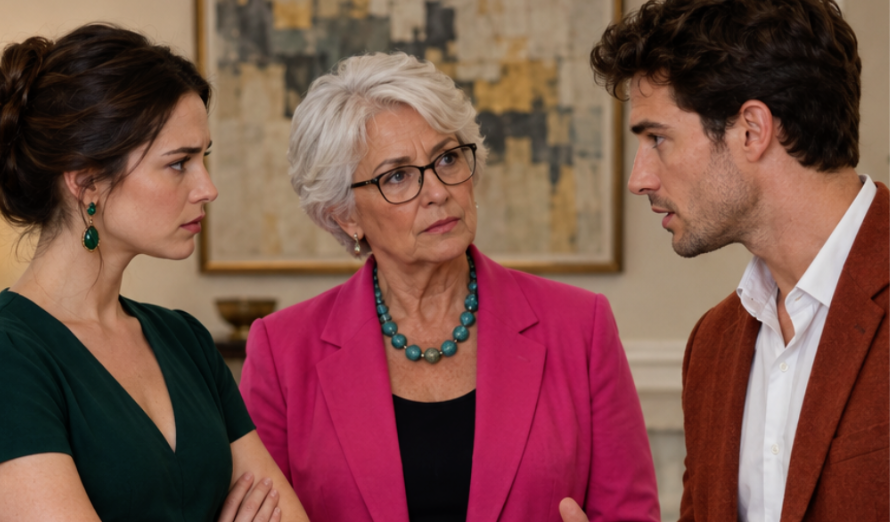
“Why did you come here, Grigory? To pick up the drill? It’s on the balcony – grab it and leave.”
“That’s not the only reason I’m here. Here, take this. It’s a pay slip. Now I’m officially on minimum wage. So, the child support payments will be tiny.”
“Are you serious? Kirill is eleven years old. He needs new shoes, and he’s hoping to go to sports camp.”
“He’ll manage as it is. My mom is right, you’re asking for too much.”
Anna didn’t move away from the door, so Grigory had to suck in his stomach to squeeze into the hallway. Right behind him came Polina Andreyevna – she wore a brand-new shearling coat, a chunky raspberry necklace, and had a folding stool tucked under her arm.
The stool was meant for the balcony. Grigory had already decided the drill was on the top shelf, and he’d need a boost to reach it. He hadn’t thought it necessary to call his ex-wife first. Even though it had been two years since the divorce, he still entered this apartment as if he were just temporarily letting others live here.
“At least take off your shoes.”
“We’re just here for a minute,” Polina Andreyevna replied. “We won’t even have time to dirty your mat.”
She looked around the hallway. On the cabinet was Kirill’s knitted hat, and next to it stood his old shoes with worn-out toes. Polina Andreyevna noticed them, but pretended she was just inspecting the mirror.
Grigory shoved the pay slip into Anna’s hands and adjusted the heavy-bracelet watch on his wrist. He’d only bought the watch recently, and now adjusted it every five minutes. It was supposed to show everyone that he was a busy, professional man who valued his time. Meanwhile, the document said something else entirely: according to the paper, the director of a trading company made barely more than the company’s cleaners.
Anna looked at the stamp, the accountant’s signature, then at the salary amount again.
“So you cut your own salary?”
“Not me, the circumstances did. Times are tough. Expenses keep piling up while income drops.”
“And the watch was also a result of these circumstances?”
Grigory covered his wrist with his sleeve.
“It was a gift.”
“And is the car a gift, too?”
“Anna, don’t start. The car isn’t even mine.”
Polina Andreyevna immediately perked up.
“That’s right. The SUV is in my name. And the country house with the sauna is mine too. I’m a retiree, I have every right to own property. Everything’s above board—perfectly legal, so no one can say otherwise.”
She said this with such authority, like she personally wrote the laws and was now graciously allowing people to use them.
“How convenient,” Anna commented.
“What’s so convenient about it?” Polina Andreyevna pressed her necklace against her coat. “A son helping his mother—that’s family. In a normal family, everyone sticks together.”
“Kirill is his family too.”
“Kirill lives with you. That means you provide for him. Grisha pays child support—he’s not dodging his responsibilities.”
Anna glanced at the pay slip again. Her face grew uncertain—at least, Grigory decided it did. He even smirked a little, pleased with himself and the impression he’d made.
He’d been preparing for this conversation for days. He’d practiced his calm voice in front of the mirror, consulted an accountant friend, and asked whether you could officially set a low salary for a director. The friend assured him that you could—as long as all the documents were in perfect order.
For Grigory, alimony stopped being money for his son a long time ago. Now, it felt like a monthly reminder that Anna was still benefiting from him. That thought bothered him more than the amount itself. He wanted to prove to his ex-wife that without his say-so, she wouldn’t get anything extra.
He considered almost everything to be ‘extra’. New shoes, additional math lessons, and Kirill’s trip to a sports camp all fell into that category. Yet, buying an expensive watch seemed like a reasonable investment in his business image.
“Why are you so quiet?” he asked. “Did you finally figure out that money doesn’t grow on trees?”
“I get it.”
“Good. You keep asking for summer camps and branded shoes. Back when we were kids, we just played in the yard all summer and we were happy with it.”
“You went to the beach every year with your parents as a kid.”
“That was different.”
“Of course it was different. Your trips were a necessity, but for Kirill, the camp is just a whim.”
Polina Andreevna set down a folding chair and began to unbutton her sheepskin coat.
“Let’s not compare. We had more opportunities back then. Grisha’s situation is tough right now.”
“Especially tough in his brand new SUV.”
“I already said, the car is mine.”
“But you don’t know how to drive.”
“That doesn’t mean I can’t own it.”
Grigory grimaced.
“We didn’t come here to argue. Where’s the drill?”
“On the balcony, in the cabinet. Right where you left it.”
He walked through the room. Polina Andreevna followed, not forgetting her chair. Anna stayed in the hallway, holding a paper in her hand.
Kirill peeked out from the kids’ room. He had just gotten back from training, changed clothes, and was putting together a construction set. At eleven, he already understood more from the adults’ tone than from what they actually said.
“Is Dad here?”
“He’s here for a tool.”
“Will he come see me?”
Anna glanced toward the balcony. The sound of a creaky cabinet and Polina Andreevna sighing with annoyance came from there.
“Probably.”
Kirill waited, but Grigory didn’t come into the kids’ room. He found the drill, checked the box, and carried it to the hallway. Polina Andreevna followed, clutching her chair in front of her.
“Everything is here,” Grigory announced. “At least no unpleasant surprises this time.”
Kirill came out into the hall.
“Hi, Dad.”
“Hey. How’s school?”
“It’s fine. We’re having a summer camp this year. Coach said we need to submit an application in advance.”
Grigory looked at Anna, as if his son had memorized lines in advance.
“Are you two in on this together or what?”
“I just mentioned the camp.”
“There’s no money right now. When you grow up, you can earn your own money and travel wherever you want.”
Kirill frowned and went back to his room. He didn’t slam the door, just closed it a little tighter than usual.
Anna folded the paper in half.
“You shouldn’t have said that.”
“What did I say that was so wrong? It’s the truth. Kids need to understand the value of money.”
“You know the value of your own watch. Why not his shoes?”
Polina Andreevna sighed wearily.
“Shoes again. You’d think the boy was walking around barefoot.”
“Those are too small for him.”
“He’ll break them in.”
“Shoes don’t stretch in length.”
Grigory grabbed the drill box.
“Alright, we’re leaving. Give the paperwork to the bailiff. Starting next month, you’ll get payments based on the new calculation.”
Anna leaned against the wall. Grigory saw nothing unusual in her calm demeanor. He figured his ex-wife had finally accepted her powerlessness.
“You won’t need to pass anything on. The bailiff already called me.”
Grigory stopped in his tracks.
“When was that?”
“The day before yesterday.”
“And what did he want?”
“He asked if I knew why your income had suddenly dropped so much.”
“What did you say?”
“I told him I didn’t know. Then he asked if I still had any documents from your company.”
Grigory’s smile vanished. He slowly set the box down on the floor.
“What documents?”
“The ones you brought here six months ago.”
Polina Andreevna stopped buttoning her coat.
“Grisha never brought anything here.”
“He did. Two boxes. He put them on the balcony behind the old armchair and said he’d pick them up in a couple of days.”
Grigory started blinking rapidly.
Six months earlier, he’d had a disagreement with the owner of the neighboring warehouse. He really had removed some of the papers from his office back then. He didn’t want to keep them at his young lover’s apartment—she liked to tidy up and might throw away something she didn’t understand. He didn’t take them to his mother, either. Polina Andreevna had a habit of reading anything within reach.
Anna’s apartment had seemed the safest place. He’d brought the boxes over one evening, claiming there were temporary repairs happening in his office. Anna didn’t argue. Eventually, Grigory forgot all about them.
“They’re just old invoices,” he said quickly. “Just archived stuff, nothing important. Nobody needs them.”
“Maybe. I don’t know anything about your line of work.”
“So where are the boxes?”
Anna carefully placed the document on the nightstand.
“I took one to the tax office. I gave the other to the financial crimes unit.”
Polina Andreevna opened her mouth but couldn’t say anything right away. Her raspberry-colored beads swung and gently clacked together.
“You couldn’t have,” Grigory said.
“Why not?”
“Because those are my documents.”
“They sat on my balcony for six months. The bailiff suggested I show them to some experts.”
“Did you even look at what was inside?”
“I did. One box had an off-the-books cash register. The other had a notebook with fake accounting. There were also stamps, payroll sheets, and envelopes with names.”
“What off-the-books cash? You don’t even know what you’re talking about.”
“Which is exactly why I handed them over to people who do.”
Grigory grabbed the document and unfolded it, as if hoping to find a clue on the paper. His watch slid down towards his wrist.
“When did you do this?”
“Yesterday morning.”
“And you kept quiet?”
“You never asked.”
“Grisha, call the accountant,” Polina Andreevna whispered.
“Don’t tell me what to do.”
He pulled out his phone, walked over to the window, and dialed the number. No one picked up for a while. Then he called again. His face grew tense.
“You’ve conspired,” he said, putting away his phone. “You and that bailiff.”
“They asked me to confirm your real income. I confirmed what I found at home.”
“Do you realize what you’ve done?”
“I realize Kirill needs new shoes. Let the specialists figure out the rest.”
Polina Andreevna quickly put on her coat.
“Come on, Grisha. We need to go.”
Grigory picked up the box with the power drill, but it slipped from his hands and hit the floor. He opened the lid, checked the tool, and closed it again.
“If the company gets into trouble, you won’t see any money at all.”
“That’s not for you to decide anymore.”
“You think you’re so clever, don’t you?”
“No. I just have a good memory.”
He looked at her as if seeing her for the first time. This wasn’t the Anna who, during the divorce, asked not to argue in front of Kirill and agreed to verbal promises. This woman spoke quietly, but she wasn’t backing down.
“You’ll regret this.”
“Maybe you should sort out your own papers first.”
Grigory left, accidentally bumping the doorframe with his box. Polina Andreevna hurried after him. Out on the landing, she realized she’d forgotten her folding stool, went back silently to grab it, and left again.
Anna closed the door and stood for a few seconds, listening to the footsteps. Then she walked toward Kirill.
He was sitting on the carpet, attaching pieces of his construction set, even though the tower he built had been finished for a while.
“Did you hear everything?”
“Just a little.”
“Dad’s not mad at you.”
“He always gets mad when something needs to be bought.”
Anna sat down next to him.
“You’re still going to camp.”
“And the boots?”
“You’ll get boots too.”
Kirill looked at her, not quite believing.
“Even if dad doesn’t make much money?”
“He makes enough. Sometimes adults think a piece of paper can make any story true.”
“Can it?”
“We’ll find out soon enough.”
That very evening, Grigory arrived at the office. The accountant greeted him with a pale face and a stack of papers in her hands. She already knew that both the tax authorities and the economic crimes division were interested in the documents.
“What exactly was in the boxes?” she asked.
“Old payroll records.”
“And in the black notebook, just old information too?”
“How should I know what Anna calls the black notebook?”
“I know. You used to bring it to staff meetings.”
Grigory walked into his office and closed the door. His young mistress was sitting at his desk, looking through files on the computer. She worked as the director’s assistant and was used to thinking the company belonged to both of them. After all, restaurant bills, trips, and gifts were all paid from the company card.
“Gather up all the flash drives,” Grigory said. “And don’t give anything to anyone.”
“Why?”
“Because I’m the director.”
“I remember that. But what’s going on?”
“Anna is what’s going on.”
It was easier for him to blame his ex-wife than to admit his own carelessness. He was the one who had left the boxes behind. He kept the notebook himself. He reduced his own salary, too. All these separate decisions seemed sensible—until they all collided at once.
A week later, inspectors arrived at the company. The warehouses were sealed. Employees were brought in one by one for questioning. The accountant presented orders Grigory had signed. The warehouse workers showed the real volumes of inventory. The drivers remembered deliveries that never made it into the official reports.
The young mistress lasted until lunchtime. Then she packed up her personal things, handed over all the flash drives to the inspectors, and wrote her resignation letter.
“You promised to keep quiet,” Grigory said.
“I promised while it was just about your business. Now I’m being called in for questioning too.”
“We were together for years.”
“Three years.”
“All the more reason.”
“I’m not about to answer for your secret stash.”
She took her bright coat from the back of the chair and left. Two days later, Grigory found out she had left with another man. He worked at a neighboring company and had a regular, official salary. Apparently, after dealing with the secret bookkeeping, she found such simplicity especially appealing.
Polina Andreevna also had to give her own explanations. The SUV and the dacha with a sauna were registered under her name, but the money for these purchases had come from accounts linked to her son’s company.
“I’m a pensioner,” she kept repeating. “I don’t understand any of these calculations.”
They explained to her that the signatures on the documents were hers.
“Grisha told me everything was legal.”
Grigory and his mother were facing huge fines. On top of that, they had to pay additional taxes and explain the origin of the money. Polina Andreevna immediately stopped bragging about her possessions. Now, she called the SUV a burden, the dacha too large, and the sauna an unnecessary construction.
On Saturday, Anna took Kirill to shop for boots. She didn’t have much money, but decided to pay in installments. Kirill walked beside her, telling her about his workout.
Grigory and Polina Andreevna were waiting for them by the building entrance. His mother sat on that same folding stool. She wore her old jacket without beads. Grigory paced by the bench, checking his watch, though he no longer had any reason to hurry. The company’s business had stopped.
“Kirill, go upstairs,” Anna said. “You have the key.”
“What about the boots?”
“We’ll buy them after lunch.”
Grigory took a step toward his son.
“Hey. How are you?”
“I’m fine.”
“Is your training going well?”
“It is.”
“Good job.”
The conversation ended there. Kirill looked at his mother, then opened the building door and went inside.
Polina Andreevna got up from her stool.
“We need to talk.”
“Go ahead.”
“Not here,” Grigory said. “The neighbors will hear.”
“You came to my building yourself.”
They moved over to the bench. Polina Andreevna folded her stool and hugged it to her chest.
Grigory started from afar. He explained that inspectors could be too picky, that every company made small mistakes, that it’s hard to do business without cash transactions. He spoke smoothly, almost in the same voice he had used a week earlier when giving her proof of his minimal income.
“Basically, I need your help.”
“What kind of help?”
“You’ll say you handled part of the accounting.”
Anna thought she had misheard.
“I work as an administrator at a medical center. What kind of accounting could I have managed?”
“Household. You helped me sometimes. We were still married back then.”
“Two years ago.”
“What’s the difference? The documents are old. You’ll say you mixed up the numbers.”
“And what happens then?”
“Nothing much. You’ll explain it was a mistake. You’re not a specialist, so they won’t expect much from you.”
Polina Andreevna nodded quickly.
“Exactly. They’ll forgive a woman. You’ll say you dealt with the papers at your husband’s request and didn’t understand them. A family matter.”
Anna looked at her former mother-in-law.
“A week ago, you said that after a divorce, everyone should take care of themselves.”
“The situation has changed.”
“For whom?”
“For all of us. If Grisha gets fined, Kirill won’t be any better off.”
“The fines aren’t because of Kirill anymore.”
Grigory moved closer to Anna.
“Listen. I’ll give you money for the camp.”
— You wanted to give barely any child support, and now you’re ready to pay for the summer camp?
— I’ll even buy new boots.
— How generous of you.
— Don’t start. I’ll get good boots, really good ones. I’ll pay for the camp, too. Just sign the statement.
He pulled a folded sheet from his inside pocket. The text was prepared in advance. According to it, Anna helped her husband keep the accounts during their marriage, mistakenly provided incorrect information due to inexperience, and Grigory fully trusted his wife and never checked the records.
Anna read all the way through.
— It says here that I kept the notebook.
— That’s right.
— The handwriting isn’t mine.
— Let’s say you dictated and one of the workers wrote it.
— It also says here that I collected the money envelopes at home.
— That’s just for clarity.
— So you want to make me look like I was part of a scam.
— Not a scammer, just an inattentive wife. Nothing will happen to you.
— And what makes you so sure?
Grigory averted his eyes.
— I was told.
— By whom?
— Doesn’t matter. What matters is, the business can be saved. They’ll reopen the warehouses, business will go on, I’ll get back to paying child support.
— Based on minimum wage?
— I’ll increase it later.
— When?
— When things get better.
Anna handed the sheet back to him.
— No.
Polina Andreevna set the little stool down on the ground.
— Think carefully. This isn’t just about Grisha. People are out of work.
— Those people have already said how he paid part of their wages in envelopes.
— They were pressured.
— They were simply asked to tell the truth.
— Easy for you to say, — Grigory interrupted. — You have a steady job, an apartment, your child close by. They’re taking everything away from me.
— We bought that apartment together. After the divorce, you got your share in cash.
— I put that money into the business.
— That was your decision.
— And now you’re here to ruin me.
Anna felt the all-too-familiar urge to defend herself. During their marriage, Grigory could twist any conversation so she’d start doubting even the simplest things. If he was late, it was her fault for cooking dinner too early. If he forgot the groceries, it was her fault again for not reminding him twice. After the divorce, this trick worked for a while.
But not anymore.
— I’m not taking anything from you. You were the one who showed a fake income statement. You left the documents with me. You made your mother the owner of your assets.
— Everybody does that.
— I can’t speak for everyone else.
Polina Andreevna crossed her arms.
— And have you thought about Kirill? His father could lose his business.
— His father was the first to think about how to pay less child support.
— A man should grow, invest in his business.
— Kids grow too. That’s why his boots get too small for him.
Grigory crushed the prepared sheet in his hand.
— So you won’t help?
— No.
— Not even for your son’s sake?
— Don’t use him as an excuse.
— I’m offering you money.
— For camp and boots.
— Yes.
— And just a week ago, you said those were outrageous demands.
— I was wrong.
— You just thought you had everything under control.
Anna glanced at Polina Andreevna.
— Do you remember what you said? Everything by the book, not a detail out of place.
Her former mother-in-law lowered her eyes.
— Don’t nitpick at my words.
— I’m not. I’m just reminding you.
Grigory made another attempt.
— Fine. Name your price.
— For what?
— For your signature.
“You still don’t get it.”
“Everyone gets it. It’s just that everyone has their own price.”
“Then you’ll have to find someone with a different price.”
Anna headed towards the apartment building. Polina Andreevna caught up with her at the door.
“Anya, wait. I know there’s bad blood between you two. But now we’ll have to sell the dacha.”
“You were the one who said it was yours.”
“On paper it’s mine. Grisha paid for everything.”
“Explain that to the inspectors.”
“That’s easy for you to say.”
“It wasn’t exactly easy for me when Kirill asked why his dad didn’t want to buy him shoes.”
“He wanted to. Just later.”
“Kids grow up, Polina Andreevna. ‘Later’ doesn’t wait.”
Grigory came closer.
“I’ll ask one last time. Will you sign?”
“No.”
“Then don’t say I didn’t warn you.”
“You already tried to put your calculations on me once. It won’t work a second time.”
She walked inside and closed the door. Her hands trembled, though her voice had stayed steady the whole time. Anna leaned against the wall and let out a slow breath.
Kirill was waiting by the elevator.
“Did they leave?”
“They’ll be gone in a moment.”
“Did Dad talk about money again?”
“Yes.”
“Will he pay for camp?”
“He won’t. But you’re going anyway.”
“Will you pay for it yourself?”
“I will.”
“Then I don’t have to go. So it’s easier for you.”
Anna hugged her son.
“No. You’re going. And it will get easier for me when you stop trying to manage grown-up money issues.”
On Monday, she filed a request for alimony in a fixed amount, attached Grigory’s previous income statements, and included a copy of the certificate showing his sudden minimum wage. The bailiff had already received the investigation materials. Her ex-husband’s fake income now looked less like a clever trick and more like just another piece of the big picture.
Anna didn’t feel triumphant. She just wanted some order. She wished Kirill didn’t have to beg his father for every little thing. That normal expenses for a child wouldn’t turn into humiliating family negotiations. That the word ‘justice’ would mean something real, not just an empty phrase.
Meanwhile, Grigory was trying to save his company. He visited various offices, gave explanations, and changed lawyers. Each new specialist started with the same thing—asking for a complete document list. Then they’d study Grigory carefully and name the sum he’d likely have to pay.
The first thing to be sold was the SUV. Polina Andreevna signed the papers with a look on her face as if she were being robbed of an achievement. Next, they found a buyer for the dacha with the sauna. There was enough money to cover some of the fines, taxes, and mandatory payments.
They couldn’t keep the company the way it was. The warehouses went to a new owner. The name on the gate changed, and the employees were officially registered.
For several months, Grigory looked for a director’s position, but his old confidence no longer impressed anyone. In small towns, business news travels fast. Finally, he got hired as a warehouse manager. The salary was official, no cash, no notebooks. A quarter of it went directly to Anna for their son.
He moved in with Polina Andreevna. He had sold his own place back during the investigation to pay off debts. At first, his mother reminded him about the dacha, the car, and the sauna. Then she stopped—because every time, he’d point out that everything was in her name.
Kirill got a new pair of comfortable shoes. That summer, he went off to a sports camp and came back with a certificate for team competitions. Anna displayed the certificate on the shelf next to a photo of her son, dressed in his bright sports uniform, squinting in the sunlight.
He showed the picture to Grigory, too.
“Looks good,” said his father. “You’ve grown up.”
“My coach told me I can go again next year.”
“If you keep up your grades, you can go.”
Kirill didn’t reply. He already knew that his mom was the one paying for the trip, with part of the money coming through the bailiff. His dad still wanted the final say, even when the decision wasn’t really his to make.
In the fall, Grigory came to Anna’s building. He was going to hand Kirill a sports bag he’d bought on sale. Two neighbors sat by the entrance. They remembered him from when he was married and weren’t shy about asking questions.
“Grisha, I heard you work at the warehouse now.”
“I’m the warehouse manager.”
“That’s a pretty good job.”
“Depends who you ask. I used to be my own boss.”
“But at least the paycheck comes on time.”
“The salary comes in, but I barely see it. Child support gets taken out immediately.”
“It goes to your own son.”
“Easy for you to say. My ex ruined my whole business.”
“Didn’t Anna never even work at your warehouse?”
“She handed over the documents. Did it all out of jealousy.”
“It’s been two years since the divorce. Who would she be jealous of?”
“A woman’s jealousy knows no time limits. She saw I had a new life—a car, a summer cottage—so she decided to destroy it all.”
“But the car and the cottage were registered to Polina Andreyevna.”
“That was just for convenience.”
“Convenience came at a steep price.”
At that moment, Anna walked out of the building. She caught the last part of the conversation and stopped.
“Are you telling the neighbors stories about me again?”
“What, am I supposed to keep quiet? People deserve to know the truth.”
“Then tell them about the director’s minimum wage.”
“I had the right to lower my own salary.”
“Sure, and did the notebook with the fake calculations fill itself out, too?”
“Don’t twist things. Stuff like that happens in business.”
“And the boxes just magically appeared in my storage room?”
“You could have called and warned me.”
“Did you warn me when you decided to lower the child support payments?”
“I brought in the paperwork.”
“Along with a power drill.”
One of the neighbors smirked.
“That’s quite an expensive tool you ended up with, Grisha.”
“Why is everyone ganging up on me? I did everything for the family.”
“Which family exactly?” Anna asked.
“All of them. The business was bringing in money.”
“It was still hard to buy boots for Kirill with that income.”
“You’re bringing up the shoes again?”
“Because that’s where it all started.”
“Really, Anna? You’re the one who ruined me. You’re the one who destroyed my business.”
“And who told you to hide your earnings and keep a fake cash register?”
“It’s all because of your jealousy. You handed those boxes over to the tax office and the financial police on purpose.”
“I’m not jealous, I’m just fair. You did it all to yourself.”
“That’s always how it goes. The woman ruins the man and then tries to make him out to be the bad guy.”
“Go home, Grigory. Kirill has school in the morning.”