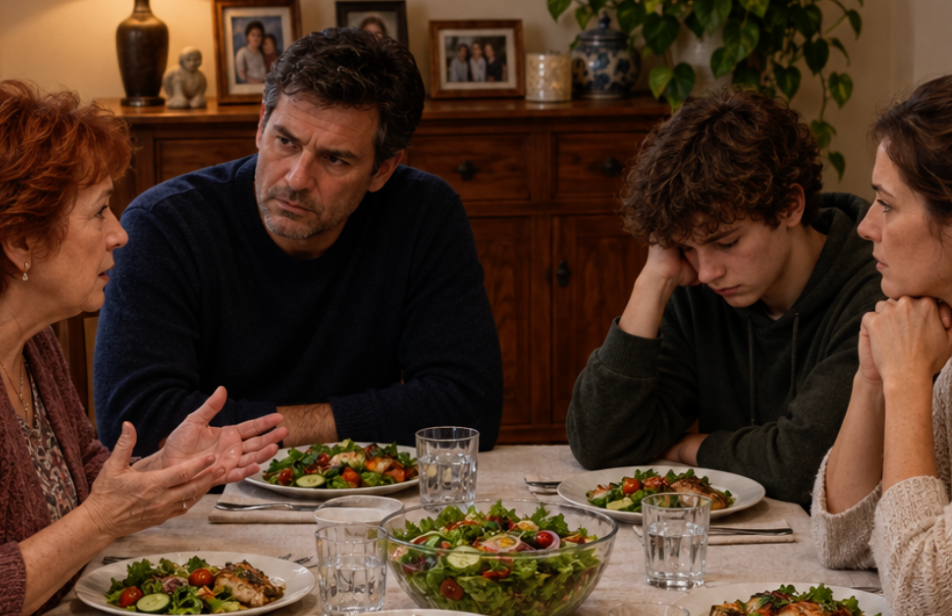
That Sunday evening, for the very first time, Maxim refused to go to Lyudmila Pavlovna’s—even though before, his mom could ask him any day, no questions asked.
His mother-in-law called Andrei around seven, as usual, and said that Vlad had an algebra test in two days, but his tutor was sick. Maxim is great at explaining things, she insisted, so he should come by after school and go over a couple topics with the boy.
Andrei covered the phone with his hand and looked over at his stepson. Maxim was sitting at the kitchen table with an open notebook and his English textbook in front of him. He didn’t even look up.
“He won’t be coming, Mom,” Andrei said.
There was a pause on the other end of the line.
“Why not?”
Andrei didn’t answer right away. Just a week ago, his mother herself had made it clear why Maxim wasn’t her grandson. But now, suddenly, he was needed again—as an older brother, a helper, almost a part of the family.
Nadezhda placed a plate of apples in front of her son and left the kitchen. She didn’t want to hear this conversation again.
It took a long time before money was ever brought up
When Nadezhda married Andrei, Maxim was ten. His biological father lived in another city, always sent his child support payments on time, and visited his son a few times a year. Andrei never tried to play the role of a second father. He drove Maxim to sports practices, helped fix his bike, could scold him for a bad grade, but always said, “You have a father. I’m just here.”
Things with Lyudmila Pavlovna looked calm on the surface but were more complicated underneath.
She never openly offended Maxim. She brought a gift for his birthday, asked about school at the table. But Masha and Vlad, Oksana’s kids, she called “my grandchildren,” and when she spoke of Maxim, it was usually “Nadya’s son.”
Nadezhda kept telling herself it was nothing. Her son had his real grandfather—Sergey Nikolaevich, her own father. For the seventh year now, he’d been living in Belgrade: first for work, then he just stayed. He and Maxim talked on the phone every week, and some summers Maxim would visit him.
But the real issue was something else. Whenever Lyudmila Pavlovna needed help, family boundaries seemed to vanish.
At the dacha, Maxim worked alongside Andrei, carrying boxes to the attic and helping assemble the shelving unit. If Vlad didn’t understand his math homework, the mother-in-law would call Nadezhda:
“Let Maks explain. He’s older, is it so hard for him?”
One evening after this happened, Maxim asked:
“Mom, does Grandma Lyuda even consider me family?”
Nadezhda brushed it off then:
“That’s just the way she is. Don’t overthink it.”
That phrase was the one she remembered the most. Because her son wasn’t overthinking anything.
One dinner set everything straight
In the spring, Oksana found a private school for Masha and Vlad. It was close to their home, had small classes, and more English lessons than the regular school. Tuition was just over forty thousand rubles a month for each child.
That was a hefty sum for Oksana and her husband, so Lyudmila Pavlovna and her spouse decided to help cover some of the costs.
The family discussed the news over Sunday lunch. Plates of hot food were on the table, Oksana showed photos of the classrooms on her phone, Masha flipped through the programs, and Vlad asked if there’d be a soccer team.
“If the kids are doing well in school, you can’t cut corners on their education,” said Lyudmila Pavlovna. “Their father and I have decided to help out every month.”
Nadezhda said sincerely:
“That’s wonderful. They’re really lucky.”
Maksim was finishing ninth grade and was also choosing his next steps. Nadezhda looked at her son:
“We’re considering options for Maksim too. He wants a school with a stronger English program.”
Lyudmila Pavlovna immediately turned to her.
“Just don’t count on us.”
At first, Nadezhda didn’t even understand what she meant.
“Did we even ask?”
“No, I’m just saying it now so there’s no misunderstanding later. ‘We’ll pay for our grandchildren’s lyceum, but your son can stick to the local school,'” her mother-in-law said.
She said it in an ordinary tone, as if she was talking about who would buy bread.
Maksim stopped eating and set his fork on the edge of his plate.
Andrey frowned:
“Mom, why did you have to say that now?”
“What’s the problem? Maksim has parents, he has his own grandfather. We help our grandchildren.”
“No one asked you for money,” said Nadezhda.
She was already upset but didn’t want to cause a scene in front of her son.
“Good, then,” Lyudmila Pavlovna replied. “So everyone understands each other.”
They drove home almost in silence. When they got to their building, Maksim didn’t open the car door right away.
“Mom, you really didn’t ask her for anything, right?”
“Of course not.”
“Then why did she say that in front of me?”
Nadezhda wanted to give her usual answer, “just ignore it,” but couldn’t.
“I don’t know.”
Maksim nodded.
“I’m not going over to help her anymore. She has her grandkids. Let them help her.”
This time Andrey didn’t argue.
The apology lasted four days
Two days later, Andrey went to his mother alone. Nadezhda didn’t ask him to break off contact, but made it clear: if he tried to turn it into “mom just misspoke” again, they’d be having a separate conversation at home.
He came back late, took off his jacket, hung it on the hook in the hallway, and went to the kitchen.
“We had a fight,” he said.
“And?”
“She thinks it’s her money and she has the right to decide who to help.”
“No one’s arguing with that.”
“That’s what I told her.”
Nadezhda put the kettle on the stove.
“And about Maksim?”
Andrey looked away.
“She said she doesn’t have to think of a child from your first marriage as her grandchild.”
The next day, Lyudmila Pavlovna messaged Nadezhda: “If Maksim was hurt, let him know I didn’t mean it. Everyone is only responsible for their own kids.”
Maksim read the message on his mom’s phone and handed it back to her.
“Should we reply?”
“No need.”
For four days, it felt like that was the end of it.
Then the mother-in-law called Andrey again. Vlad had an important test coming up, his tutor was sick, and Maksim was already explaining algebra to him quite well.
That time, Andrey said for the first time:
“He won’t come.”
“Are you really going to take it out on a child?” his mother protested.
“So Maksim isn’t a child?”
Lyudmila Pavlovna started speaking faster: she insisted he wasn’t twisting things, that she hadn’t offended anyone, she’d just said something obvious. Andrey listened, then replied that Vlad could keep working with the tutor they were already paying anyway.
Maksim heard it all.
Later he said to his stepfather:
“Thank you.”
Andrey just shrugged.
“I should have said this earlier.”
Nadezhda realized that she herself had been swallowing small slights for years just to keep the peace. Andrey had been choosing to overlook things for far too long. Even Maksim now avoided some family gatherings, even though Masha had never done anything bad to him.
But pretending that nothing happened was no longer an option for them.
They had known about Belgrade since winter.
Back then, Lyudmila Pavlovna didn’t know anything about a school abroad. In fact, they barely talked about it at home either, since no decision had been made yet.
Way back in January, Sergei Nikolaevich sent Nadezhda a link to a private gymnasium in Belgrade. The school offered a combined curriculum: some classes in Serbian, some in English. Maksim had been seriously studying English for the past two years, and he was gradually learning Serbian with his grandfather during their summer visits.
“Let him try to get in,” Sergei Nikolaevich said, calling over video chat. “If he doesn’t pass, we’ve lost nothing.”
“Dad, just the tuition alone is about seven thousand euros a year.”
“First let him get accepted. We can talk about the money later.”
Maksim, together with his mother, filled out the application form, sent his grade report, had an interview with the school psychologist, and took the English test.
After the test, he looked even gloomier than usual.
“Did you fail?” Andrey asked.
“I don’t know. The written part was tough.”
A few days later, they received an email: the school was willing to accept Maksim after ninth grade, provided his documents were in order and the first payment was made.
Nadezhda immediately called her father.
“They’re taking him.”
“I know. He already texted me.”
“Now, about the money.”
Sergei Nikolaevich hadn’t suddenly become a millionaire. He had been working as an engineer in Belgrade for several years and had spent the last four years saving money for his grandson’s education.
“I was thinking about university,” he admitted. “Looks like we’ll start earlier.”
With the early rate, a year of tuition would be about seven thousand euros. Sergei Nikolaevich offered to pay for the school, while Nadezhda and Andrey would take care of insurance, tickets, clothing, and all the other expenses.
They argued for two evenings before finally agreeing.
There was still one part left, far less dramatic than stories about suddenly moving abroad: paperwork.
Maksim was a minor. It wasn’t possible to just buy a ticket and leave him with his grandfather until the next summer. Nadezhda contacted the school, clarified the list of documents, and spoke with Maksim’s biological father. He asked her to send him details about the school and Sergei Nikolaevich’s address, then agreed to sign the necessary papers.
In the summer, Nadezhda took a vacation and flew with Maksim to Belgrade. They signed the school contract and submitted the documents needed for Maksim to legally reside in the country as a student. He was supposed to live with his grandfather.
Only after that did Sergei Nikolaevich make the next payment.
There was still more than a month to go before the first day of school.
When Maksim suddenly became “ours”
Lyudmila Pavlovna didn’t find out that Maksim had been accepted right away. Andrey only told his mother once the documents had been approved and the trip was no longer a vague family idea.
She called back ten minutes later.
“To Belgrade? For a long time?”
“To study.”
“And how much does the school cost?”
Andrey smirked:
“Mom, does it really matter now?”
A week later, they all got together at Masha’s birthday party. Maxim mostly came just to see her. He gave his cousin a pair of headphones—the ones they picked out together in advance—and took a seat next to Vlad.
At first, Lyudmila Pavlovna kept her distance, but as the evening wore on, she eventually approached.
“So, traveler, are you leaving soon?”
“In August.”
“Imagine that. Our Maxim will be going abroad to study now.”
Maxim looked at her carefully.
“Ours?”
“Well, who else’s would you be? After all these years together.”
Nadezhda noticed that Andrei had stopped smiling.
Lyudmila Pavlovna seemed not to notice anything.
“By the way, since your English is so good, maybe you could give Vlad a little help before you leave? They’ll have pretty high standards at his lyceum.”
Maxim set his juice glass on the table.
“I can’t. I have my own classes and paperwork to deal with.”
“I’m sure you can find a couple of free evenings.”
At this, Andrei stepped in:
“Mom, are you serious right now? In the spring, you told Maxim he wasn’t your grandson when he needed help. Now he’s family again because Vlad needs English lessons?”
Oksana put her napkin down next to her plate.
“Mom, seriously, let’s not.”
“I was just asking.”
Maxim stood up from the table.
“I’m not offended, Lyudmila Pavlovna. You were right back then: everyone has their own relatives. I have my granddad. Vlad has you.”
He helped Masha clean up the gift box, said his goodbyes, and left with his mother and Andrei.
In the car, Nadezhda asked:
“Do you regret coming?”
“No. I had a good talk with Masha.”
After a pause, he added:
“And now at least no one is pretending I misunderstood anything.”
On September first, Granddad waited by the school gates.
In August, Maxim flew to Belgrade. Nadezhda saw him off right up to security, asking three times if he’d packed his passport and papers in his carry-on.
“Mom, I’ve got everything. I’m not heading off to first grade.”
“Just wait until you have a child of your own, then we’ll talk.”
Sergey Nikolaevich picked his grandson up at the airport. A few hours later, Nadezhda received a photo: the suitcase was in the hallway by the wall, there was a plate of hot food waiting for Maxim on the kitchen table, and Granddad stood holding the set of apartment keys in his hand.
Underneath the photo was a message: “Delivered. Fed. Room occupied.”
Those first weeks were far from a fairy tale. Maxim got tired switching between languages, missed the bus twice, and got a note about his homework. Sergey Nikolaevich grumbled that his grandson left his sneakers right in the middle of the hallway. Nadezhda listened to these little complaints and found joy in how normal they sounded.
Lyudmila Pavlovna didn’t ask about him for almost a month.
Then, a message popped up in the family chat:
“How’s our Maxim? Has he settled in yet?”
Andrei read it and looked over at his wife.
“Are you going to reply?”
“That message wasn’t for me.”
Maxim saw the message that evening but didn’t post anything in the group chat.
Instead, just a few minutes later, he texted his mom directly. He sent her a photo of his class schedule and another shot: Sergey Nikolaevich standing by the school gates holding two paper bakery bags.
With the photo he wrote:
“All good. Got my first decent grade in English today. Granddad came to pick me up, even though I told him not to.”
Nadezhda smiled and put her phone back in her bag.
And Lyudmila Pavlovna’s message in the family group chat still went unanswered.